Equation of a Line
x

Revision notes for Edexcel GCSE Maths Equation of a Line. Open the guide for explanations and worked examples. Written against the Edexcel GCSE Maths (1MA1) specification, so the content matches what's examinable rather than general Maths background.

Equation of a Line

What you'll learn

  • How to read the gradient and y-intercept of a straight line.
  • How to use the form y=mx+cy = mx + cy=mx+c.
  • How to find an equation from a graph or from key information.
  • How to recognise parallel and horizontal lines.

Coordinates and the y-axis

A coordinate grid has an xxx-axis going across and a yyy-axis going up. Points are written as pairs, like (3, 4).

A coordinate pair gives the horizontal position first and the vertical position second.

Definition

Coordinate pair

A coordinate pair tells you the xxx-coordinate first, then the yyy-coordinate. So (3, 4) means 3 across and 4 up.

A line crosses the yyy-axis when its xxx-coordinate is 0. This is a very common one-mark question.

Example

Crossing the y-axis

  1. The line is y=4x−6y = 4x - 6y=4x−6. A line crosses the yyy-axis where x=0x = 0x=0.

The line crosses the y-axis at the point where x is 0, which is the y-intercept.

  1. Substitute x=0x = 0x=0 into the equation:

    y=4(0)−6=−6y = 4(0) - 6 = -6y=4(0)−6=−6
  2. The value of yyy where the line crosses the yyy-axis is -6.

Gradient: how steep the line is

Definition

Gradient

The gradient of a straight line tells you its steepness. It is the change in yyy divided by the change in xxx, written as m=change in ychange in xm = \frac{\text{change in } y}{\text{change in } x}m=change in xchange in y​.

A positive gradient goes up as you move from left to right. A negative gradient goes down.

Positive gradients rise from left to right, while negative gradients fall from left to right.

Example

Finding a gradient from two points

  1. Choose two clear points on the line, such as (1, 7) and (3, 1).

The gradient is found by comparing the vertical change with the horizontal change between two points on the line.

  1. From the first point to the second, xxx increases by 2 and yyy decreases by 6.

  2. Work out the gradient:

    m=−62=−3m = \frac{-6}{2} = -3m=2−6​=−3
  3. The gradient is -3, so the line slopes downwards from left to right.

Tip

Direction check

Always read gradients from left to right. Up means positive gradient; down means negative gradient.

The form y=mx+cy = mx + cy=mx+c

The most useful straight-line form at GCSE is:

y=mx+cy = mx + cy=mx+c
Definition

y-intercept

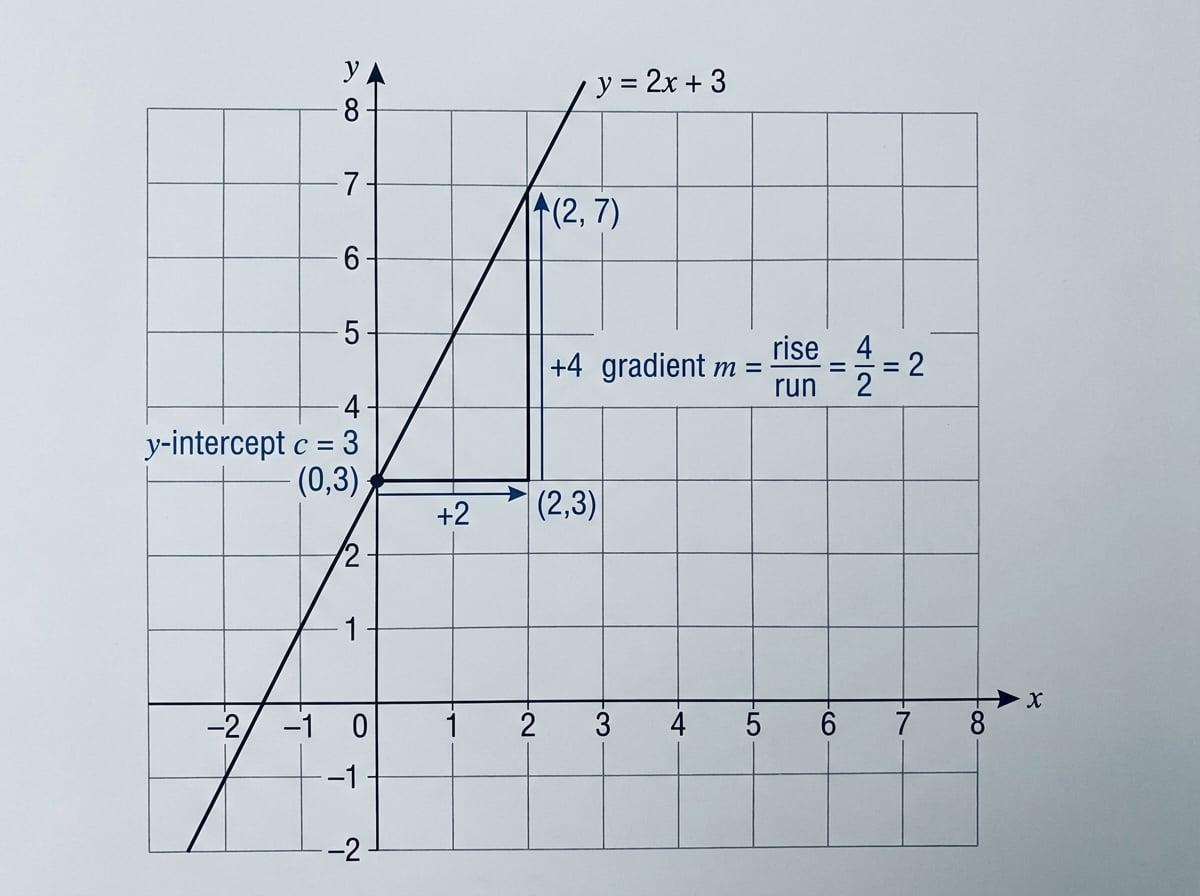
The y-intercept is where a line crosses the yyy-axis. In y=mx+cy = mx + cy=mx+c, the value of ccc is the yyy-intercept, so the crossing point is (0,c)(0, c)(0,c).

Key Idea

What m and c mean

In y=mx+cy = mx + cy=mx+c, mmm is the gradient and ccc is the value where the line crosses the yyy-axis.

In y = mx + c, the gradient controls the steepness and c gives the y-intercept.

Example

Reading y=6−2x

  1. Rewrite the equation in the usual order:

    y=−2x+6y = -2x + 6y=−2x+6
  2. The number multiplying xxx is -2, so the gradient is -2.

  3. The number on its own is 6, so the line crosses the yyy-axis at (0, 6).

Common Mistake

Forgetting the hidden 1

In y=2−xy = 2 - xy=2−x, the xxx term is really −1x-1x−1x, so the gradient is -1, not 2 or 1.

Writing an equation from gradient and intercept

If you know the gradient and where the line crosses the yyy-axis, you can put them straight into y=mx+cy = mx + cy=mx+c.

Example

Using a gradient and a y-intercept

  1. The line has gradient 4, so m=4m = 4m=4.

  2. It passes through (0, -3), so it crosses the yyy-axis at -3. This means c=−3c = -3c=−3.

  3. Substitute into y=mx+cy = mx + cy=mx+c:

    y=4x−3y = 4x - 3y=4x−3

Finding the equation from a graph

To find a line’s equation from a graph, you need two things:

  • the gradient
  • the y-intercept

If the graph clearly crosses the yyy-axis, read that point first.

Example

Finding an equation from two graph points

  1. The line goes through (0, 5) and (2, -1). Since (0, 5) is on the yyy-axis, c=5c = 5c=5.

The point on the y-axis gives c, and the step between the two points gives the gradient.

  1. From (0, 5) to (2, -1), xxx increases by 2 and yyy decreases by 6.

  2. Work out the gradient:

    m=−62=−3m = \frac{-6}{2} = -3m=2−6​=−3
  3. Put m=−3m = -3m=−3 and c=5c = 5c=5 into y=mx+cy = mx + cy=mx+c:

    y=−3x+5y = -3x + 5y=−3x+5

Rearranging into y=mx+cy = mx + cy=mx+c

Sometimes the equation is not already in the form y=mx+cy = mx + cy=mx+c. The subject of an equation is the variable on its own. So “make yyy the subject” means rearrange until it starts with y=y =y=.

Example

Finding the gradient after rearranging

  1. Start with 3y−6x=123y - 6x = 123y−6x=12. Add 6x6x6x to both sides:

    3y−6x=123y=6x+12\begin{aligned} 3y - 6x &= 12 \\ 3y &= 6x + 12 \end{aligned}3y−6x3y​=12=6x+12​
  2. Divide every term by 3:

    y=2x+4y = 2x + 4y=2x+4
  3. Now compare with y=mx+cy = mx + cy=mx+c. The gradient is 2.

Parallel lines

Definition

Parallel lines

Parallel lines are lines that stay the same distance apart and never meet. Straight parallel lines have the same gradient.

Parallel straight lines have equal steepness, so they share the same gradient.

So if two lines are parallel, keep the same mmm value. The ccc value can change.

Example

Finding a parallel line

  1. Rearrange x+2y=10x + 2y = 10x+2y=10 into y=mx+cy = mx + cy=mx+c:

    x+2y=102y=10−xy=−12x+5\begin{aligned} x + 2y &= 10 \\ 2y &= 10 - x \\ y &= -\frac{1}{2}x + 5 \end{aligned}x+2y2yy​=10=10−x=−21​x+5​
  2. The gradient is −12-\frac{1}{2}−21​, so a parallel line must also have gradient −12-\frac{1}{2}−21​.

  3. The new line passes through (0, 1), so its y-intercept is 1.

  4. The equation is y=−12x+1y = -\frac{1}{2}x + 1y=−21​x+1.

Matching equations to graphs

When matching lines to equations, look for quick clues:

  • Does it go up or down?
  • Where does it cross the yyy-axis?
  • Is it horizontal?

A horizontal line is flat. Its equation looks like y=cy = cy=c, because the yyy-value stays the same.

A horizontal line has the same y-value everywhere, so its equation is y = c.

Example

Matching lines to equations

  1. A positive line through the origin matches y=2xy = 2xy=2x, because there is no added constant.

  2. A flat line crossing the yyy-axis at 4 matches y=4y = 4y=4.

  3. A positive line crossing the yyy-axis at 4 matches y=2x+4y = 2x + 4y=2x+4.

  4. A negative line crossing the yyy-axis at 4 matches y=4−2xy = 4 - 2xy=4−2x.

Exam technique

In the exam

  1. Put the equation into y=mx+cy = mx + cy=mx+c before reading the gradient.

  2. On a graph, choose two exact grid points and use change in yyy over change in xxx.

  3. For parallel lines, keep the gradient the same and change the intercept if needed.

Self review

Check yourself

  • Can you read the gradient and y-intercept from y=7−4xy = 7 - 4xy=7−4x?
  • If a line goes through (0, -6) and has gradient 3, what would its equation look like?
  • Why do parallel lines have the same mmm value in y=mx+cy = mx + cy=mx+c?

Recap questions

Test yourself with 5 quick questions on this guide. Answer them all correctly to complete it.

You've reached the end

Test yourself on this topic, or move on to the next guide.

Practice questionsTake a quick quiz on this topicFlashcardsSelf-test with active recall
Spheres and ConesUp next

How was this guide?

Equation of a Line Revision Guide

  1. GCSE
  2. /Maths
  3. /Equation of a Line