GCSE Combined Science 4 to 6: A Practical Plan
GCSE combined science 4 to 6: learn how stronger knowledge, maths, practical skills and exam technique can turn missed marks into a higher grade.
A grade can feel like a label when it is really a collection of habits. If you are searching for gcse combined science 4 to 6 advice, the short answer is this: move from recognising content to applying it accurately, make the common calculations automatic, improve practical and data questions, and use mark schemes to repair specific weaknesses.
In Combined Science, the formal comparison is usually between paired grades such as 444-444 and 666-666. Reaching 666-666 also requires Higher tier because Foundation tier is capped at 555-555. Your school makes the entry decision, so discuss your recent evidence with your teacher rather than treating tier as a personal verdict.
The jump is not normally created by learning obscure facts. It comes from losing fewer accessible marks across Biology, Chemistry and Physics.
Your grade 444 to grade 666 checklist
Focus on six changes:
- retrieve essential knowledge without relying on notes;
- explain scientific processes in linked, precise steps;
- apply familiar ideas in unfamiliar contexts;
- become reliable with equations, units, graphs and percentages;
- understand required practicals as investigations, not scripts;
- mark questions closely and revisit the exact skill that failed.
Before planning revision, confirm your exam board, specification and tier. AQA, Edexcel, OCR and Eduqas organise content and papers differently, even though the central scientific and mathematical skills overlap.
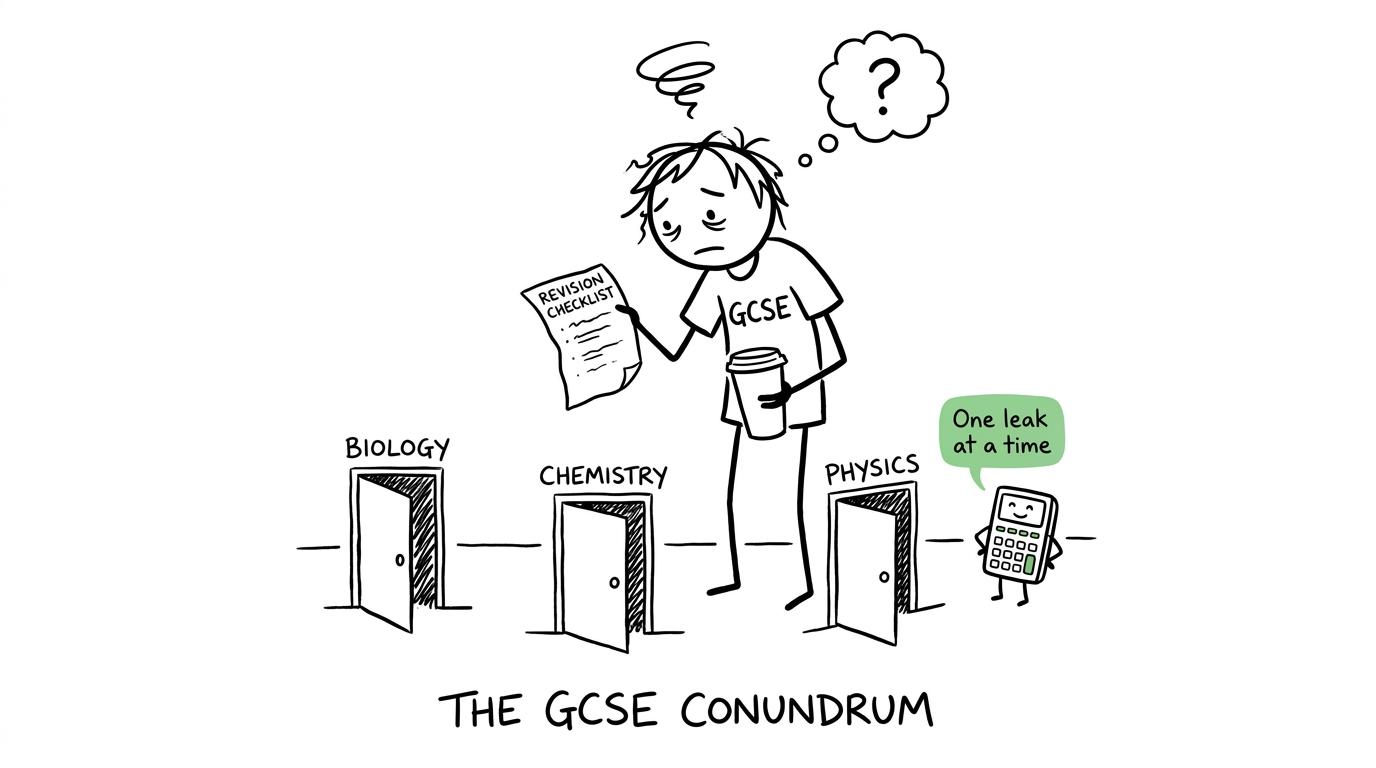 A student choosing between three science doors while a calculator recommends fixing one revision leak at a time
What separates a grade 444 from a grade 666?
There is no permanent number of marks separating the grades. Boundaries are set for each exam series, and your double grade comes from your total performance across the qualification rather than separate final grades for Biology, Chemistry and Physics. The GCSE Combined Science grade boundaries guide explains how equal and adjacent double grades work.
Still, the quality of a grade 666 response tends to differ in recognisable ways.
Knowledge becomes usable
At grade 444, a student may recognise the correct topic and recall several relevant words. At grade 666, they are more likely to select the right knowledge and organise it into a causal explanation.
That distinction matters. Knowing that temperature affects reaction rate is not the same as explaining the chain from increased particle energy to more frequent successful collisions. Revision should therefore include questions such as:
- What happens?
- Why does it happen?
- What evidence would show it?
- Which variable causes the change?
Flashcards can help with retrieval, but they should not be the final stage. Follow recall with exam-style application.
Answers respond to the context
Many students plateau because they reproduce a memorised paragraph without adapting it. A stronger response uses the information in the question: the named organism, material, graph, apparatus or environmental condition.
Underline the command word and circle the context. For an explain question, create a linked chain. For compare, address both sides. For evaluate, use evidence, limitations and a justified conclusion. A correct fact that does not answer the question may earn nothing.
Accuracy replaces optimistic guessing
Grade improvement often looks less dramatic than students expect. It may be one fewer unit error, one more graph read correctly and one explanation that reaches its final link. Those small decisions accumulate across several papers.
Make science maths a dependable source of marks
Official GCSE Combined Science requirements allocate at least 20%20\%20% of marks to mathematical skills. These include ratios, percentages, standard form, algebra, graphs, means, areas, volumes and rates. This is good news: mathematical methods can be practised until they become predictable.
Prioritise:
- substituting into equations;
- rearranging formulae;
- converting units;
- calculating percentage change;
- using ratios and proportionality;
- reading scales and finding gradients;
- calculating means and rates;
- writing very large or small values in standard form.
MathsGenie's standard form revision lesson and changing the subject of a formula resources target two especially useful science skills. The broader GCSE maths topic guide can help you identify other gaps.
For any calculation, use the same visible structure:
- write or select the equation;
- rearrange it before inserting values if necessary;
- convert quantities into compatible units;
- substitute carefully;
- calculate without rounding too early;
- state the final unit;
- check whether the size of the answer is sensible.
For instance, the relationship
density=massvolume\text{density} = \frac{\text{mass}}{\text{volume}}density=volumemassis simple, but the question may also test unit conversion, rearrangement and significant figures. Having an equation sheet in the exam does not perform those decisions for you. For GCSE Combined Science examinations in 202620262026 and 202720272027, students receive the prescribed physics equation support sheet, but you should practise finding and applying the right relationship quickly.
Turn required practicals into connected knowledge
Practical questions are not a small side topic. Official conditions require at least 15%15\%15% of assessment marks to relate to practical work. You may be asked about methods, variables, measurements, graphs, uncertainty, safety or improvements.
For every required practical on your specification, be able to identify:
- the independent, dependent and control variables;
- the equipment and the reason it is suitable;
- the measurements taken and relevant units;
- how reliability could be improved through repeats;
- likely sources of random or systematic error;
- how results should be processed and presented;
- whether the evidence supports the conclusion.
Do not memorise a method as one unbroken paragraph. Break it into decisions. If an apparatus changes, you can then rebuild the method logically rather than hoping the remembered script still fits.
Use mark schemes to diagnose missing marks
A marked paper is valuable only when it changes what you do next. Writing “revise Chemistry” is too broad. Write the precise cause:
- confused ionic and covalent bonding;
- omitted a control variable;
- converted centimetres incorrectly;
- described a graph but did not explain it;
- ignored the word compare;
- rounded during an intermediate calculation.
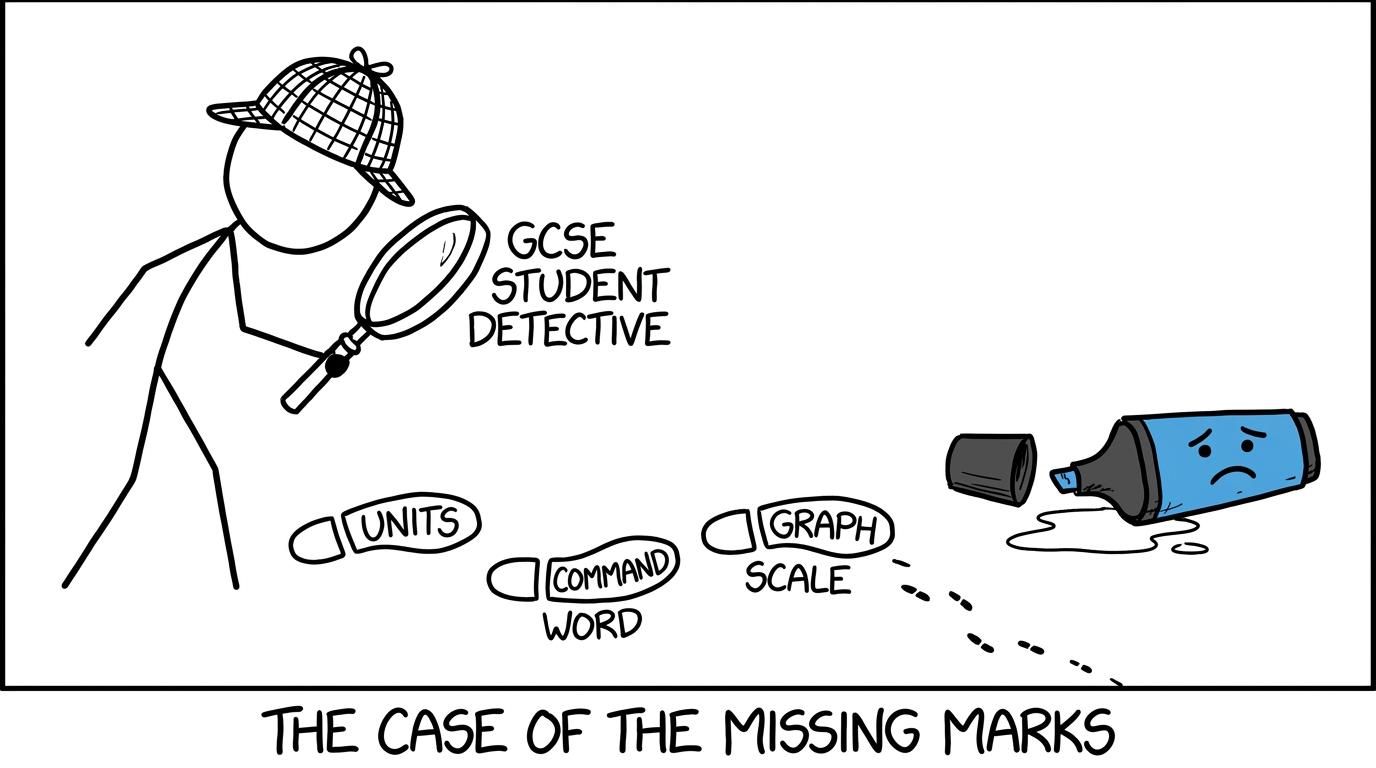 A student detective investigates units, command words and graph scales in the case of the missing marks
Sort errors into four categories: knowledge, application, maths and exam technique. Then repair them differently. A missing fact needs retrieval. A weak explanation needs structured questions. A calculation error needs repeated practice. A command-word error needs careful reading and comparison with the mark scheme.
This learn-practise-mark-retest loop is also central to MathsGenie's guide on revising efficiently without wasting time.
Build a weekly grade-improvement routine
A realistic week should combine all three sciences instead of allowing a favourite subject to dominate.
Short topic sessions
Use four or five sessions of about 303030 to 454545 minutes. Each session should contain:
- brief retrieval from an older topic;
- focused revision of one weak area;
- exam-style questions without notes;
- marking and a written correction.
The one-month GCSE revision plan provides a useful model for balancing retrieval, focused practice and timed papers.
One calculation session
Practise a mixed set of science-related maths each week. Rotate through standard form, formula rearrangement, graphs, ratio, percentages and unit conversions. MathsGenie's overview of high-frequency GCSE maths topics helps you choose productive areas.
One timed paper section
Do not wait until every topic feels complete. Timed sections reveal whether you can retrieve knowledge under pressure, recognise question types and move on when stuck. Mark the work strictly, then redo missed questions after a short gap.
The OCR Physics revision routine offers a clear approach to equations, graphs, mark schemes and short practice blocks. If you study WJEC or Eduqas, the Physics and maths exam-week checklist provides a similarly calm structure.
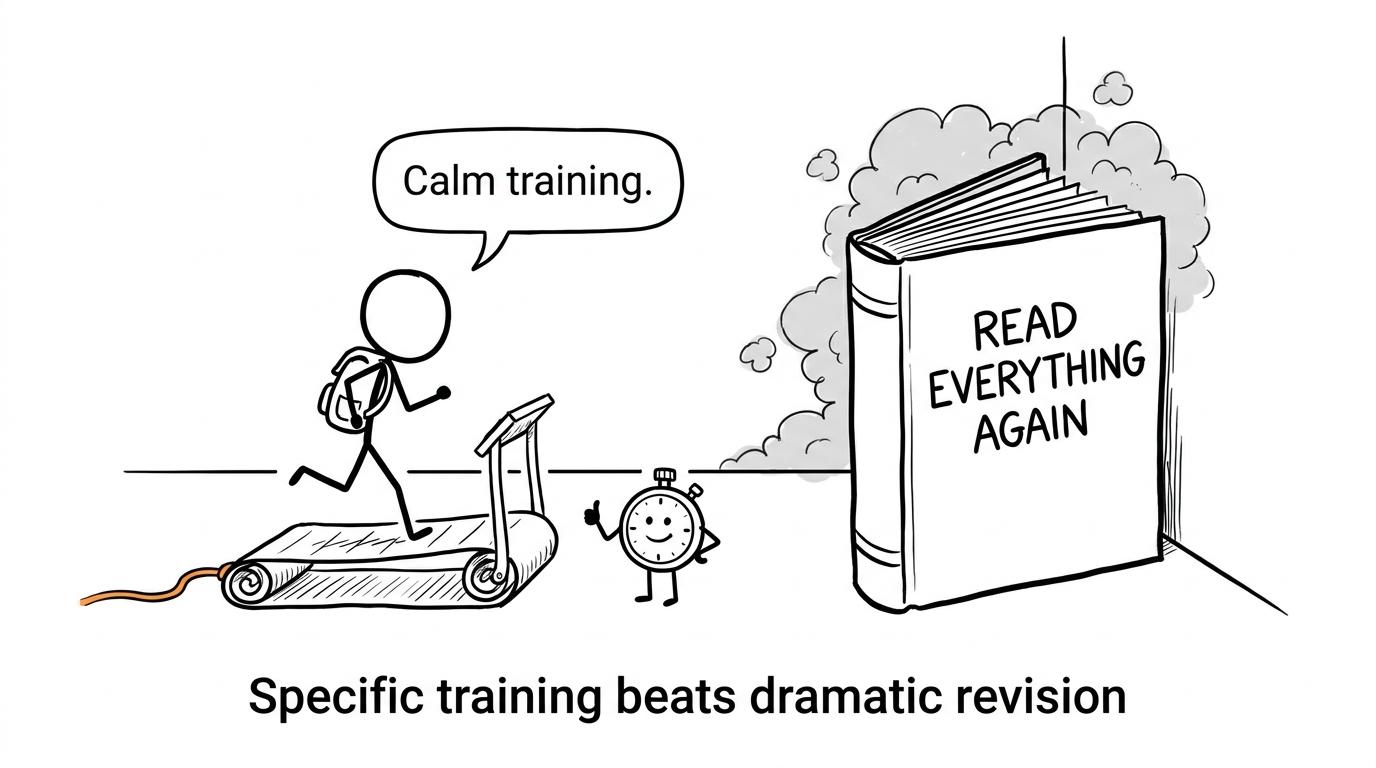 A student trains calmly on a practice-paper treadmill while an enormous rereading book gathers dust
Common mistakes that keep students near grade 444
Revising only by reading
Reading notes creates familiarity, but the exam requires retrieval and application. Close the book, answer questions and check what remains available without prompts.
Chasing only difficult Higher-tier content
Grade 666 progress depends heavily on securing accessible and medium-demand marks. Repair core knowledge, standard calculations and practical skills before spending most of your time on the hardest questions.
Treating the equation sheet as a substitute for practice
The sheet gives relationships, not judgement. You must still choose the equation, rearrange it, convert units and interpret the result.
Ignoring one science
Your grade reflects performance across the whole qualification. A persistent weakness in Chemistry or Physics cannot be hidden simply by doing more Biology revision. Divide your time using evidence from marked papers.
Counting hours instead of corrections
Three hours of highlighting can produce less improvement than thirty minutes spent fixing one recurring graph error. Measure completed questions, corrected misconceptions and successful retests.
Your next step with MathsGenie
Going from 444-444 towards 666-666 is not about suddenly becoming a different kind of student. It is about making your knowledge more usable and your mistakes more specific. Learn the content, practise in context, mark honestly and return to the weakness before it fades from memory.
Use MathsGenie as your free revision base for the mathematical skills behind Combined Science. Start with revision lessons and practice questions, check your work with mark schemes and video solutions, then use mini tests, past papers and predicted papers to build accuracy under time pressure. Choose one marks leak today. Fix it, test it and move to the next.