GCSE WJEC Exam Week Checklist (Physics + Maths Calm Plan)
GCSE WJEC exam week checklist for Physics with a calm maths-first routine: past papers, formulas, timing and common mistakes to avoid for top marks.
The week you stop learning and start performing (GCSE exam week)
GCSE exam week has a particular kind of pressure: you’re not trying to become a different student, you’re trying to become yourself on a good day: calm, accurate, and consistent. If you’re sitting WJEC GCSE Physics, the temptation is to cram facts late into the night and hope adrenaline fills the gaps. But exam week doesn’t reward chaos. It rewards routines.
This is a WJEC guide built for UK GCSE students who are revising maths alongside Physics. Not because maths and Physics are the same subject, but because your GCSE marks in Physics often depend on simple maths executed under time pressure: rearranging formulas, interpreting graphs, handling standard form, and using units correctly.
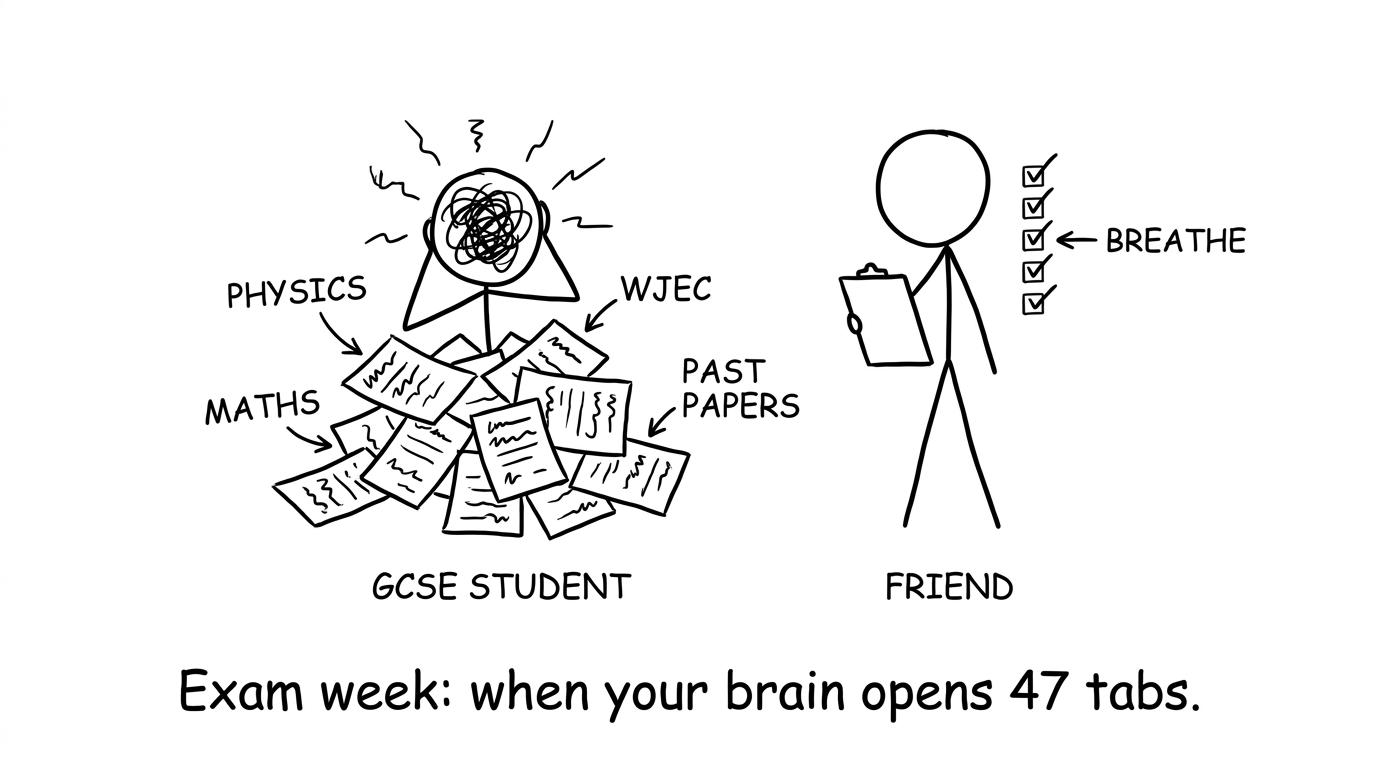 A stressed student meets a calm checklist
The simple checklist (printable in your head)
Use this GCSE checklist each evening of exam week (20-40 minutes total):
- Confirm your paper details: exam board (WJEC), tier if applicable, start time, equipment.
- Pick two Physics topics and do targeted retrieval (no rewriting notes).
- Do one short maths skills block: formulas, graphs, standard form, percentages.
- Mark with a mark scheme mindset: “What would get the method marks?”
- Fix one recurring error and write a one-line rule.
- Stop revision early enough to sleep.
For maths practice that supports your Physics calculation marks, keep YesGenie open in another tab:
- WJEC GCSE Maths Revision
- GCSE Past Papers (all boards)
- Resources (Predicted Papers, mini tests, more)
What WJEC GCSE Physics exam week really tests
In the story students tell themselves, Physics is about remembering content. In the story the paper tells, Physics is also about being numerate.
Three things quietly decide a lot of GCSE marks:
Formula fluency (and rearranging under pressure)
You don’t lose marks because you “don’t know Physics”. You lose marks because you know the idea but your algebra slips.
If you can rearrange reliably, you protect marks across topics.
Reading graphs and units
WJEC questions love graphs, gradients, and unit conversions. These are GCSE maths skills wearing a lab coat.
Working that earns method marks
Mark schemes often reward a correct method even if the final number is off. Your working is not decoration; it’s insurance.
If you want a clean algebra refresher for exam week, these YesGenie pages help:
The 30-minute “maths for Physics” routine (GCSE-safe)
When you’re tired, you need a routine that doesn’t depend on motivation.
Choose one skill per night
Rotate through these GCSE staples:
- Rearranging formulas
- Standard form
- Proportion and percentage change
- Graph gradients and intercepts
- Units and conversions
If you’re not sure what to practise, open a topic list and choose one weak spot:
Worked Example 1: Rearranging a Physics-style formula
Suppose a question gives:
V=IR V = IR V=IRand asks you to make III the subject.
Start by dividing both sides by RRR:
I=VR I = \frac{V}{R} I=RVNow apply numbers (typical GCSE setup): if V=12V = 12V=12 and R=3R = 3R=3, then
I=123=4 I = \frac{12}{3} = 4 I=312=4The maths is simple. The exam pressure isn’t. The win is doing the same clean step every time.
Worked Example 2: Standard form without panic
In Physics, you might see 3.6×1053.6 \times 10^53.6×10⁵ and be asked to write it as an ordinary number.
Because 105=10000010^5 = 100000105=100000,
3.6×105=3.6×100000=360000 3.6 \times 10^5 = 3.6 \times 100000 = 360000 3.6×105=3.6×100000=360000Or the reverse: write 0.000720.000720.00072 in standard form.
Move the decimal 4 places to make 7.27.27.2:
0.00072=7.2×10⁻⁴ 0.00072 = 7.2 \times 10^{-4} 0.00072=7.2×10⁻⁴Standard form is a GCSE maths topic that turns into a Physics mark factory when you’re fluent.
Worked Example 3: Percentage change (common in data questions)
If a value increases from 505050 to 626262, the percentage increase is:
percentage change=62−5050×100=1250×100=24% \text{percentage change} = \frac{62-50}{50} \times 100 = \frac{12}{50} \times 100 = 24\% percentage change=5062−50×100=5012×100=24%For quick revision on percentages and conversions:
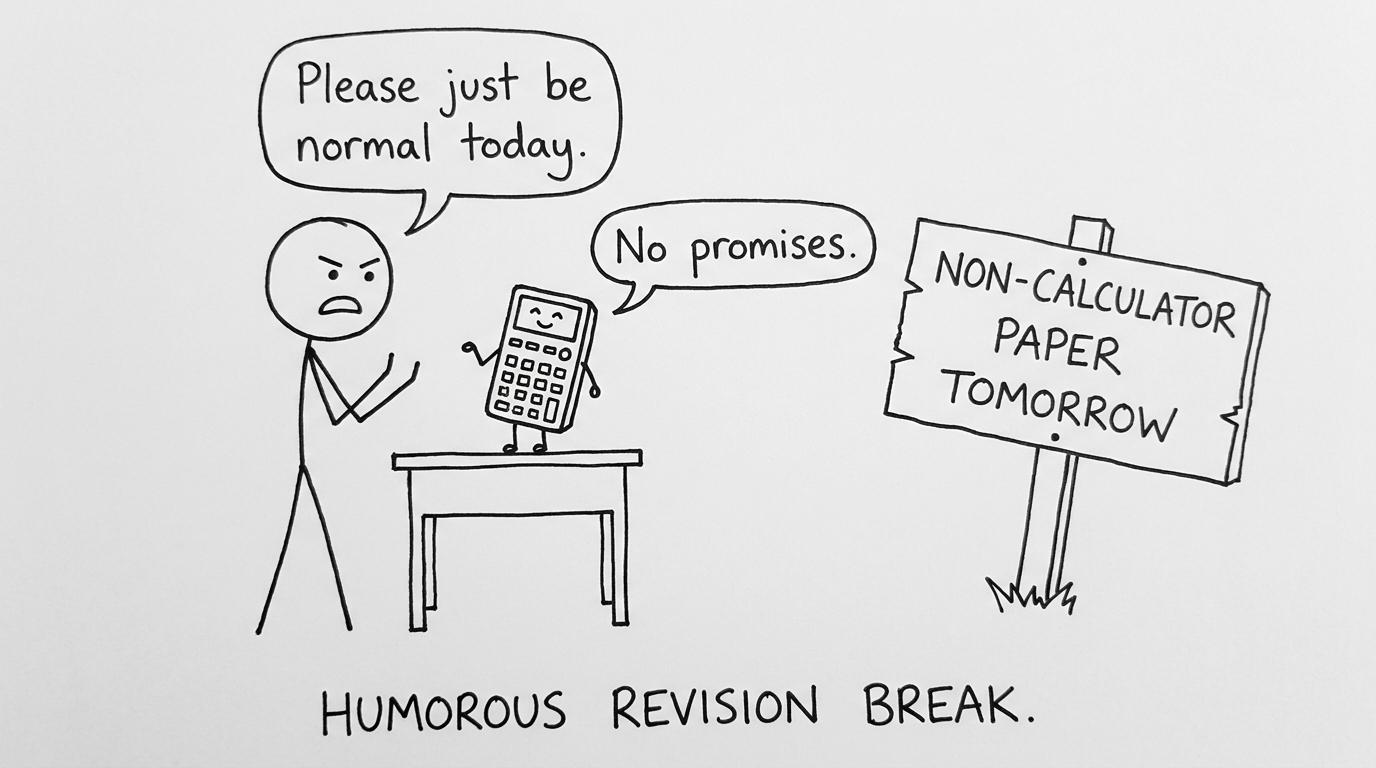 Student negotiates with a calculator
The WJEC exam-week plan: what to do each day
This is built for GCSE students juggling multiple papers. Adjust the order, keep the shape.
Two days before the WJEC GCSE Physics exam
- Do one timed section from a past paper (not a full marathon).
- Mark it strictly, then rewrite only the errors.
- Build a “last page list”: formulas and facts you keep forgetting.
For maths paper practice in the same week, use:
The day before
- Stop collecting new resources.
- Do a short retrieval session: definitions, units, core equations.
- Do one maths skills block (20 minutes) on your weakest area.
If you want structured mixed practice, explore:
The morning of the exam
- Warm up with two easy questions (confidence matters).
- Re-read your “one-line rules” for mistakes.
- Eat something boring and reliable.
In the exam (the calm technique)
- If you freeze, start by writing the formula and substituting values.
- Show unit steps. Even a partial setup can earn GCSE marks.
- If an answer looks unreasonable, do a sanity check using orders of magnitude.
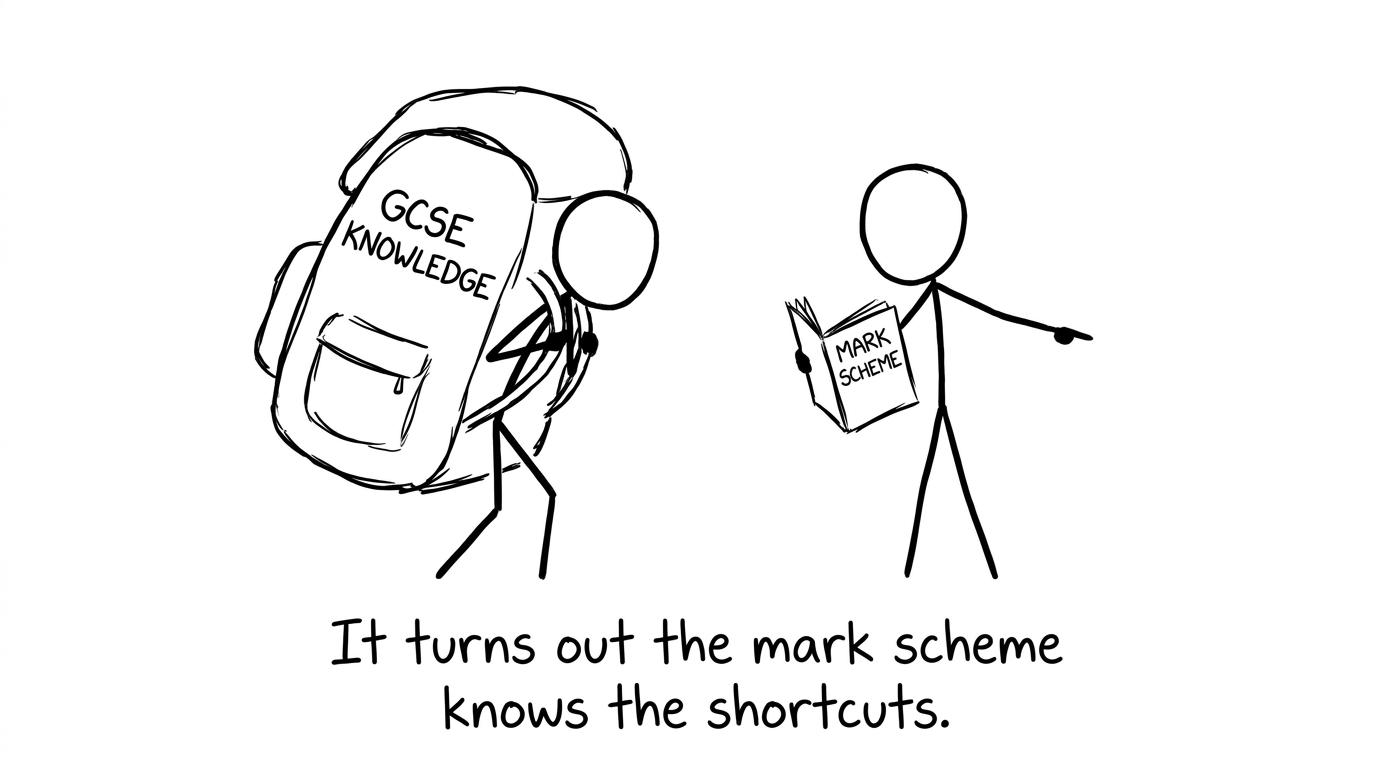 The mark scheme carries the map
How to use mark schemes without crushing your confidence
A mark scheme is not a judgement of you. It’s a description of what counts.
When you mark, train your eye to spot:
- Where method marks come from (usually a correct formula or correct substitution).
- Where accuracy matters (rounding, standard form, calculator slips).
- Which words are compulsory (state, describe, explain).
For maths, the fastest way to understand mark schemes is to practise on real papers and then watch worked solutions where available. Start here:
Common mistakes that cost easy GCSE marks (and how to avoid them)
Dropping units or mixing them
You might correctly calculate a value but lose marks because the unit is missing or inconsistent. Make units part of the calculation line, not an afterthought.
Rearranging incorrectly
A classic slip is moving a term across an equals sign without doing the same operation to both sides. Write one line per operation.
Standard form sign errors
Students often write 10−410^{-4}10−4 when they mean 10410^4104. Remember: negative powers are for tiny decimals.
Rounding too early
If you round in the middle, you can drift away from the mark scheme answer. Keep full calculator accuracy, round at the end.
Treating the calculator like an oracle
Calculators are brilliant at doing what you tell them, not what you intend. Use brackets. Write your expression clearly first.
Closing: keep GCSE exam week simple, and let the routine win
WJEC GCSE Physics exam week can feel like a spotlight, but it’s really a mirror: it reflects the habits you built in quieter months. If your revision has been messy, your goal now isn’t to become perfect; it’s to become consistent. Use the checklist. Do small, repeatable sessions. Protect your sleep. And keep your maths sharp, because GCSE marks often live in the working.
When you’re ready, make YesGenie your home base for the week: revision lessons, practice questions, mark schemes, past papers, and predicted papers that help you focus without panic. Start with WJEC GCSE Maths Revision, practise with WJEC GCSE Maths Past Papers, and use the wider GCSE Past Papers and Resources pages to build a plan you can actually stick to.
GCSE exam week doesn’t need a new personality. It needs a simple checklist, and the courage to follow it.