GCSE Classical Civilisation Topics Breakdown
GCSE classical civilisation topics breakdown: understand OCR paper weightings, compare every option and focus your revision where it can gain the most marks.
Revision becomes difficult when every page feels equally important. One evening disappears into Greek gods; another goes on Roman houses; the prescribed literature remains waiting in the background. A useful GCSE classical civilisation topics breakdown changes that. Under the current OCR J199 specification, you study two components worth 50%50\%50% each: one Thematic Study and one Literature and Culture option. Your first priority is therefore to divide revision evenly between the two papers, before giving extra time to the areas where practice reveals lost marks.
This guide explains the options, their approximate weight and the most sensible places to spend your time. Although MathsGenie specialises in free GCSE and A Level maths revision, the same evidence-led method works across subjects: identify the paper, test yourself, mark honestly and return to the weakest area.
The GCSE Classical Civilisation course at a glance
OCR is currently the awarding organisation offering GCSE Classical Civilisation. Its specification code is J199. Unlike GCSE maths, where your school might enter you with Edexcel, AQA, OCR or Eduqas, there is no equivalent choice of several current Classical Civilisation specifications.
You study one option from each component group. You do not need to revise all five options listed in the specification.
| Component group | Your school chooses | Exam | GCSE weighting |
|---|---|---|---|
| Thematic Study | Myth and Religion or Women in the Ancient World | 909090 marks, 111 hour 303030 minutes | 50%50\%50% |
| Literature and Culture | The Homeric World, Roman City Life or War and Warfare | 909090 marks, 111 hour 303030 minutes | 50%50\%50% |
Both examinations contain short-answer and extended-response questions. Across the complete qualification, AO1 knowledge and understanding accounts for 60%60\%60%, while AO2 analysis and evaluation accounts for 40%40\%40%.
That gives you a simple starting checklist:
- Confirm the two options taught by your school.
- Give each paper roughly half of your total revision time.
- Cover both factual knowledge and source analysis.
- Practise short answers as well as extended responses.
- Use marked work to move time towards your weakest section.
 A student navigating two enormous revision scrolls with an unhelpfully confident classical owl
Component Group 1: Thematic Study
The Thematic Study paper is worth 909090 marks and 50%50\%50% of the GCSE. It contains three equal sections:
- Greece: 303030 marks
- Rome: 303030 marks
- Greece and Rome: 303030 marks
Each section therefore represents approximately
30180×100%=16.7%\frac{30}{180}\times 100\%=16.7\%18030×100%=16.7%of the complete qualification. This matters because comparison is not an optional finishing touch. The comparative section carries the same number of marks as the Greece section and the Rome section.
Myth and Religion
This option compares religious beliefs and practices in Greece and Rome. Its content includes the gods, temples, sacrifice, festivals, death and burial, beliefs about the Underworld, Heracles or Hercules, and myths connected with the foundation and identity of Athens and Rome.
Effective revision needs three connected layers:
- accurate knowledge of Greek material;
- accurate knowledge of Roman material;
- the ability to compare what the sources suggest about each culture.
Do not revise the Greek and Roman gods as one blended family. Similarities can be useful, but names, roles, stories and cultural settings still need to be precise. Visual and material sources matter too. Knowing a myth without recognising how it appears in a temple, sculpture, vase or other prescribed source leaves part of the course uncovered.
Women in the Ancient World
This option examines the representation and experience of women across the ancient Greek and Roman worlds. It includes women in myth and legend, women in the home and society, marriage, religious roles, women associated with power or influence, and figures presented as improper, dangerous or worthy of admiration.
A strong revision structure separates three questions:
- What does the source claim or depict?
- What does its context tell us about the society that produced it?
- How far can it support a broader conclusion about women?
This distinction protects you from turning a source into a fact about every ancient woman. A literary portrayal may reveal an author’s values, fears or purpose rather than provide a neutral record of ordinary life.
Component Group 2: Literature and Culture
The Literature and Culture paper is also worth 909090 marks and 50%50\%50% of the GCSE. It has two equal sections:
| Section | Marks | Share of complete GCSE |
|---|---|---|
| Culture | 454545 | 25%25\%25% |
| Literature | 454545 | 25%25\%25% |
The Culture section may use prescribed and unseen sources. The Literature section is based on prescribed material. This equal split makes the most common strategic error easy to see: enjoying the stories does not justify neglecting archaeology and material culture, while memorising buildings and objects cannot compensate for insecure literary knowledge.
The Homeric World
The Homeric World combines Mycenaean culture with prescribed parts of Homer’s Odyssey. The cultural study includes archaeological sites, burial evidence, buildings, artwork and objects that help reconstruct the Mycenaean world. The literary study examines selected episodes from the Odyssey, including their characters, themes and narrative effects.
Spend separate sessions on culture and literature, then add short linking sessions. Archaeological evidence should be revised with its location, features and possible significance. Literature revision should move beyond remembering what happens. You need to explain how language, characterisation and narrative choices create meaning.
Roman City Life
Roman City Life explores Roman society through cultural evidence and prescribed literature. Areas include housing, family life, education, slavery and entertainment, alongside literary perspectives on the benefits, pressures and inequalities of urban life.
Organise the cultural material by aspect of society rather than as one long collection of facts. For each literary source, record the speaker or author, context, target, tone and limitations. Satire, complaint and personal correspondence do not all function in the same way, even when they describe similar features of Roman life.
War and Warfare
War and Warfare considers Greek and Roman military practice, equipment, organisation, significant conflicts and the ways warfare is presented in literary and visual sources. It requires both practical knowledge of warfare and interpretation of attitudes towards courage, leadership, duty, suffering and victory.
Chronology can help, but a timeline alone is not enough. Build thematic groups around soldiers, tactics, leadership, commemoration and the consequences of conflict. Then connect factual evidence to the arguments made by the prescribed authors and material sources.
 A Greek vase and Roman statue using flashcards while a student acts as invigilator
Where should you spend your revision time?
Begin with the official weighting, not with which topic feels most comfortable. If you have 101010 hours available, a neutral starting allocation is:
| Revision area | Baseline time |
|---|---|
| Thematic Study | 555 hours |
| Literature and Culture | 555 hours |
Within the Thematic Study allocation, divide time approximately equally between Greece, Rome and comparison. Within Literature and Culture, begin with 2.52.52.5 hours for Culture and 2.52.52.5 hours for Literature.
Then adjust this baseline using evidence. Complete a timed question or paper section, check it against the mark scheme and classify each lost mark as one of the following:
- missing knowledge;
- weak source recognition;
- unsupported analysis;
- poor comparison;
- misunderstood command word;
- incomplete answer caused by timing.
The MathsGenie guide to finding your weakest GCSE topics explains this diagnostic approach in more detail. It is written for maths, but its central principle transfers cleanly: revise according to demonstrated weaknesses, not vague anxiety.
A useful weekly rhythm is two knowledge sessions, two source or literature sessions and one timed response. Revisit mistakes within a few days rather than waiting until the next full mock. Maths students can use the same timetable alongside the free GCSE Maths revision hub, keeping both subjects active without allowing either to consume the entire week.
Revise knowledge and analysis differently
Because AO1 and AO2 reward different things, they need different revision activities.
For AO1, use active recall:
- blank-page retrieval;
- source identification cards;
- character, author or artefact profiles;
- timelines and thematic grids;
- short factual questions completed without notes.
For AO2, practise decisions and arguments:
- identify what a source suggests;
- select precise supporting evidence;
- explain significance rather than paraphrasing;
- consider purpose, context or limitations;
- compare evidence before reaching a judgement.
A balanced session might spend roughly 60%60\%60% of its time securing knowledge and 40%40\%40% applying it, reflecting the overall assessment-objective weighting. Treat this as a starting point, not a rigid rule. If your knowledge is secure but extended responses remain descriptive, AO2 deserves more time.
The same learn-practise-mark-fix cycle sits behind efficient GCSE maths revision. For maths, MathsGenie provides revision lessons, practice questions and video solutions. For Classical Civilisation, use your prescribed sources, OCR materials and teacher feedback within the same cycle.
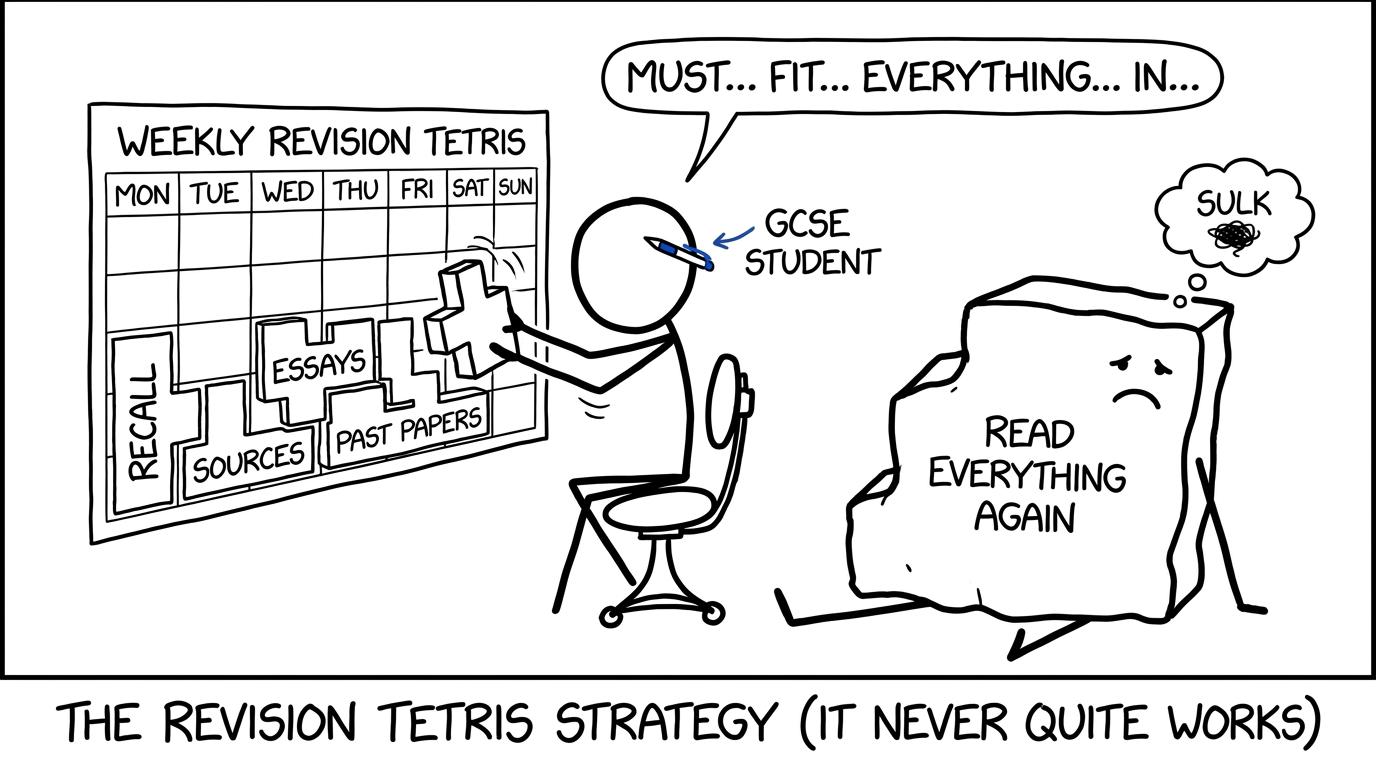 Revision blocks fitting neatly into a calendar while rereading everything fails to fit
Common mistakes that waste revision time
Revising all five specification options
Your school selects one Thematic Study and one Literature and Culture option. Confirm your component codes before downloading materials or making flashcards.
Treating every subtopic as officially equal
OCR publishes component and section weightings, but that does not mean every individual god, author, building or battle receives a fixed share of marks. Aim for complete coverage, then prioritise weaknesses revealed by questions.
Rereading instead of retrieving
Familiar pages create recognition, not necessarily recall. Close the book and reproduce the information before checking it. The awkward moment when you cannot remember is useful because it identifies the gap.
Ignoring visual and material culture
Classical Civilisation is not assessed through literature alone. Learn what prescribed objects and sites look like, what they show, their contexts and how securely they support an interpretation.
Writing description instead of analysis
Retelling a myth or summarising a passage may demonstrate knowledge, but analysis must explain how evidence answers the question. Every paragraph should move from evidence to significance.
Leaving timed practice until the end
Past-paper work is a diagnostic tool, not merely a final performance. The reasoning in MathsGenie’s guide to starting GCSE past papers applies here too: begin with sections, mark them carefully and build towards complete timed papers.
Make the breakdown serve your whole GCSE timetable
The central lesson is simple: revise the course you will actually sit. Give the two Classical Civilisation papers equal baseline time, protect the equal Culture and Literature split, and do not neglect the comparative third of the Thematic Study paper. After that, let marked evidence decide your priorities.
Your other GCSEs still need regular attention. Use the MathsGenie one-week maths revision plan to organise short maths sessions around Classical Civilisation, or use GCSE maths mini tests when time is limited. Near the exams, MathsGenie remains your free home for revision lessons, practice questions, past papers, predicted papers, mark schemes and video solutions.
Choose one Classical Civilisation section to test today. Mark it, record why each mark was lost and make tomorrow’s revision answer that evidence. A large syllabus becomes manageable when the next action is small and exact.