GCSE Classical Civilisation Paper 1 Exam Date 2026
GCSE Classical Civilisation Paper 1 exam date 2026 was Tuesday 19 May, in the afternoon. Check the format, equipment and last-week revision plan.
There is a particular kind of exam stress that has nothing to do with how much you know. It comes from wondering whether you have written down the right date.
The GCSE Classical Civilisation Paper 1 exam date 2026 was Tuesday 19 May 2026, in the afternoon session. Both OCR Thematic Study options: Myth and Religion (J199/11) and Women in the Ancient World (J199/12), were scheduled at the same time. The examination lasted one hour and thirty minutes.
This page records the official 2026 arrangement and explains what students needed to have ready. If you are using the timetable to understand a past entry, check it against your personal school timetable and component code.
For students balancing Classical Civilisation with foundation or higher tier maths, the date was also a useful anchor. Once one exam has a fixed place in the calendar, the surrounding revision becomes easier to organise.
Exam date overview
Here are the essential details from OCR's final June 2026 examination timetable:
| Detail | Official 2026 arrangement |
|---|---|
| Exam board | OCR |
| Qualification | GCSE Classical Civilisation, specification J199 |
| Paper type | Component Group 1: Thematic Study |
| Myth and Religion code | J199/11 |
| Women in the Ancient World code | J199/12 |
| Date | Tuesday 19 May 2026 |
| Session | Afternoon |
| Duration | One hour and thirty minutes |
| Maximum mark | 909090 marks |
| Qualification weighting | 50%50\%50% |
OCR's published afternoon starting time was 1.30 pm, but centres could adjust the precise start within the permitted afternoon window. A student's school timetable, reporting time, room and seat details therefore remained the instructions to follow.
The other half of the qualification, Literature and Culture, was scheduled for the morning of Monday 1 June 2026. Its exact component depended on whether the student studied The Homeric World, Roman City Life, or War and Warfare.
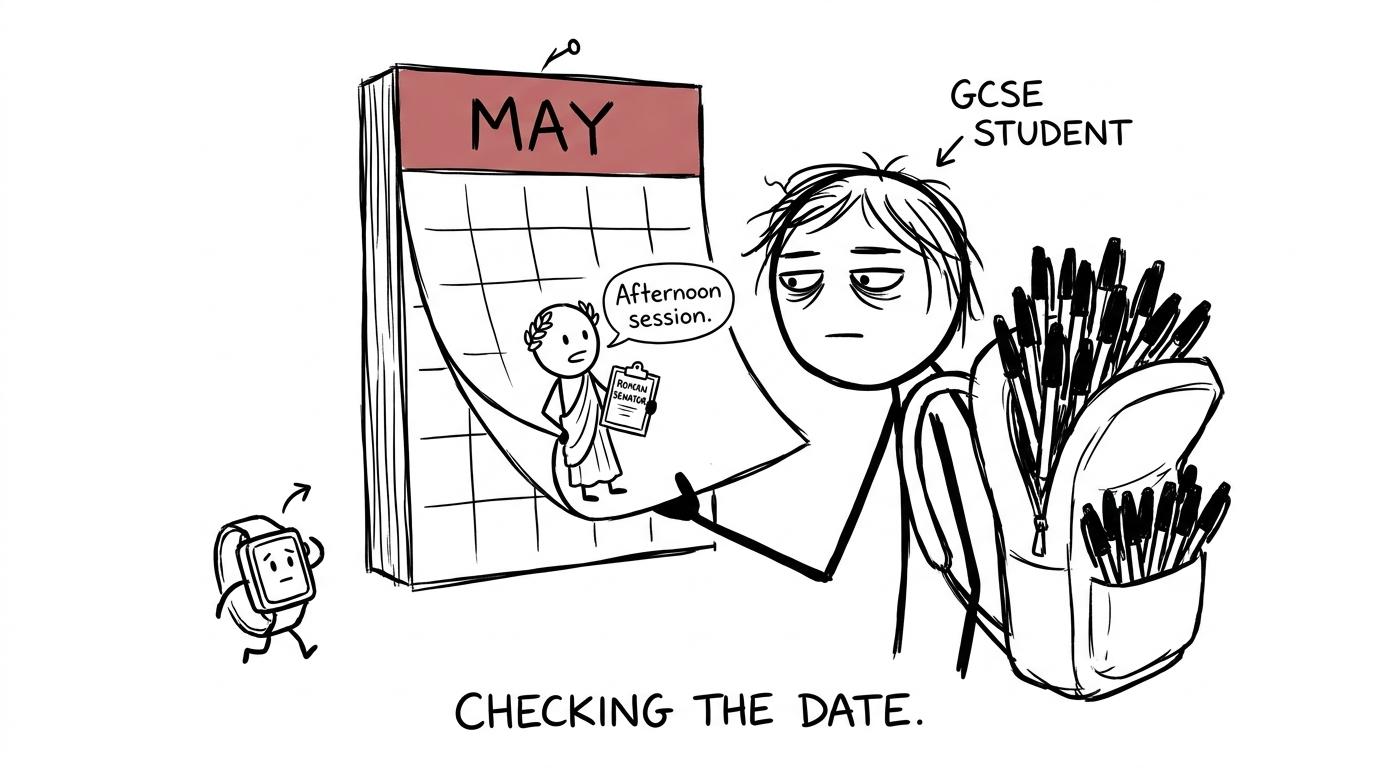 A student discovers an unexpectedly organised Roman senator inside an exam calendar
What “Paper 1” meant for Classical Civilisation
Students often called this assessment Paper 1, but OCR's specification describes it more precisely as Component Group 1: Thematic Study. Each candidate took one of two options:
- J199/11 Myth and Religion, comparing beliefs and practices in ancient Greece and Rome.
- J199/12 Women in the Ancient World, comparing women's lives and representations across the Greek and Roman worlds.
The paper contained three sections. One focused on Greece, one on Rome, and one required comparison between Greece and Rome. Each section was worth 303030 marks, giving:
30+30+30=90 30 + 30 + 30 = 90 30+30+30=90Students answered short questions and extended-response questions. They also needed to work with literary and visual or material sources, including prescribed material and sources that could be unseen.
That structure matters for revision. Knowing isolated facts is not enough if you cannot select evidence, explain its importance and compare the two civilisations. Equally, sophisticated analysis cannot replace precise knowledge. OCR assesses both knowledge and understanding through AO1 and analysis and evaluation through AO2.
What to have ready before the exam
A calm exam morning usually begins the night before. Not with one final heroic revision session, but with several ordinary decisions already made.
Confirm the correct component
Check whether your entry was J199/11 or J199/12. The two components shared the same date and session, so recognising “Classical Civilisation” on a timetable was not enough. Your personal timetable should also have shown your room, seat or candidate details.
If any entry appeared incorrect, the right person to contact was your school's exams officer. Students should never assume that a timetable discrepancy will resolve itself.
Pack permitted equipment
JCQ's 2025/26 candidate guidance said students should bring a clear pencil case and at least two black ink pens. For this written paper, a sensible kit included:
- at least two working black ink pens;
- pencils and an eraser if needed for planning;
- a clear pencil case;
- a clear, label-free water bottle, if permitted by the centre;
- any approved equipment or access arrangements confirmed by the school.
A calculator was not required for Classical Civilisation. Notes, revision cards, mobile phones and smart devices could not be taken into the examination. JCQ guidance also prohibited watches, including analogue, digital and smart watches.
Keep electronic devices outside the room or store them exactly as your centre instructs. A switched-off phone in a pocket is still an unauthorised item.
Know when and where to report
The published session was afternoon, but students needed their school's exact arrival time. Schools normally require candidates to arrive before the examination begins so that seating and instructions can be completed without rushing.
Write down three facts separately from your revision notes:
- the reporting time;
- the examination room;
- the person to contact if illness, disruption or travel problems make you late.
If something goes wrong, contact the school immediately. The 2026 contingency session on Wednesday 24 June 2026 existed for national or significant local disruption. It was not an alternative sitting for an examination missed by an individual student.
A focused preparation plan for Paper 1
The strongest final preparation is selective. A student who tries to reread every myth, building, ritual and prescribed source often finishes with a familiar feeling but little evidence that the material can be recalled under pressure.
Instead, prepare in layers.
Secure the specification content
Create a checklist based on your actual option. For each specification area, ask whether you can:
- recall accurate Greek and Roman knowledge;
- identify relevant literary or material sources;
- explain what each source reveals;
- compare Greek and Roman practices or attitudes;
- form a supported judgement in an extended response.
Retrieval should come before rereading. Close the book, write what you remember, then check what is missing. The gap between recall and the source material is your real revision list.
Practise with the clock visible
The assessment allowed 909090 minutes for 909090 marks, but this does not mean every answer deserves an identical amount of thought. Longer evaluative responses need planning, evidence and a clear judgement. Shorter questions should not absorb time needed later.
OCR examiner guidance has repeatedly emphasised the importance of reaching the midpoint of the paper on time. Complete timed sections as well as full papers, then review whether the problem was missing knowledge, weak explanation or slow decision-making.
Mark for quality, not comfort
After answering a question, compare it with the mark scheme and any teacher feedback. Look for three things:
- precision: did you name the correct person, practice, object or source?
- development: did you explain why the evidence matters?
- judgement: did your conclusion answer the exact question asked?
A useful error log contains one specific correction per mistake. “Revise Rome” is too broad. “Need two precise examples of Roman religious practice and their purposes” creates a task you can complete.
Balancing Classical Civilisation with GCSE maths
Exam seasons rarely offer the luxury of revising one subject at a time. Classical Civilisation requires source knowledge and extended writing; maths requires repeated problem solving. Both improve through retrieval, timed practice and honest marking, even though the content is different.
Start by placing every confirmed examination into one calendar. The GCSE maths revision timetable guide can help you build a realistic weekly structure around fixed dates rather than vague intentions.
On a busy school day, use one short recall block for Classical Civilisation and one question-based maths block. The twenty-minute GCSE maths revision routine is designed for days when energy and time are limited.
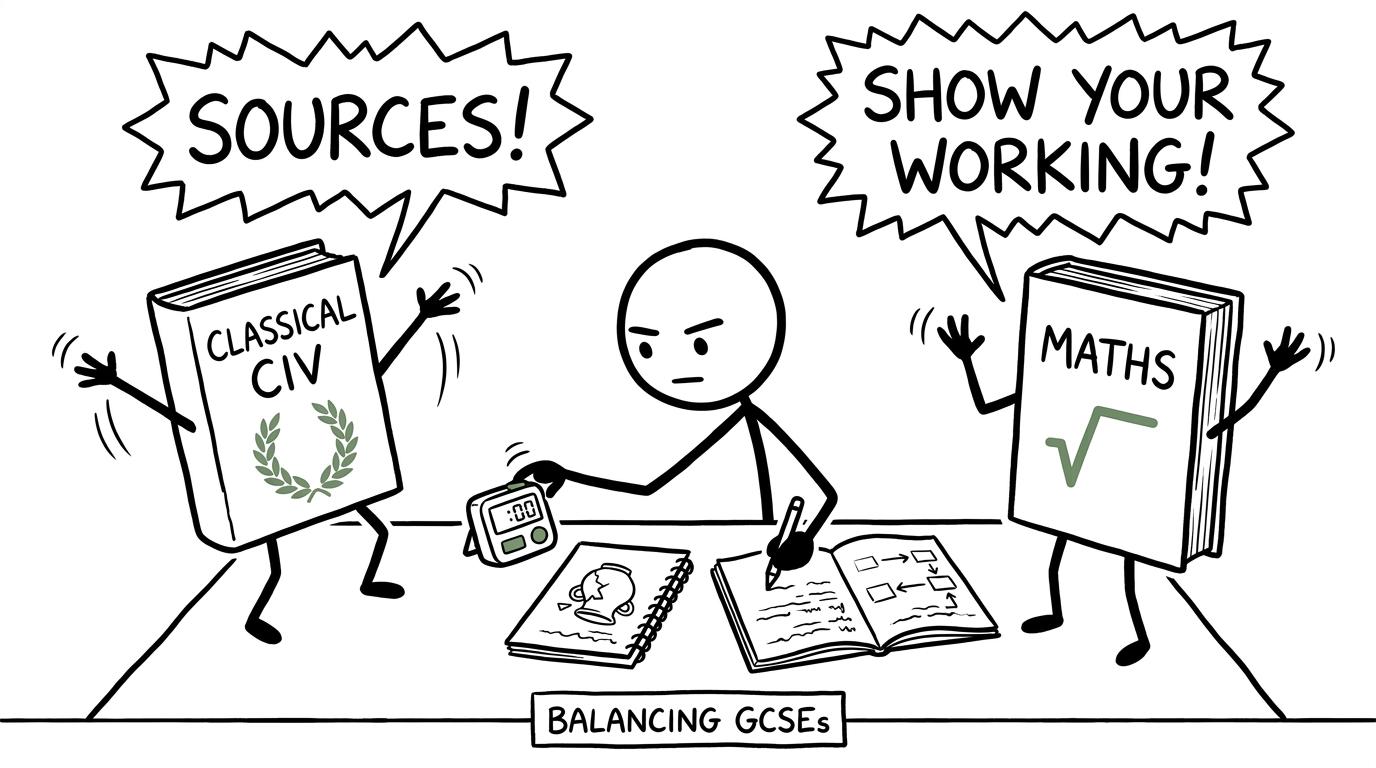 A Classical Civilisation book and maths book offer different exam advice while a student calmly uses a timer
For longer-term planning, the GCSE one-month revision plan shows how to combine topic repair with timed practice. MathsGenie's GCSE maths revision hub then lets you choose Edexcel, AQA, OCR, Eduqas, WJEC or CCEA resources at the correct tier.
Use board-specific papers rather than assuming every maths specification has the same structure. Students taking OCR maths can use OCR GCSE maths past papers, while Edexcel candidates can use the Edexcel GCSE maths past-paper collection.
The evening before the exam
The final evening is for reducing uncertainty, not creating more of it.
Use a short routine:
- check your component code and reporting time;
- place your clear pencil case and black pens in your bag;
- review a compact source or comparison checklist;
- stop revision at a planned time;
- set an alarm and organise transport;
- keep your phone away from the packed examination equipment.
The same principle applies before maths papers. The GCSE maths night-before plan prioritises a small amount of useful practice, equipment checks and rest over a late-night attempt to cover everything.
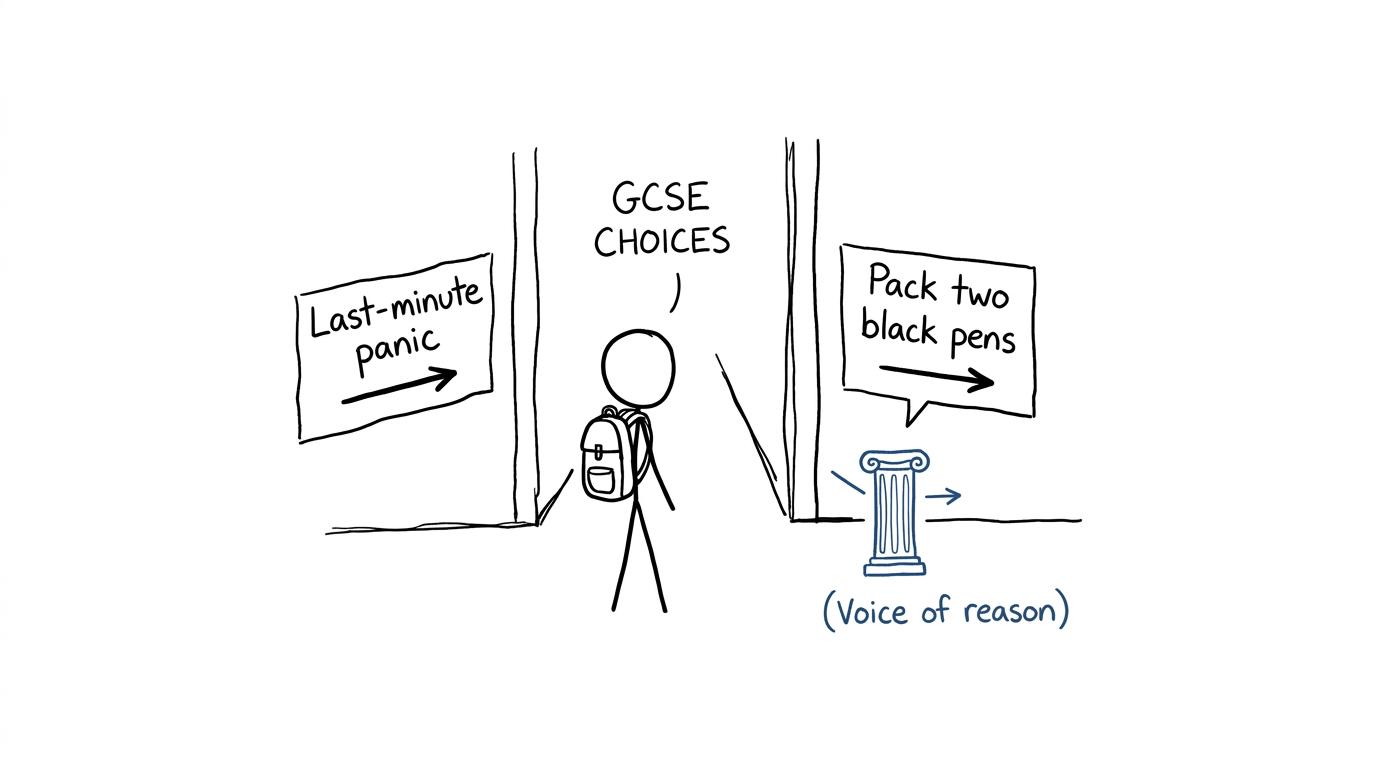 A student chooses packed black pens over the corridor marked last-minute panic
Common mistakes to avoid
Confusing Paper 1 with the later component
The Thematic Study was on Tuesday 19 May 2026. The Literature and Culture component was on Monday 1 June. Keep both dates beside their full component titles and codes.
Checking an unofficial timetable only
Search results and third-party calendars can contain outdated or incorrect dates. The OCR final timetable and your school's personal timetable were the relevant sources for the 2026 sitting.
Assuming every afternoon exam starts at the same school time
OCR published a standard afternoon session, but centres controlled the exact reporting arrangements within official rules. Follow the time issued by your centre.
Bringing a watch or phone into the room
A device does not become permitted because it is switched off. Follow your centre's storage instructions before entering the examination room.
Revising facts without practising comparison
Paper 1 required knowledge of both Greece and Rome as well as comparative thinking. Revise connections and contrasts, not two entirely separate lists.
Sacrificing every other subject
One urgent exam can take over the week. Protect short maths sessions so methods remain retrievable. MathsGenie's Edexcel predicted papers, mini tests, practice questions and video solutions make it easier to maintain progress without planning a new session from scratch.
Turn the date into a plan
The 2026 date was straightforward: OCR GCSE Classical Civilisation Paper 1 was scheduled for Tuesday 19 May 2026 in the afternoon, with a duration of one hour and thirty minutes. The more useful question was what a student did with that certainty.
A date written on a calendar creates a boundary. Before it, there is time to recall sources, practise comparisons, complete timed responses and prepare the correct equipment. Around it, there is still a wider GCSE timetable to manage.
For that maths preparation, make MathsGenie's free GCSE revision hub your starting point. Use revision lessons to rebuild weak methods, practice questions and mini tests to make them reliable, then move to past papers and predicted papers. Mark each attempt with the mark schemes and use video solutions when the written method is not yet clear.
The calendar tells you when to arrive. Deliberate practice determines what you can do once the paper opens.