

GCSE Classical Civilisation Cross Curricular Overlap
GCSE classical civilisation cross curricular overlap explained: find shared content and skills, then revise efficiently without duplicating your work.
Revision can feel strangely repetitive. In Classical Civilisation you analyse a source; in English you analyse a text. In History you evaluate evidence; in Religious Studies you compare beliefs. Then maths asks you to reason clearly and show how you reached a conclusion.
So, does GCSE classical civilisation cross curricular overlap genuinely help? Yes, but mainly when you distinguish shared knowledge from shared skills. Overlap can reduce duplicated revision, strengthen your reasoning and make connections easier to remember. It cannot replace learning each subject's content, terminology or exam technique.
The useful principle is simple: revise a shared skill once, then practise expressing it in the form each exam rewards.
Your cross-curricular revision checklist
Before combining any revision, ask:
- Is the knowledge genuinely shared, or does the connection merely look similar?
- Is the transferable part a skill, such as comparison or evidence selection?
- What terminology does each subject require?
- How does the mark scheme reward the answer?
- Which facts, formulae or methods still need separate retrieval practice?
- Have you checked your own specification and options rather than relying on another student's course?
That last point matters. Current OCR GCSE Classical Civilisation involves one thematic study and one literature and culture component. The available routes include Myth and Religion, Women in the Ancient World, The Homeric World, Roman City Life, and War and Warfare. Your strongest overlaps therefore depend on the components your school teaches.
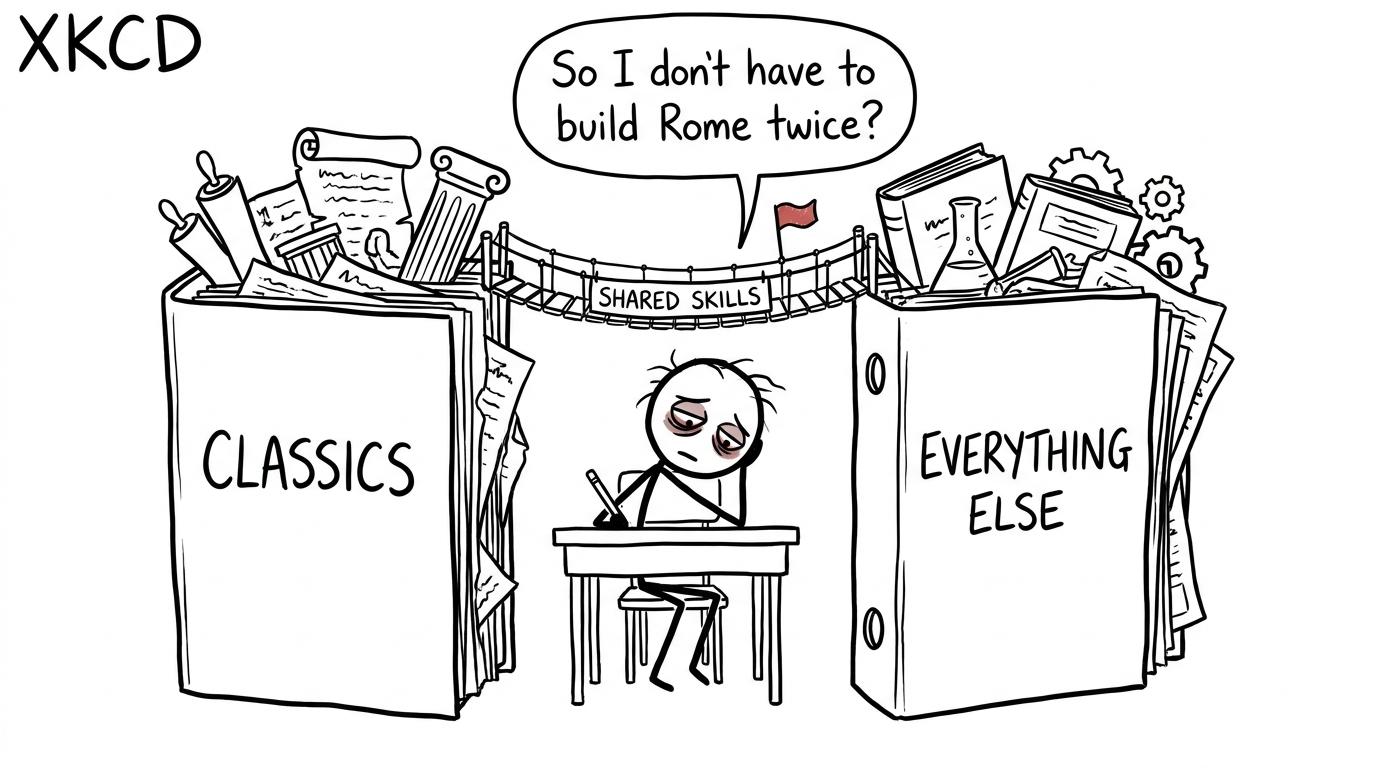 A student discovers a bridge of shared skills between revision folders
What actually transfers from Classical Civilisation?
Official GCSE subject content requires the study of ancient literature in translation and visual or material culture from Greece, Rome and their surrounding worlds. Students must use knowledge alongside analysis and evaluation.
In current assessment guidance, AO1 accounts for 60%60\%60% and concerns knowledge and understanding. AO2 accounts for 40%40\%40% and concerns analysing, interpreting and evaluating evidence while producing coherent, reasoned arguments.
That creates four especially transferable habits:
- selecting relevant evidence rather than writing everything remembered;
- connecting a source to its social, historical or cultural context;
- comparing interpretations without pretending they are identical;
- constructing a conclusion supported by reasons.
These habits travel well. The underlying factual material usually does not.
Classical Civilisation and English
English has one of the clearest skills overlaps. Both subjects reward careful reading, precise quotation or reference, interpretation and coherent argument. Studying epic, poetry or other ancient writing in translation can sharpen your awareness of characterisation, imagery, structure, audience and viewpoint.
The saving comes from practising the architecture of an argument. A clear paragraph normally needs a claim, suitable evidence, an explanation of its significance and a link back to the question. That broad pattern is useful in both subjects.
The limits are equally important. English Literature requires detailed knowledge of its prescribed texts and subject-specific analysis of writers' methods. Classical Civilisation asks you to understand ancient literature and material culture within classical contexts. A polished English paragraph cannot compensate for missing knowledge of a prescribed classical source.
Share the habit of analysis. Keep the quotations, contexts and assessment language separate.
Classical Civilisation and History
The overlap with History lies in contextual reasoning and the disciplined use of evidence. Both subjects ask you to move beyond description. You need to consider what evidence suggests, what its limitations may be and how it fits a wider society.
However, the questions are not interchangeable. History specifications may emphasise causation, change, consequence, significance and interpretations of a defined period. Classical Civilisation centres on literary and visual or material culture, including how sources reflect cultural contexts and may be interpreted by different audiences.
A shared evidence checklist can save time:
- What does the source show or claim?
- Who might its intended audience have been?
- Which contextual knowledge helps explain it?
- What can the source support securely?
- What remains uncertain?
You can learn that thinking routine once. You must then apply the correct historical or classical knowledge in the relevant exam.
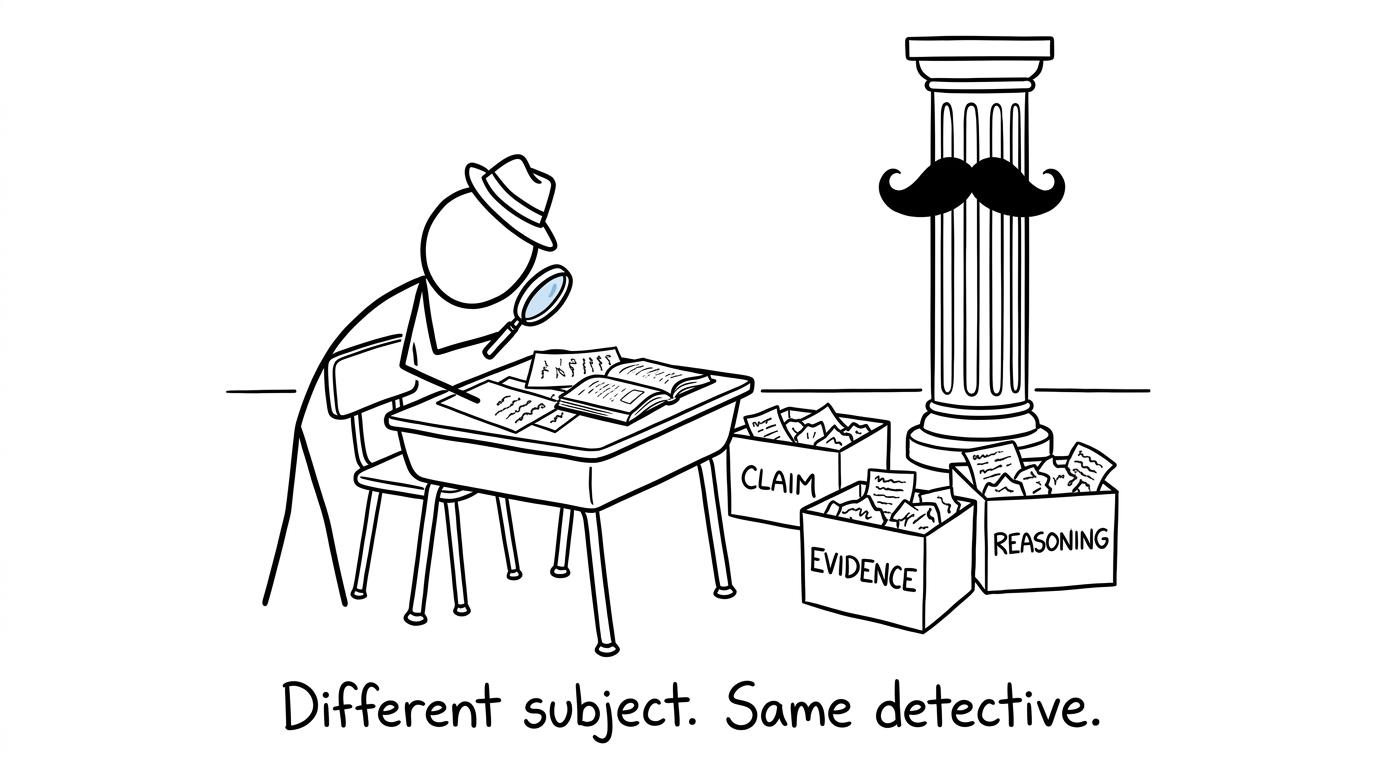 A student detective sorts claims, evidence and reasoning while a classical column looks suspicious
Classical Civilisation and Religious Studies
Myth and Religion can connect naturally with Religious Studies through ritual, sacrifice, festivals, temples, beliefs about divine power and the relationship between religion and community.
This overlap is useful for developing comparison. You become more alert to how beliefs influence practices, institutions and moral expectations. You also learn to distinguish an outsider's description from the perspective of someone participating in a tradition.
But avoid collapsing different traditions into one vague category called “religion”. Ancient Greek and Roman practices must be understood in their own contexts. Your Religious Studies course will have its own prescribed religions, themes, teachings and terminology. The transferable skill is respectful, evidence-based comparison, not the assumption that two beliefs serve the same purpose.
Classical Civilisation, Art and Drama
Visual and material sources create genuine connections with Art and Design. Architecture, sculpture, pottery and other artefacts can be examined through composition, materials, symbolism, function and audience. Art may make you more observant; Classical Civilisation teaches you to turn those observations into historical and cultural interpretation.
Drama can overlap where your chosen material involves performance, conflict, character, gender or public identity. English and Drama may also help you notice how a scene would affect an audience rather than treating a text as a silent collection of quotations.
These are strong interpretive connections, but they remain option-dependent. Revise what appears in your specification and your teacher's course plan.
Does Classical Civilisation overlap with GCSE maths?
The direct content overlap is limited. Knowing about Roman city life will not teach algebra, probability or trigonometry. Classical architecture might make geometry feel more visible, but recognising a column is not a substitute for calculating area, applying Pythagoras' theorem or using an exact formula.
The valuable connection is reasoning.
In both subjects, marks depend on making a defensible chain of thought visible. A Classical Civilisation answer needs relevant evidence and an explained judgement. A maths solution needs an appropriate method, clear working and a checked result. In neither subject is an unsupported final statement enough.
Comparison also transfers. When comparing two ancient sources, you identify meaningful similarities and differences. When comparing distributions or graphs in maths, you must select appropriate features rather than say that one is simply “better”. The content changes, but the discipline of choosing relevant evidence remains.
Keep the distinction clear by using the GCSE Maths revision hub for board-specific mathematical content. If data interpretation is a weakness, the GCSE Statistics revision area separates statistical methods from general essay-based source analysis. You can also target specific foundations with the ratio revision guide, averages revision guide and probability revision guide.
How to use overlap without revising everything twice
Build one shared-skills list
Create a short list containing comparison, source analysis, evidence selection, concise explanation and time management. These are skills you can revisit across subjects.
Do not place subject knowledge on this list. The causes of a historical event, features of a Roman household and the quadratic formula belong in separate retrieval sets.
Attach each skill to a different exam output
After practising comparison, remind yourself what it looks like in each paper:
- Classical Civilisation: compare literary or visual and material sources in context;
- English: compare ideas, perspectives or writers' methods where required;
- History: compare interpretations or evidence according to the question;
- maths: compare numerical or graphical features using precise values and language.
This prevents the common problem of carrying a generic essay structure into every subject.
Use one timetable, not one set of notes
The main efficiency comes from planning, not merging folders. Put linked subjects near each other in your week, but give each session a specific outcome. A Classical Civilisation session might retrieve prescribed sources; a later English session might practise analytical writing; a maths session should involve actual mathematical questions.
The GCSE maths revision timetable guide can help you organise topic practice, marking and timed papers without allowing essay subjects to crowd out maths.
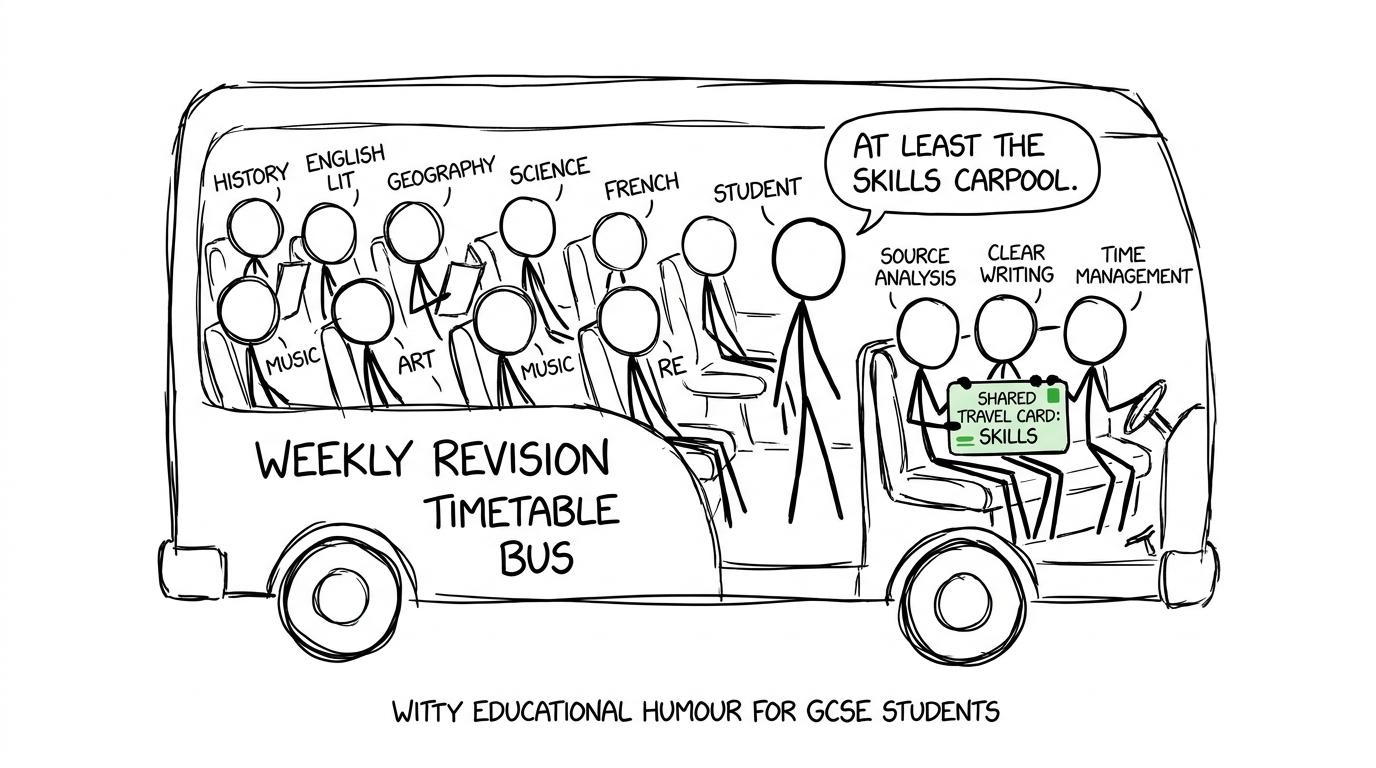 Revision skills share a travel card on a crowded timetable bus
Let assessment reveal what is not transferring
A shared skill is only useful if it survives exam conditions. Use a Classical Civilisation question to test source analysis, then use a maths mini test to test mathematical reasoning. If one goes well and the other does not, you have found a subject-specific gap.
MathsGenie's free revision resources and self-assessments help turn a vague concern into a topic list. As exams approach, the guide to starting GCSE past papers explains how to move from short practice to timed papers.
Common mistakes when combining subject revision
Assuming a similar theme means identical knowledge
War, religion, power and gender appear in several subjects, but each specification frames them differently. Check the prescribed period, sources and command words before reusing notes.
Reusing one paragraph formula everywhere
A structure can support clear thinking, but it should not control the answer. Respond to the precise question and mark scheme rather than forcing every response into the same template.
Spending all your time making crossover resources
Colour-coded maps can feel productive while producing little retrieval. Keep shared resources short. Most revision time should involve recalling knowledge, answering questions, marking and correcting.
Treating maths as another reading subject
Watching a solution or reading notes is not enough. Maths fluency grows through attempting questions, showing working and fixing errors. Foundation and higher tier students should practise material matching their own board and tier.
Letting overlap replace specification checks
OCR Classical Civilisation options differ, while GCSE maths organisation and assessment vary between Edexcel, AQA, OCR and Eduqas. Always work from the course you are actually taking.
Make the overlap serve your revision
Cross-curricular overlap helps when it reduces unnecessary repetition without hiding real gaps. Classical Civilisation can strengthen source analysis, comparison, contextual thinking and reasoned judgement. English, History, Religious Studies, Art and Drama may reinforce those habits. Maths benefits from the same clarity and evidential discipline, but its methods still require dedicated practice.
Start by separating shared skills from subject-specific knowledge. Then open MathsGenie, choose your exam board and tier, and diagnose one mathematical weakness. Use free revision lessons to understand it, practice questions to build fluency, mini tests to check recall, and past papers or predicted papers to develop timing. Mark schemes and video solutions then show exactly what to repair.
The goal is not to revise less carefully. It is to make every revision session do one clear job, without building Rome twice.











