GCSE Classical Civilisation Cram Guide: 1 Week
GCSE classical civilisation cram guide 1 week: a focused seven-day plan for sources, essays, past papers and balanced maths revision without panic.
There is a particular kind of panic that arrives when an exam is seven days away and the revision folder still looks almost untouched. The temptation is to read everything, sleep less and hope intensity can replace direction. It cannot. But a week is still enough time to make meaningful progress.
This gcse classical civilisation cram guide 1 week plan gives you a direct route: identify your OCR components, prioritise prescribed sources, practise retrieval and complete timed exam questions. You will not learn the entire course perfectly. The aim is to recover the knowledge and exam technique most likely to produce marks, while protecting time for your GCSE maths revision and other subjects.
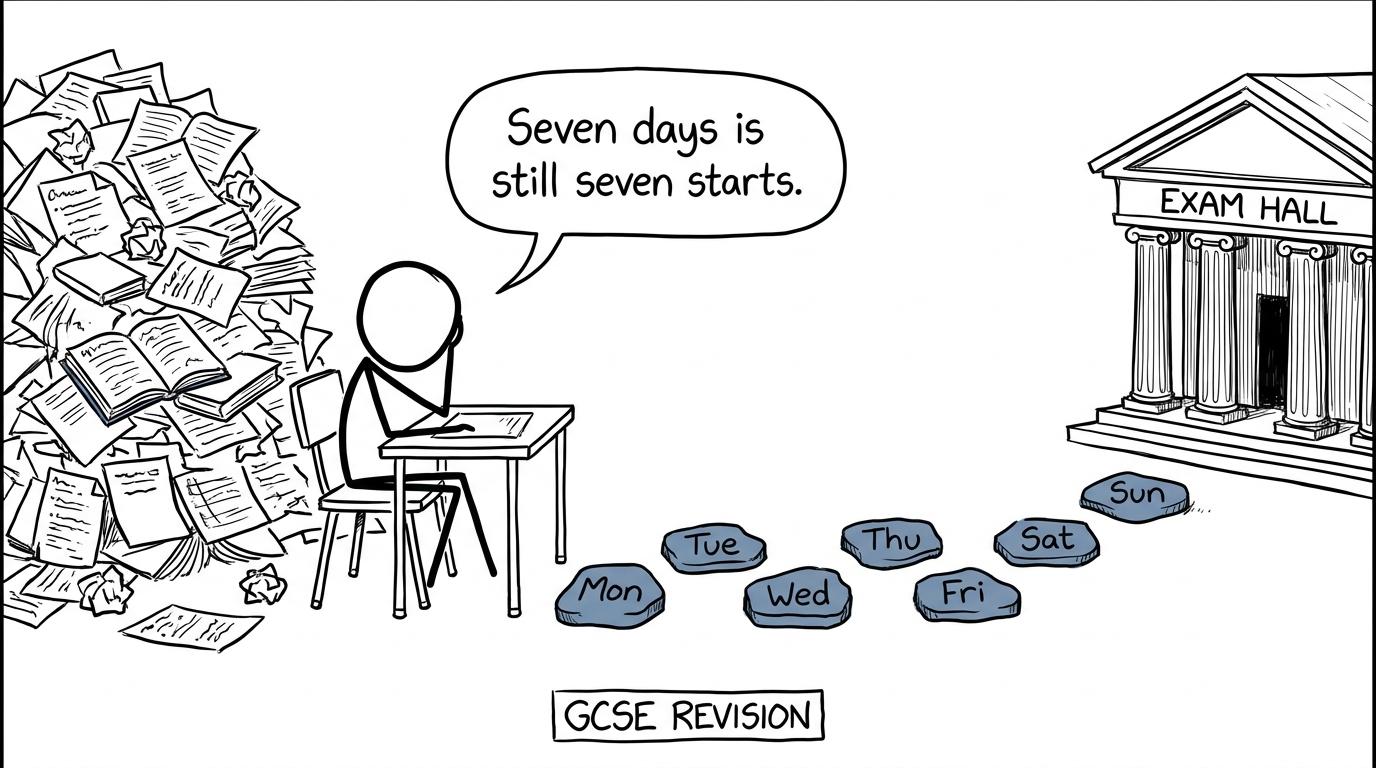 A student crossing seven stepping stones towards an exam hall
Your one-week Classical Civilisation checklist
Before the detailed plan, gather the following:
- Your exact OCR component codes and exam dates
- The current specification or a teacher-provided topic checklist
- Class notes and your prescribed literary sources
- Images or details of the prescribed visual and material culture
- At least one relevant past paper, mark scheme and examiner report
- Blank cards or a digital system for active recall
- A timer and an error log
- A realistic timetable covering Classical Civilisation, maths and other exams
OCR GCSE Classical Civilisation is qualification J199. Students take one Thematic Study, either Myth and Religion or Women in the Ancient World, and one Literature and Culture component: The Homeric World, Roman City Life or War and Warfare.
Each component is a 909090-mark written examination lasting 111 hour 303030 minutes and contributes 50%50\%50% of the qualification. The papers test both knowledge and understanding through AO1 and analysis, interpretation and evaluation through AO2. Across the qualification, AO1 carries 60%60\%60% and AO2 carries 40%40\%40%. That balance matters: knowing stories and objects is necessary, but simply retelling them is not enough.
The rule that makes this cram plan work
Every revision block should contain three actions:
- Retrieve: write or say what you remember without looking.
- Check: compare it with your notes, specification or mark scheme.
- Apply: answer a question, plan an argument or analyse a source.
Passive rereading feels comfortable because it hides gaps. Retrieval exposes them. With only seven days available, discovering what you cannot remember is more useful than admiring what you recognise.
Government exam-pressure guidance similarly recommends breaking revision into manageable topics, setting time limits, testing yourself and reviewing progress. Build your sessions around those actions rather than counting pages read.
Day one: diagnose the course
Your first task is not memorisation. It is deciding what deserves your remaining time.
Write down your two components and divide each into its specification sections. Use a simple traffic-light system:
- Red: little reliable knowledge
- Amber: partial knowledge but weak evidence
- Green: can explain and support an argument without notes
Then attempt a selection of short questions from a relevant past paper. Do not worry about your score. This is diagnosis, not judgement. Mark the attempt and create an error log with four headings: missing fact, confused source, weak analysis and exam technique.
Finish by choosing your five highest-priority areas. A red topic that appears across several sources deserves attention before an isolated detail.
Protect a separate maths block too. The GCSE Maths revision hub lets you choose your exam board and move directly to lessons, questions and papers instead of losing time searching.
Day two: secure your prescribed sources
Classical Civilisation rewards precise source knowledge. Today, focus on the prescribed literary and visual or material sources for your Thematic Study.
For each source, make one compact card containing:
- The source or object name
- Its Greek or Roman context
- Two or three accurate details
- What those details suggest
- A limitation or alternative interpretation
- One theme to which it connects
Do not create beautiful miniature textbooks. A card is useful only if you can test yourself with it. Cover the answer, recall the details aloud, then turn the card over and correct yourself.
The Thematic Study includes Greek, Roman and comparative material. Build comparison pairs deliberately. Ask what is similar, what differs and why the social or religious context might explain that difference.
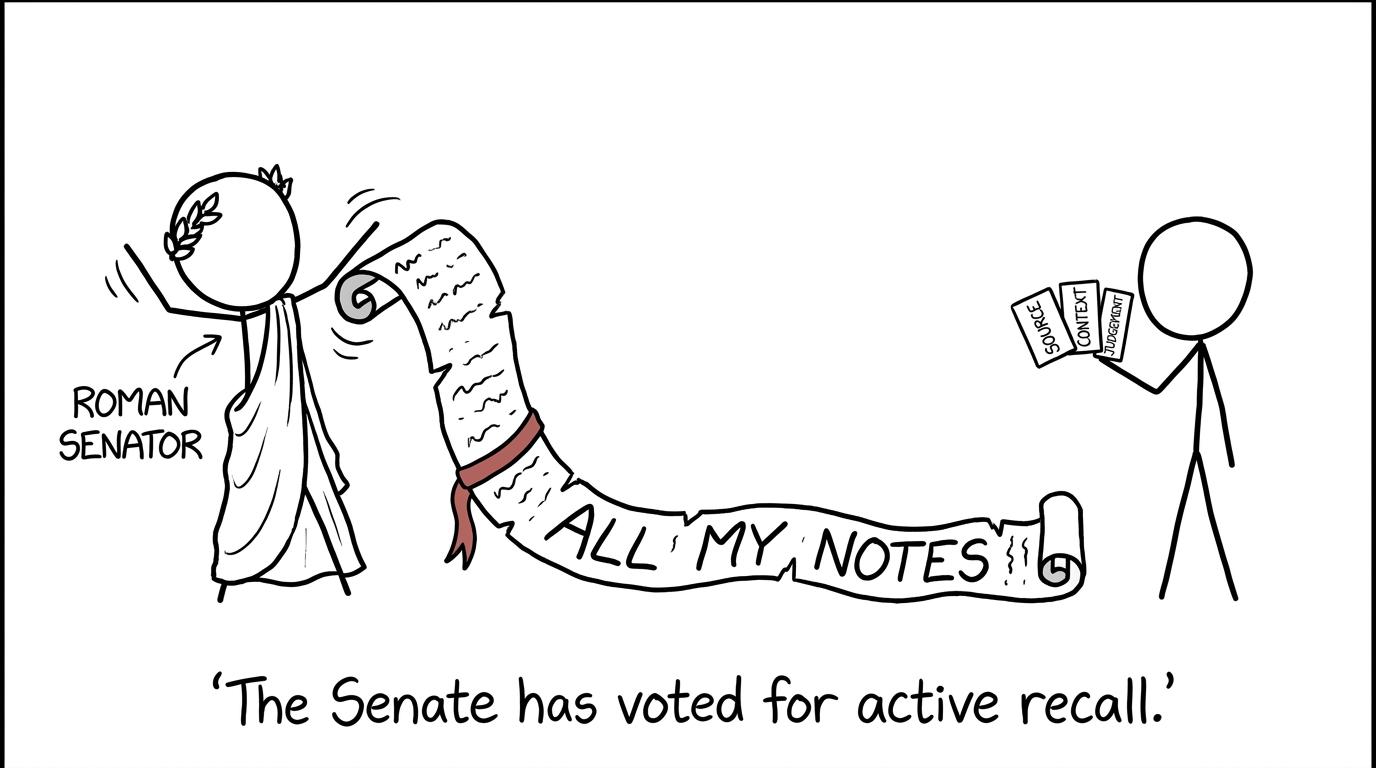 A Roman senator offering a huge scroll while a student chooses three recall cards
Day three: rebuild the literature and culture component
Turn to The Homeric World, Roman City Life or War and Warfare, depending on your entry.
Divide the day between cultural material and prescribed literature. For culture, revise named sites, objects, practices and social contexts. For literature, organise knowledge around characters, themes, significant episodes and authorial presentation.
Use a source grid with four prompts:
- What happens or appears?
- Which precise detail proves it?
- What does it reveal about the classical world?
- How convincing or limited is the source?
End each block with closed-book retrieval. If you cannot reproduce the core information, return to that section tomorrow. Familiarity is not yet recall.
For maths, use the same principle. The full GCSE maths topic list by board and tier can help you identify exactly what belongs to your Foundation or Higher paper.
Day four: turn knowledge into arguments
Today is about AO2. Choose several extended-response questions from your component and plan them rather than writing every answer in full.
For each question:
- Underline the command word and the exact issue being judged.
- Decide your overall judgement before planning paragraphs.
- Select evidence that supports different sides of the argument.
- Explain how each source detail supports your reasoning.
- Return explicitly to the question after each major point.
A useful paragraph has a claim, precise evidence, analysis and a link to the judgement. Avoid treating the source reference as self-explanatory. The examiner needs to see why it matters.
Write one timed extended response after planning. Use the relevant mark scheme to identify whether the weakness was knowledge, evidence selection, analysis or structure. Add the result to your error log.
Day five: practise source questions and comparisons
Source work is not a memory contest alone. You must observe carefully, place evidence in context and evaluate what it can reveal.
Practise with both familiar and unseen material. Before writing, annotate:
- Visible or quoted details
- Relevant contextual knowledge
- The source's possible purpose or audience
- What can reasonably be inferred
- What the evidence cannot establish by itself
For comparison questions, organise the answer by points of comparison rather than writing everything about Greece followed by everything about Rome. This keeps the relationship between the sources visible.
Complete a timed group of short and medium questions. Mark it immediately. Short questions often expose avoidable losses caused by vague names, incomplete details or answers that ignore the command word.
Day six: simulate and repair
Complete one paper, or the largest timed section your schedule permits, under realistic conditions. Put away notes and your phone. Keep moving when a question feels difficult, leaving space to return later.
Mark the paper carefully. The value lies less in the raw mark than in what happens next. Sort every lost mark into your error log, then repair the three most expensive patterns.
You might discover that you know the myths but lack precise source evidence, or that your knowledge is sound while your judgements remain undeveloped. Revise the cause, not just the question.
Your maths revision should work similarly. Read when to start and how to use GCSE past papers, or choose a short Edexcel GCSE Maths mini test if a full paper would overload the day. Mark schemes and video solutions turn mistakes into specific next steps.
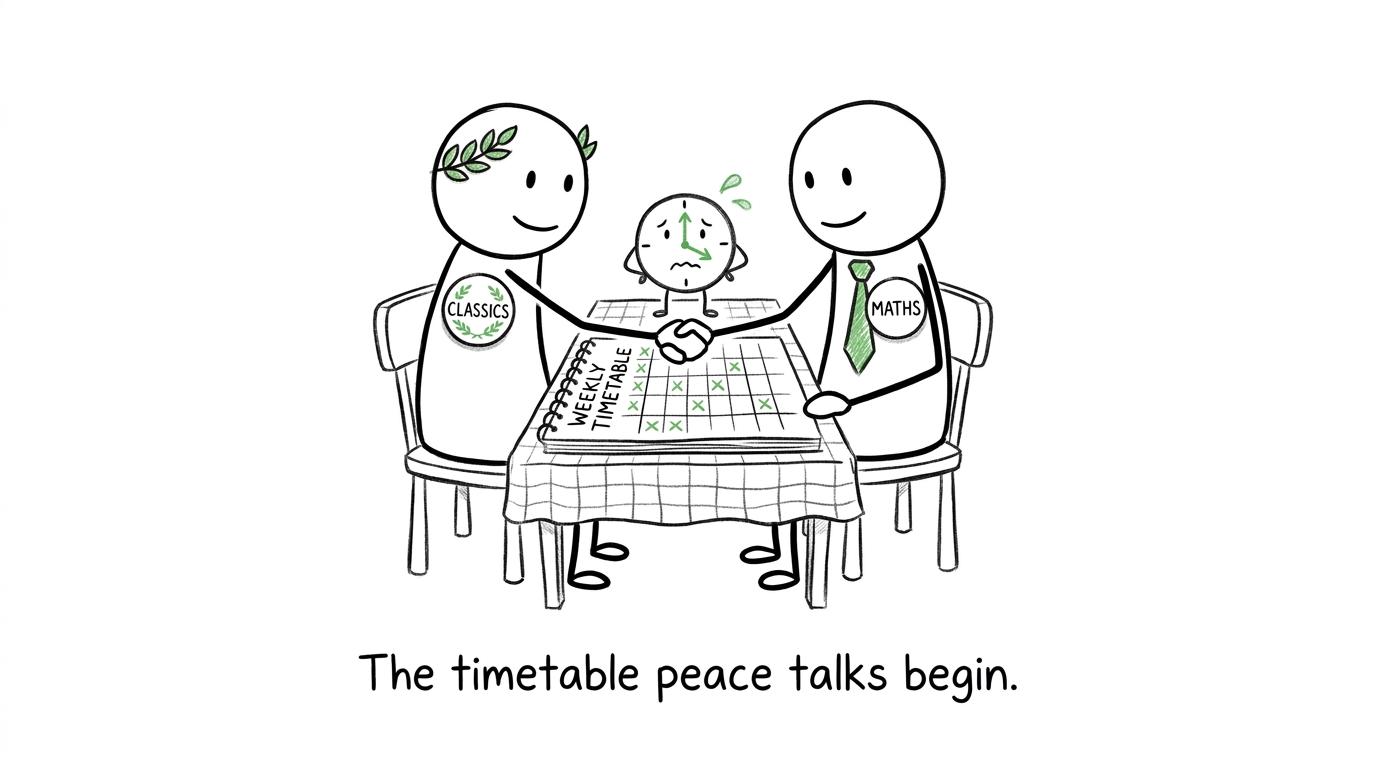 Classical Civilisation and maths negotiating over a revision timetable
Day seven: consolidate without exhausting yourself
The final day is for sharpening, not expanding the course.
Start with your error log and revise only recurring weaknesses. Run through source cards in both directions: identify the source from its details, then recall useful details from its name. Review comparison pairs, essay judgements and the facts you repeatedly forget.
Complete one short set of questions, but avoid beginning another exhausting full paper late at night. Pack the equipment you need, confirm the exam time and stop revision at a sensible hour. Sleep supports concentration and accuracy; an all-nighter trades tomorrow's judgement for a few more hours of increasingly weak revision.
If maths is your next exam, follow the GCSE maths night-before plan rather than attempting every remaining topic. You can also use GCSE predicted papers for focused maths practice once you have repaired the underlying skills.
How to divide each revision day
A sustainable day might contain three focused Classical Civilisation blocks, one maths block and time for another subject. Adapt the duration to your commitments, but preserve the order:
- First block: closed-book recall
- Second block: relearning the weakest material
- Third block: exam application and marking
- Final short review: update cards and the error log
Take brief breaks and move away from the desk. More hours do not automatically mean more learning. Attention is the scarce resource.
If maths also needs substantial rebuilding, use the best order for learning GCSE maths topics to prevent random topic-hopping. Your Classical Civilisation plan and maths plan should coexist rather than compete until one is abandoned.
Common mistakes in a one-week cram
Trying to cover everything equally
A week forces choices. Prioritise specification content, prescribed sources, recurring weaknesses and exam application. Do not spend an hour polishing a topic you can already retrieve accurately.
Memorising plots without source details
Knowing the broad story may help you begin, but precise evidence makes an answer convincing. Connect events and objects to themes, context and possible interpretations.
Writing essays without a judgement
A collection of facts is not an argument. Decide what you think, consider reasonable alternatives and make the conclusion answer the wording of the question.
Ignoring mark schemes and examiner reports
These show how knowledge and analysis are rewarded. Marking your own work may feel uncomfortable, but it is where vague weaknesses become fixable actions.
Sacrificing every other subject
Seven days of Classical Civilisation cannot come at the cost of abandoning maths. Keep a protected daily maths session using the MathsGenie GCSE revision resources, especially if an Edexcel, AQA, OCR or Eduqas maths paper is close.
Staying up to create more revision time
Late-night rereading can feel heroic while producing little durable recall. Set a stopping time. The goal is to arrive able to think, interpret and write clearly.
Make the next seven days count
Starting late is not ideal, but regret has no value unless it changes the next action. Begin with your component codes, diagnose your gaps and make the first retrieval card today. Then let each practice question tell you what tomorrow should contain.
MathsGenie does not replace your Classical Civilisation specification or prescribed texts. It does, however, give your maths revision a reliable home while you follow this plan. Use its free revision lessons, practice questions, mini tests, past papers, mark schemes, video solutions and predicted papers to protect your maths progress without wasting time deciding where to begin.
Open the GCSE Maths revision hub, choose your board and tier, and schedule one focused maths task beside each day of this Classical Civilisation plan. Seven days cannot make revision perfect. They can make it deliberate.