GCSE Classical Civilisation Busy Schedule Guide
GCSE classical civilisation busy schedule? Build a realistic daily plan around sport, work and maths with short recall, source study and exam practice.
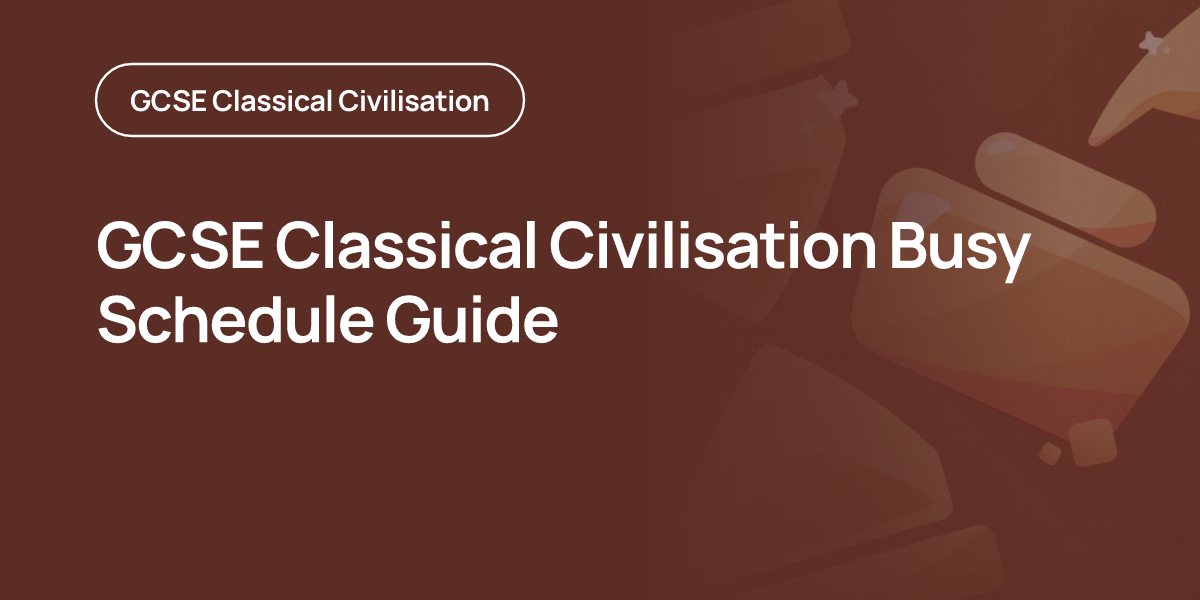
Some evenings disappear before revision has even begun. Training runs late. A work shift takes the hours after school. Maths needs attention, another subject has a deadline, and Classical Civilisation sits at the bottom of the bag looking worryingly large.
If you are managing a GCSE Classical Civilisation busy schedule, the answer is not to wait for a free evening. It is to use small, deliberate sessions: identify your exact OCR components, retrieve knowledge from memory, connect facts to sources and practise planning exam answers. Fifteen focused minutes can move the subject forward. An unfocused hour often does not.
This guide shows you how to keep Classical Civilisation alive while protecting the maths revision that also needs regular practice.
Your survival checklist
Start with these actions:
- Confirm the two OCR components your school teaches.
- Divide each component into small, named topics.
- Set a minimum session of ten to fifteen minutes.
- Revise by retrieving, not simply rereading.
- Build a compact bank of literary and visual evidence.
- Practise short plans before attempting complete extended responses.
- Keep maths organised through the GCSE Maths revision hub.
- Review your plan weekly and remove tasks you cannot realistically complete.
The goal is not to create a heroic timetable. It is to build one that survives contact with your actual week.
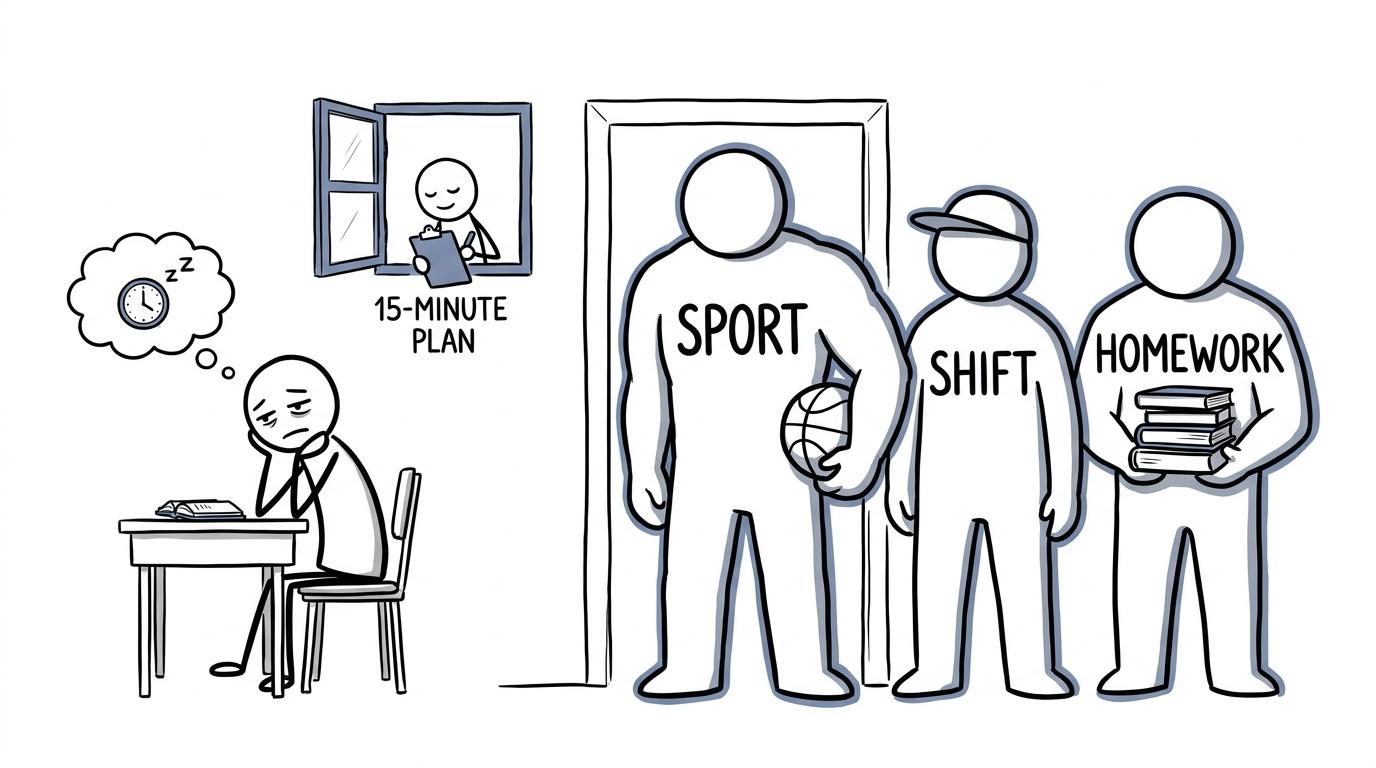 A busy student finds room for a small revision plan
Know what your Classical Civilisation course requires
Time pressure becomes worse when the course feels like one enormous collection of gods, heroes, buildings and ancient opinions. The first useful move is to replace that vague picture with the actual specification.
OCR's current GCSE Classical Civilisation qualification has specification code J199. Students study one thematic component, either Myth and Religion or Women in the Ancient World, and one Literature and Culture component: The Homeric World, Roman City Life or War and Warfare.
Each component is assessed by a written paper lasting one hour and thirty minutes. Each paper is worth 909090 marks and contributes 50%50\%50% of the qualification. Unlike GCSE Maths, there is no foundation or higher tier choice for this qualification.
The assessment balances two objectives:
- AO1 assesses knowledge and understanding of literature, visual or material culture, context and possible interpretations.
- AO2 assesses analysis, interpretation, evaluation and the construction of coherent, evidence-based arguments.
Across the qualification, AO1 carries 60%60\%60% of the weighting and AO2 carries 40%40\%40%. That matters. You need secure knowledge, but knowledge alone is not a complete revision strategy. You must also practise using it to answer the precise question asked.
Check your component codes with your teacher rather than revising every option. When time is scarce, revising material that is not on your course is an expensive mistake.
Build a timetable around fixed commitments
A busy timetable should begin with reality, not ambition. Put training, matches, shifts, travel, homework deadlines and sleep into the week first. Revision goes into the spaces that remain.
Use three kinds of session
Give each available window a job:
- Ten-minute maintenance: retrieve names, terms, events, quotations or source details without notes.
- Twenty-minute development: revise one micro-topic and connect it to two useful pieces of evidence.
- Forty-minute exam session: plan or write an exam response, then compare it with guidance from your teacher or an official mark scheme.
On a training night, maintenance may be enough. On a quieter weekend, complete the longer session. A small minimum prevents the all-or-nothing thinking that turns one missed evening into a missed week.
Maths needs a similar rhythm because fluency fades when question practice stops. The twenty-minute GCSE Maths routine offers a useful model: recall, practise, mark and choose the next task. The subjects differ, but the efficient loop is transferable.
Decide your next task in advance
Do not spend the opening minutes of every session asking what to revise. Keep a short list of specific actions, such as:
- retrieve the roles of five figures from a prescribed text;
- annotate one visual source from memory;
- sort evidence by theme;
- plan one comparison paragraph;
- improve an earlier conclusion.
“Revise Roman City Life” is too broad. “Recall evidence about patronage and explain what it suggests about status” gives you somewhere to begin.
If your whole GCSE timetable needs rebuilding, the principles in the GCSE Maths revision timetable guide can help you organise weak areas, spaced review and timed practice without filling every evening.
Revise Classical Civilisation actively
Rereading feels reassuring because every page looks familiar. The difficulty appears when the book closes and the facts must be selected under exam conditions. Your revision should therefore create small moments of retrieval.
Make compact source cards
For each important literary or visual source, record:
- what it is;
- its relevant context;
- two precise details;
- what those details may suggest;
- a limitation or alternative interpretation;
- the themes or questions it could support.
Keep the card selective. A source card is not a rewritten textbook page. Its purpose is to make evidence available when you need to form an argument.
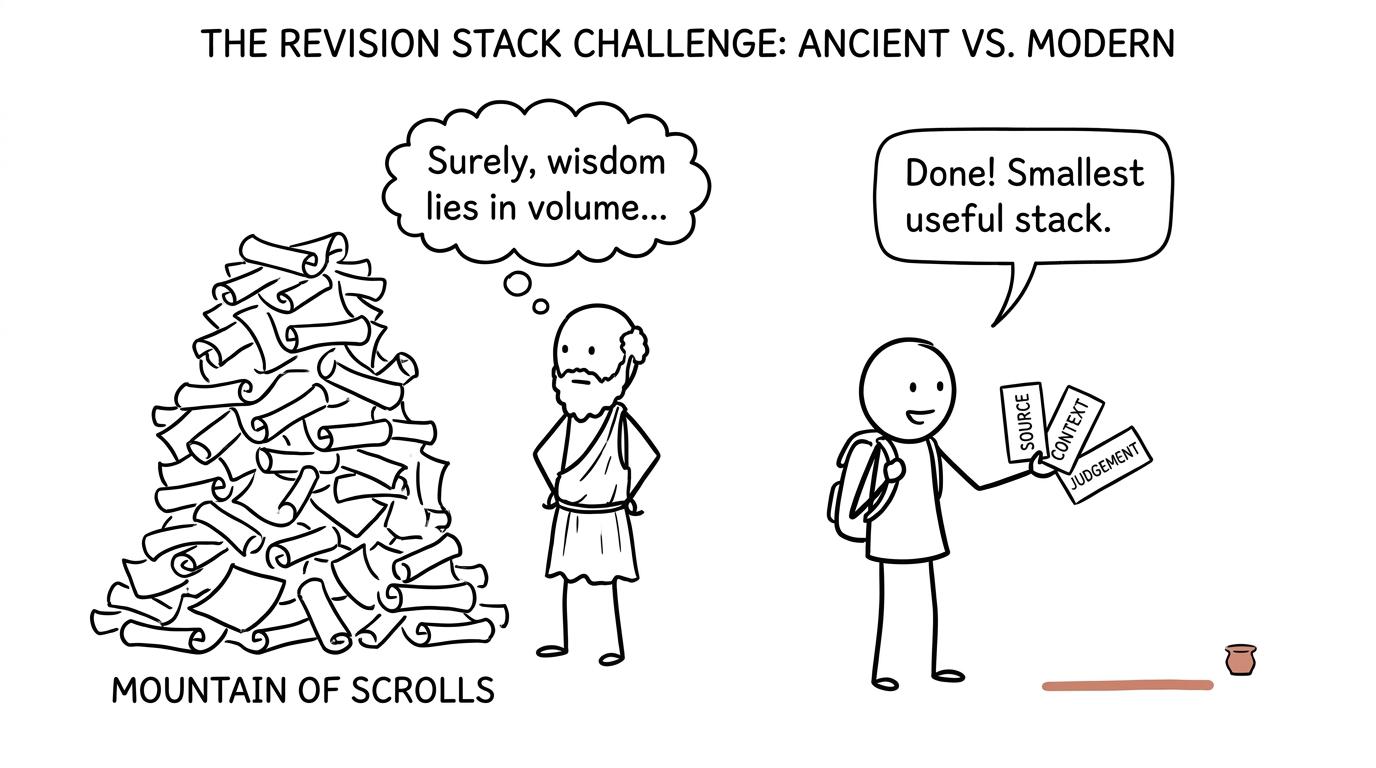 A student defeats a mountain of scrolls with three useful cards
Use closed-book retrieval
Choose one small topic and write everything you can remember before checking your notes. Then add only what was missing or inaccurate. Finish by answering a question such as, “Why is this evidence useful?” or, “How might a different ancient audience have responded?”
That final question moves revision from AO1 towards AO2. It also prevents a common problem: memorising facts as isolated objects rather than evidence that can support a judgement.
Practise answer architecture
When there is no time for a complete response, plan one. Identify the command word, write a provisional judgement, select the strongest evidence and decide the order of your paragraphs.
A useful paragraph needs a relevant claim, precise evidence, explanation and a link to the question. For an evaluative response, it should also consider significance, limitations or another interpretation where appropriate.
Do not force every fact you know into the plan. Selection is part of exam performance.
Protect maths without abandoning Classical Civilisation
When several subjects compete for the same evening, the sensible question is not “Which subject matters?” They all do. Ask which kind of work each subject needs next.
Classical Civilisation often fits well into short retrieval sessions during travel, lunch or the period before training. Maths generally needs paper, working and immediate checking. Reserve a desk-based block for maths, then place a short Classical Civilisation recall task beside it rather than expecting two long sessions.
Use the MathsGenie GCSE Maths hub to choose your exam board and find revision lessons, practice questions, mini tests and papers. If maths time is especially restricted, follow the targeted loop in Revise GCSE Maths Without Wasting Time: identify a weak area, practise it, mark the work and retest it.
A weekly pattern might contain:
- two short Classical Civilisation retrieval sessions;
- one source or essay-planning session;
- two focused maths topic sessions;
- one timed maths section or mini test;
- one brief weekly review.
This is a framework, not a compulsory quota. Adjust it around your job, sport and approaching examinations. During a Classical Civilisation assessment week, shift more time towards source knowledge and answer planning. Before a maths paper, use GCSE Maths past-paper guidance to move from topic work into timed practice.
Make weekends carry the heavier work
A packed weekday is a poor place for ambitious essay writing. Use weekdays to preserve familiarity, then place deeper work in a protected weekend block.
Start that block with one clear outcome. You might complete a timed response, review a whole prescribed text section or test a group of visual sources. Mark or review the work immediately while your decisions are still fresh.
Use the same principle for maths. Complete a paper matching your board and tier, then diagnose the lost marks. MathsGenie's Edexcel GCSE Maths past papers, for example, place papers and mark schemes together so that practice leads directly to correction. Students taking AQA, OCR or Eduqas can select their board through the main GCSE hub.
Do not turn the weekend into repayment for every missed weekday. Choose the most valuable unfinished task and restart the routine. Revision works better as a repeated system than as a cycle of guilt and exhaustion.
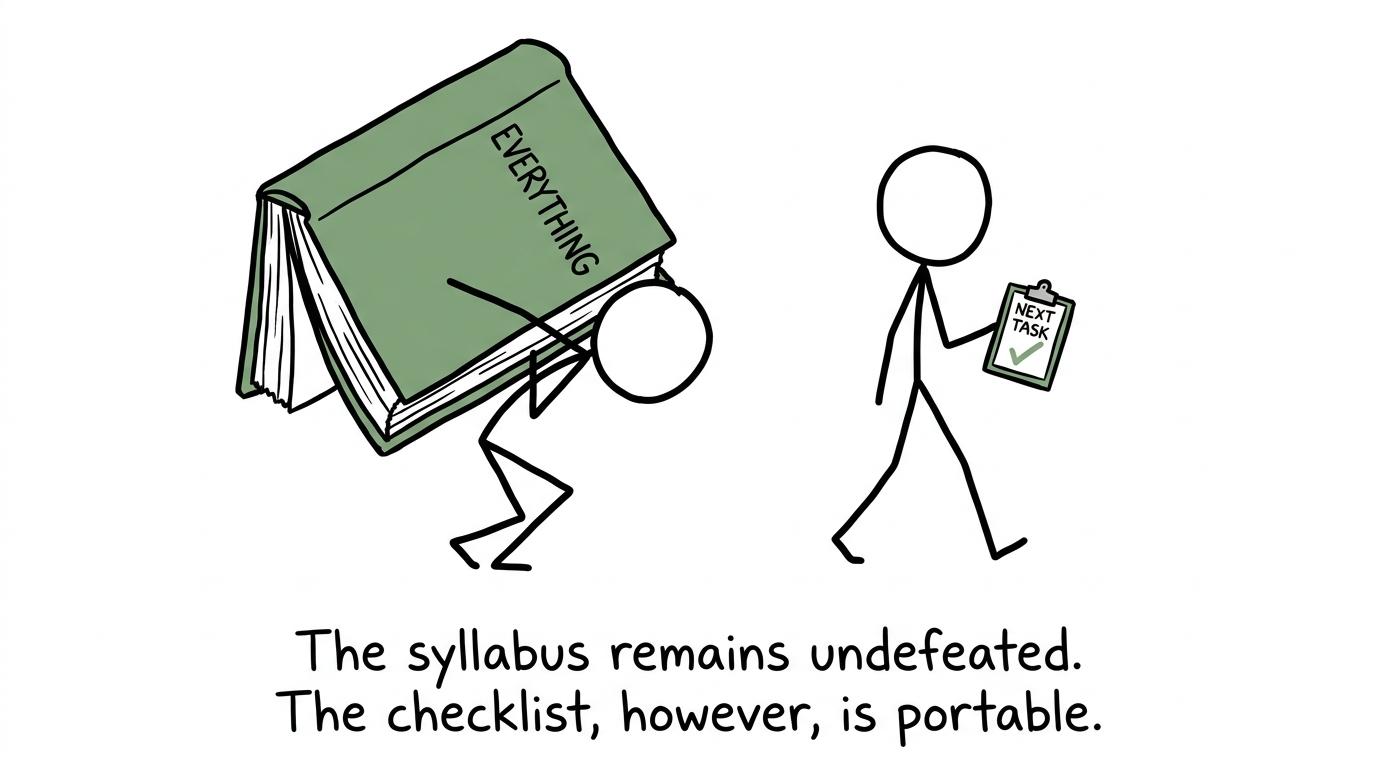 A portable checklist calmly passes an impossible revision mountain
Common mistakes when revision time is limited
Making a timetable with no spare space
A plan that assumes every evening will run perfectly is already broken. Leave one catch-up window and protect sleep. If work or training overruns, move the essential task rather than stacking it on top of tomorrow's plan.
Revising every Classical Civilisation option
Your school teaches one component from each OCR group. Confirm those components and stay within them. Specification awareness is one of the fastest ways to remove wasted work.
Copying notes instead of retrieving knowledge
Neat notes can hide weak recall. Close the materials, produce what you know, check it and record the gap. The difficult part is usually the useful part.
Memorising evidence without interpretation
Knowing a quotation, object or architectural feature is valuable, but you must explain what it reveals and how it supports your answer. Pair every source detail with at least one possible inference.
Writing full essays every time
Complete responses matter, especially under timed conditions, but they are not the only valid practice. On busy days, planning a judgement and selecting evidence is more useful than avoiding the task because a full answer feels impossible.
Letting one subject consume the whole week
Urgent homework can repeatedly displace maths or Classical Civilisation. Set a small maintenance minimum for each vulnerable subject. For maths, a mini test or focused question set can preserve momentum; the GCSE exam-week checklist explains how to prioritise practice, marking and correction when time tightens.
A calm route forward
You do not need to discover extra hours. You need to give the available minutes clearer jobs.
Confirm your OCR components. Break them into micro-topics. Retrieve facts from memory, attach them to useful sources and practise turning evidence into a judgement. Let short sessions maintain the course, and save longer exam practice for protected blocks.
Then remove uncertainty from maths by making MathsGenie your free revision base. Use the revision lessons to repair weak methods, practice questions and mini tests to build accuracy, past papers to develop timing, and predicted papers, mark schemes and video solutions to sharpen your final preparation.
Open the MathsGenie GCSE Maths revision hub, choose your board and set one focused task for today. A busy schedule may limit the size of each step. It does not prevent you from taking the next one.