GCSE Classical Civilisation 5 to 8: Grade Guide
GCSE classical civilisation 5 to 8: use stronger evidence, analysis, judgement and timed practice to lift your OCR exam performance this year.
A grade 5 answer often knows the story. A grade 8 answer knows which detail matters, what it reveals and how far it supports the argument. That is the central lesson in moving from GCSE Classical Civilisation 5 to 8: you do not simply need more facts. You need to select evidence more intelligently, analyse it more precisely and make reasoned judgements throughout your response.
This guide explains the specific changes that tend to move students into a higher grade band. It also shows how to build those habits while keeping your maths revision moving, rather than allowing one subject to consume the entire timetable.
Your grade 5 to grade 8 checklist
Use this as a quick diagnosis before changing your revision:
- Know exactly which OCR components and prescribed sources you study.
- Replace general knowledge with accurate, source-specific evidence.
- Explain what each detail reveals about its classical context.
- Analyse visual and material sources as carefully as literature.
- Consider more than one credible interpretation.
- Make evaluative judgements throughout extended responses.
- Practise selecting evidence under timed conditions.
- Mark answers against the official level descriptors and mark schemes.
- Keep a record of why marks were lost, then retest the same skill.
The leap is not from knowing nothing to knowing everything. It is from producing plausible answers to producing controlled, evidence-led arguments.
What separates a grade 5 from a grade 8?
OCR's official grade descriptors make the distinction unusually clear. A grade 5 student demonstrates mostly accurate knowledge, some awareness of interpretations and generally coherent analysis. Their arguments are plausible and mostly organised.
At grade 8, knowledge becomes relevant and comprehensive rather than merely mostly accurate. Understanding is more sophisticated, analysis is perceptive, interpretation is sensitive and evaluation is critical. Evidence is used effectively to build a coherent, reasoned argument.
| Grade 5 tendency | Grade 8 development |
|---|---|
| Mostly accurate knowledge | Relevant, comprehensive and precisely selected knowledge |
| Some awareness of interpretations | Sophisticated awareness of different possible interpretations |
| Generally coherent analysis | Perceptive analysis tied closely to the question |
| Some evaluation | Critical evaluation sustained across the response |
| Plausible argument | Coherent, reasoned argument supported by a range of evidence |
The important word is relevant. Grade 8 is not awarded for unloading every remembered fact. It comes from choosing the facts that do the most work.
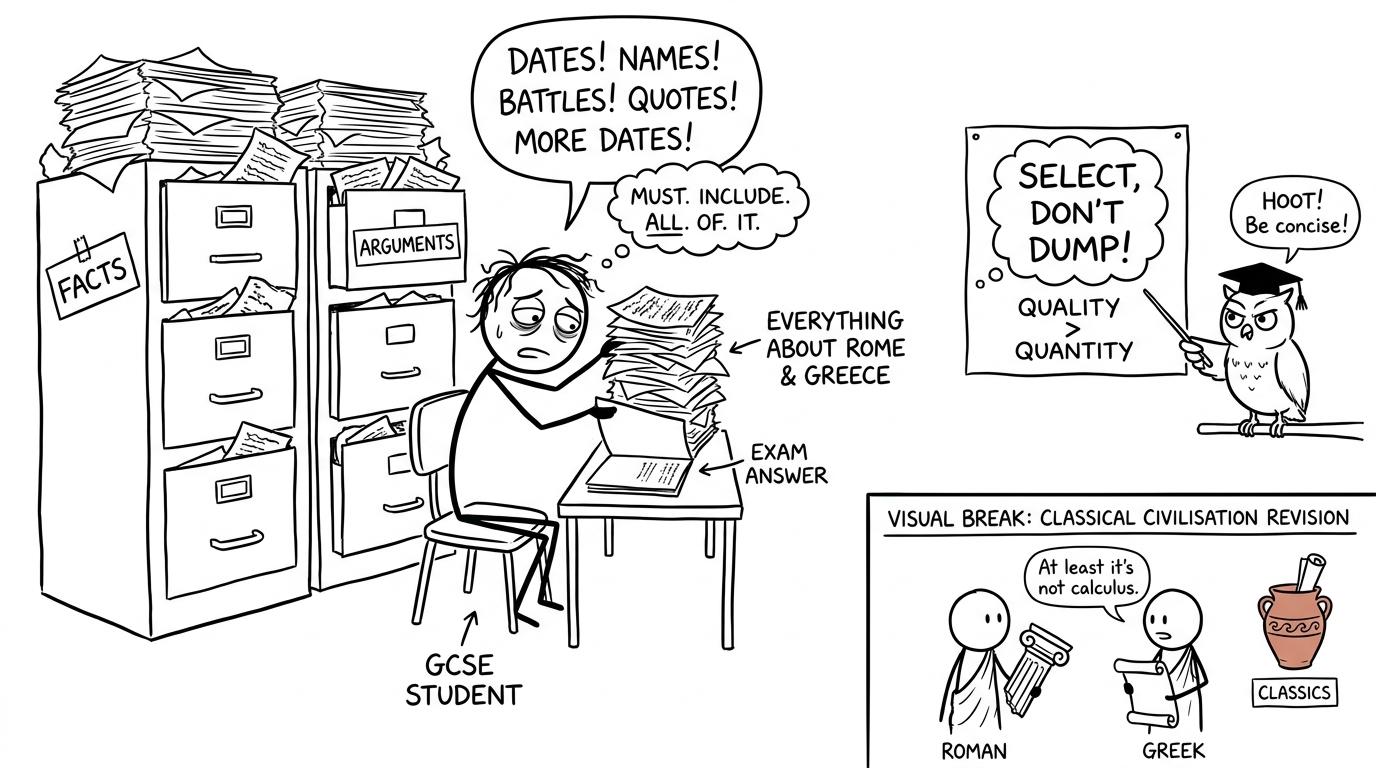 A student tries to fit every fact into an answer while an owl examiner recommends selection
Understand what the OCR examinations reward
GCSE Classical Civilisation is currently offered by OCR under specification J199. Students take two externally assessed written components, each lasting 1 hour 30 minutes and worth 90 marks. One is a thematic study, while the other covers literature and culture. Your school chooses from the available component options.
Across the qualification, AO1 accounts for 60% and AO2 for 40%:
- AO1 rewards knowledge and understanding of literature, visual or material culture, cultural context and possible interpretations.
- AO2 rewards analysis, interpretation and evaluation using evidence to create coherent, reasoned arguments.
This explains why memorising content can take a student to a secure middle grade but may not carry them to grade 8. Knowledge matters most overall, but a substantial proportion of the qualification depends on what you do with it.
Grade boundaries change between examination series and component combinations. Use previous boundaries only as a rough reference, not as a permanent target. Your safest strategy is to improve the qualities named in the assessment objectives.
Turn knowledge into precise evidence
Many grade 5 students know the broad narrative but reach for evidence that is vague: a character was brave, a ritual was important or a building demonstrated Roman power. These statements may be defensible, but they do not yet show detailed command of the prescribed material.
Build an evidence bank organised around examinable themes. For each source, record:
- its name or secure identification;
- two or three precise details;
- its social, religious, political or literary context;
- what each detail might suggest;
- a limitation or alternative interpretation;
- themes or questions for which it could be useful.
Keep quotations short and purposeful. Accurate paraphrase can be valuable where it preserves the relevant detail. For visual and material culture, learn identifiable features and their significance rather than memorising a list of architectural terms without context.
OCR examiner feedback has repeatedly distinguished stronger answers by their specific references to sources. It has also warned against including details that are not visible in the source or misidentifying prescribed material. Accuracy is not decorative. It is the foundation supporting every analytical claim.
Build analysis after every piece of evidence
A useful paragraph should move through three distinct jobs:
- Claim: answer the question directly.
- Evidence and context: select a precise supporting detail and place it within the classical world.
- Analysis and judgement: explain what the evidence reveals, test its value and decide how strongly it supports the claim.
Do not treat this as a rigid writing acronym. It is a thinking sequence. After using evidence, ask:
- Why is this detail significant?
- What does it reveal about ancient values, beliefs or audiences?
- Could the source be interpreted differently?
- Is the evidence typical, exceptional, idealised or limited?
- How far does it prove the point in the question?
A grade 5 response may explain what happened. A grade 8 response explores why the representation matters, whose perspective it reflects and how confidently a conclusion can be drawn.
Make evaluation continuous
Students sometimes save evaluation for one sentence at the end of a paragraph: “However, this source may be biased.” That sounds analytical, but it is too general to change the argument.
Stronger evaluation is specific. Explain how the purpose, genre, audience, context or survival of a source affects its usefulness. A literary source may exaggerate qualities for dramatic effect. A public monument may communicate an ideal rather than everyday reality. A myth may permit different responses from ancient and modern audiences.
Then return to the exact question. Decide whether the limitation weakens the evidence slightly, significantly or not at all. Evaluation should refine your judgement, not automatically dismiss the source.
OCR examiner reports also indicate that successful extended responses make evaluative comments throughout rather than saving them for a brief conclusion. Your conclusion should therefore gather an argument that already exists, not introduce one at the last moment.
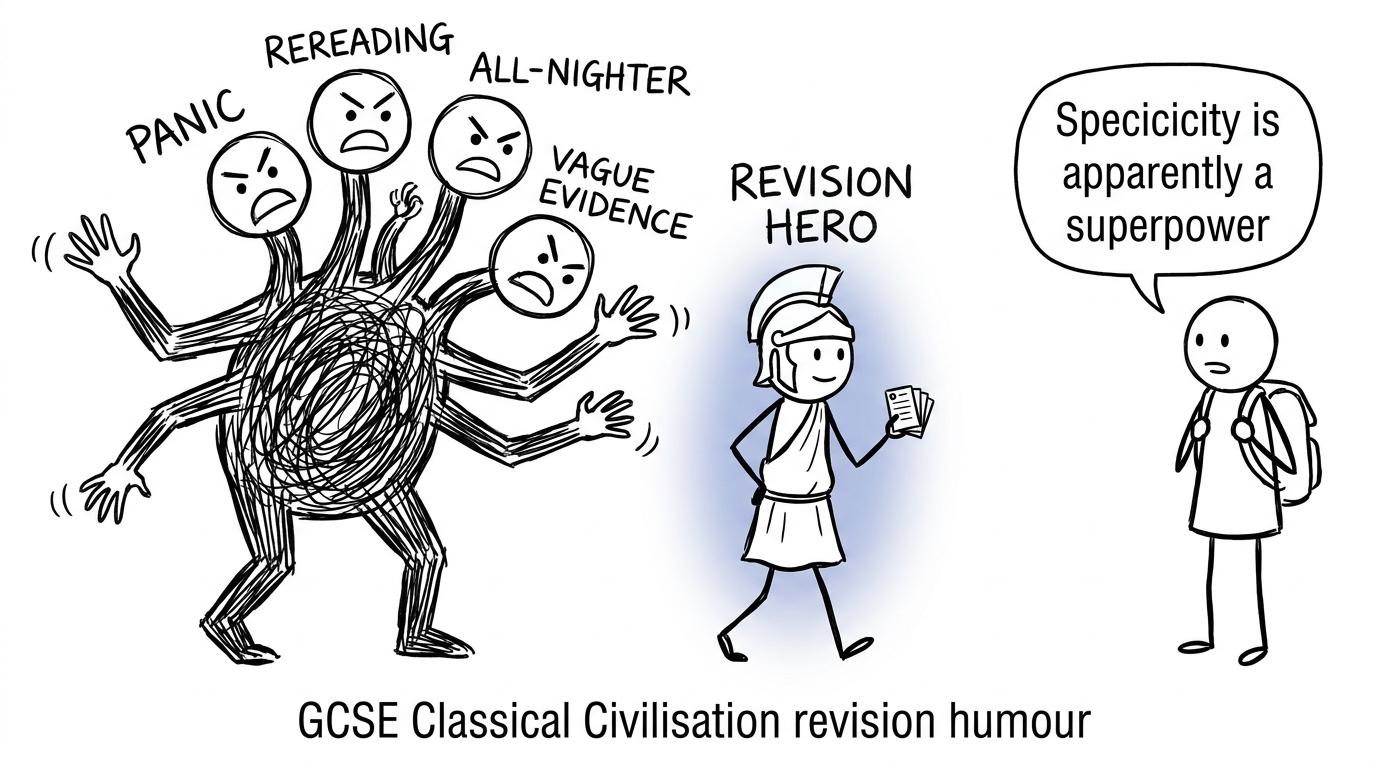 A revision hero walks past a monster labelled with unhelpful revision habits
Revise by retrieval, not recognition
Rereading can create a dangerous feeling of familiarity. You recognise the page, so you assume you could reproduce its content under pressure. The examination asks for retrieval and selection instead.
Use closed-book prompts such as:
- Identify the source from one visual or textual feature.
- Recall three details linked to a specified theme.
- Give two possible interpretations of one source.
- Select the best evidence for a particular judgement.
- Plan an extended response using only a blank sheet.
Return to material after a gap instead of completing one enormous topic session. Frequent retrieval exposes uncertain names, confused contexts and fragile interpretations while there is still time to repair them.
This is also an effective way to balance Classical Civilisation with maths. The MathsGenie guide to active recall shows how notes can become prompts, while the GCSE revision timetable guide helps you protect regular maths practice during an essay-heavy revision week.
Use past questions as diagnostic evidence
Do not wait until you feel completely ready. Complete one timed section, mark it carefully and classify every weakness:
| Weakness | Specific next action |
|---|---|
| Knowledge | Retrieve the missing source details without notes |
| Selection | Re-plan the answer using only directly relevant evidence |
| Analysis | Add an explanation of significance after each detail |
| Evaluation | Test purpose, audience, context or alternative interpretation |
| Structure | Write a clear line of argument before beginning |
| Timing | Practise a similar question within a fixed limit |
Read the level descriptors as well as the indicative content. Mark schemes are not exhaustive scripts to memorise; they explain the qualities examiners credit. Examiner reports are especially useful because they identify where students used sources effectively, wrote everything they knew or left evaluation too late.
The same feedback loop works in maths: attempt, mark, diagnose, practise and retest. MathsGenie's guide to finding your weakest GCSE topics explains how to turn lost marks into a focused plan. For your maths papers, use the GCSE Maths revision hub, choose your board and work through the relevant lessons and questions.
Make small changes that lift a grade band
A grade jump usually comes from several repeatable improvements rather than one brilliant essay.
Change vague claims into qualified judgements
Replace absolute claims with conclusions that reflect the evidence. Phrases such as “to a considerable extent”, “for an elite audience” or “within this literary portrayal” can add precision when they are supported by reasoning.
Compare significance, not just features
Where comparison is required, avoid writing two disconnected descriptions. Establish a basis for comparison, explain a similarity or difference and judge why it matters within the Greek and Roman contexts.
Select before writing
Spend a short period choosing your strongest evidence. OCR feedback warns against writing everything known about a topic. Selection produces more time for analysis and makes the argument easier to follow.
Practise decisions under time pressure
Timed practice is not merely about writing faster. It trains you to interpret command words, allocate attention sensibly and abandon irrelevant material. Build from plans to individual responses and then full papers.
For maths alongside this routine, short formats can prevent the subject from disappearing from your week. Use GCSE Maths mini tests for focused practice and the OCR GCSE Maths revision hub if OCR is your maths board.
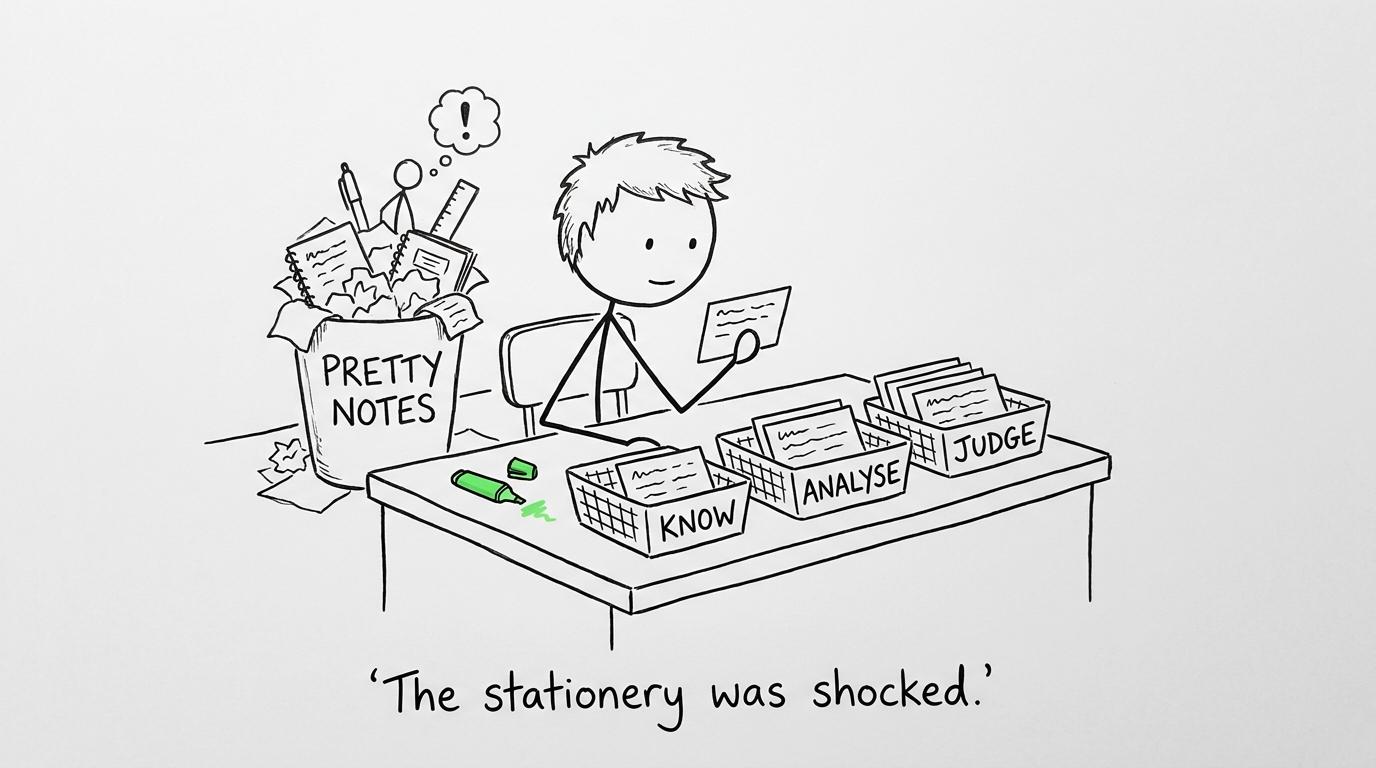 A student sorts revision cards into know, analyse and judge while ignoring decorative notes
Common mistakes that hold students at grade 5
Retelling instead of analysing
Narrative knowledge is useful only when it answers the question. After each detail, explain its significance and connect it to the developing judgement.
Using evidence vaguely
References such as “in the poem” or “on the temple” rarely demonstrate secure source knowledge. Identify the relevant source and use a precise feature.
Treating technical vocabulary as analysis
Terminology can make description accurate, but naming a feature does not explain its meaning. Follow terminology with context and interpretation.
Forcing balance into every answer
Considering alternatives does not mean pretending both sides are equally convincing. Weigh the evidence and reach a defensible conclusion.
Leaving evaluation until the conclusion
Build judgement into the body of the response. A final paragraph cannot rescue pages of description.
Completing papers without reviewing them
A marked paper should create the next revision session. If you only record the total, you lose the most useful information it contains.
Your next step with MathsGenie
Moving from grade 5 to grade 8 in Classical Civilisation means becoming more selective, more analytical and more deliberate. Learn the prescribed material securely, connect it to context, consider interpretations and make judgements supported by a range of precise evidence.
Then protect your wider GCSE preparation. MathsGenie gives you free GCSE maths revision resources, revision lessons, practice questions, mini tests, mark schemes and video solutions. Once topic knowledge is secure, use GCSE past-paper guidance and Edexcel past papers, where relevant, before progressing to predicted papers.
Start with one Classical Civilisation response and one short maths test. Mark both honestly. Identify one recurring weakness in each, fix it and retest it. Grade improvement often looks less dramatic than students imagine; it is a collection of better decisions, repeated until they become normal.