GCSE Citizenship Studies Revision Burnout Guide
GCSE citizenship studies revision burnout can derail May. Spot the warning signs early, pace each subject wisely and protect sleep without losing progress.
Revision burnout rarely announces itself dramatically. More often, a student who was working steadily begins rereading the same paragraph, avoiding practice questions and feeling guilty whenever they stop. GCSE citizenship studies revision burnout is best addressed early: reduce the immediate load, restore sleep and breaks, then rebuild revision around short, purposeful sessions.
That matters even if maths is your greatest concern. GCSE revision is one shared workload. If Citizenship Studies consumes every evening, there is less energy for algebra, English or science. The answer is not to abandon a subject. It is to create a pace you can still sustain when May arrives.
This guide will help you:
- recognise early physical, emotional and behavioural warning signs
- distinguish an unproductive day from a developing pattern
- revise Citizenship Studies actively rather than endlessly
- share your time sensibly across Citizenship Studies and maths
- know when to pause and ask for support
What revision burnout can look like
Burnout is more than ordinary tiredness after a demanding day. It describes physical, mental and emotional exhaustion associated with prolonged stress. It is not a diagnosis you should make from one difficult evening, but a repeated cluster of changes deserves attention.
NHS guidance identifies possible signs of exam stress in young people including poor sleep, headaches, stomach pains, irritability, changes in appetite, difficulty concentrating, low mood and losing interest in previously enjoyable activities. Mind also notes that students may feel exhausted, overwhelmed or unable to cope, avoid revision, work excessively without breaks or withdraw from people they care about.
Early signs during Citizenship Studies revision
Look at what happens while you work. Possible early signals include:
- reading notes about Parliament, rights or the legal system without remembering them
- repeatedly postponing source questions or extended responses
- feeling disproportionately angry when you cannot recall a term
- needing much longer to complete a familiar task
- making notes late into the evening because stopping feels like failure
- losing interest in breaks, friends, exercise or normal routines
- believing that no amount of revision will ever be enough
One sign on its own may simply mean you need food, sleep or a different task. The pattern matters. If several signs continue and begin affecting everyday life, tell a parent, carer, teacher, school pastoral lead or GP.
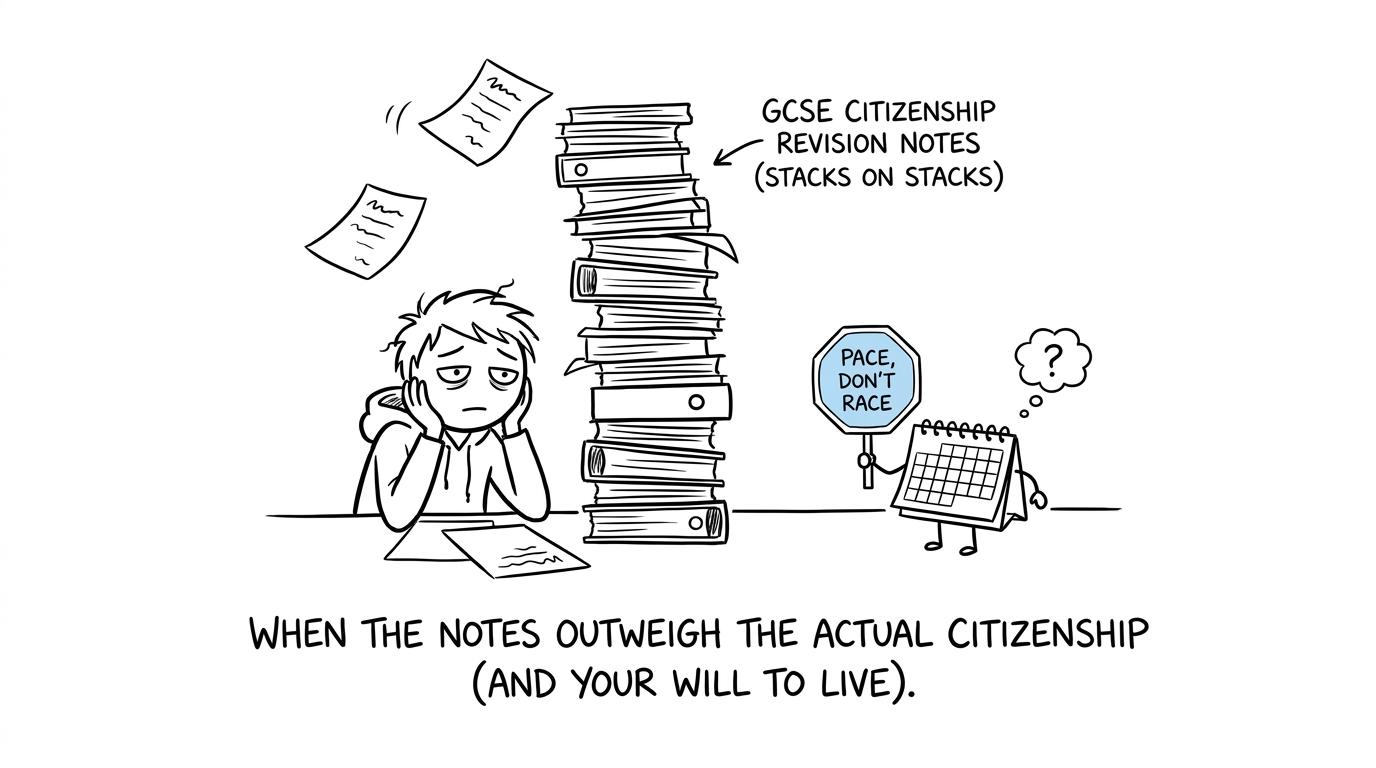 A tired student learns to pace rather than race through Citizenship Studies revision
Why Citizenship Studies can quietly become exhausting
Citizenship Studies can appear smaller than maths because it does not contain a long sequence of calculations. Yet its cognitive demands are broad. Students must know concepts, apply them to contexts, interpret sources, consider competing viewpoints and construct reasoned judgements.
Current GCSE subject content in England includes democracy and government, citizen participation, rights and the legal system, identities and diversity, economic and financial matters, citizenship skills and taking citizenship action. Your exact organisation and assessment structure depend on whether you follow AQA, Pearson Edexcel or OCR, so revise from your own specification and teacher's guidance.
AQA and Edexcel, for example, use different theme names, although both assess knowledge, application, analysis and evaluation. Trying to revise everything as one giant collection of facts creates unnecessary strain. Split the subject into three kinds of work:
- Knowledge: institutions, processes, rights, laws and terminology
- Application: connecting knowledge to a source, issue or citizenship action
- Argument: analysing viewpoints and reaching a supported judgement
This distinction makes the workload visible. You may not need another hour of highlighting. You may need one short recall check followed by one planned paragraph.
Use a pace you can maintain until May
The revision plan that looks most impressive in March is not necessarily the one that survives April. Sustainable revision has a clear stopping point. It leaves room for sleep, school, meals, movement and other subjects.
Set a realistic minimum and maximum
A daily minimum reduces the pressure to feel heroic. On a difficult weekday, that might be one focused task: retrieve key terms, plan one response or review one marked answer. A maximum matters too. It prevents anxiety from turning a useful session into an exhausting late-night marathon.
Use the free MathsGenie revision planner to see your whole week rather than planning each subject in isolation. Enter fixed commitments first, include breaks and decide when revision stops. Then allocate tasks small enough to complete.
The GCSE maths revision timetable guide offers a useful principle across subjects: build a repeatable weekly rhythm instead of depending on occasional bursts of motivation.
Work in short, complete cycles
A productive Citizenship Studies session should have an outcome. Try this sequence:
- recall one defined area without notes
- check omissions against trusted course material
- answer or plan one exam-style task
- compare your response with the mark scheme or teacher feedback
- record one action for next time
The precise length is less important than genuine concentration. If your attention fades after a short block, stop briefly, move away from the desk and return with a clear target. Regular breaks, manageable chunks and realistic timetables are consistent with NHS exam-stress guidance.
Do not turn the break into another form of revision. Drink water, stretch, walk around or speak to someone. Your brain needs contrast, not a different revision tab.
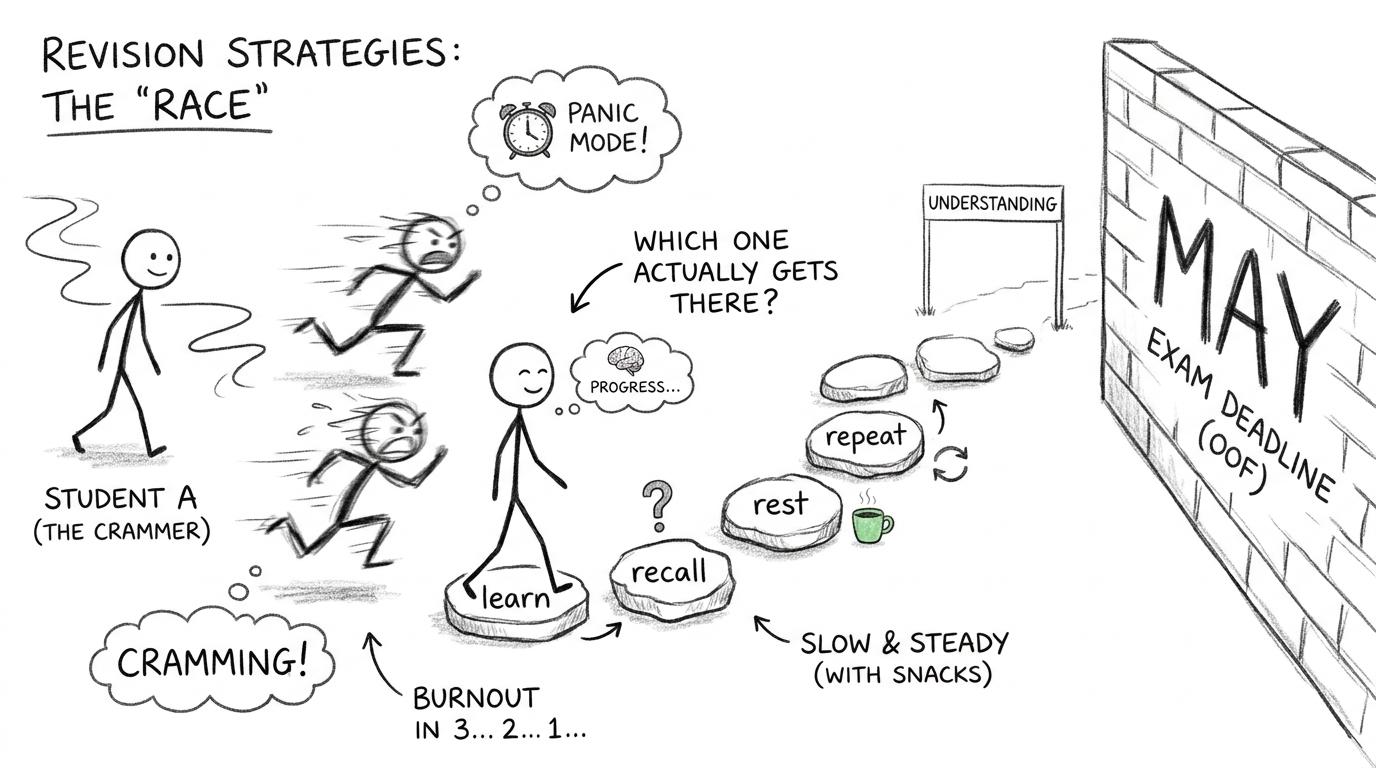 One student sprints into the May wall while another follows a steady revision path
Balance Citizenship Studies with GCSE maths
Burnout is often caused by the total timetable rather than one subject. A student might revise Citizenship Studies sensibly, then add a full maths paper, science flashcards and English quotations to the same evening.
Start by diagnosing rather than guessing. In maths, the guide to finding your weakest GCSE topics helps you identify where focused practice can replace broad, tiring revision. Then use the GCSE maths revision hub to choose lessons and questions for your exam board and tier.
A balanced week might contain different kinds of demand:
- a Citizenship Studies knowledge-retrieval session
- a short maths topic-practice session
- a Citizenship Studies source or argument task
- a maths mini test or selected paper section
- one longer timed task when you are rested
- protected time with no revision
Alternate demanding tasks where possible. Writing an extended Citizenship Studies judgement immediately after a full maths paper may produce more time at the desk but less useful learning.
When you are ready for maths paper practice, learn how to use GCSE past papers properly. Students following AQA can use AQA GCSE Maths past papers, while those following Edexcel can choose Edexcel GCSE Maths past papers. Match the board and foundation or higher tier shown on your entry.
Make revision active enough to be shorter
Passive revision feels safe because it creates neat pages. Unfortunately, it can also continue for hours without showing what you can recall or apply.
For Citizenship Studies, useful active methods include:
- closing your notes and listing everything remembered about one specification point
- sorting statements into claims, evidence and counterarguments
- planning an extended response before writing it
- identifying the command word and deciding what the answer must do
- using a mark scheme to examine how knowledge, application and evaluation earn marks
- explaining a political or legal process aloud in precise language
Your citizenship action also deserves specific revision. Use your own genuine experience and your board's requirements. Review the issue, methods, evidence, decisions, outcomes and evaluation rather than memorising a generic account.
In maths, the same principle becomes attempt, mark, repair and retest. MathsGenie predicted papers can provide fresh exam-style practice near the examination, but they should supplement specification coverage and past papers, not be treated as promises about what will appear.
Protect sleep and your stopping time
Most teenagers need around 888 to 101010 hours of sleep each night, according to NHS guidance. Good sleep supports thinking and concentration. A late revision session that removes sleep may therefore undermine the performance it was meant to protect.
Choose a firm stopping time and allow space to wind down. Put books away, prepare what you need for the next day and avoid negotiating with yourself for one more chapter. If unfinished work repeatedly spills into bedtime, the plan is too large. Adjust the plan rather than borrowing from sleep.
Food, hydration and movement also belong inside an exam plan. They are not rewards that must be earned by completing revision.
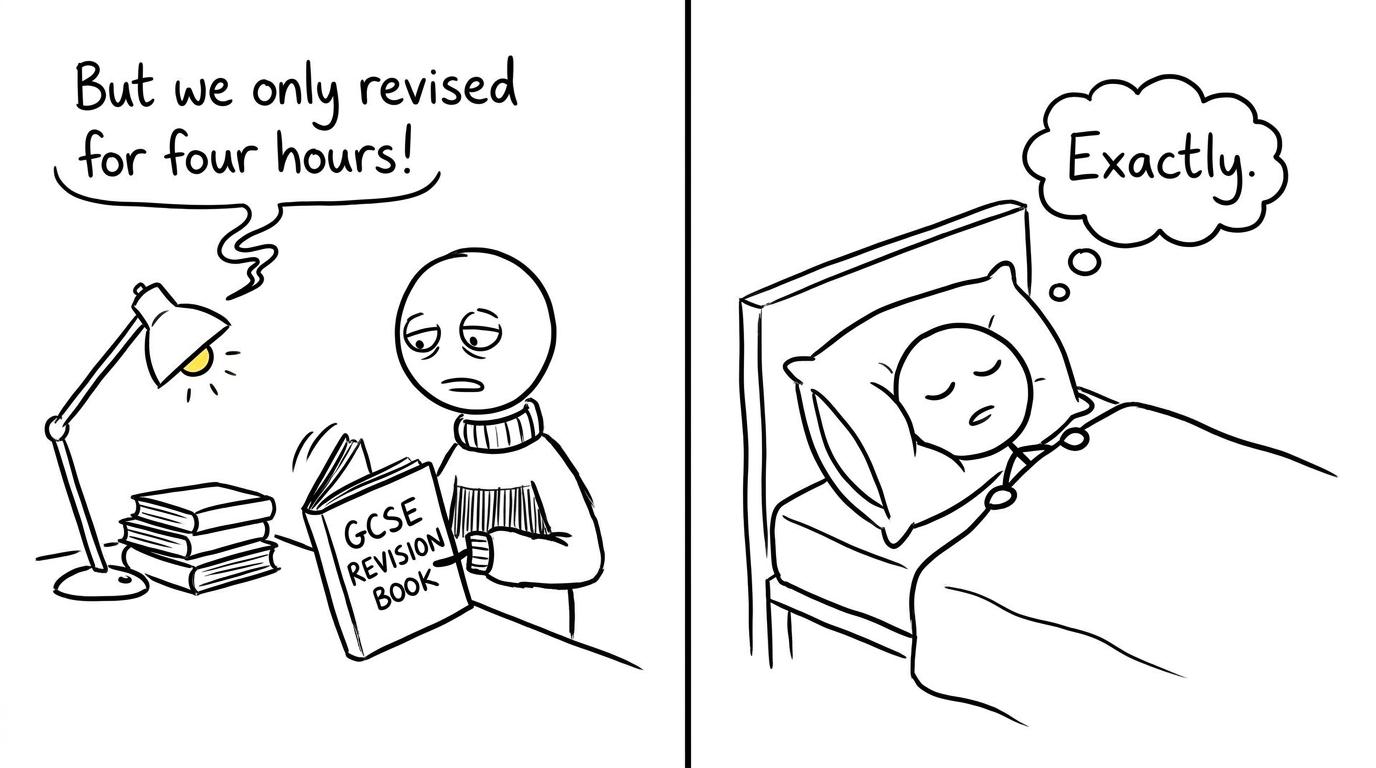 A pillow wins an argument with an overenthusiastic revision lamp
What to do when warning signs appear
First, stop escalating. Adding more hours because you feel behind often deepens the problem.
Take a proper break, eat if you have missed a meal and tell someone how you are feeling. Then reduce the next task until it is specific and achievable. You might review one small topic rather than the whole specification, or plan a response rather than forcing yourself through a complete paper.
If severe anxiety, low mood or exhaustion persists, interferes with daily life or makes you feel unable to cope, seek help from a trusted adult, school support service or health professional. If you feel unsafe or at risk of harming yourself, tell an adult immediately and seek urgent help. Revision advice is not a substitute for mental-health support.
Common mistakes that increase burnout
Measuring effort only in hours
Time at a desk is not the same as learning. Measure completed recall, answered questions, corrected errors and improved plans.
Revising every topic equally
Use the specification and feedback to prioritise genuine gaps. Familiar topics can receive shorter maintenance checks.
Filling every free period
A timetable without spare space is fragile. One school deadline or poor night's sleep can make the entire plan feel broken.
Saving all exam practice until the end
Introduce small exam-style tasks early. Build towards full papers rather than jumping from notes to exhausting simulations. Maths students can follow the staged approach in the one-month GCSE maths revision plan.
Treating rest as failure
Rest is part of maintaining attention. Burnout is not evidence that you are lazy; it is a signal that the current load or method needs attention.
Arrive in May with something left
The goal is not to prove how much pressure you can tolerate. It is to reach your GCSE examinations able to recall, reason and respond.
Keep Citizenship Studies revision divided into knowledge, application and argument. Use short cycles with visible outcomes. Protect sleep. Balance written subjects with focused maths practice, and speak up when stress starts affecting everyday life.
For maths, let MathsGenie remove unnecessary decisions. Start with free revision lessons and practice questions, use mini tests to check progress, then move into past papers and predicted papers. Mark carefully with mark schemes and use video solutions to repair the methods that cost you marks. A calm, repeatable system will usually take you further than one enormous burst of revision, and it is far more likely to carry you safely into May.