GCSE Citizenship Studies Half-Term Revision
GCSE Citizenship Studies half-term revision made manageable: build a focused plan, use active recall, practise exam questions and still enjoy your break.
Half-term creates a strange kind of pressure. A whole week appears in the calendar, so it feels as though you should have time to revise everything. Then the first few days disappear, the unfinished work starts to feel heavier, and revision threatens to consume what remains.
The answer is not to surrender your entire break. Effective GCSE Citizenship Studies half-term revision means choosing a small number of priorities, testing what you know, correcting the gaps and stopping at a planned time. Six focused sessions across the week can achieve more than several days spent rearranging notes.
This guide shows you how to build that plan while protecting time for rest, friends and your other subjects, including GCSE maths.
Your half-term revision checklist
Before making an elaborate timetable, settle these essentials:
- Confirm your Citizenship Studies exam board and current specification.
- List the topics that could be assessed.
- Choose three weak areas rather than trying to relearn the course.
- Plan short sessions across several days.
- Use closed-book recall before reading your notes.
- Answer exam questions and mark them carefully.
- Revisit mistakes later in the week.
- Reserve clear periods when you will not revise.
GCSE Citizenship Studies is not divided into foundation and higher tiers. However, your exam board still matters because AQA, Pearson Edexcel and Cambridge OCR organise their content and papers differently. Use the latest specification and assessment materials supplied by your school or exam board rather than revising from a generic topic list alone.
Begin with the exam, not the textbook
A large textbook makes revision feel endless because it was written to teach a course, not to organise one week. Your specification is a better starting point.
Current GCSE Citizenship Studies specifications assess three broad abilities:
- AO1: knowledge and understanding of citizenship concepts, terms and issues
- AO2: applying that knowledge to contexts and citizenship actions
- AO3: analysing and evaluating evidence and viewpoints to form reasoned arguments and supported judgements
Across the regulated specifications, these objectives carry approximate overall weightings of 30%30\%30%, 30%30\%30% and 40%40\%40% respectively. That has an important consequence: memorising definitions is necessary, but it is not sufficient. A student who can define democracy yet cannot compare viewpoints or justify a conclusion is leaving a substantial part of the assessment untouched.
The content labels vary. AQA includes areas such as life in modern Britain, rights and responsibilities, politics and participation, and active citizenship. Edexcel organises content into themes including living together in the UK, democracy, law and justice, power and influence, and taking citizenship action. OCR covers rights and the legal system, democracy and government, the UK and the wider world, and citizenship action.
Specifications can be updated. For example, content about the UK's relationship with the European Union has changed since Brexit. Check the current version for your examination series instead of trusting an old revision sheet.
Build a plan small enough to start
The most useful half-term timetable is rarely the most impressive one. It is the one you can follow when your motivation is ordinary.
Choose four to six revision blocks and spread them through the week. A block might last around thirty-five to fifty minutes, followed by a proper break. Keep at least one day substantially free. You are trying to create repeatable attention, not prove how long you can remain at a desk.
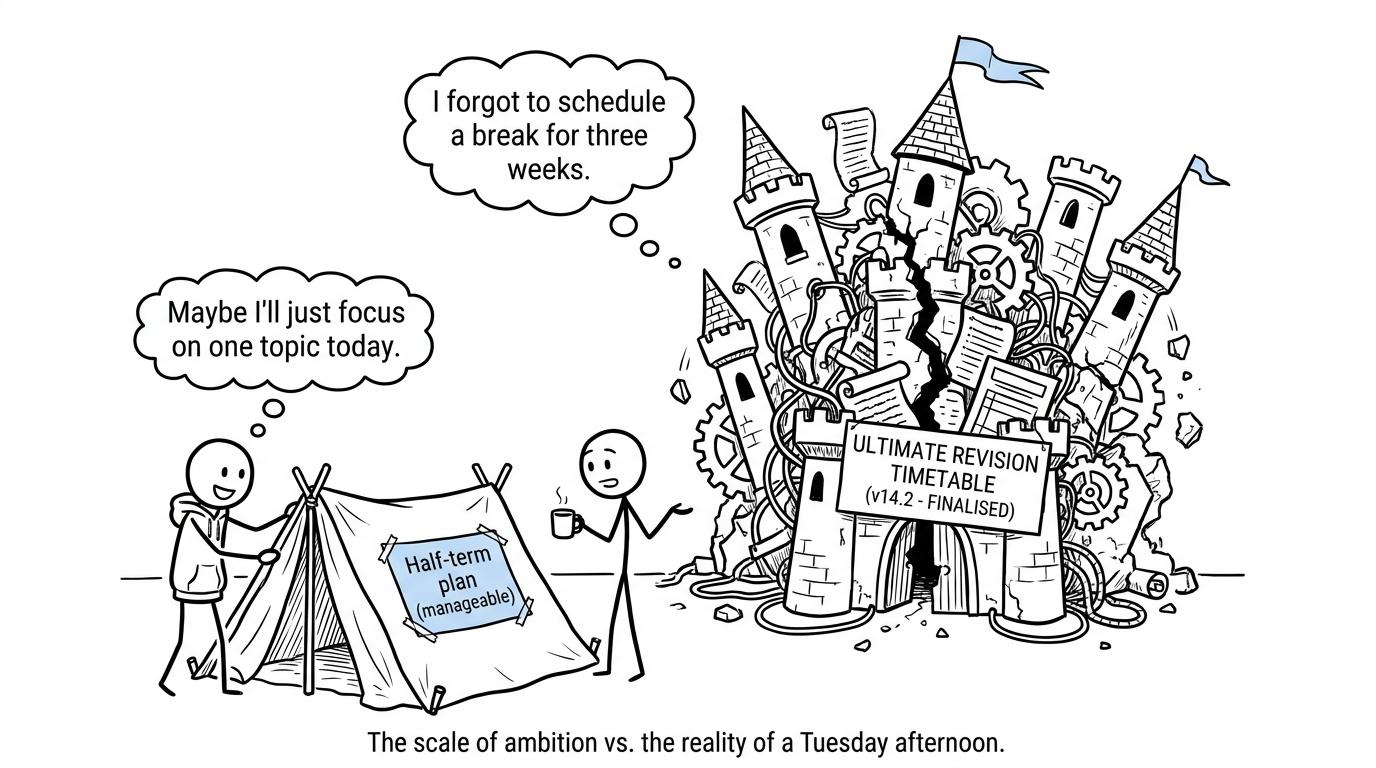 A student chooses a realistic half-term plan instead of an enormous timetable
Give every block a visible output. Compare these two intentions:
- revise politics
- recall the roles of Parliament and government, check the gaps, then answer one source-based question
The second is easier to begin and easier to judge. At the end, there will be evidence that something happened.
A balanced week could contain:
- one diagnostic session
- two knowledge and retrieval sessions
- two exam-question sessions
- one correction and retesting session
Do not assign every available hour. Unallocated time absorbs delays, family plans and tiredness without making the whole timetable feel ruined.
Maths revision benefits from the same restraint. If you also need to prepare for maths, the GCSE Maths revision hub keeps lessons, questions and paper resources together, reducing the time spent deciding what to open.
Use retrieval instead of repeatedly reading
Reading notes can feel reassuring because the material looks familiar. The difficulty is that recognition is not the same as recall. In an examination, the page will not be there to prompt you.
Retrieval practice means trying to bring information to mind before looking at the answer. Research on learning consistently supports combining retrieval with spacing: recall information, receive corrective feedback, then revisit it after a gap.
For Citizenship Studies, you could:
- write everything you remember about a topic on blank paper
- define key terms without notes
- sketch the relationship between institutions from memory
- list arguments on both sides of an issue
- explain a concept aloud as though answering an examiner
- turn specification statements into questions
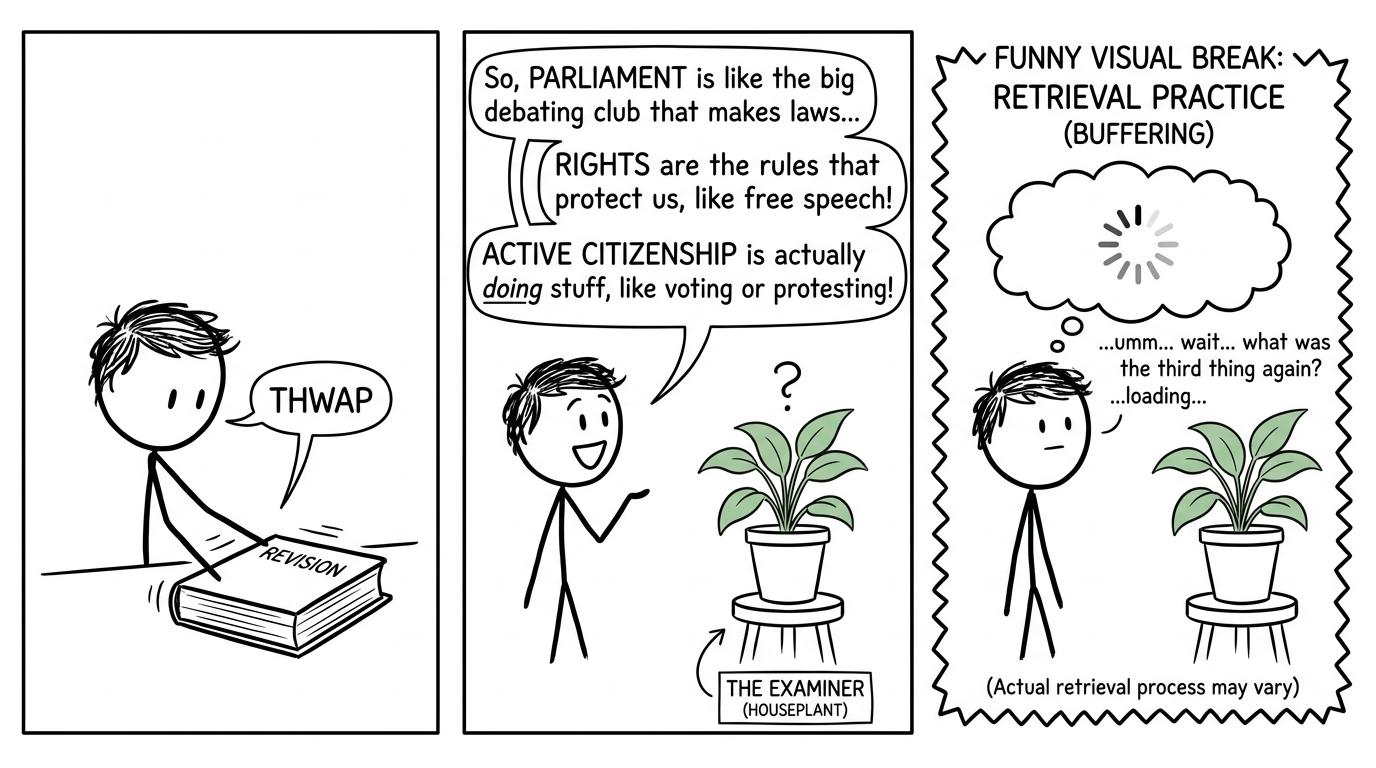 A student explains Citizenship Studies to a highly attentive houseplant
Always check your recall afterwards. Corrective feedback matters because confidently remembering something incorrectly only strengthens the wrong version. Add omissions in another colour, then test the same material again later rather than immediately copying it out.
This is also why short, spaced sessions are useful. Revisiting a difficult topic on Monday and Thursday makes your memory work again. One long Monday session can create fluency in the moment without showing what will remain several days later.
If identifying gaps is difficult, adapt the diagnostic process in MathsGenie's guide to finding your weakest GCSE topics: test first, record the reason for each lost mark and retest after a delay.
Separate knowledge revision from answer practice
Citizenship questions do not all demand the same response. A definition, a source inference and an extended evaluation require different kinds of thinking. Before answering, notice the command word, available marks, source material and issue being tested.
For shorter questions, precision matters. Use the relevant citizenship term and answer what was asked rather than writing everything you know nearby.
For extended answers, build an argument rather than a list. A strong response typically:
- makes a relevant claim
- explains why it matters
- uses accurate citizenship knowledge or evidence
- considers another viewpoint where required
- links the reasoning back to the question
- reaches a supported judgement
A conclusion should not merely repeat the introduction. It should weigh the arguments and explain why one factor, principle or piece of evidence is more persuasive in the context of the question.
Source-based practice deserves its own session. Ask who produced the source, what claim it makes, what evidence supports that claim, what might be missing and how your own knowledge changes the interpretation. Avoid dismissing a source as biased without explaining the nature and effect of that bias.
Use your board's official past papers and mark schemes for Citizenship Studies. For maths, MathsGenie's past-paper library demonstrates the same productive cycle: attempt, mark, diagnose, repair and retest.
Mark the thinking, not just the answer
The most valuable part of an exam question often begins after you finish writing it.
When marking, do not simply record a score. Label the cause of every lost mark:
- missing knowledge
- inaccurate terminology
- weak application to the context
- unsupported assertion
- limited analysis
- unbalanced evaluation
- unclear judgement
- poor use of the source
- time management
Then write one next action. If the problem was missing knowledge, retrieve that specific content. If it was evaluation, improve the reasoning in one paragraph. If it was timing, complete another question under a sensible limit.
MathsGenie's advice on using past papers properly follows the same principle: a completed paper is data, not the finish line.
Keep maths moving without sacrificing the break
Citizenship is probably not your only GCSE. Trying to give every subject a full day quickly turns half-term into an imitation school week, except with less structure and more guilt.
Instead, alternate demanding tasks. A Citizenship evaluation could be followed later by a short maths mini test. The change of subject can refresh your attention while preserving momentum.
Use MathsGenie's GCSE maths topic guide to confirm what belongs to your board and tier. Then choose one weak skill rather than vaguely scheduling "maths revision". The one-week GCSE maths revision plan can help you organise short practice, marking and correction around your Citizenship sessions.
Nearer the maths exams, Edexcel GCSE maths predicted papers can provide fresh exam-style practice. Predicted papers should complement official past papers, not replace them.
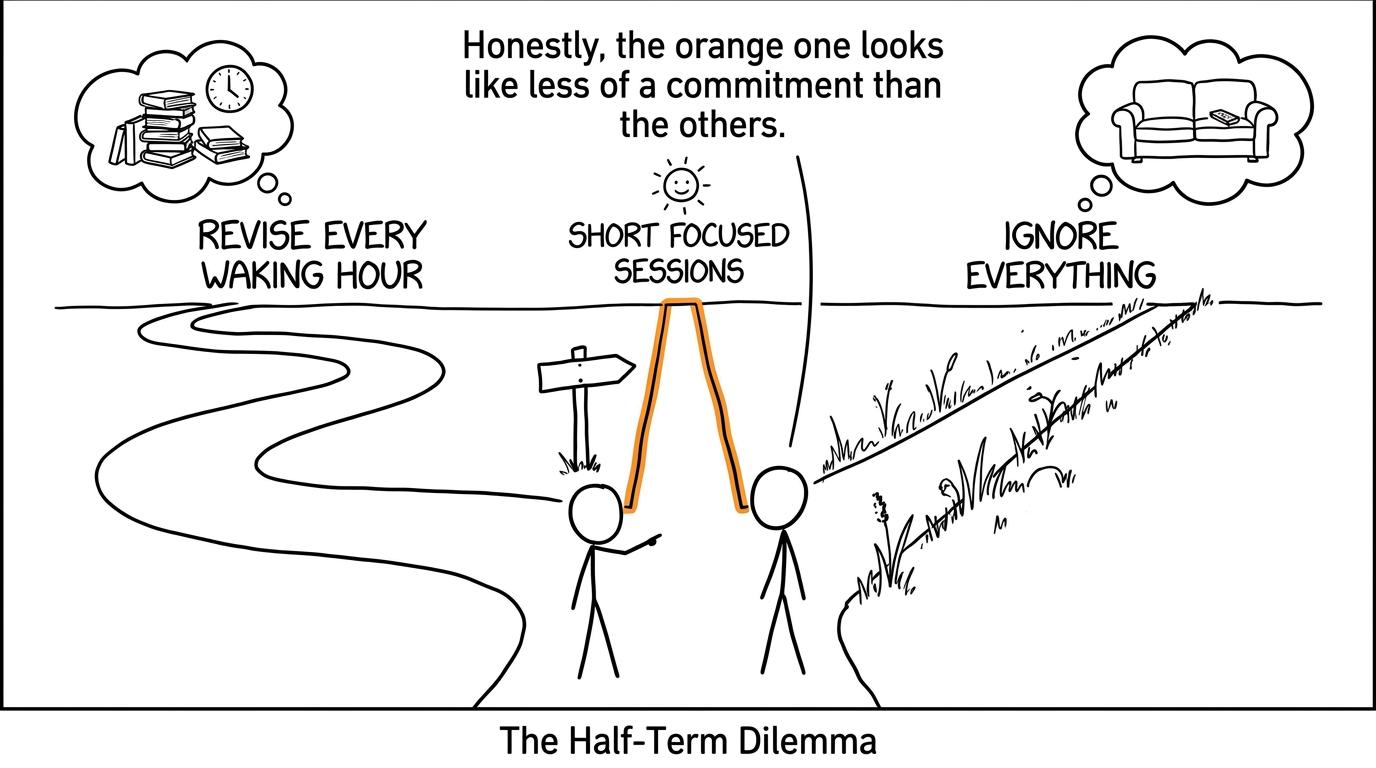 The sensible revision path runs between overworking and avoiding everything
Common half-term revision mistakes
Planning the entire course in detail
A crowded timetable can provide the emotional reward of organisation without any retrieval or practice. Limit planning, then begin the first useful task.
Making beautiful notes from open books
Notes have value when they clarify something. Copying pages word for word is usually passive. Close the book, recall first and use notes to correct what was missing.
Revising only facts
Citizenship rewards application, analysis and evaluation as well as knowledge. Include sources, viewpoints, arguments and judgements in your practice.
Ignoring citizenship action
Your own citizenship investigation or action can be assessed, depending on the specification. Refresh the issue, aims, methods, evidence, outcomes and evaluation while the details are still recoverable.
Completing questions without using the mark scheme
Unmarked practice hides misconceptions. Mark while your reasoning is fresh, record one precise improvement and return to it later.
Losing the whole break to revision
Rest is not evidence that you have failed. Set finishing times and protect them. A plan that leaves room for life is more likely to survive contact with a real week.
Finish half-term with proof, not promises
By the end of the break, you do not need to feel that every Citizenship topic is complete. You need evidence of progress: several retrieval attempts, corrected exam answers, a shorter list of weak areas and a clear next step for the school week.
Keep the routine simple: choose, recall, practise, mark, fix and retest. Then stop.
For your maths preparation, make MathsGenie your free revision base. Use focused revision lessons and practice questions to repair weak skills, mini tests to check recall, and past papers or predicted papers to develop timing. Mark schemes and video solutions then show you exactly what to improve next, without allowing revision to take over the whole break.