GCSE Citizenship Studies Access Arrangements Guide
GCSE citizenship studies access arrangements explained: learn how extra time works, what evidence schools need, and when to request support for exams.
A student can know exactly how Parliament works, understand the arguments around human rights and still struggle to show that knowledge before the clock runs out. That is the problem GCSE citizenship studies access arrangements are designed to address. If a disability, learning difficulty, medical condition or temporary injury puts you at a substantial disadvantage, speak to your school’s SENCO or learning support team as early as possible. Your school gathers the evidence, decides which support is appropriate and, where required, submits the application to the exam boards.
Access arrangements do not make the examination easier. They change how you access it without changing the knowledge, analysis or judgement being assessed.
Your access arrangements checklist
Start with these practical steps:
- Tell your SENCO, exams officer, form tutor or subject teacher what happens when you work under timed conditions.
- Ask whether existing support is already recorded as your normal way of working.
- Use the proposed arrangement in lessons, internal tests and mock examinations.
- Keep relevant assessment reports or medical evidence available for your school.
- Ask which arrangements require an online application and which can be approved by the centre.
- Confirm the final decision, room, equipment and timing before the examination series.
- Raise new injuries or changes in your condition immediately, even if a published deadline has passed.
You should not try to apply directly to AQA, Pearson Edexcel or another awarding organisation. For GCSEs, the school or registered examination centre manages the process.
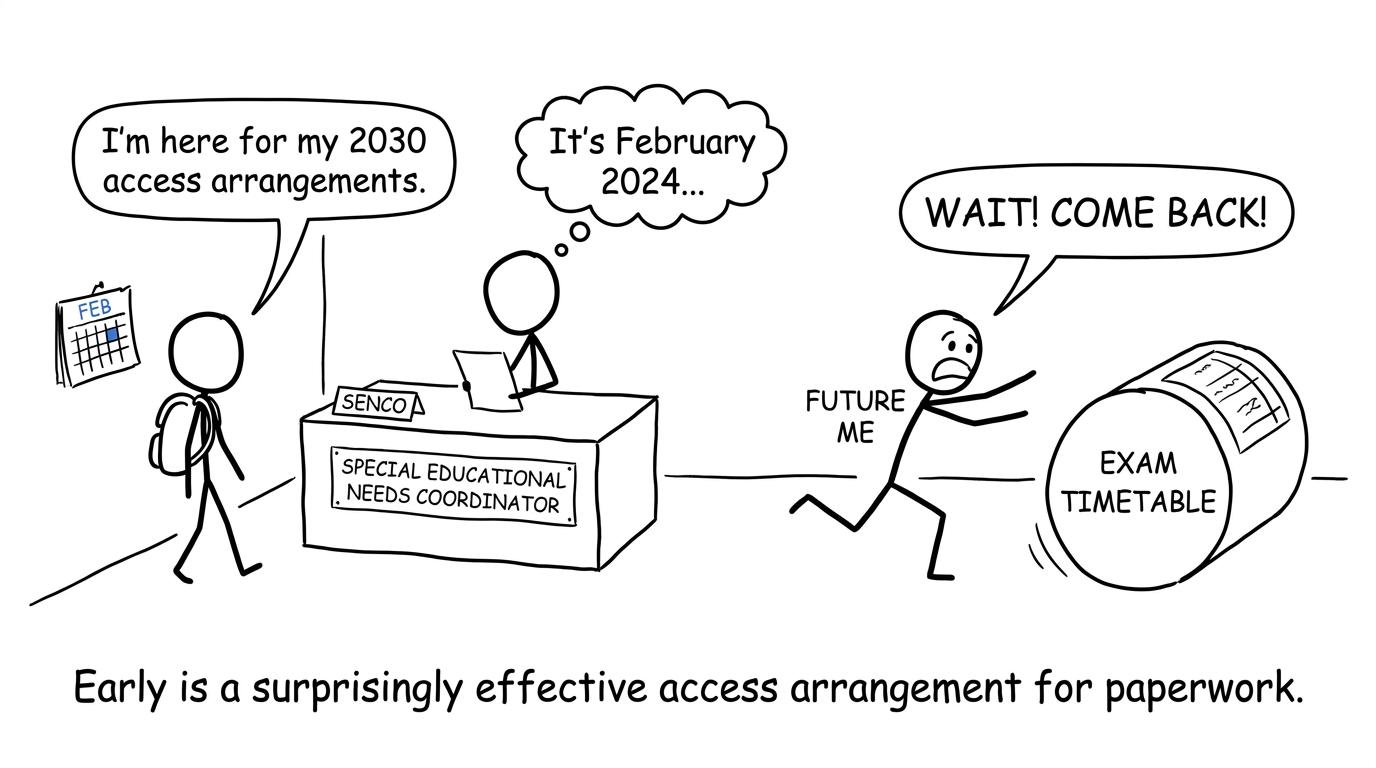 A student discovers that starting access-arrangement paperwork early is easier than chasing an exam timetable
What are GCSE Citizenship Studies access arrangements?
Access arrangements are agreed before an assessment for candidates with specific needs. Those needs may arise from special educational needs, disabilities, long-term medical conditions or temporary injuries.
Examples include:
- extra time;
- supervised rest breaks;
- a word processor;
- a computer reader or human reader, where permitted;
- a scribe or speech-recognition technology;
- modified papers, such as enlarged print or Braille;
- assistive technology;
- an examination reading pen that meets the rules;
- practical assistance or alternative rooming arrangements where justified.
Not every arrangement is suitable for every student or every assessment. The support must reflect your individual needs and remain within the rules of the qualification.
A reasonable adjustment is the legal term used when support removes or reduces a substantial disadvantage experienced by a disabled candidate. Access arrangements can also cover temporary needs, such as being unable to write because of a broken arm. Special consideration is different: it normally concerns illness, injury or disruption at the time of an examination and is handled after or around the affected assessment.
How extra time works in Citizenship Studies
The most familiar allowance is 25%25\%25% extra time, but it is not automatically awarded because a student has a diagnosis. The centre must establish that it is needed, supported by the required evidence and consistent with the student’s normal way of working.
The general calculation is:
total time=standard time×1.25\text{total time}=\text{standard time}\times 1.25total time=standard time×1.25For example, AQA’s current GCSE Citizenship Studies specification has two written papers, each lasting 111 hour 454545 minutes and worth 808080 marks. As 111 hour 454545 minutes is 105105105 minutes:
105×0.25=26.25 minutes105\times 0.25=26.25\text{ minutes}105×0.25=26.25 minutesThat gives 262626 minutes 151515 seconds of additional time and a total of 222 hours 111111 minutes 151515 seconds. Your centre will manage the official timing, and paper lengths vary between specifications, so check your own board rather than assuming every Citizenship Studies paper has the same duration.
Extra time gives you longer to complete the existing questions. It does not add questions, marks or hints. In Citizenship Studies, it may help an eligible student read source material, organise extended responses and check that arguments are supported. It must not replace subject knowledge or alter the standard being assessed.
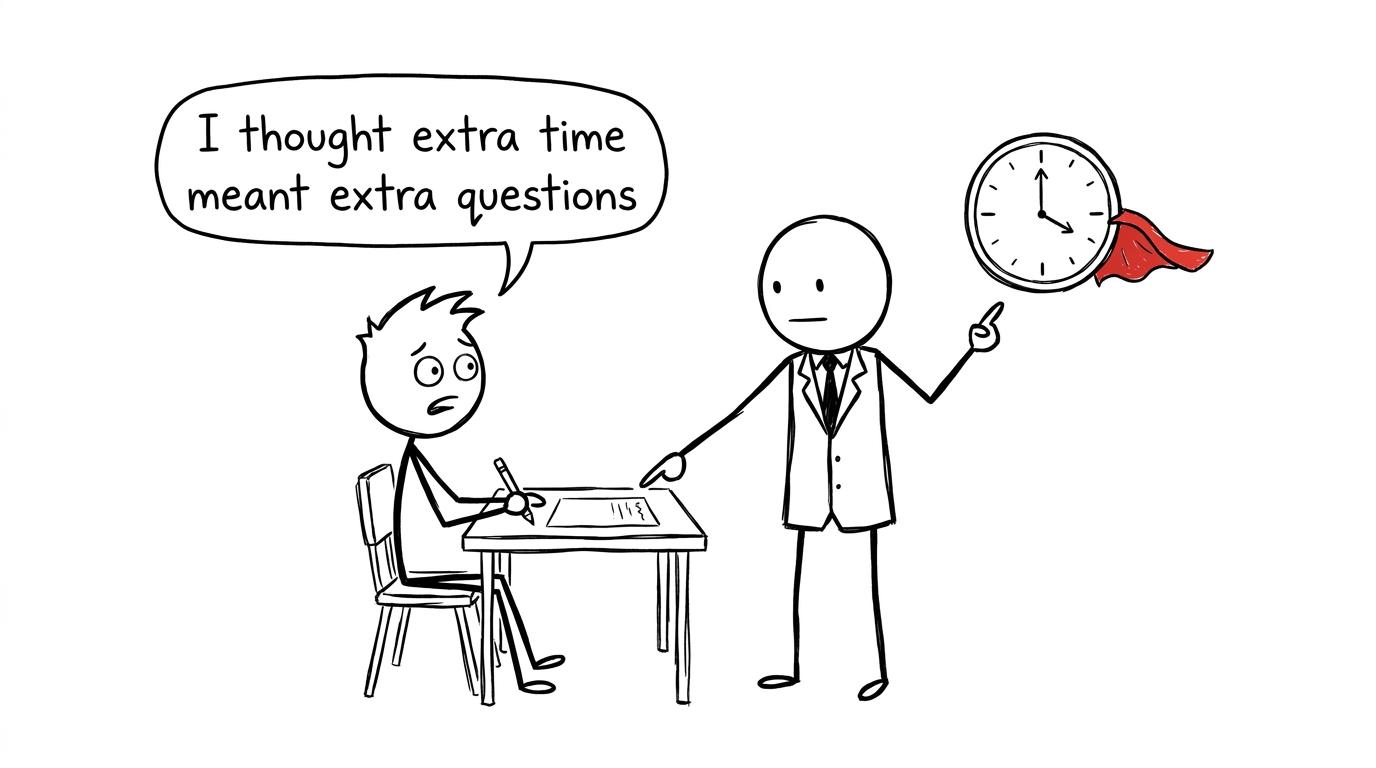 An invigilator explains that extra time does not come with extra exam questions
Extra time and supervised rest breaks are different
With extra time, you continue working for longer. During a supervised rest break, you normally stop working and the examination clock is paused for the approved break. You remain supervised and cannot revise, discuss the paper or use a phone.
Rest breaks may be more appropriate where concentration, fatigue, pain, anxiety or a medical condition makes sustained working difficult. Current JCQ rules require centres to consider and document the arrangement that actually addresses the candidate’s need. Receiving rest breaks does not automatically mean receiving extra time as well.
Evidence your school may need
The central idea is your normal way of working. An arrangement should usually reflect the support you use in lessons, timed assessments and mock examinations, rather than appearing for the first time on the morning of the GCSE.
Depending on the reason for the request, evidence may include:
- teacher comments describing persistent difficulties;
- examples from internal tests or mock papers;
- records showing how an arrangement was used;
- an assessment completed by a suitably qualified assessor;
- information about an Education, Health and Care Plan;
- evidence relating to a disability or medical condition;
- documentation of a temporary injury;
- records showing that another arrangement was trialled.
For applications for 25%25\%25% extra time processed under the JCQ rules in force from September 2025, centres normally need representative internal-test or mock evidence across relevant subjects, alongside staff observations explaining why the time is needed and how it is used. The emphasis is on useful evidence, not an enormous folder.
A diagnosis can be important, but it does not by itself determine the exact examination arrangement. Two students with the same diagnosis may experience different barriers. The decision must connect the need, the evidence and the proposed support.
How to request access arrangements
Speak to the right person early
Contact your school’s SENCO or equivalent learning support lead. If you do not know who that is, ask your form tutor, Citizenship Studies teacher, head of year or exams officer.
Describe the practical barrier rather than requesting a particular benefit without explanation. For example, explain whether you lose your place while reading sources, need breaks because of pain, cannot produce legible handwriting for a sustained period or use assistive technology in lessons.
Let the school build a picture of need
Your SENCO may speak to teachers, review existing records, arrange an assessment and trial support in lessons or mocks. Under current rules, relevant teacher feedback and evidence of normal working practices need to be gathered properly. Parents and carers can alert the school to concerns and provide reports, but the formal JCQ evidence must meet the published requirements.
Use the arrangement in mock examinations
A mock is not just rehearsal for the subject. It can show whether the proposed adjustment works.
For example, your centre may record when extra time begins, retain a marked script or ask teachers to comment on whether the additional time improves completeness and allows you to demonstrate your knowledge. If a word processor, reader or rest break is proposed, trialling it also helps you become familiar with the process.
The same principle matters for maths. If support is relevant across your subjects, practise under realistic conditions using the GCSE Maths revision hub or your board’s papers. Students taking Pearson Edexcel can combine the Edexcel GCSE Maths revision lessons with timed assessment practice.
The centre submits or records the arrangement
Some arrangements, including 25%25\%25% extra time, a computer reader or reader, and a scribe, generally require the centre to process an application through Access Arrangements Online. Other arrangements, including certain supervised rest breaks and word-processor arrangements, may be centre delegated. They still need to be appropriate, documented and consistent with current rules.
An online outcome is not the whole story. The centre must retain the required evidence and implement the arrangement correctly on examination day.
When should you request support?
The safest answer is as soon as a need becomes apparent. Do not wait for the final weeks of Year 111111.
A sensible timeline looks like this:
| Stage | What should happen |
|---|---|
| Year 101010 or earlier | Raise concerns and establish support in ordinary lessons. |
| Start of Year 111111 | Confirm that teachers and the SENCO understand your current needs. |
| Autumn term | Complete assessments where needed and trial arrangements in timed work. |
| Mock season | Use the arrangement and collect representative evidence. |
| Before the JCQ deadline | The centre submits required applications and orders modified papers. |
| Before the first examination | Confirm approval, rooming, equipment and practical instructions. |
JCQ publishes new guidance and deadlines for each academic year. For the June 2026 series, the final deadline was 31 January 2026 for modified papers and 21 March 2026 for other online applications. Those dates have passed and must not be reused for a later series. AQA currently lists 31 January 2027 as its deadline for ordering hard-copy modified papers for June 2027, but your centre must check the complete current JCQ and awarding-body timetable.
Modified papers have an earlier deadline because they must be prepared for a specific subject and component. If you need enlarged print, Braille or another modification, raising it early is especially important.
A new injury, diagnosis or unexpected change can happen after a deadline. Tell the exams officer immediately. Centres should contact the relevant awarding organisation rather than assuming nothing can be done.
Using your arrangement confidently in Citizenship and maths
Approval removes a barrier; practice teaches you how to use the support well. Complete timed work with the same arrangement you expect in the examination. If you receive extra time, decide how you will use it rather than simply slowing every answer down.
For maths revision, begin with a short diagnostic assessment before moving to full papers. The guide to finding your weakest GCSE Maths topics helps turn lost marks into specific revision tasks. You can then build stamina gradually, following the advice on when to start GCSE past papers.
Near the examination period, Edexcel GCSE Maths predicted papers provide fresh timed practice. Use mark schemes and video solutions afterwards. The purpose is not merely to finish a paper, but to learn whether your knowledge, timing and approved support work together.
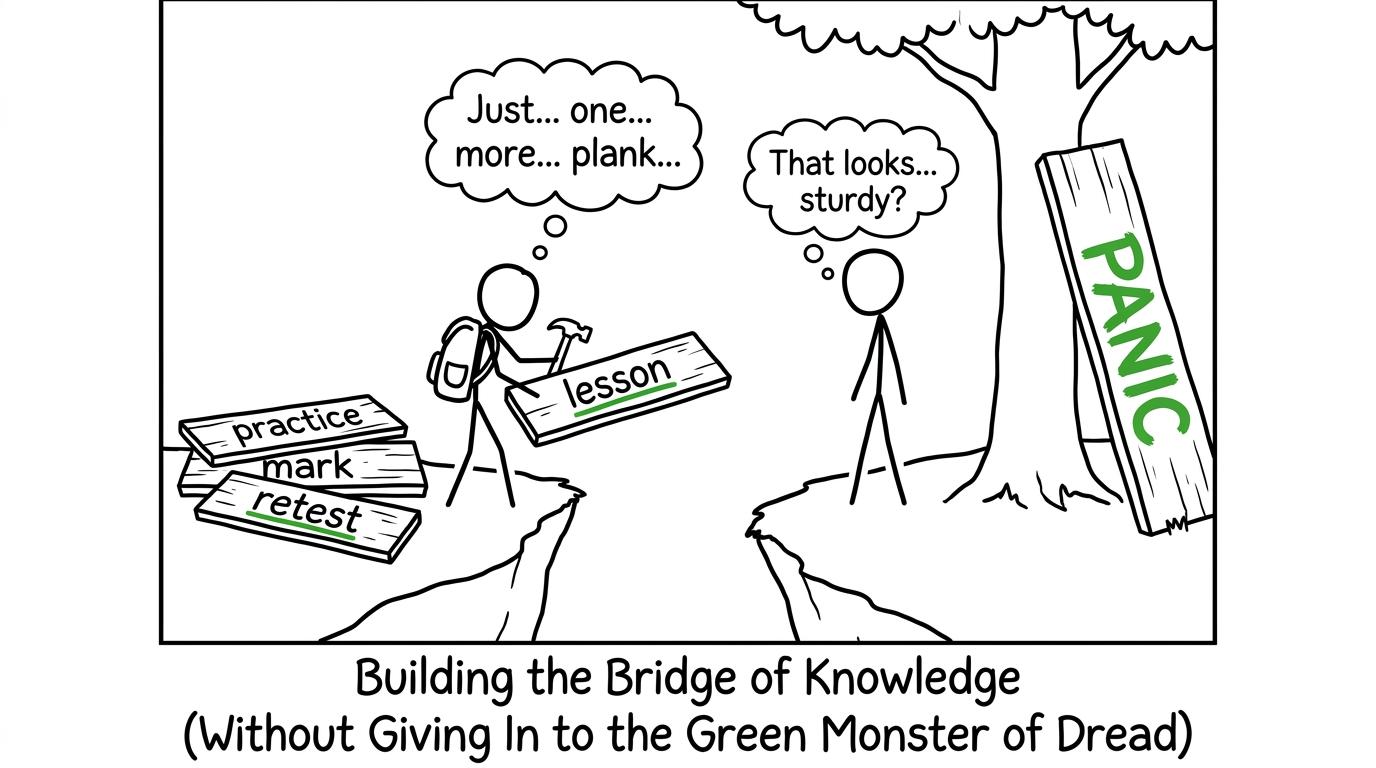 A student builds a revision bridge while leaving the panic plank unused
Common mistakes to avoid
Waiting until the examination timetable arrives
Evidence, assessments and trials take time. Ask early, even if you are uncertain whether you qualify.
Assuming a diagnosis guarantees extra time
Eligibility depends on the effect of your difficulty, the published criteria and the evidence held by the centre. The right support may be rest breaks, assistive technology or another arrangement rather than extra time.
Never using the arrangement in mocks
An unfamiliar reader, word processor or stopping procedure can become another source of stress. Mocks help establish normal practice and reveal practical problems.
Confusing access arrangements with easier marking
Citizenship Studies answers are marked against the same assessment objectives. You still need accurate knowledge, application, analysis, evaluation and reasoned conclusions.
Assuming one arrangement works identically in every subject
Assessment rules matter. Support permitted in Citizenship Studies may operate differently in a component specifically assessing reading, speaking, listening or practical skills. Ask the SENCO how your arrangements apply to each GCSE.
Ignoring revision because support has been approved
Extra time cannot supply missing knowledge. Keep revision structured with the best order for learning GCSE Maths topics, then use a realistic one-week GCSE revision plan when examinations are close.
Make the next step small and early
The access-arrangements process can look administrative from the outside, but its purpose is simple: allowing you to demonstrate what you know without an avoidable barrier getting in the way. Speak to your SENCO, explain the difficulty clearly, use agreed support in mocks and confirm the final arrangements before the examination series begins.
Then return your attention to the part you can practise. Use MathsGenie’s free revision lessons, practice questions and mini tests to strengthen individual skills. Move on to past papers with mark schemes and video solutions, then use predicted papers for fresh examination practice. The arrangement creates fair access; calm, repeated revision helps you turn that access into marks.