GCSE Chinese Results Day Wrong Grade? What to Do
GCSE Chinese results day wrong grade? Follow a calm first-hour checklist, check your marks and learn when to request a script or review of marking.
Results day can turn certainty into doubt in a few seconds. Your GCSE Chinese mocks suggested one grade. Your teacher predicted another. The result on the page is lower, and your first thought is that something must have gone wrong.
If you are searching for GCSE Chinese results day wrong grade advice, the immediate answer is this: keep the result slip, speak to your teacher or exams officer, confirm your exam board and component marks, and ask about accessing your marked work. Do not request a review simply because the grade is disappointing. First gather evidence, because a predicted grade is an estimate rather than proof of a marking error.
For the June 2026 series, GCSE results day in England is Thursday 20 August 2026. Post-results deadlines are strict, and schools often set internal deadlines earlier than the exam boards do. The first hour matters, not because you must make a final decision immediately, but because it is the best time to find the right people and preserve your options.
Your results-day checklist
Before leaving school or closing your results portal, try to establish:
- your exact qualification, exam board and specification code;
- whether you entered foundation or higher tier;
- your overall grade and total mark, if shown;
- your marks for listening, speaking, reading and writing, where available;
- the official overall grade boundary for your exam series;
- your school's deadline and procedure for post-results requests;
- whether a teacher can examine your script or assessment evidence;
- whether the result affects sixth-form entry or another immediate decision.
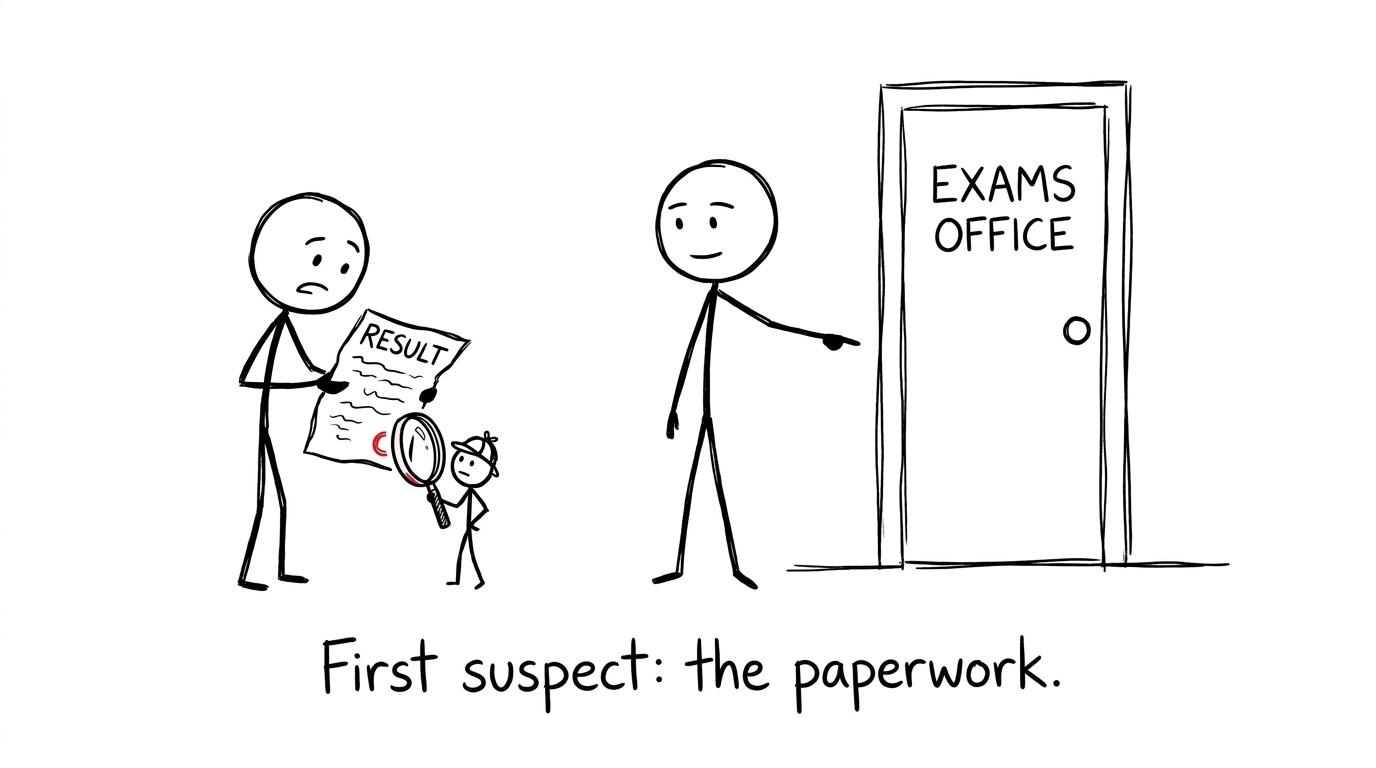 A results-day detective investigates the paperwork
What to do in the first hour
Panic asks for a verdict. A good process asks for facts. Use the first hour to move through the following stages.
Keep a copy of everything
Photograph or download your results information. Record the subject title, grade, exam board, tier and any marks shown. If your slip only gives a grade, ask whether the exams office can provide your total and component marks.
Check that the entry itself is correct. GCSE Chinese qualifications are not identical across boards, and International GCSE Chinese is a different qualification from a regulated GCSE. Do not compare your mark with a boundary from another specification or year.
Find your Chinese teacher or exams officer
Tell them calmly that the result is substantially different from what you expected and that you want to understand the component marks before deciding what to do. Your school or college normally submits a post-results request to the awarding organisation. Most exam boards do not accept ordinary requests directly from students, although private candidates have different arrangements.
Ask these direct questions:
- Which exam board and specification did I take?
- Can I see my total and component marks?
- How far am I from the next overall grade boundary?
- Does one component look unusual compared with my normal performance?
- Can you request access to my written script or relevant assessment evidence?
- What is the school's internal deadline?
- What would the service cost, and when might a fee be refunded?
The same disciplined approach is explained in MathsGenie's guide to GCSE remark requests, deadlines and appeals.
Check the correct overall boundary
A grade boundary is the minimum overall mark required for a grade in that particular exam series. Use the official qualification boundary, not an estimate circulated before results day or a notional boundary for one paper.
The distance to the next grade can be written as:
marks needed=next grade boundary−current total mark\text{marks needed}=\text{next grade boundary}-\text{current total mark}marks needed=next grade boundary−current total markThis calculation tells you how close you are. It does not prove that marks were lost incorrectly. MathsGenie's GCSE grade boundary table guide explains how to match the board, specification, tier and exam series correctly.
Tell sixth form if the result affects your place
If your Chinese result affects admission to a course, speak to the sixth form or college that day. Explain that you are checking the result and ask what evidence or revised grade they would need. Do not promise that the grade will change.
If maths is the subject controlling your next step, use the same process for that result. The GCSE Maths revision hub can also help you identify the correct board and tier if a resit becomes necessary.
Why a mock or predicted grade can differ
A predicted grade is a professional estimate based on the evidence available at the time. It is not an awarded grade or a guarantee.
Mocks may use different boundaries, selected papers or adapted conditions. Your final qualification may also combine skills differently from your school's mock. Both AQA GCSE Chinese (Spoken Mandarin) and Pearson Edexcel GCSE Chinese assess listening, speaking, reading and writing, but their raw marks and scaling arrangements are not interchangeable.
For example, AQA scales component marks before combining them into the overall qualification total. Pearson Edexcel's GCSE Chinese specification also gives each of the four skills a weighting of 25%25\%25%, although the papers do not all have the same raw maximum mark. That is why adding numbers without checking the board's rules can create a false discrepancy.
A lower final grade may therefore reflect:
- a particularly difficult listening or reading performance;
- a writing response receiving a lower level than expected;
- differences between mock and final boundaries;
- component scaling;
- normal variation between assessments;
- or, less commonly, an administrative or marking error.
The size of the surprise tells you to investigate. It does not tell you what the investigation will find.
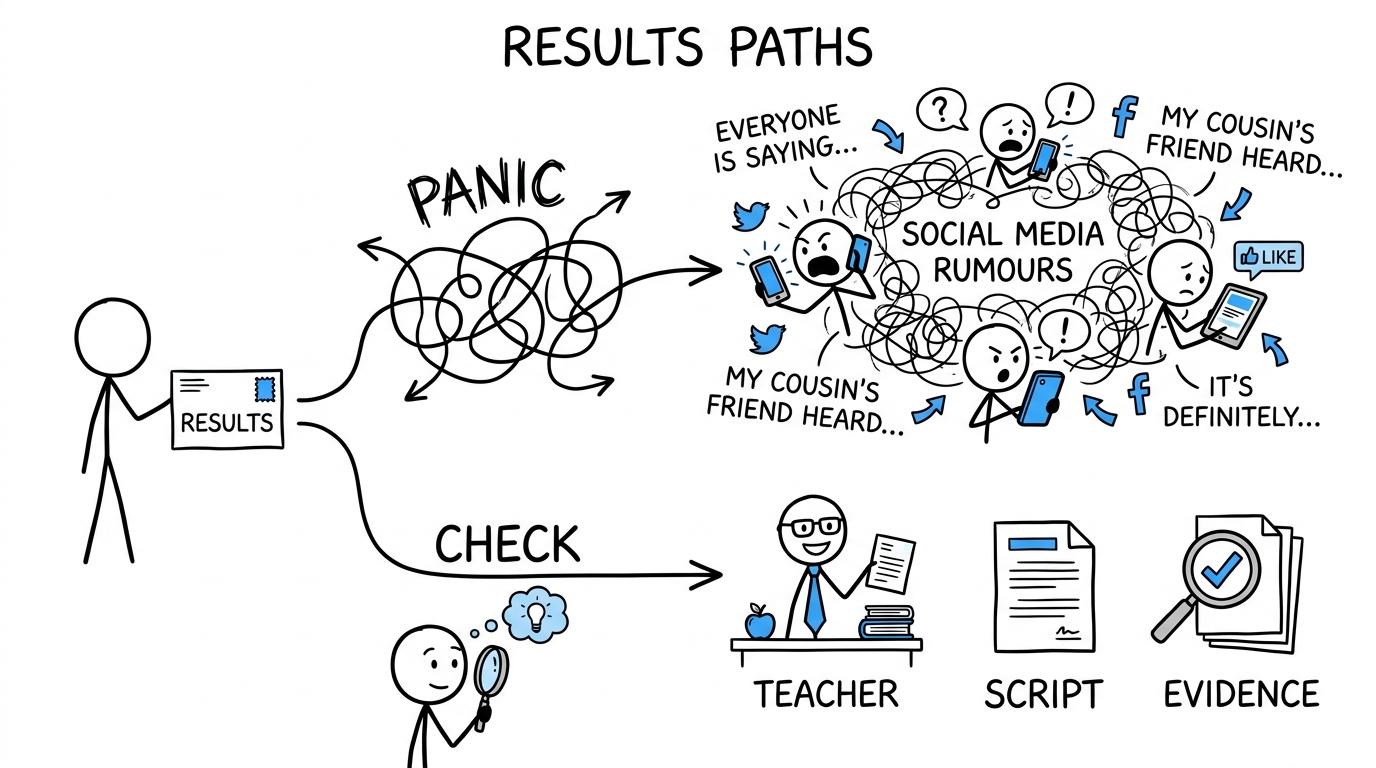 The calm evidence path avoids the social-media panic loop
Access to scripts before requesting a review
Ofqual advises students who suspect a mistake to speak to their school or college. The centre may use the awarding organisation's Access to Scripts service to obtain marked work and help decide whether a review is justified.
Ask your Chinese teacher to compare the available work with the mark scheme. In reading and listening, they may notice an uncredited response or an apparent recording issue. In writing, they can consider whether the level descriptors appear to have been applied appropriately. For speaking, ask the exams officer what recording and mark information can be accessed under your board's arrangements.
Access is not the same as changing a mark. It provides evidence. That distinction matters because a teacher may conclude that the result is harsh but defensible, or may identify a specific part that appears inconsistent with the mark scheme.
Candidate permission is normally required before a centre accesses a script. Availability and access deadlines differ by board and component, so ask immediately rather than assuming the service remains open until the review deadline.
Clerical re-check or review of marking?
These services answer different questions.
| Service | What it checks | When it may be suitable |
|---|---|---|
| Clerical re-check | Whether all parts were marked and whether marks were totalled and recorded correctly | When the concern appears administrative |
| Review of marking | Whether the original marking applied the mark scheme correctly; it includes administrative checks | When the script or teacher's analysis suggests a marking error |
| Access to scripts | Provides available marked work or assessment evidence for inspection | When you need evidence before choosing another service |
A review of marking is not an automatic fresh re-mark from the beginning. The reviewer considers the original marking and corrects identified errors under the awarding organisation's rules.
Your mark can rise, stay unchanged or fall. Your overall grade can do the same. JCQ rules therefore require written candidate consent after results are published before a clerical re-check or review of marking is submitted.
For the June 2026 series, the JCQ deadline for standard reviews of results is 24 September 2026. Your school may set a substantially earlier date to allow time for teacher advice, consent, payment and submission. Always follow the centre's published deadline.
How to decide whether a review is sensible
A review is strongest when several pieces of evidence point in the same direction:
- you are close to a meaningful overall boundary;
- an experienced teacher has examined the available work;
- the concern can be tied to particular answers or assessment criteria;
- the possible benefit matters for progression;
- you understand the fee and the risk of a lower mark;
- and you have considered every component that contributes to the total.
Being one mark below a boundary does not mean the missing mark must exist. Equally, being several marks away does not prove the marking is correct. Distance from the boundary affects the practical likelihood of a grade change, while script evidence addresses whether an error may have occurred.
If the school refuses to request a review, ask for its internal appeals procedure. Schools and colleges must allow students to appeal a decision not to request a review. If a review has happened and concerns remain, the centre can consider an appeal to the exam board. An appeal challenges a possible marking or procedural error; it cannot be used simply to object to the grade boundary itself.
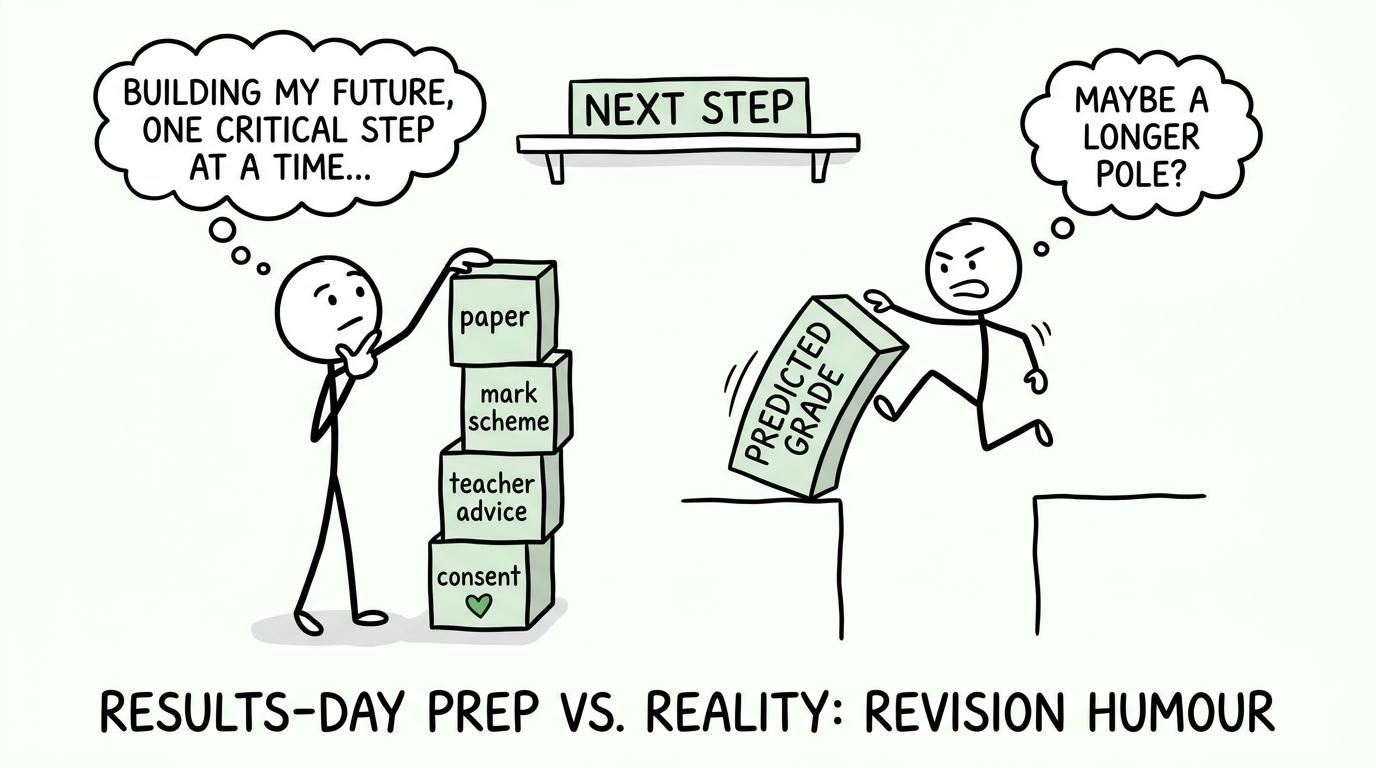 Evidence blocks reach the next step more reliably than a predicted-grade pole vault
Common mistakes after an unexpected Chinese grade
Treating a predicted grade as proof
Predictions provide context, but they do not replace the final assessment evidence. Lead with marks, scripts and mark-scheme concerns rather than saying only that you were predicted a higher grade.
Comparing the wrong boundaries
Do not use last year's figures, another board's table, International GCSE boundaries or a single paper's notional boundary. Match the exact qualification and series.
Asking for every component to be reviewed
Reviews are normally requested by component and may carry separate fees. Teacher analysis can help identify where a request has a credible basis.
Missing the school deadline
The exam board's final date is not necessarily your deadline. Centres need time to process requests, and script-access arrangements may close earlier.
Forgetting that the result can fall
Candidate consent is not a formality. Read it carefully. Once the reviewed mark replaces the original, you cannot simply choose the more favourable version.
Letting one result stop every other plan
While the review is considered, continue with enrolment conversations and any necessary revision. If you are resitting maths, MathsGenie's results-day resit plan gives you a practical starting structure.
Turn uncertainty into a useful next step
Results day feels personal because a grade compresses months of work into one character. But the best response is procedural: record the facts, ask for the marks, consult your teacher, inspect the available evidence and choose the correct service before the deadline.
Then protect what comes next. If maths remains part of your GCSE or A Level route, use MathsGenie's free past-paper library and learn how to use GCSE past papers properly. The revision lessons, practice questions, mini tests, mark schemes, video solutions and predicted papers turn each lost mark into a specific action.
Start with the evidence in front of you. Ask the right question. Then let MathsGenie help you build the next result, one carefully corrected mistake at a time.