

GCSE Remark Request: Deadlines, Costs and Appeals
GCSE remark request guide covering 2026 deadlines, re-mark cost, reviews of marking and the GCSE appeal process through your school or exam centre.
Opening a results slip can turn months of uncertainty into one stubborn thought: that grade does not look right. If that is where you are, make your GCSE remark request through your school or exam centre as soon as possible. The official service is called a review of marking, not a re-mark. Your centre submits it, your mark can rise, fall or stay unchanged, and the deadline for the June 2026 series is 24 September 2026.
The important thing is to replace panic with a process. Check how far you are from the relevant grade boundary, ask to inspect your marked script where possible, speak to your teacher, then decide whether the evidence justifies the cost and risk.
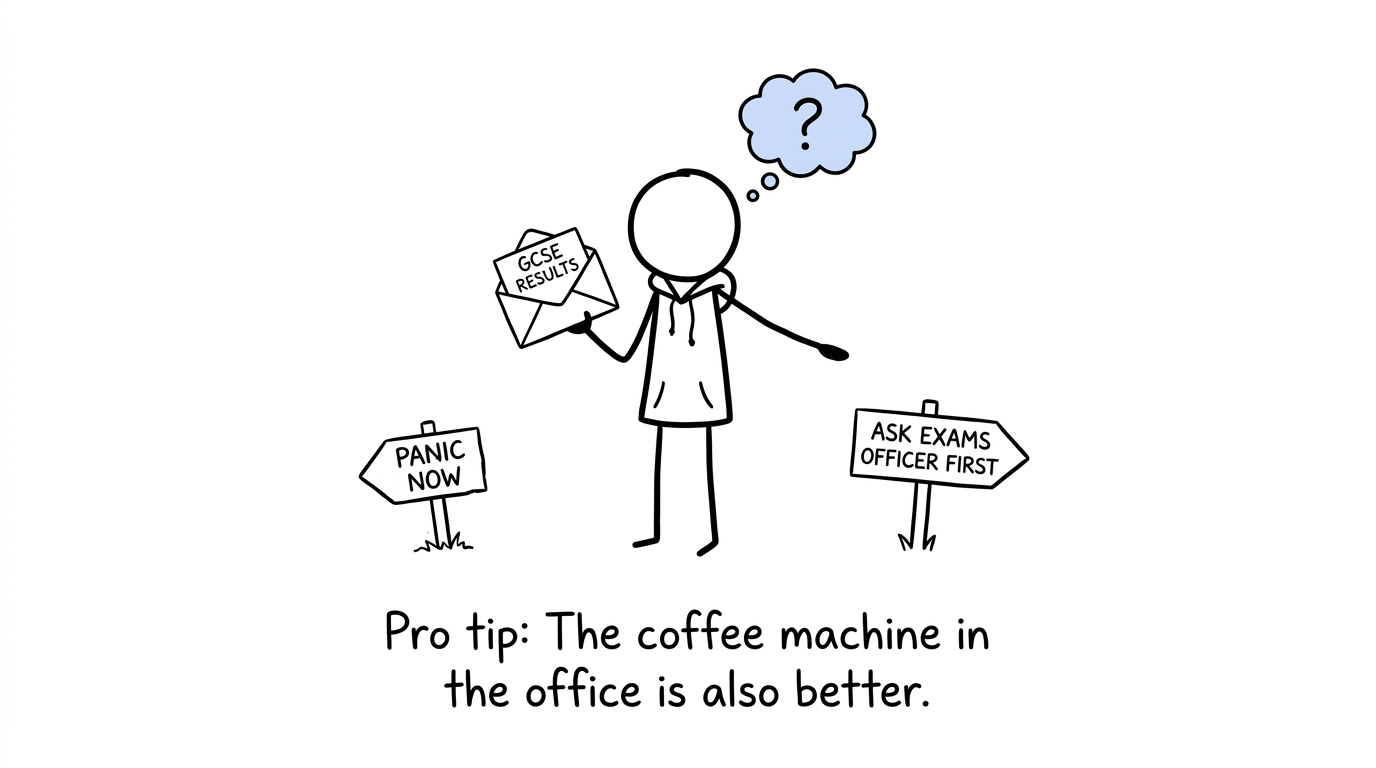 A student calmly choosing to ask the exams officer before panicking
GCSE remark request checklist
- Contact your subject teacher or exams officer immediately.
- Confirm your exam board, paper, mark and overall grade.
- Compare your total with the correct grade boundary.
- Ask whether your marked script can be accessed first.
- Choose between a clerical re-check and a review of marking.
- Read and sign the candidate consent form.
- Confirm the fee and your school's earlier internal deadline.
- Wait for the outcome before considering an appeal.
GCSE review deadlines for 2026
GCSE results are released to candidates on 20 August 2026. JCQ states that awarding bodies must receive standard review-of-results requests by 24 September 2026. Schools normally set an earlier deadline so that exams staff have time to collect consent, payment and paper details.
| Stage | June 2026 timing | What to do |
|---|---|---|
| GCSE results day | 20 August 2026 | Collect your result and contact your school if something appears wrong. |
| Request your script | Ask immediately | Your board may set an earlier access-to-scripts deadline. |
| School's internal deadline | Set by your school | Submit consent and payment before this date. |
| Final review deadline | 24 September 2026 | The awarding body must receive the request by this date. |
| Standard review outcome | Within 20 calendar days | Your centre receives the revised or confirmed result. |
| Appeal after a review | Within 30 calendar days of the outcome | The head of centre normally submits the appeal. |
Do not treat 24 September as your personal target. A request reaching your school on that date may already be too late.
How to request a review of marking
Check the grade boundary
Find your exact examination series, board and tier. Grade boundaries apply to the overall qualification, so being close on one paper does not automatically mean you were close to a higher subject grade.
Use the relevant MathsGenie page:
- Edexcel GCSE Maths grade boundaries
- AQA GCSE Maths grade boundaries
- OCR GCSE Maths grade boundaries
- Eduqas GCSE Maths grade boundaries
- WJEC GCSE Maths grade boundaries
A small gap may make a review worth discussing, but it does not prove that marks are missing. Equally, a larger gap could still matter if a teacher identifies a clear marking error.
Ask for the marked paper
Access to scripts lets a teacher compare your answers with the mark scheme. This is usually more useful than requesting a review based only on disappointment. A teacher may notice an uncredited method, an unchecked page or, just as importantly, that the original marking appears sound.
Select the correct service
A clerical re-check checks administrative matters such as whether every page was marked and whether marks were totalled and recorded correctly.
A review of marking checks whether the agreed mark scheme was applied correctly. It is not a fresh mark by an examiner who simply substitutes their judgement whenever an answer is borderline.
Give written consent
Your centre must obtain your written consent after results have been published. This matters because a review can lower your mark and subject grade. A parent cannot remove that risk by requesting the service on your behalf.
Private candidates may contact the awarding body directly or ask the centre that entered them to submit the request.
What does a re-mark cost?
The re-mark cost is normally charged per paper or component, not once for the entire subject. Published GCSE review-of-marking fees for the June 2026 series include:
| Exam board | Review of marking fee per component |
|---|---|
| AQA | £44.85 |
| OCR | £67.75 |
| WJEC or Eduqas | £45.00 |
| Pearson Edexcel | Confirm the August 2026 fee with your centre |
Pearson's previous UK fee schedule ended on 31 July 2026, so students should use the new fee confirmed by their centre rather than relying on an older online figure. Schools may also explain their payment arrangements and whether the fee is waived or refunded following a qualifying grade change. Always confirm this before signing.
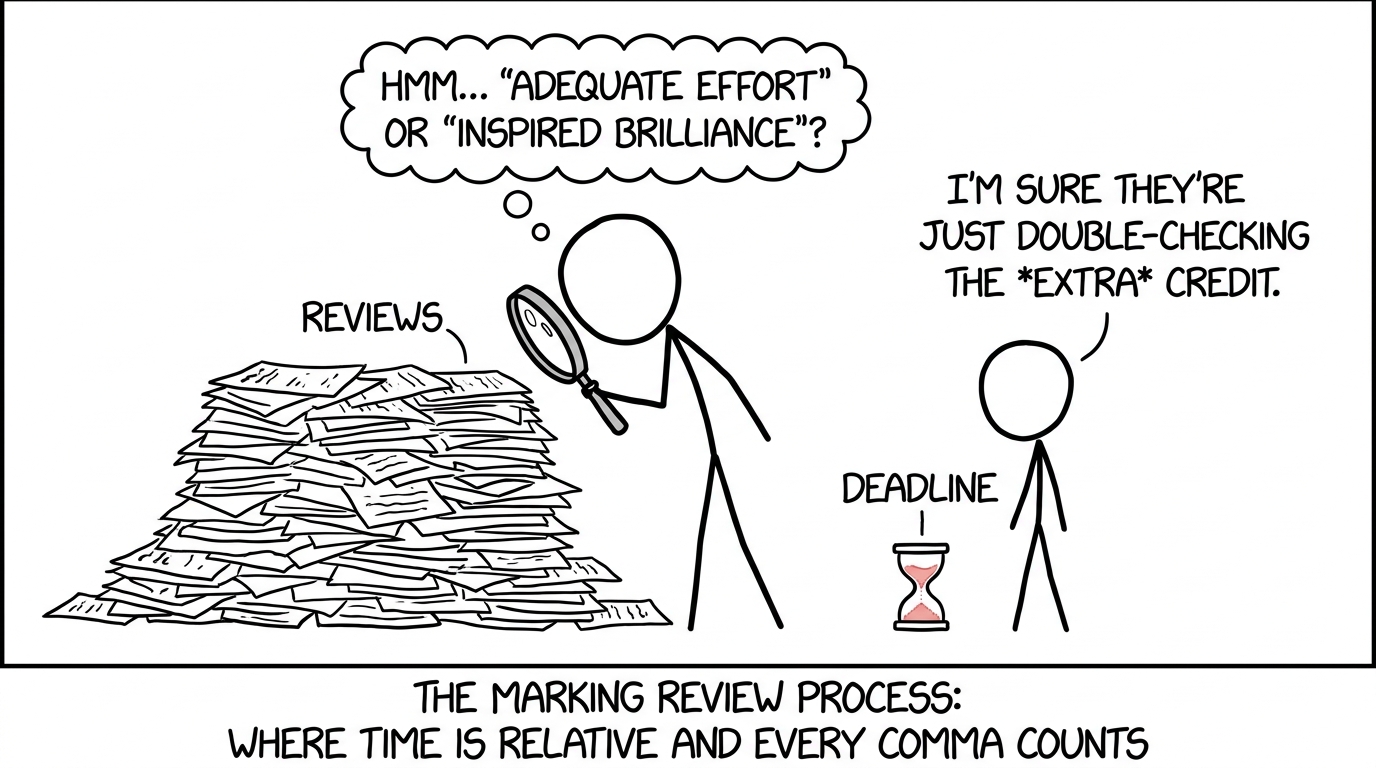 An examiner racing a tiny deadline hourglass while reviewing papers
The GCSE appeal process
An appeal comes after the review outcome. It is not a shortcut around the review of marking or an opportunity to request repeated re-marking until the grade changes.
For a student entered through a school, the head of centre submits the appeal. It may challenge an uncorrected marking error or argue that the awarding body's procedures were not applied properly, fairly or consistently. JCQ requires an appeal to be made within 30 calendar days of the review outcome.
If your school refuses to request a review, it must give you access to its internal appeals arrangements. Private candidates can normally submit their own appeal. Awarding bodies may charge for appeal stages, although fees are refunded or waived when an appeal is upheld.
Only after the awarding body's appeal process has been completed can an eligible case be referred to Ofqual's Exam Procedures Review Service. Ofqual examines whether procedures and regulatory requirements were followed; it does not provide an informal extra re-mark.
Common mistakes to avoid
- Waiting for the national deadline: your school's deadline will probably be earlier.
- Requesting every paper automatically: each component can carry a separate fee.
- Assuming marks cannot fall: there is no grade protection for a review of marking.
- Using an old fee list: exam-board charges can change between academic years.
- Confusing a review with an appeal: complete the review stage first.
- Checking the wrong boundary: use the correct board, series and foundation or higher tier.
- Ignoring progression requirements: tell your school promptly if a sixth-form or college place depends on the result.
Turn the result into a useful next step
A disappointing grade deserves a careful check, not a rushed gamble. Compare the boundary, inspect the script, listen to your teacher's judgement and make the request before your centre's deadline. That is the calmest route through the GCSE appeal process.
Whatever the outcome, MathsGenie can help you prepare for a resit or the next stage. Start with the GCSE Maths revision hub, then use free revision lessons, practice questions, past papers, mark schemes and video solutions. For focused timing practice, try the GCSE predicted papers and Edexcel GCSE Maths mini tests. Check your subject-specific grade boundary first, then turn the marks you missed into a precise revision plan.











