

GCSE Grade Boundary Table Explained for Results Day
GCSE grade boundary table explained clearly: compare raw marks, tiers and exam series, understand UMS-style tables, and check your result confidently today.
Results day can turn a calm-looking table into a wall of numbers. You know your mark, but which row matters? Is it a raw mark or UMS mark? Does a paper boundary decide your grade? This GCSE grade boundary table explained guide gives you the short answer: match the correct exam board, subject, specification, tier and exam series, then compare your overall mark with the qualification boundaries. The boundary is the minimum mark needed for that grade.
Before checking anything, use this checklist:
- Confirm your exam board and specification code.
- Select the correct exam series, such as June or November.
- Check whether you sat foundation or higher tier.
- Identify whether the table uses raw, scaled or UMS marks.
- Compare your overall subject mark, not an isolated paper mark, unless the table specifically says otherwise.
You can begin at MathsGenie's GCSE grade boundaries hub, which separates results by board, subject and year.
 A student navigating the grade-boundary table maze
What a GCSE grade boundary actually means
A grade boundary is the lowest mark that receives a particular grade. If the grade 777 boundary is 162162162, a mark of 162162162 earns grade 777. A mark of 161161161 does not.
Boundaries are confirmed after papers have been marked. Exam papers can vary slightly in difficulty, so exam boards use evidence from the assessment alongside expert judgement to maintain comparable standards between exam series. This is why last year's boundary can inform your revision target but cannot predict this year's boundary exactly.
When reading exam board grade boundaries, locate these fields first:
| Field | What to check |
|---|---|
| Qualification | The correct subject and specification code |
| Tier | Foundation or higher |
| Exam series | The month and year in which you sat the papers |
| Maximum mark | The total against which your result is measured |
| Grade columns | The minimum mark required for each grade |
Dashes normally mean that a grade is unavailable for that tier or entry, not that the student automatically receives a fail. Foundation GCSE maths generally offers grades 111 to 555, while higher tier offers grades 444 to 999, with grade 333 available as a safety-net outcome under the awarding rules.
Raw marks and UMS-style tables
Raw marks
A raw mark is the mark awarded for your answers before any necessary scaling or conversion. For many current linear GCSEs, component marks are added, or weighted where required, to create an overall subject mark. That total is compared with the qualification boundary.
Current reformed GCSEs graded 999 to 111 do not use UMS. In GCSE maths, you should normally expect an overall raw-mark table. However, maximum marks differ between specifications, so never compare marks across boards as though they share the same scale.
Use the page matching your board:
- Edexcel GCSE Maths grade boundaries
- AQA GCSE Maths grade boundaries
- OCR GCSE Maths grade boundaries
- Eduqas GCSE Maths grade boundaries
UMS marks
UMS means Uniform Mark Scale. It was used for modular qualifications in which raw marks could be converted onto a common scale before units were combined. UMS boundaries stayed fixed, while the raw marks needed to reach them could change between exam series.
You may still encounter UMS-style tables when viewing legacy qualifications, older documents or certain unitised courses. Read the label carefully:
- Raw means the mark awarded on the assessment.
- UMS means the converted uniform mark.
- A raw mark must be compared with a raw boundary.
- A UMS result must be compared with a UMS boundary.
Do not convert a raw mark into a percentage and assume that percentage is the UMS mark. The official conversion is determined by the exam board.
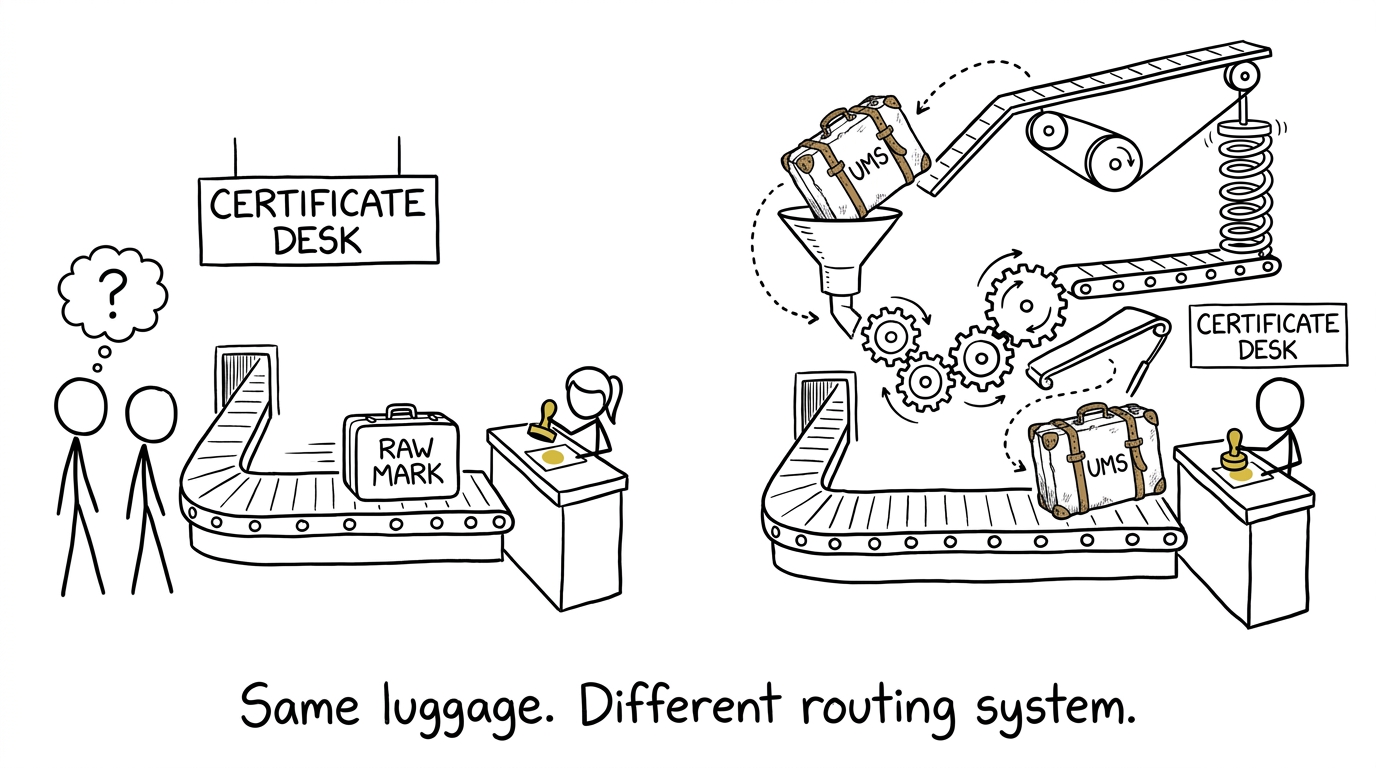 Raw marks and UMS taking different routes
Worked example: reading a raw-mark table
Suppose a higher-tier student receives these hypothetical GCSE maths paper marks:
| Paper | Raw mark |
|---|---|
| Paper 111 | 494949 |
| Paper 222 | 575757 |
| Paper 333 | 616161 |
The overall mark is:
49+57+61=167 49 + 57 + 61 = 167 49+57+61=167Now suppose the correct qualification table for that board, tier and series shows:
| Grade | Minimum overall mark |
|---|---|
| 888 | 190190190 |
| 777 | 162162162 |
| 666 | 128128128 |
The student has grade 777 because 167167167 is at least 162162162 but below 190190190. They are:
190−167=23 190 - 167 = 23 190−167=23marks below grade 888.
This is an illustrative table, not a published boundary set. The important method is to total the correct marks and compare the total with the overall qualification row.
For a UMS-style legacy table, imagine a raw unit mark has officially been converted to 686868 UMS and the UMS boundary is 646464. Compare 686868 with 646464, not the original raw mark with 646464.
Overall boundaries versus paper boundaries
A modern linear GCSE awards a qualification grade for the subject as a whole. An exam board may publish notional component boundaries showing what performance on one paper resembles, but these do not award separate certificated grades.
A weak Paper 111 can therefore be balanced by stronger marks on Papers 222 and 333. Your final grade comes from the overall mark after the required combination or weighting.
If you are checking practice results rather than an awarded result, use the correct historical table only as an estimate. The GCSE Maths revision hub provides board-specific papers, questions and mark schemes, while GCSE predicted papers can help you practise unfamiliar combinations of topics.
Common mistakes when reading grade boundaries
- Using the wrong series: June and November boundaries can differ.
- Choosing the wrong tier: Foundation and higher have separate rows.
- Comparing one paper with the overall boundary: Add the relevant component marks first.
- Treating a notional paper boundary as a final grade: Only the qualification boundary determines the certificated result.
- Mixing raw and UMS columns: Always compare marks on the same scale.
- Assuming boundaries are fixed percentages: Raw boundaries can change between series.
- Using another board's table: Edexcel, AQA, OCR and Eduqas assessments have different maximum marks and boundaries.
Turn the table into your next revision step
A boundary tells you where a grade began in one completed exam series. It does not tell you which topics cost you marks. That part requires the paper, mark scheme and honest review.
Start with the correct subject boundary page, calculate your margin above or below the relevant grade, then return to the questions you lost. MathsGenie brings the next steps together: free revision lessons, practice questions, mark schemes, video solutions, mini tests, past papers and predicted papers. The table explains the result. Focused practice helps change the next one.











