GCSE Chinese Foundation vs Higher Explained
GCSE Chinese Foundation vs Higher explained: compare grades, paper formats, language demands and tier risks, then choose the right tier confidently.
The hardest part of choosing a GCSE tier is that the decision arrives before the result. You have to commit without knowing exactly how you will feel when the recording starts, the reading passage looks unfamiliar or the speaking questions move beyond your prepared answers.
The practical answer to GCSE Chinese Foundation vs Higher is this: Foundation targets grades 111 to 555, while Higher targets grades 444 to 999. But the difference goes much further than a harder paper. The length and pace of assessments can change, writing tasks become more open-ended, translations are longer, and Higher expects greater independence across listening, speaking, reading and writing.
Your tier is also normally the same across all four skills. You cannot choose Foundation listening and Higher writing simply because one is your strength.
The difference at a glance
Before looking at individual papers, keep this checklist in mind:
- Foundation tier offers grades 111 to 555.
- Higher tier offers grades 444 to 999, with a possible grade 333 only when a mark falls narrowly below the grade 444 boundary.
- You take listening, speaking, reading and writing at the same tier.
- Each skill contributes 25%25\%25% of the qualification on the current AQA and Pearson Edexcel specifications.
- Higher assessments are generally longer and contain more demanding language, less scaffolding and more extended responses.
- Foundation is not a lesser qualification, but it places a firm ceiling of grade 555 on the final result.
- Exact timings, marks and task formats depend on whether you take AQA or Pearson Edexcel Chinese.
A useful comparison is GCSE Maths. The label on the paper does not measure ambition; it sets the range in which you can demonstrate attainment. MathsGenie's guide to GCSE Maths topics by exam board and tier explains the same principle for maths: tier choice changes both the available grades and the demands you meet.
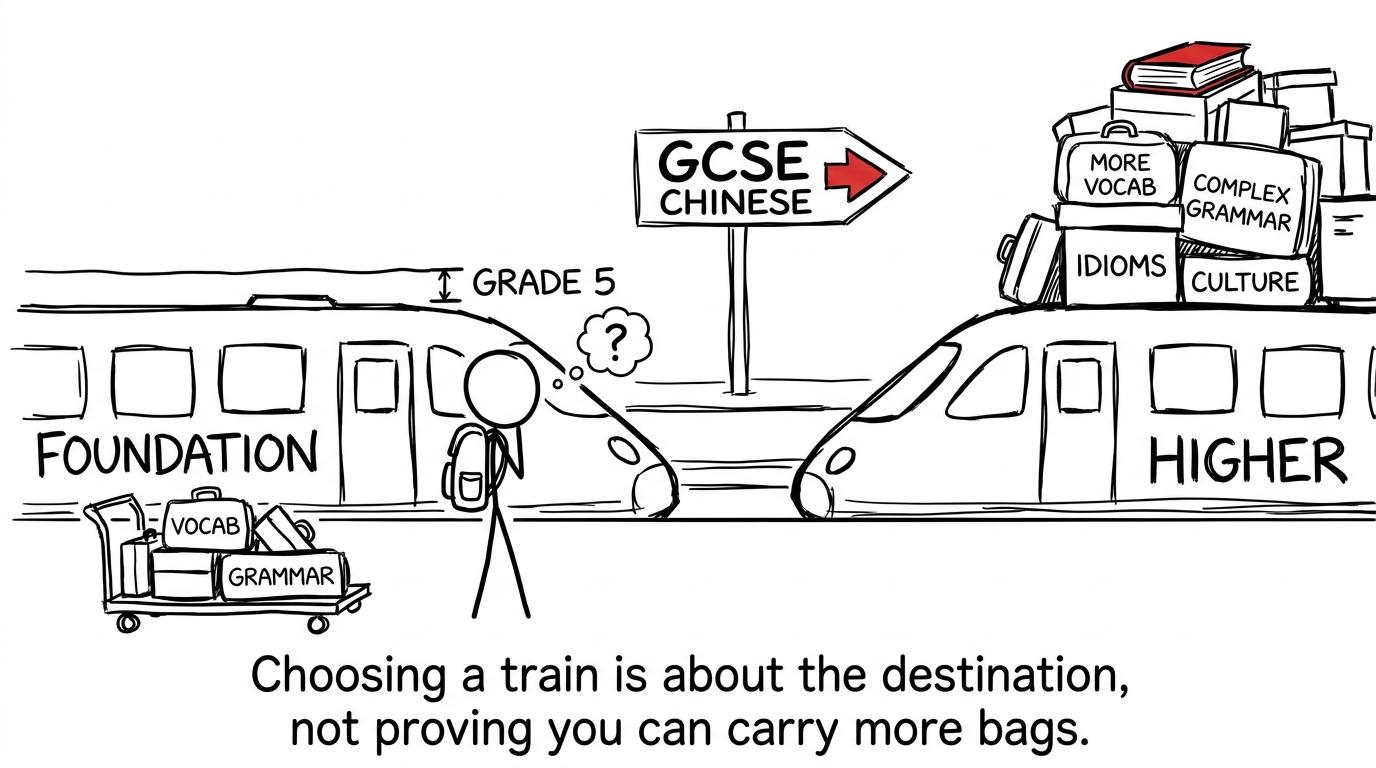 A student choosing between Foundation and Higher trains travelling towards GCSE Chinese
The grade range changes your risk and opportunity
Foundation gives you access to grades 111 to 555. If your realistic target is a grade 444 or 555, it can provide a paper whose overall demand is better matched to that goal. A strong Foundation performance can earn a grade 555, and Ofqual requires attainment at grades 444 and 555 to be comparable across the overlapping tiers.
Higher removes the grade 555 ceiling and makes grades 666 to 999 possible. The trade-off is a higher minimum demand. The possible grade 333 is a narrow safety net, not a guaranteed outcome for anyone missing grade 444. A sufficiently low Higher mark is unclassified.
This makes the choice asymmetric. A student aiming for grade 777 must take Higher. A student aiming for grade 555 has a genuine decision to make.
Do not base that decision on a fixed percentage copied from a previous year. Grade boundaries can change between examination series. Use marked assessments, current specification materials and your teacher's judgement instead.
All four skills stay at one tier
GCSE Chinese assesses:
- listening;
- speaking;
- reading;
- writing.
Current regulations use a single-tier entry model across the qualification. On Pearson Edexcel, students must be entered for one tier across all four papers. AQA also requires all four assessments to be taken at the same tier and in the same series.
That matters because language profiles are often uneven. You might read characters confidently but struggle to process unfamiliar speech at speed. Or you may speak naturally while losing accuracy in extended writing. The right tier must be manageable across the whole qualification, not merely your favourite skill.
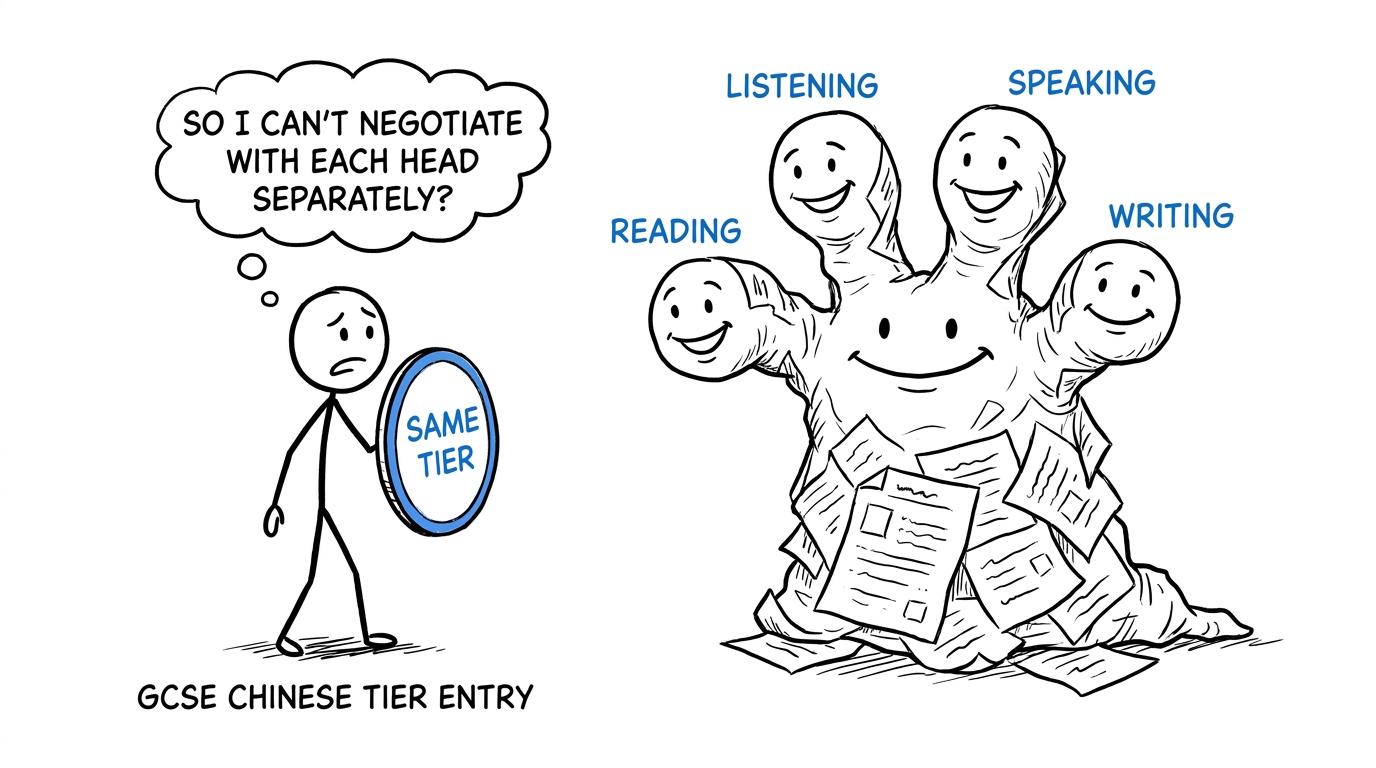 A four-headed exam paper monster meeting a student with one Same Tier shield
What changes in each GCSE Chinese paper?
The overall skill headings remain the same, but the experience inside each assessment changes.
Listening becomes longer and less forgiving
Under current requirements, Foundation listening lasts 353535 minutes, including 555 minutes of reading time. Higher lasts 454545 minutes, also including 555 minutes of reading time.
The extra time does not mean a slower version of the same test. Higher material can contain longer passages, more complex structures, less immediately obvious answers and information that must be distinguished from distractors. You may need to recognise opinions, reasons, changes of mind and references to different time frames rather than simply match a familiar word.
Foundation still requires careful listening. The difference is the sustained complexity and independence expected at Higher.
Speaking requires greater range and development
Both tiers assess your ability to communicate and interact. Depending on the board, the assessment includes activities such as role-play, a visual or photo-based task and a wider conversation.
Foundation speaking is shorter. On both AQA and Pearson Edexcel, the assessment normally lasts between 777 and 999 minutes. Higher normally lasts between 101010 and 121212 minutes.
At Higher, you have more time in which to develop answers, justify opinions, respond spontaneously and move between time frames. Memorised paragraphs alone are therefore fragile. They may sound impressive until the examiner asks a question that requires genuine adaptation.
Reading uses longer and more complex texts
Higher reading gives you more time because it expects more sustained comprehension. AQA allows 454545 minutes at Foundation and 606060 minutes at Higher. The current Pearson Edexcel specification allows 505050 minutes at Foundation and 656565 minutes at Higher.
Both tiers can include different text types and a translation from Chinese into English. Higher passages are more likely to demand inference, careful discrimination between similar ideas and understanding across a longer stretch of text. Translation passages are also longer under the Higher requirements.
The key skill is not recognising every character. It is preserving meaning while using context, grammar and familiar character components to manage what you do not immediately know.
Writing changes in structure as well as length
Foundation writing provides more support and includes shorter tasks. Higher writing asks for longer, more independent responses and places greater weight on developing ideas accurately.
For example, AQA Foundation includes short sentence and passage tasks, a structured response and translation. AQA Higher moves towards longer structured and open-ended writing alongside a more demanding translation. Pearson Edexcel Foundation currently has three open-response tasks and a translation, while Higher has two more substantial open-response tasks and a translation.
This is why counting memorised phrases is not enough. Higher rewards the ability to select language for the actual prompt, link ideas, express and justify opinions, refer to different time frames and maintain character and grammatical accuracy.
Always check your own board's current specification. AQA and Pearson Edexcel do not use identical timings, raw marks or question arrangements, even though both assess the same four broad skills.
What does not change between the tiers?
Some important features remain stable:
- The qualification still assesses listening, speaking, reading and writing.
- Each skill is worth 25%25\%25% overall.
- Broad themes are studied across both tiers.
- Core vocabulary and grammar still matter.
- Accuracy, communication and attention to the task remain important.
- Grades 444 and 555 represent comparable attainment whichever tier produced them.
Your choice of spoken variety or character format is not created by the tier. AQA's qualification is Chinese (Spoken Mandarin). Pearson Edexcel provides entry routes for spoken Mandarin or spoken Cantonese and supports simplified and traditional character materials where specified. Your school will confirm the route for which you are entered.
How to decide which tier is right for you
A tier decision should be based on a pattern of evidence, not one unusually good or bad lesson.
Start with the grade you need
If you need grade 666 or above, Higher is essential because Foundation is capped at grade 555.
If your realistic aim is grade 444 or 555, compare the security of Foundation with the opportunity and risk of Higher. The word “Higher” should not make the decision for you.
Test all four skills
Complete current specimen or past-paper tasks under appropriate conditions. Record your performance separately for listening, speaking, reading and writing. One total mark can hide an important weakness.
This is the same reason MathsGenie recommends a paper-mark-fix-retest cycle in its guide to using GCSE past papers properly. Evidence becomes useful only when you identify why marks disappeared.
Look at the nature of your errors
Ask whether lost marks come from:
- missing core vocabulary;
- failing to answer every bullet point;
- confusing time frames;
- weak character accuracy;
- running out of time;
- difficulty responding spontaneously;
- misunderstanding the English question.
A small knowledge gap may be repairable. Repeated difficulty sustaining Higher-level responses across several skills is more significant.
Discuss the full evidence with your teacher
Your teacher can compare classwork, mock assessments and speaking performance over time. They also know the exact board and specification used by your school. Bring your own evidence to that conversation, but do not reduce the decision to pride or fear.
A revision plan after the tier decision
Once the tier is settled, revision should become more specific.
For Chinese, divide your week across the four skills rather than revising vocabulary alone. Include short listening sessions, spoken answers without a script, timed reading, translation and writing that is checked against the task requirements.
For your maths exams, use the same disciplined structure through the free GCSE Maths revision hub. MathsGenie provides revision lessons and practice questions for individual gaps, followed by mini tests, mark schemes and video solutions to check whether the method has stuck.
If time feels disorganised, adapt the routine in the best order to learn GCSE Maths topics. The subject changes, but the principle survives: learn, practise, mark, revisit and then test under mixed conditions.
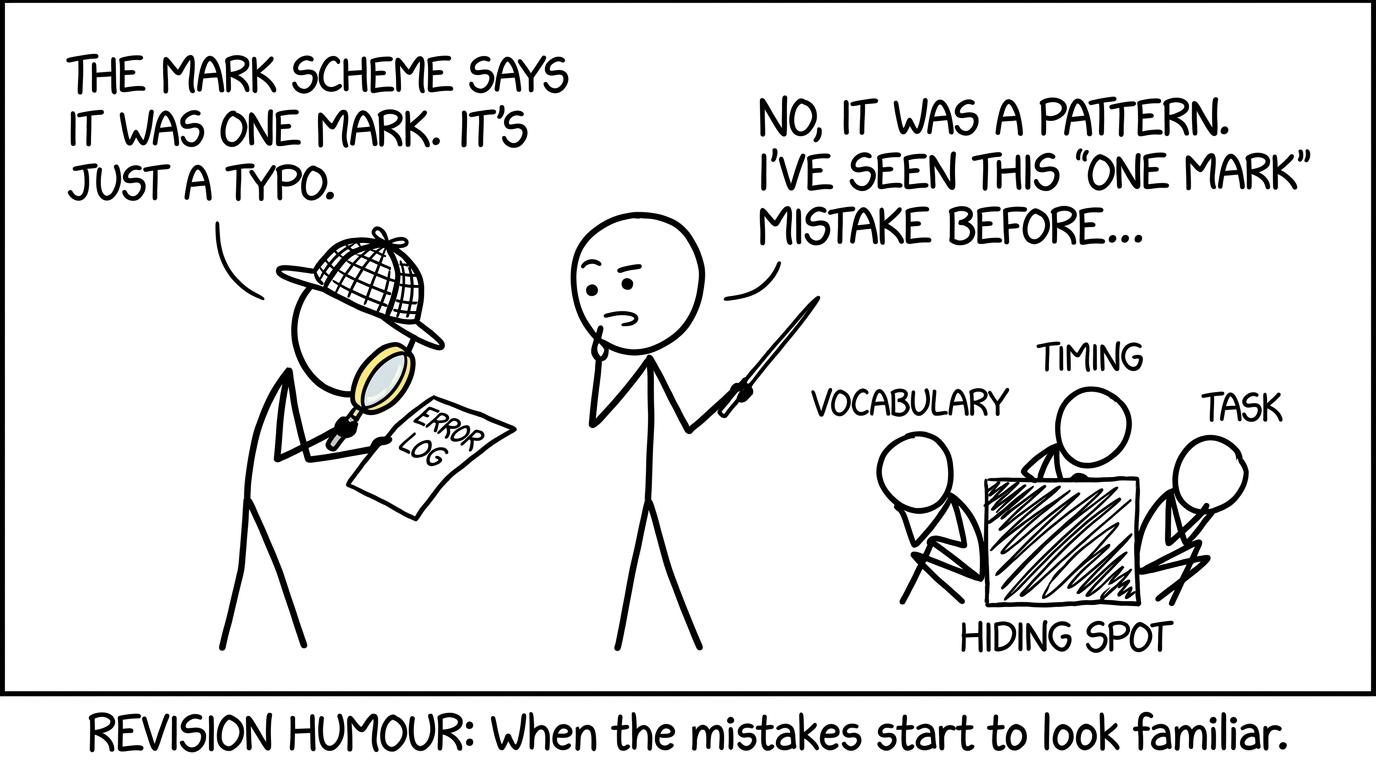 A revision detective investigating vocabulary, timing and task errors
Common mistakes when comparing Foundation and Higher
Assuming Higher automatically produces a better grade
Higher creates access to higher grades. It does not award them for choosing the harder paper. Marks still have to demonstrate the required standard.
Treating the grade 333 safety net as guaranteed
At Higher, grade 333 may be awarded only when the mark is a small number below the grade 444 boundary. It should not be treated as the normal minimum grade.
Choosing a tier from one strong skill
Excellent reading cannot change the fact that all four skills are taken at the same tier. Use balanced evidence.
Revising only prepared speaking answers
Prepared material can build fluency, but Higher speaking requires interaction and adaptation. Practise answering follow-up questions in different ways.
Ignoring the precise exam board
Do not combine AQA timings with an Edexcel task list. Check the paper codes, specification and materials provided by your school.
Confusing more revision with better revision
Repeatedly reading notes can feel productive while concealing weak recall. MathsGenie's one-week GCSE maths revision plan shows a more useful rhythm built around timed practice, marking and targeted repair. The same habit can strengthen language revision.
Choose the paper that lets you show what you know
The real difference between GCSE Chinese Foundation and Higher is not simply that one is harder. The tiers create different grade ranges, levels of linguistic independence, task demands, timings and risks. Foundation offers a route to grades 111 to 555 with assessments targeted accordingly. Higher opens grades 666 to 999, but expects stronger performance across every skill.
Choose using complete evidence. Then stop spending revision time wondering whether the label is impressive enough.
For maths, make MathsGenie your next step. Use the revision planner to organise your week, revision lessons and practice questions to close gaps, mini tests to check recall, and past papers or predicted papers with mark schemes and video solutions to prepare for the real examination. A tier sets the route. Consistent, honest practice is what moves you along it.