GCSE Chemistry vs Alternatives: What Employers Notice
GCSE chemistry vs the alternative option employers assess: discover what matters for jobs, college entry and keeping science and maths pathways open.
Choosing a GCSE can feel strangely permanent. A subject occupies one line on an options form, yet it can seem as though employers and colleges will inspect that line years later and judge the entire decision.
The short answer to GCSE chemistry vs the alternative option employers might notice is reassuring: most employers do not automatically prefer Chemistry to every other GCSE. They usually care more about whether you meet the role's stated requirements, particularly in English and maths, alongside your overall grades, relevant skills and later qualifications. Chemistry matters much more when you apply for a science-related course, apprenticeship or career.
Colleges can be more specific. If you may want to study A Level Chemistry, separate GCSE Chemistry or a strong result in Combined Science can become important, often alongside a particular GCSE Maths grade. Entry requirements vary, so the prospectus of the sixth form or college you are considering is the document that matters.
The quick decision checklist
Before choosing Chemistry or another option, ask:
- Does your school mean separate GCSE Chemistry versus Combined Science, or Chemistry versus a completely different optional subject?
- Do any courses you might take after Year 111111 specify Chemistry or Combined Science?
- Does the alternative subject fit your genuine strengths and interests better?
- Are you likely to achieve a secure grade without weakening your English and maths results?
- Have you checked current entry requirements rather than relying on rumours?
- Would dropping Chemistry close a route you realistically want to keep open?
That final question is more useful than asking which subject looks most impressive. A qualification is valuable partly because of the doors it opens, not because its title sounds difficult.
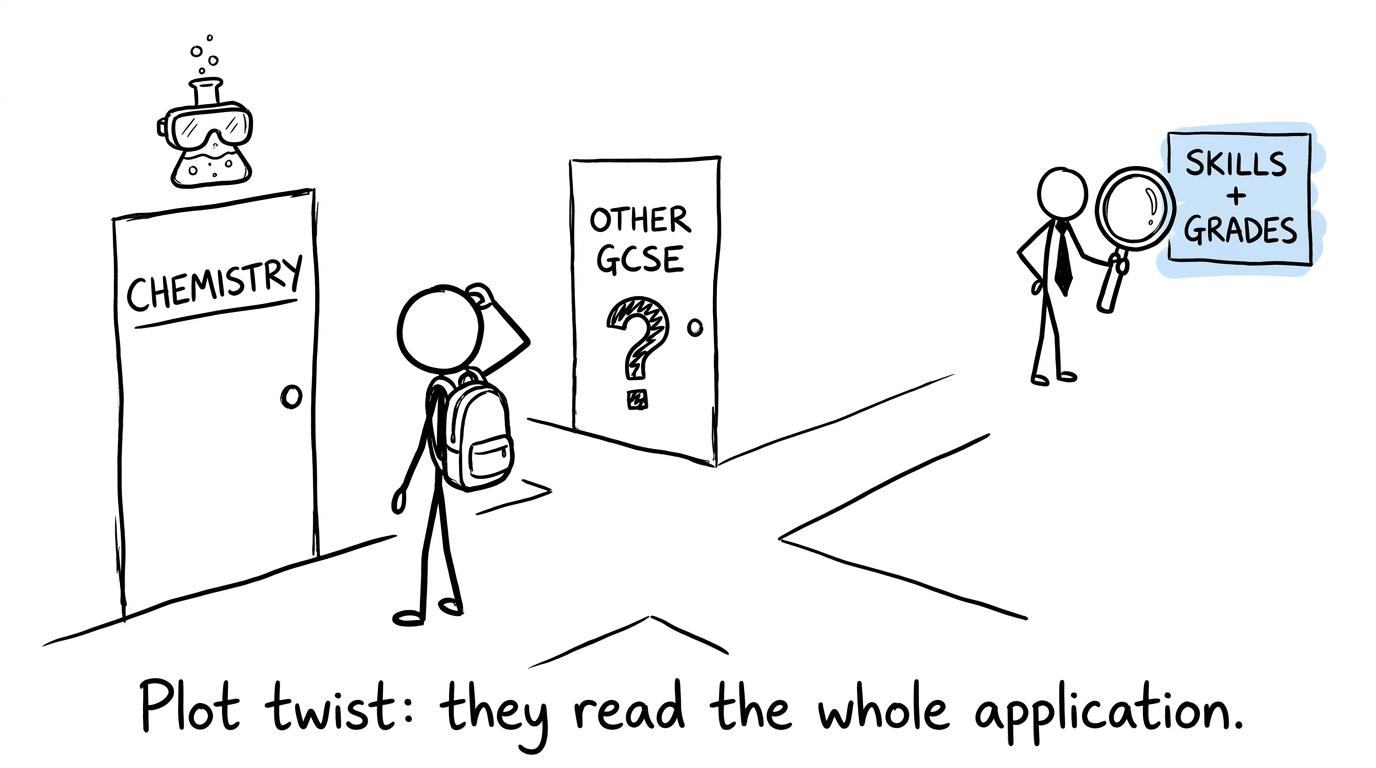 A student discovers that employers read the whole application
First, clarify what the alternative option actually is
The phrase “alternative option” can describe two different decisions, and they should not be confused.
Separate Chemistry versus Combined Science
In Combined Science, students study biology, chemistry and physics but receive two GCSE grades. Separate sciences normally lead to three GCSEs: Biology, Chemistry and Physics. The precise route offered, and whether students can choose it, depends on the school.
Combined Science is not the absence of chemistry. It still includes chemistry content and is accepted by many sixth forms for A Level science entry. However, colleges set their own thresholds. One may request a particular Combined Science double grade, while another may ask for a certain grade in separate Chemistry plus GCSE Maths.
If A Level Chemistry is a serious possibility, check the exact wording used by your likely providers before selecting your route. MathsGenie's guide to choosing A Level after GCSE Chemistry explains why both science and maths results may influence admission.
Chemistry versus a different optional GCSE
The comparison changes if the alternative is Geography, History, Computer Science, Business, Design and Technology, a language or a creative subject.
There is no universal ranking in which Chemistry always wins. A relevant, well-achieved alternative can be more useful than a weak Chemistry grade. Computer Science may support an interest in software; Geography may suit environmental pathways; Design and Technology may connect with engineering design; and a creative subject can provide evidence for a portfolio-based course.
The right comparison is therefore not “hard subject versus easy subject”. It is:
- relevance to your possible next step;
- likelihood of sustained effort and a strong result;
- skills developed through the course;
- entry requirements you may need to satisfy.
What employers usually notice on a GCSE application
Employers are not one audience with one rulebook. A laboratory employer and a retail employer are solving different recruitment problems, so they look for different evidence.
For many school-leaver roles and apprenticeships, the first checks are whether an applicant has the required GCSE grades or recognised equivalents, frequently including English and maths. Current government apprenticeship guidance also gives English and maths particular importance for younger apprentices who do not already hold suitable qualifications.
Chemistry may then help in three ways:
- Direct relevance: laboratory, manufacturing, chemical engineering, healthcare and environmental roles may ask for science.
- Evidence of quantitative skill: chemistry involves ratios, units, graphs, formulae and interpreting data.
- Preparation for later qualifications: an employer recruiting for a higher apprenticeship may care because Chemistry supported the A Levels or technical qualification required for entry.
Outside science-related routes, employers are less likely to treat GCSE Chemistry as uniquely decisive. They may simply see it as one part of an overall academic record. Meeting the stated criteria, presenting accurate information and showing relevant experience can matter more than choosing Chemistry over another respectable GCSE.
This is why GCSE Maths deserves careful attention whatever option you choose. A secure maths grade is repeatedly named in course and job requirements. If your revision needs structure, begin with the free MathsGenie GCSE Maths revision hub and work from your weakest topics rather than revising only what already feels comfortable.
What colleges and sixth forms notice
Colleges usually care more about subject combinations because they must decide whether you are prepared for the next course.
There is no single national GCSE grade that guarantees entry to A Level Chemistry. Published requirements vary between providers. Current examples commonly ask for strong results in separate Chemistry or Combined Science and may also specify GCSE Maths. Selective providers can set higher thresholds.
That makes three checks essential:
- the provider's general entry requirement;
- the subject-specific Chemistry or Combined Science requirement;
- the required GCSE Maths grade and, where stated, tier.
Do not assume that taking separate Chemistry guarantees a place. The achieved grade matters. Equally, do not assume Combined Science blocks A Level Chemistry. Many providers accept it when the required double grade and maths grade are achieved.
Chemistry contains substantial quantitative work at A Level, so the link with maths is practical rather than decorative. You may need confidence with rearranging equations, standard form, percentages, graphs and proportional reasoning. Students considering this route can use a GCSE maths revision timetable to strengthen those skills before Year 121212.
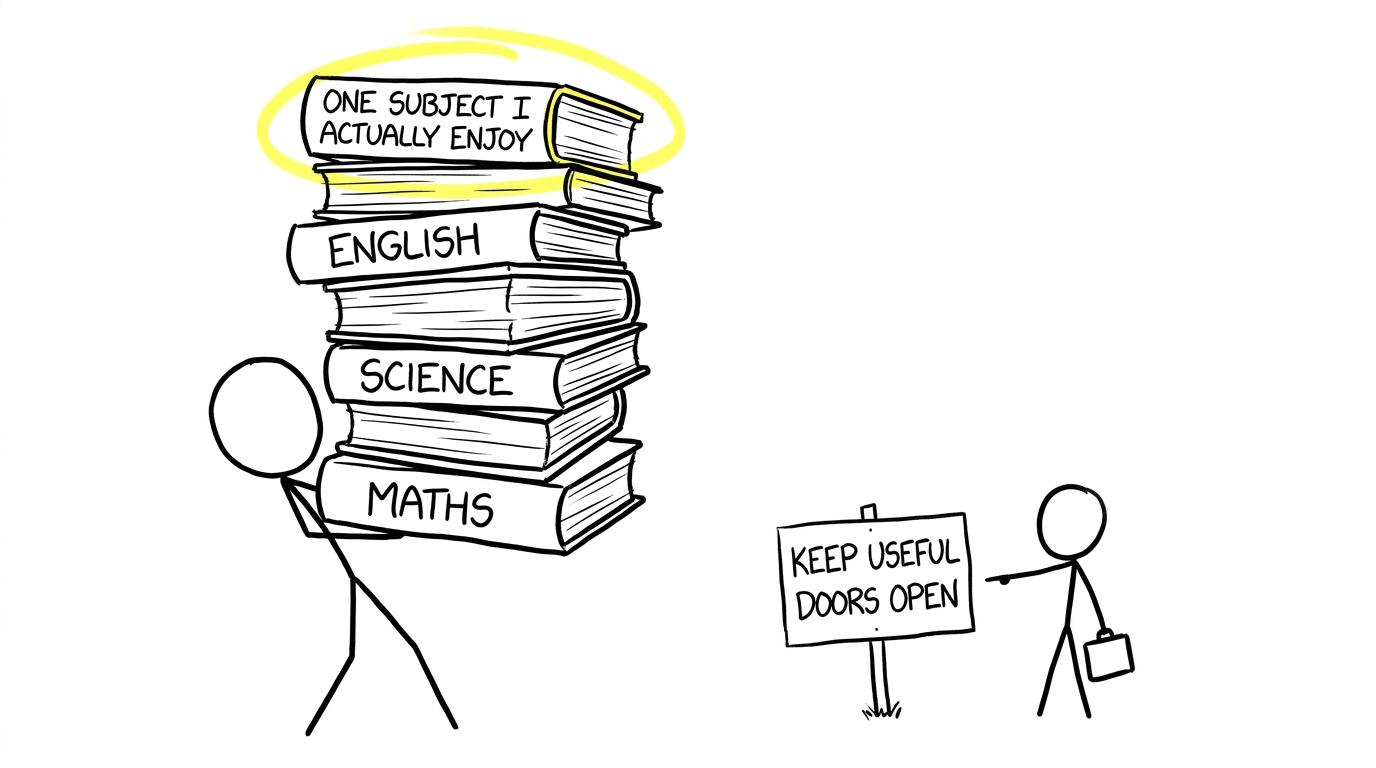 A student balances useful qualifications with a subject they enjoy
When GCSE Chemistry is the stronger choice
Chemistry deserves extra weight when you are considering:
- A Level Chemistry;
- medicine, dentistry, pharmacy or veterinary pathways;
- chemical engineering or materials science;
- laboratory and science technician apprenticeships;
- environmental science and some healthcare routes.
This does not mean GCSE Chemistry alone secures those futures. Later courses can require particular combinations of GCSEs, A Levels or vocational qualifications, and competitive programmes may consider results across several subjects. Requirements also change, so check official course pages when applying.
Chemistry may also be sensible when you are undecided but genuinely enjoy science and cope well with its workload. It preserves an additional route. Keeping a door open has value when the cost is manageable.
When the alternative may be the better choice
Another subject may be better when Chemistry is not required for your likely path and the alternative develops more relevant skills or produces stronger engagement.
Suppose the alternative is a language and you are interested in international business. Or perhaps it is Art and Design and you want to build a portfolio. In those cases, the alternative is not merely the subject you took instead of Chemistry. It is evidence aligned with your intended direction.
Balance matters too. An overloaded timetable can damage performance across several subjects. Protecting your core qualifications, particularly English and maths, can be more valuable than adding a subject for prestige.
A sensible GCSE revision system helps you see that balance honestly. Use Edexcel GCSE Maths mini tests for quick diagnosis, or follow the broader guide to finding your weakest GCSE topics. The aim is not to revise everything equally. It is to identify where the next hour can recover the most marks.
How to make either choice valuable to employers
A subject choice is only the beginning. What you do with it supplies the evidence.
Build transferable skills deliberately
Chemistry can demonstrate careful measurement, data interpretation, logical reasoning and safe practical work. Other GCSEs develop their own valuable evidence: extended writing, programming, design, research, communication or analysis.
When you later write an application, connect the skill to the role. “I took Chemistry” is information. Explaining that you learnt to analyse unfamiliar data and check units shows what the subject helped you do.
Secure the core grades that keep appearing
English and maths are common filters for further education, apprenticeships and employment. If maths is currently fragile, use a repeated cycle:
- learn one method through a revision lesson;
- complete focused practice questions;
- mark them immediately;
- record the reason for each lost mark;
- retest the topic later;
- move on to mixed exam practice.
You can build exam confidence with Edexcel GCSE Maths past papers, then use Edexcel predicted papers as additional unseen practice near the exams. Predicted papers should support official past-paper work, not replace it.
Read each requirement literally
If a college asks for Combined Science or Chemistry at a specified grade, a different GCSE does not automatically substitute for it. If an employer asks for “science”, Chemistry may qualify, but check whether another science or equivalent is accepted. When the wording is unclear, ask the provider directly and keep its reply.
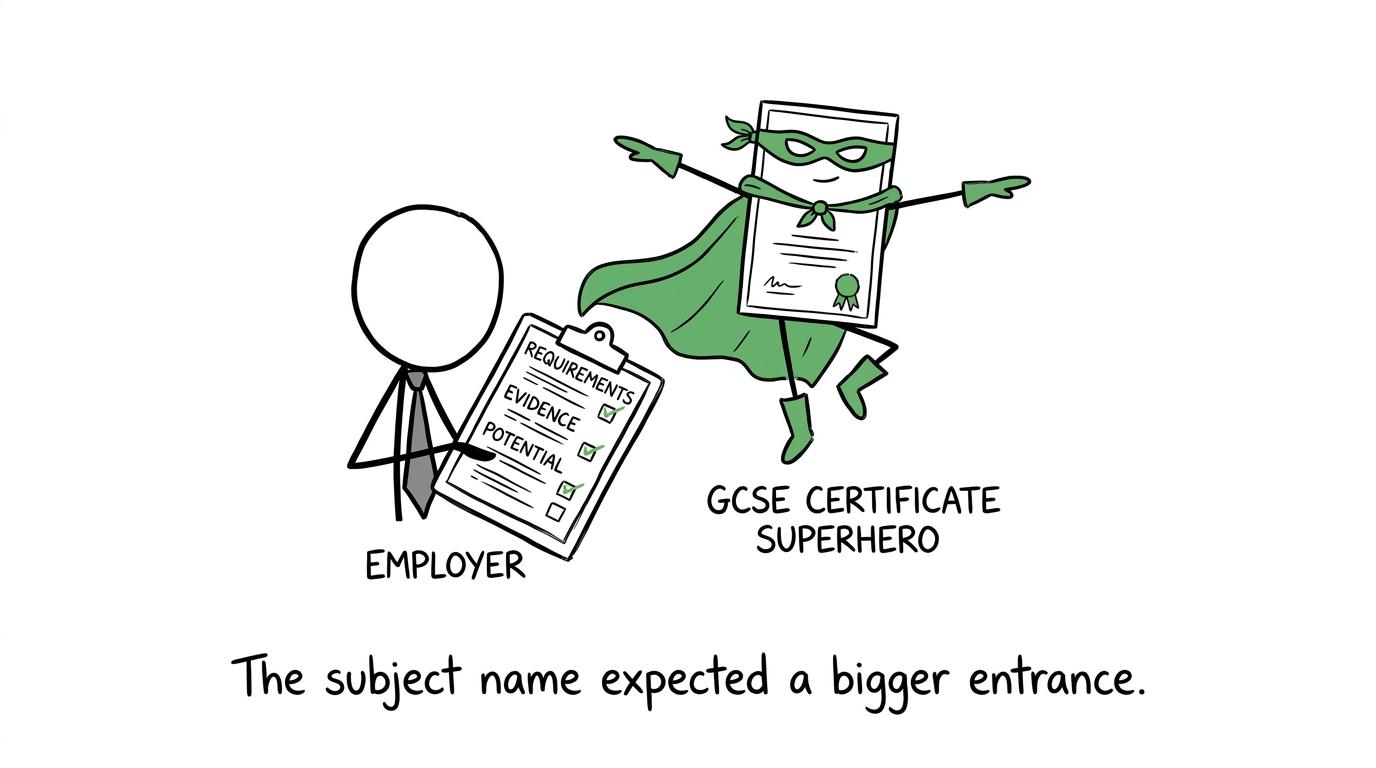 A dramatic GCSE subject discovers that employers use a practical checklist
Common mistakes when choosing between Chemistry and another GCSE
Choosing for prestige alone
A subject that sounds impressive is not automatically useful for every destination. Relevance, grade and skill evidence matter more than reputation in isolation.
Assuming all colleges use the same grades
Sixth forms set their own admissions criteria. Check several local providers, particularly if you are considering A Level Chemistry.
Treating Combined Science as “no Chemistry”
Combined Science includes chemistry and can support entry to A Level Chemistry where the provider accepts the achieved grades. Always verify the local rule.
Ignoring GCSE Maths
Science pathways often rely on quantitative confidence, while many employers and apprenticeships explicitly check maths. Your option choice should not pull so much time away that a core grade suffers.
Collecting papers without reviewing them
Finishing a paper is not the same as learning from it. Mark it, classify each error and repair the underlying topic. The guide to using GCSE maths past papers at the right time can help you move from topic practice to timed papers sensibly.
Make the choice that protects your next step
Most employers will not reject a strong applicant simply because another suitable GCSE replaced Chemistry. They notice Chemistry most when it is relevant to the role or forms part of the route into a required later qualification. Colleges are more likely to inspect the precise subject and grade when admitting students to A Level Chemistry or another science course.
So choose backwards. Start with the realistic courses, apprenticeships or careers you may want. Check their requirements. Then choose the GCSE route that keeps those doors open while giving you the best chance of strong, balanced results.
Whatever science option you take, do not let maths become the quiet barrier. Use MathsGenie's free revision lessons and practice questions to repair individual topics, mini tests to check progress, and past papers, predicted papers, mark schemes and video solutions to prepare for the exam itself. One subject choice can preserve a route. Consistent revision is what helps you travel along it.