A-Level After GCSE Chemistry: What Should You Choose?
A-level after GCSE chemistry: compare entry grades, maths demands and subject combinations to choose confidently after results day and into sixth form.
Results day turns years of lessons into a few numbers on a page. Then, almost immediately, you are asked to make a much bigger decision: what comes next?
If you are considering an A-level after GCSE Chemistry, the short answer is this: choose A Level Chemistry if you enjoyed explaining why reactions happen, are comfortable with calculations and have met your sixth form's entry requirements. Pair it with subjects that support your interests, rather than simply choosing the combination that sounds most impressive.
Your GCSE result matters, but it is only one part of the decision.
Your results-day decision checklist
Before confirming your options, ask:
- Have I met the Chemistry and Maths entry grades set by my school or college?
- Did I enjoy quantitative chemistry, practical work and explaining unfamiliar results?
- Am I willing to revise content regularly rather than relying on last-minute recall?
- Do my other A Levels support any university courses I may consider?
- Have I checked the actual course specification and assessment structure?
If most answers are yes, progressing from GCSE Chemistry to A Level is a sensible choice. If several answers are uncertain, speak to the Chemistry department before deciding.
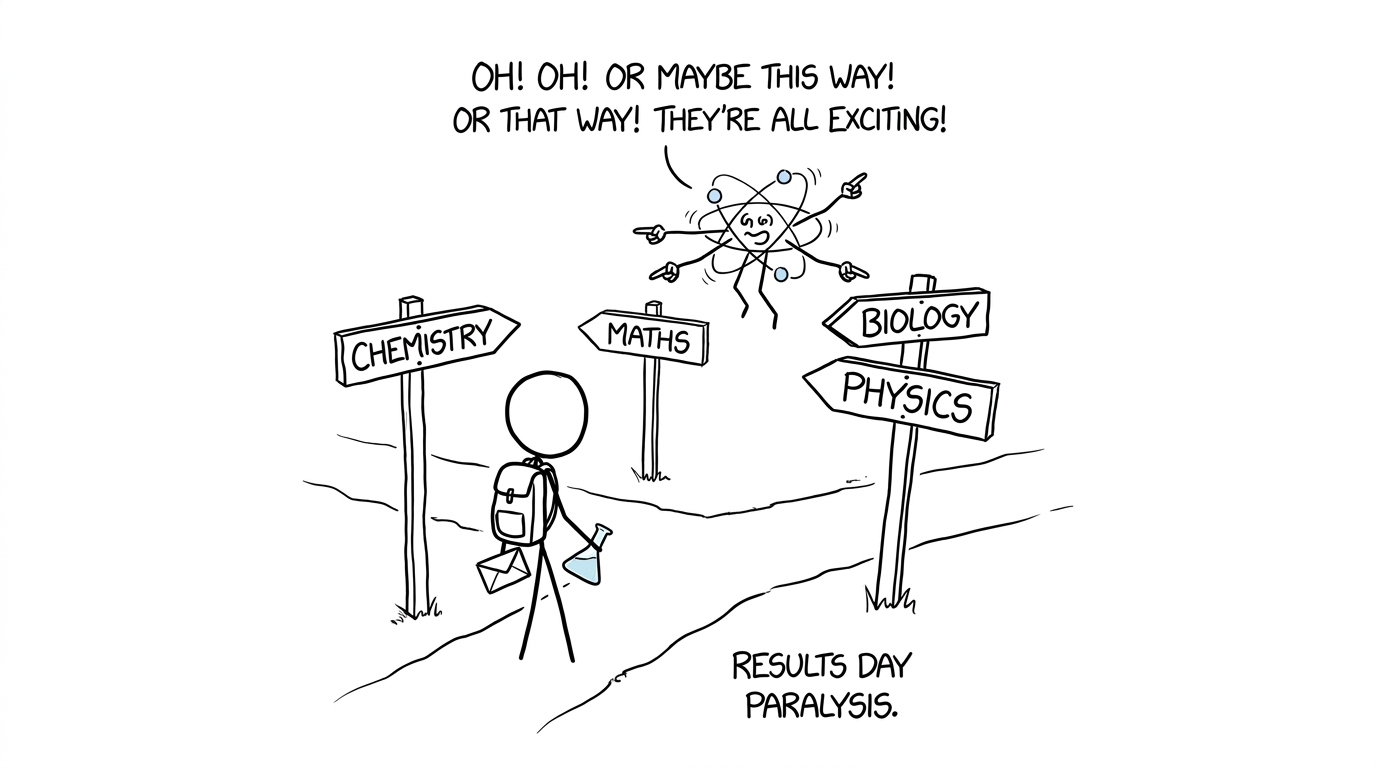 A student choosing between Chemistry, Maths, Biology and Physics after results day
What grade do you need for A Level Chemistry?
There is no single national entry grade. Sixth forms and colleges set their own admissions criteria, and current published requirements vary.
| GCSE result | What it may mean |
|---|---|
| Grade 777 or above in Chemistry | Meets the subject requirement at many selective sixth forms and suggests a strong foundation. |
| Grade 666 in Chemistry | Accepted by many providers, often alongside a required Maths grade. |
| Combined Science grades 777-777 | Commonly accepted where a provider asks for grade 777 in separate Chemistry. |
| Combined Science grades 666-666 | Accepted by some providers, but not all. Check locally. |
| Grade 555 or below | You may not meet the standard entry requirement, although policies and alternative routes vary. |
Many providers also request grade 666 or 777 in GCSE Maths because A Level Chemistry contains substantial quantitative work. These are typical examples, not universal rules. Check the prospectus for the sixth form you will actually attend, including how it treats Combined Science results.
A near miss does not always end the conversation. Ask whether the department considers your paper marks, teacher recommendation or performance in related subjects. Do not assume that admission is guaranteed, but do not reject yourself before speaking to them either.
How different is GCSE Chemistry from A Level?
The transition is less like starting a new subject and more like looking at a familiar landscape through a stronger lens. Atomic structure, bonding, energetics, rates, equilibria, inorganic chemistry and organic chemistry remain important, but explanations become more precise and calculations become less guided.
A Level Chemistry also places greater emphasis on:
- applying principles in unfamiliar situations
- interpreting experimental evidence
- selecting equations and data independently
- practical methods, uncertainty and evaluation
- linking ideas across several topics
- using accurate chemical language
Assessment differs by exam board. Schools may follow AQA, Pearson Edexcel, OCR or Eduqas, so check which specification your provider teaches. MathsGenie's AQA A Level Chemistry overview shows the course content, assessment structure, lessons and practice resources for that specification.
How much maths is in A Level Chemistry?
Maths is not a side topic. Official A Level Chemistry requirements state that at least 20%20\%20% of assessment marks must involve mathematical skills at Level 222 or above, applied in a chemical context. Lower-level calculations can appear as well.
You should expect to use:
- ratios, fractions and percentages
- standard form and powers
- unit conversions
- significant figures
- rearranging and solving equations
- logarithms
- graphs, gradients and data interpretation
- means and measurement uncertainty
You do not always need to take A Level Maths alongside Chemistry. However, secure GCSE Maths skills make the Chemistry course considerably more manageable. Before September, use the GCSE Maths revision hub to repair gaps, or choose your board from resources covering Edexcel, AQA, OCR, Eduqas, WJEC and CCEA.
For example, Edexcel GCSE Maths revision brings together lessons, topic questions, worksheets, past papers and mark schemes. Students considering both subjects can also preview the step up through the A Level Maths revision hub.
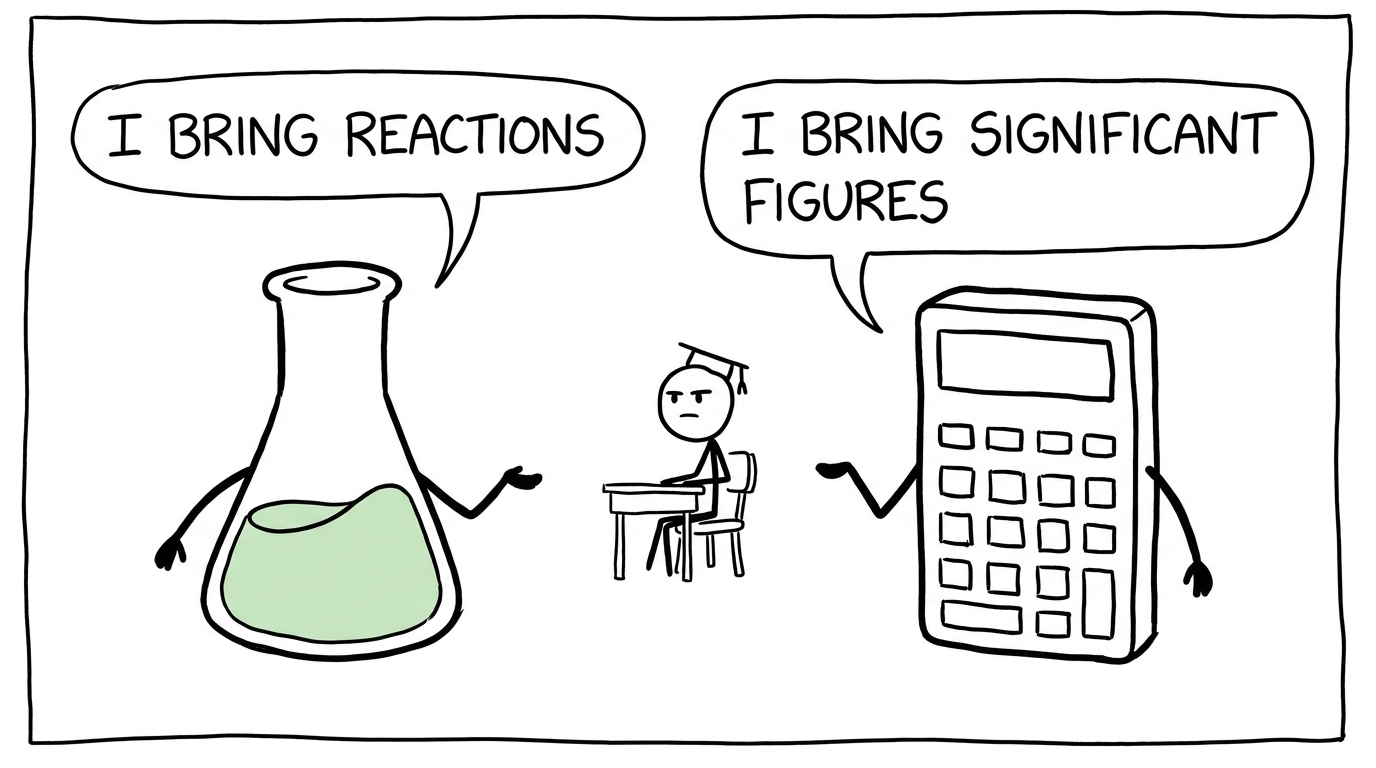 A calculator and chemistry flask interviewing each other as ideal A-level teammates
Which A Levels work well with Chemistry?
Chemistry, Biology and Maths
This is a strong combination for students considering chemistry, medicine, dentistry, veterinary science, pharmacy or biological sciences. Requirements vary substantially between universities, so check individual courses before finalising your choices.
Chemistry, Maths and Physics
This combination supports chemistry, physical sciences, materials science and some engineering routes. Chemical engineering courses commonly value or require Maths, while exact Chemistry and Physics expectations depend on the university.
Chemistry with one science and a contrasting subject
You do not have to choose three sciences. Chemistry, Biology and a humanities or language subject can preserve useful options while giving you a varied workload. The important question is whether the combination meets the requirements of any degree you are seriously considering.
If you are undecided, avoid designing your entire sixth-form experience around one imagined career. Check likely university requirements, then choose subjects in which you can remain interested and perform well.
How to prepare for the transition
Start with diagnosis, not endless note-making. Identify whether your weakest area is algebra, units, graphs, standard form or Chemistry knowledge. Then practise that specific skill.
Use the AQA A Level Chemistry revision guides to preview topics such as amount of substance, bonding and energetics without trying to learn the whole course during summer. If you are also taking Maths, the MathsGenie revision planner can help turn broad intentions into a realistic sequence of revision.
The aim is not to arrive knowing everything. It is to begin without avoidable gaps.
Common mistakes when choosing A Level Chemistry
- Looking only at the Chemistry grade. Your Maths confidence and willingness to practise calculations matter too.
- Assuming every sixth form uses the same threshold. Entry requirements differ, particularly for Combined Science students.
- Choosing it solely for prestige. A respected subject is still the wrong choice if you dislike its central ideas and workload.
- Ignoring degree requirements. Chemistry may be essential for some routes, while Maths, Biology or Physics may also be needed.
- Confusing recognition with mastery. Understanding a lesson when the teacher explains it is different from answering an unfamiliar question independently.
- Dropping the subject after one disappointing result. First check your component marks, local admissions policy and available advice.
Make the decision using evidence
Choosing A Level Chemistry should not feel like guessing at a crossroads. Check your grades, read your provider's entry policy, inspect the specification and think honestly about which parts of GCSE you enjoyed.
Then test the choice. Explore the free AQA A Level Chemistry overview, preview a revision lesson and look through some practice questions. MathsGenie brings together revision guides, question banks, past papers, predicted papers, mini tests and mark schemes so you can see what the next stage genuinely involves.
A result tells you where you finished GCSE. A thoughtful plan decides where you go next.