GCSE Chemistry Study Planner: Work Backwards
GCSE chemistry study planner: work backwards from exam day, prioritise weak topics, space practice and protect time for calculations and papers.
The uncomfortable part of Chemistry revision is rarely a lack of effort. It is uncertainty. You sit down, open a book and wonder whether today should be electrolysis, quantitative chemistry or another set of flashcards.
A GCSE chemistry study planner removes that daily guesswork. Start with the date of each Chemistry paper, move backwards through the available weeks, and assign every phase a clear purpose: final review, timed papers, targeted repair and topic coverage. The plan should also reserve time for calculations, practical methods and mark-scheme feedback, not just reading notes.
This guide shows you how to build that plan without creating a timetable so ambitious that it collapses after three days.
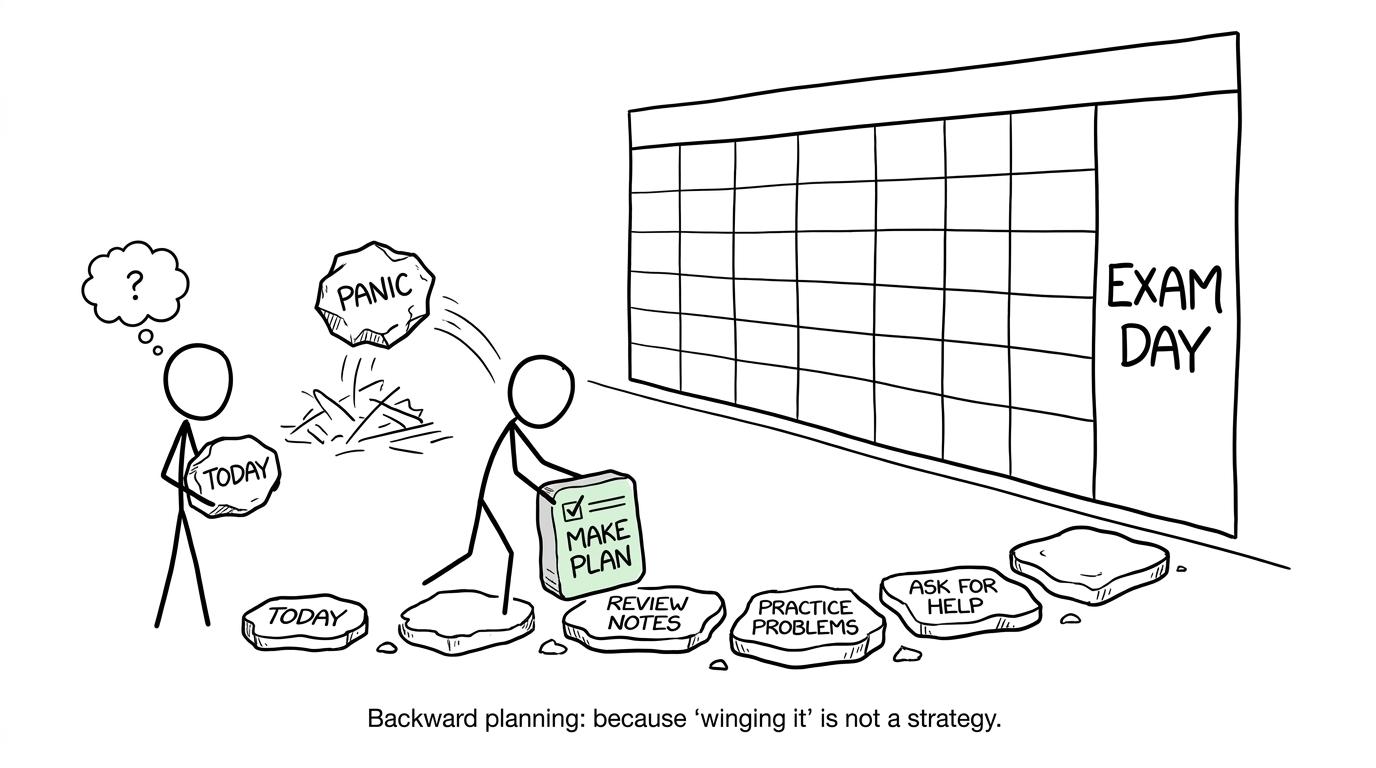 A student replacing panic with stepping stones leading backwards from exam day
Your backward-planning checklist
Before filling a calendar, collect the information that controls it:
- your exam board: AQA, Edexcel, OCR or Eduqas
- whether you take separate Chemistry or Combined Science
- your tier, where applicable
- the date and start time of every Chemistry paper
- the content assessed on each paper
- school assessments, holidays and other GCSE exams
- topics you know, partly know and cannot yet answer
- practical work and mathematical skills that need attention
- realistic revision sessions available each week
Use your school-issued candidate timetable as the final authority. Exam boards publish timetables, but your school will confirm your personal arrangements, including clashes or access arrangements. Keep any published contingency date free as instructed by your centre.
If you are balancing Chemistry with Maths, English and your other subjects, the broader GCSE maths revision timetable guide can help you organise the whole week without allowing one subject to absorb every evening.
Begin with the real exam dates
Write each Chemistry examination on your calendar first. Do not begin with a generic note saying “science exams in June”. Paper dates are deadlines, and different papers may assess different sections of the specification.
Check your board’s specification or subject guide to establish:
- which topics belong to each paper
- the paper duration and available marks
- whether you are sitting Foundation or Higher tier
- which equations or information will be provided
- the required or core practical knowledge that may be assessed
Paper organisation is not identical across AQA, Edexcel, OCR and Eduqas. Nor should separate Chemistry students assume their course matches Combined Science exactly. Build the plan around the qualification you are actually taking.
Once both paper dates are fixed, treat them as separate destinations. Revision for Paper 1 should reach its timed-practice phase before Paper 1, while Paper 2 content continues to receive shorter maintenance sessions. After the first examination, the balance can shift decisively towards Paper 2.
Count usable sessions, not imaginary weeks
A calendar may show ten weeks until the exam, but not every evening is available. School days, other subjects, family commitments and rest all occupy real space.
Count the sessions you can genuinely protect. If there are WWW weeks available and you can complete SSS Chemistry sessions each week, your initial capacity is:
available sessions=W×S\text{available sessions}=W\times Savailable sessions=W×SThen remove sessions that fall during important commitments or other examinations. Leave a small buffer as well. A plan using every available hour has no way to recover when life changes.
Keep school-night sessions compact. A useful structure is:
- short retrieval from memory
- focused exam questions
- immediate marking and correction
Longer weekend sessions can hold mixed questions, practical-method reviews or timed paper sections. If a full session feels impossible, the principles in MathsGenie’s 20-minute GCSE revision routine can be adapted to Chemistry.
Divide the countdown into four phases
Backward planning works because each stage prepares you for the next. The precise number of weeks depends on when you begin, but the order should remain stable.
Final days: protect recall and accuracy
Reserve the last few days before each paper for calm consolidation. Review your error log, required practical summaries, equations, units, definitions and recurring mark-scheme language.
This is not the moment to rebuild the entire course. Use short retrieval tasks and selected corrected questions. Stop at a sensible time, prepare your equipment and protect sleep.
Final few weeks: simulate the examination
Move backwards and reserve the preceding phase for timed Chemistry papers or substantial paper sections. Mark each attempt carefully and convert every lost mark into an action.
A paper is useful only when its feedback changes your next session. Classify mistakes as:
- missing knowledge
- weak application
- practical-method misunderstanding
- mathematical error
- imprecise exam language
- timing or question-reading error
MathsGenie’s guide to using GCSE mark schemes to improve explains the wider feedback habit: attempt, mark, diagnose, repair and retest. Although Chemistry mark schemes use subject-specific wording, the same disciplined loop applies.
Middle phase: repair weak topics
Before sustained paper practice, assign sessions to the exact topics that diagnostic questions expose. Avoid broad tasks such as “revise organic chemistry”. Choose smaller outcomes, such as recalling reaction conditions, interpreting a rate graph or explaining a required practical control variable.
For every weak area, use this sequence:
- retrieve what you know without notes
- check the specification or trusted class material
- answer focused exam questions
- mark immediately
- record one precise correction
- revisit the topic after a gap
Research on learning consistently supports spacing material across separate sessions rather than concentrating the same total revision into one sitting. Your planner should therefore bring difficult topics back more than once.
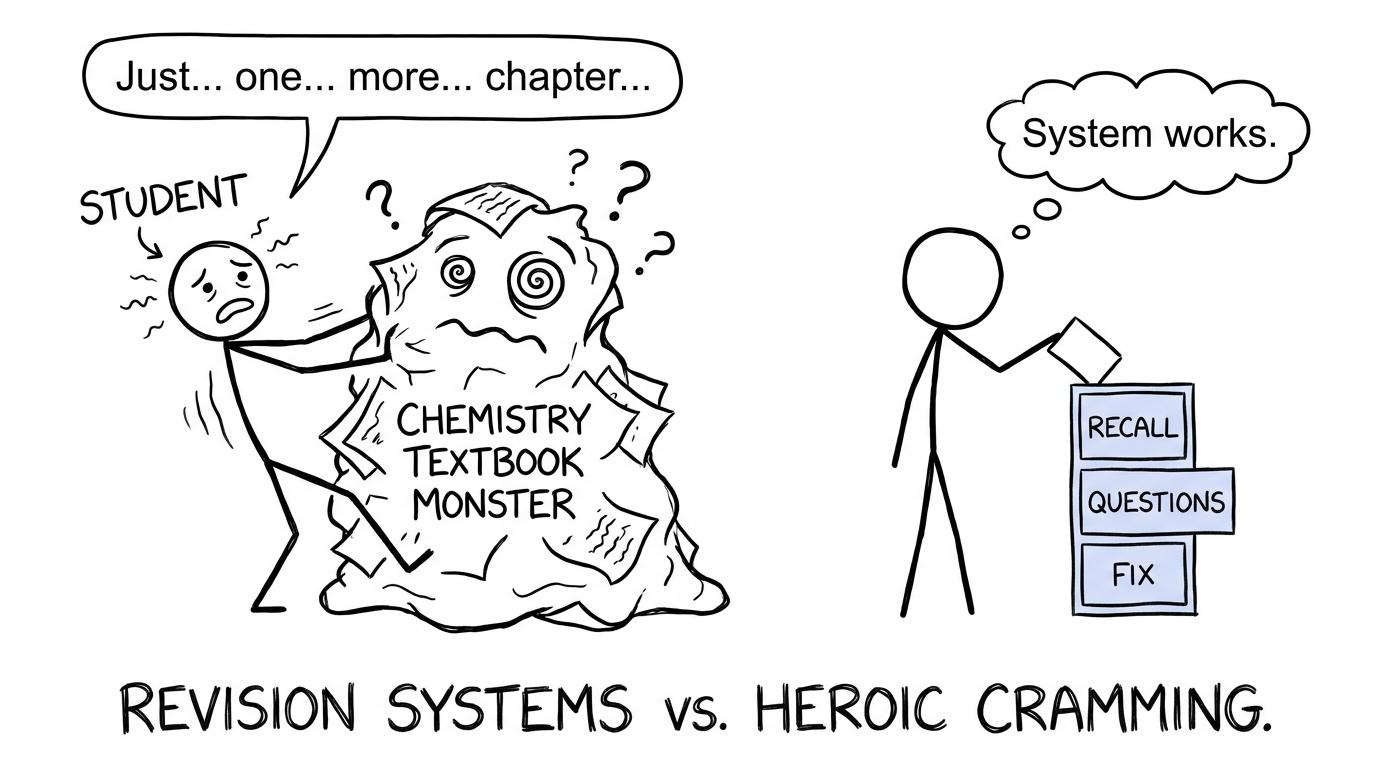 A textbook monster defeated by three small revision drawers labelled Recall, Questions and Fix
Earliest phase: secure coverage
The first phase is for mapping the specification and closing major knowledge gaps. Give each Chemistry topic an initial status:
- secure: you can recall and apply it without support
- developing: you recognise it but lose marks in questions
- weak: you cannot reliably explain it or begin a question
Spend most time on weak and developing areas, but schedule occasional retrieval for secure topics so they remain secure. MathsGenie’s guide to revising GCSE Chemistry when stuck at a pass offers a useful framework for turning broad weaknesses into specific, manageable tasks.
Give every session a visible output
“Revise bonding” is an intention, not a session plan. A useful entry tells you what you will produce.
Better outputs include:
- complete a closed-book retrieval grid
- answer and mark a focused question set
- write a concise required-practical method from memory
- correct a previous paper section
- practise calculation questions with units
- retest three errors from last week
A simple session can devote roughly half its time to answering questions, with the remaining time split between retrieval, checking and correction. Adjust that balance when a topic needs teaching, but always finish with evidence of what you can now do.
The revise GCSE Chemistry fast guide uses a similar retrieve, check, repair and repeat cycle.
Protect the mathematical marks in Chemistry
For separate GCSE Chemistry qualifications regulated in England, at least 20%20\%20% of the marks must assess relevant mathematical skills. Practical-related questions must also account for at least 15%15\%15% of the qualification marks. These areas belong inside the plan, not in a final optional week.
Your Chemistry maths list may include:
- ratios, fractions and percentages
- standard form and significant figures
- rearranging and substituting into equations
- unit conversions
- means and data interpretation
- plotting and interpreting graphs
- gradients and tangents
- proportional relationships
Use the GCSE Maths revision hub to repair the underlying method, then return to Chemistry questions so that you can apply it in context. Useful starting points include the percentages revision guide and MathsGenie’s topic lessons, question banks and video solutions.
Add one short Chemistry calculation session each week. Nearer the examination, mix calculations into timed papers rather than practising them only as isolated exercises.
Build an error log that changes the planner
A timetable should respond to evidence. After every test or paper section, log:
- the topic
- the type of mistake
- the missing fact, method or phrase
- the date you will retest it
- whether the retest was successful
Write “converted cm3\mathrm{cm^3}cm3 incorrectly”, not “bad at calculations”. Write “did not identify the control variable”, not “practicals weak”. Precision makes the next action obvious.
Review the log once a week. Replace low-value sessions with work on repeated errors. This is how a fixed calendar becomes an intelligent plan.
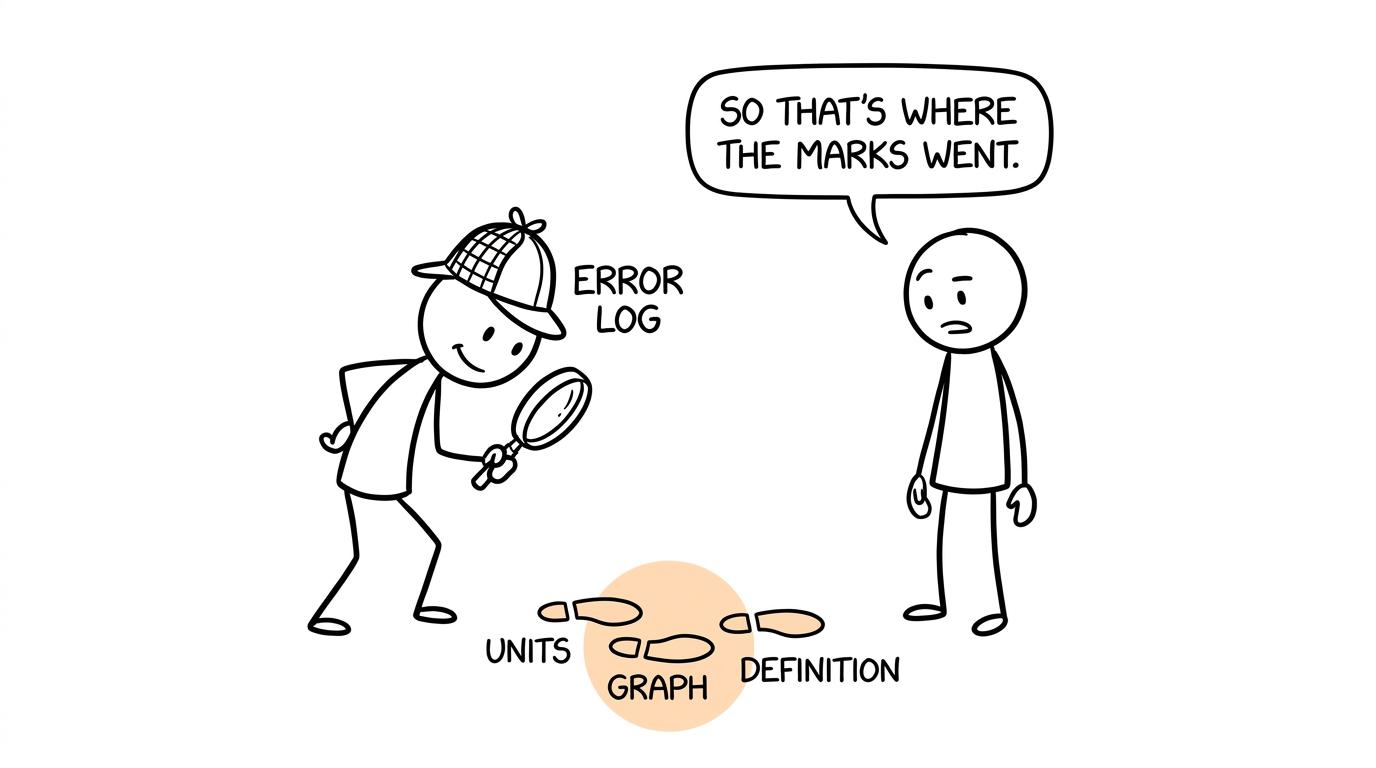 A detective-style error log discovers where units, graph and definition marks disappeared
Common GCSE Chemistry planning mistakes
Planning by chapter size
A long chapter is not automatically your biggest priority. Allocate time according to weakness, exam relevance and the number of successful retests needed.
Filling every evening
A schedule without rest or buffer time is fragile. Leave space for unexpected homework, illness and demanding exam weeks.
Reading instead of retrieving
Reading can rebuild understanding, but it does not prove that you can recall or apply knowledge. Close the book, answer something and then check.
Saving questions until the end
Exam questions are diagnostic tools, not merely final tests. Use them early enough for their feedback to alter your plan.
Ignoring Paper 2 while preparing for Paper 1
Paper 1 may be closer, but abandoning later content creates a second revision crisis. Keep one or two brief Paper 2 maintenance slots in the schedule.
Treating Chemistry calculations as somebody else’s problem
If ratios, percentages, standard form or graphs cost you marks, repair them directly. Short MathsGenie GCSE mini tests can fit beside Chemistry revision without consuming an entire evening.
Turn the countdown into your next action
Working backwards does not make the examination easy. It makes today clear.
Enter your confirmed paper dates, reserve the final review and timed-paper phases, then distribute weak topics across the remaining sessions. Include practical knowledge, calculations, marking and retesting. Finally, add buffer time so the plan can survive an imperfect week.
Use MathsGenie as the free maths engine underneath your Chemistry preparation. Strengthen calculation skills through revision lessons and practice questions, check progress with mini tests, and build exam discipline through past papers, mark schemes and video solutions. As your maths examinations approach, add GCSE predicted papers to your wider revision planner.
Start with one action today: confirm the exam dates and schedule the final week first. Once the destination is fixed, the route becomes much easier to see.