GCSE Chemistry Revision: Silence or Noise?
GCSE chemistry revision silence or noise? Explore the evidence on lyrics, instrumental music and the best conditions for reading, recall and calculations.
Revision can look productive while quietly achieving very little. The textbook is open. A playlist is running. You have highlighted three paragraphs. Yet if somebody asked what you had just read, the answer might feel strangely distant.
So, for GCSE chemistry revision, silence or noise: which is better? The most defensible answer is silence for demanding reading, memorisation and exam practice. If silence makes it difficult to begin or masks unpredictable household sounds, quiet instrumental audio may be a reasonable alternative. Music with lyrics, background speech and frequently changing tracks are the riskiest choices because they compete with the language and memory processes revision requires.
The evidence does not show that everyone must always revise in total silence. It does suggest that feeling focused and performing well are not necessarily the same thing.
The quick revision sound checklist
Use this as your starting point:
- Choose silence for learning unfamiliar content, recalling definitions and completing timed papers.
- Avoid music with lyrics while reading explanations or writing extended answers.
- If needed, use quiet, familiar instrumental audio during routine tasks.
- Avoid television, podcasts and nearby conversations.
- Keep the volume low and the sound predictable.
- Test your choice using marks and recall, not mood alone.
- Practise some sessions in silence because the real examination will not come with a playlist.
The central idea is simple: match the sound environment to the mental demand of the task.
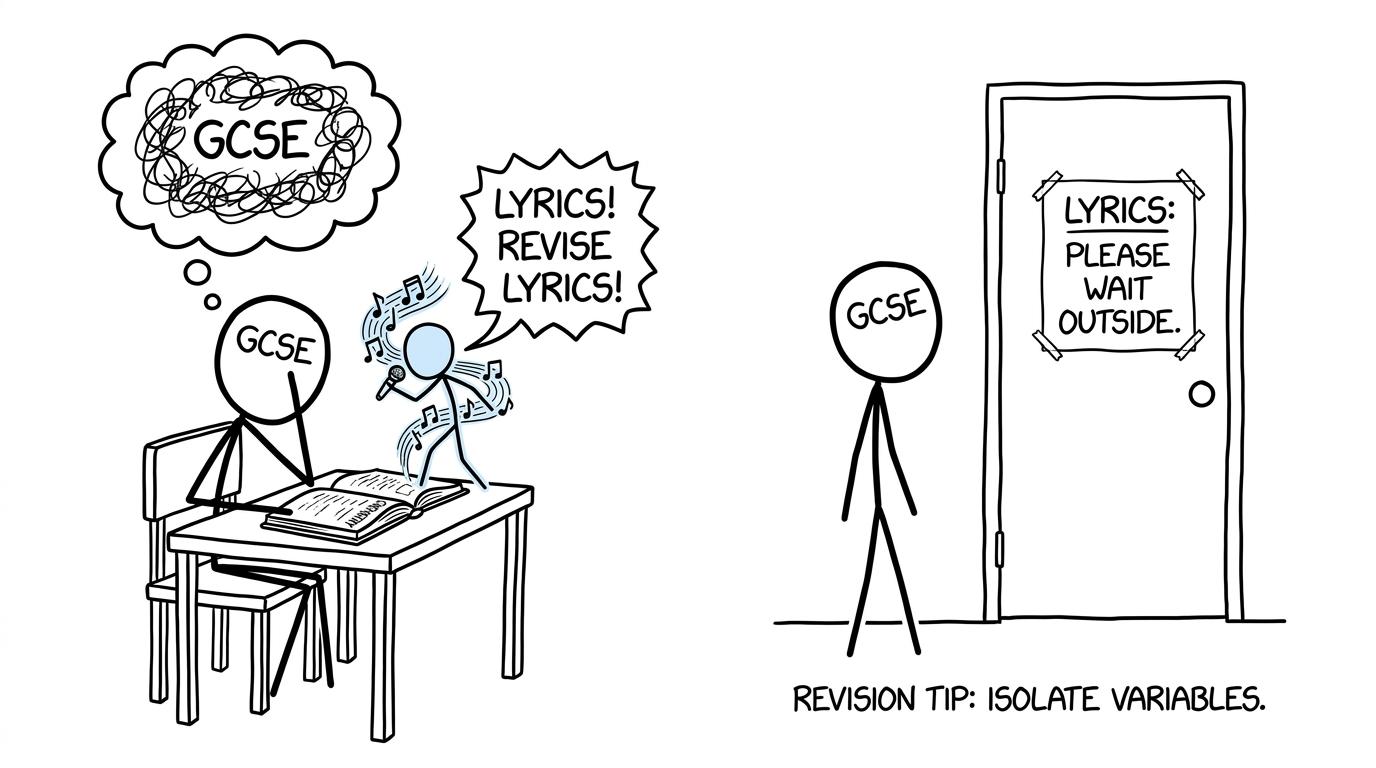 A student politely asking song lyrics to wait outside the revision room
What the evidence actually says about silence and noise
Research into background music is more nuanced than claims such as “classical music makes you clever” or “all noise destroys concentration”. Different studies use different tasks, types of audio and groups of participants. Results therefore vary.
However, several patterns are reasonably consistent.
A systematic review covering memory, language, reasoning, attention and other cognitive tasks found that background music did not have one universal effect. In many comparisons, it made no clear difference. Where harm did appear, music with lyrics was particularly likely to interfere with memory and language-based performance. Instrumental music was generally less disruptive than lyrical music, but it did not reliably improve performance.
A large meta-analysis of auditory distraction during reading reached a similar conclusion. Background speech, noise and music had small negative effects on reading overall, with intelligible speech and lyrical music producing the greatest distraction. The effects were often modest, but revision is built from many modest moments. A small loss of comprehension repeated across an evening can matter.
A controlled study published in 202320232023 compared silence, instrumental lo-fi music and lyrical music. Lyrics reduced performance in verbal memory, visual memory and reading comprehension. Instrumental music produced no credible improvement over silence, although participants sometimes felt that it helped.
That final distinction matters. Enjoyment can make revision feel easier without making recall more accurate.
Why chemistry makes background speech especially risky
GCSE Chemistry is not a single type of mental task. Whether you follow AQA, Edexcel, OCR or Eduqas, revision can involve reading technical explanations, retrieving precise vocabulary, interpreting practical methods, rearranging equations and analysing graphs.
Lyrics and conversations are especially distracting when the task also contains language. Your attention is asked to process two verbal streams at once: the chemistry in front of you and the words entering through your headphones.
This is most relevant when you are:
- learning definitions and required terminology;
- reading about bonding, electrolysis or rates of reaction;
- recalling practical methods and sources of error;
- explaining trends or observations;
- interpreting command words;
- writing structured examination answers.
Instrumental audio removes the competing words, but it can still attract attention through dramatic changes, familiar melodies or the temptation to select another track. A quiet song that causes you to adjust the playlist every few minutes is not really background sound. It is a series of interruptions.
Silence is usually best for high-effort revision
Silence gives demanding work fewer competitors. That does not make the work effortless. In fact, silence can reveal how difficult a topic really is, which may be why music sometimes feels helpful. It softens the discomfort.
But productive revision often includes that discomfort. Trying to retrieve a definition before checking it, completing an unfamiliar calculation or explaining a practical from memory should require effort. That effort gives you information about what you can actually do.
Choose silence when you are:
- learning a new chemistry topic;
- using active recall without notes;
- answering unfamiliar exam questions;
- checking whether you can remember equations and units;
- marking work carefully;
- sitting a timed paper.
This applies equally to mathematical work within science. Chemistry calculations can require proportional reasoning, graph interpretation, standard form and rearranging formulae. If those skills need strengthening, MathsGenie’s Edexcel GCSE Maths revision hub brings together free lessons, worksheets and exam-style questions. Eduqas students can use the equivalent Eduqas GCSE Maths revision resources.
When background sound may be a practical compromise
Silence is a strong default, not a moral rule. Some students revise in homes where conversations, traffic or other unpredictable sounds cannot be removed. In that situation, steady instrumental audio may mask more disruptive noise.
It may also help with low-demand tasks such as:
- organising notes;
- preparing flashcards from material already understood;
- checking completed work;
- sorting questions by topic;
- setting up a revision timetable.
If you use background audio, choose something quiet, familiar and without lyrics. Avoid tracks with sudden changes. Put the playlist on before beginning, then leave the controls alone.
There is also a difference between starting and learning. Music may make sitting down feel less unpleasant. One sensible compromise is to use instrumental sound for a short set-up period, then switch it off when active recall or exam questions begin.
MathsGenie’s guide to building a GCSE revision timetable you can follow can help you define the task before the session starts. A clear task removes one reason students reach for their phones and playlists: uncertainty about what to do next.
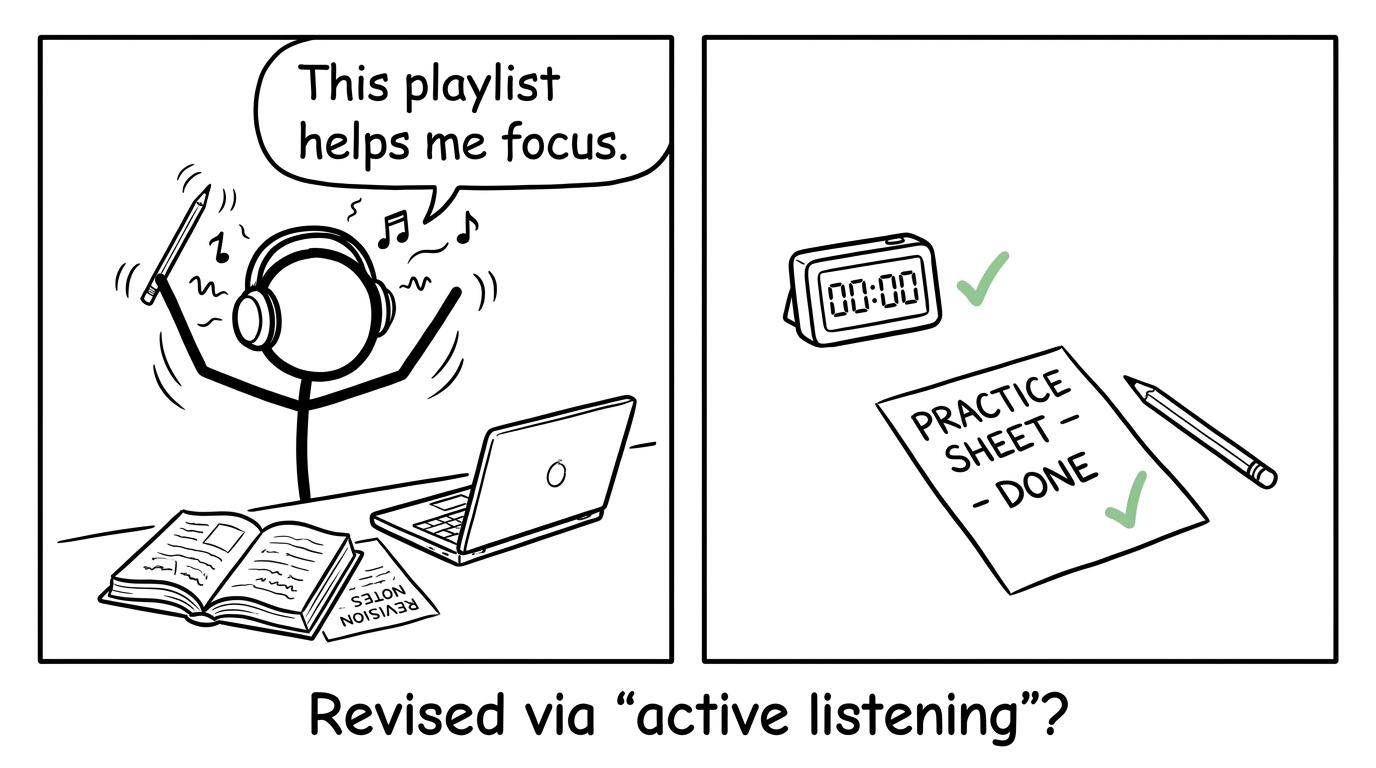 A playlist claims to improve focus while a quiet practice sheet gets the work done
Test your revision environment rather than guessing
Preferences are real, but they are not perfect evidence. You may prefer music because it improves your mood, covers distracting sounds or makes time pass faster. None of those feelings proves that you remembered more.
Run a small personal test across three comparable revision sessions:
- one in silence;
- one with quiet instrumental audio;
- one in your usual sound environment.
Keep the topic difficulty, session length and question type as similar as possible. At the end, record:
- how many questions you completed;
- how many marks you earned;
- how often you checked your phone or changed tracks;
- what you could recall the following day;
- how mentally tired you felt.
Do not judge from one session. Sleep, topic familiarity and mood can distort a single result. Repeat each condition before deciding.
The best environment is the one that supports accurate recall and sustained work, not simply the one that feels most pleasant. This measurement-first approach is also useful in maths. The GCSE one-month revision plan explains how short retrieval, focused practice and mark-scheme review can turn revision into visible evidence of progress.
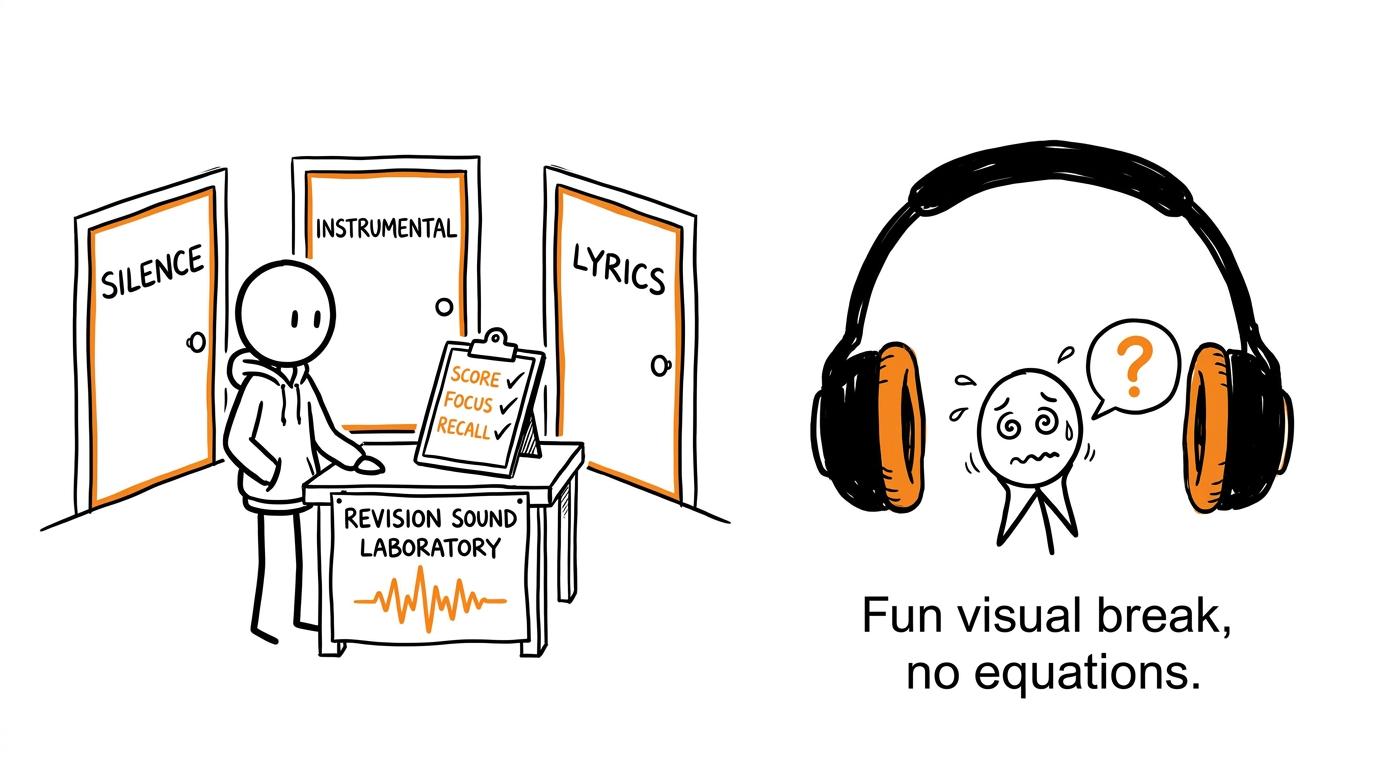 A student conducting a tiny experiment on silence, instrumentals and lyrics
Match the sound to each stage of revision
A useful routine separates learning, retrieval and examination practice.
Learning and understanding
Use silence where possible. Read a short section, close the resource and explain the idea without looking. If you cannot explain it precisely, return to the source and repair the gap.
Retrieval and practice questions
Again, silence is usually best. Retrieval is meant to show whether knowledge is available without prompts. Lyrics can become an accidental cue, making information seem easier to remember in revision than it will be in the examination hall.
Marking and correction
Quiet instrumental audio is less likely to cause difficulty here, provided the task is routine. Switch back to silence if you are reading detailed mark-scheme wording or diagnosing why an answer lost marks.
Timed paper practice
Use silence and realistic conditions. Your sound environment is part of exam preparation, just like timing and equipment. Maths students can build this habit with board-specific papers and guidance on when to start GCSE past papers.
Nearer the examination, MathsGenie’s Edexcel GCSE predicted papers provide fresh timed practice. Predicted papers should support topic revision and official past-paper work rather than replace them.
Common mistakes when choosing revision sounds
Assuming preference equals performance
A favourite playlist may improve mood while reducing recall. Check completed questions, marks and next-day memory.
Choosing “instrumental” music that demands attention
Film scores, dramatic electronic music and familiar melodies can still pull attention away. Instrumental does not automatically mean neutral.
Revising with television or a podcast
Speech is difficult to ignore, particularly during reading. A programme playing “in the background” still competes for language processing.
Changing songs repeatedly
Searching, skipping and adjusting volume break concentration. If you need audio, prepare one stable playlist and keep the phone out of reach.
Never practising in exam conditions
Even if instrumental sound helps you start ordinary revision, complete regular silent sessions. A silent examination room should feel familiar rather than unusually exposed.
Blaming the environment for an ineffective method
Perfect silence cannot rescue passive rereading. Strong revision requires retrieval, practice questions, marking and correction. MathsGenie’s guide to using Edexcel past papers properly shows how the attempt-mark-fix-retest cycle turns paper practice into learning.
The calmest answer is also the most useful
There is no evidence that one soundtrack unlocks everybody’s concentration. The clearest practical conclusion is narrower: silence is the safest default for difficult reading, memory work and examination practice; lyrics and background speech are more likely to interfere; quiet instrumental sound can be an acceptable compromise, but it is not a proven learning boost.
Start by removing words. Then test silence against quiet instrumental audio using actual recall and marks. Keep whichever environment helps you perform, and retain regular silent practice for exam readiness.
For maths alongside your science revision, make MathsGenie’s free GCSE and A Level maths resources your next stop. Use revision lessons to rebuild weak methods, practice questions and mini tests to test them, then past papers and predicted papers to develop timing. Mark every attempt with the available mark schemes and use video solutions when the method is unclear.
The goal is not to create a revision session that looks focused. It is to build knowledge you can retrieve when the room becomes quiet and the paper begins.