GCSE Chemistry Revision Book Reviews: Buying Guide
GCSE chemistry revision book reviews can mislead. Learn how to check the exam board, tier, specification coverage, questions and answers before buying.
A revision guide can look reassuring on a shelf. The cover promises complete coverage. The online rating is glowing. The pages are bright, tidy and considerably less alarming than your class notes.
But none of that proves it is the right book for your exam.
Reading GCSE chemistry revision book reviews is worthwhile before buying, but star ratings should only begin your investigation. Check the guide against your exam board, qualification, tier and current specification. Then inspect how well it teaches calculations, practical methods and exam technique. A popular book that does not match your course is still the wrong book.
For students balancing chemistry with GCSE maths revision, there is another question: will the guide help you practise the numerical skills chemistry actually examines? In separate GCSE Chemistry, at least 20%20\%20% of the marks assess mathematical skills. That makes the quality of its calculation support more than a minor detail.
Your pre-purchase checklist
Before spending anything, confirm that the book:
- names your exam board: AQA, Pearson Edexcel, OCR or Eduqas;
- matches separate Chemistry or the correct Combined Science route;
- covers your foundation or higher tier requirements;
- follows the current specification rather than an older course;
- includes required practical knowledge and data analysis;
- teaches chemistry calculations clearly and uses correct units;
- provides enough exam-style questions, not just summaries;
- includes accessible answers or a separate answer book;
- explains why answers gain marks;
- suits the way you genuinely revise.
That final point matters. The best book is not the one reviewers admire most. It is the one you will use actively.
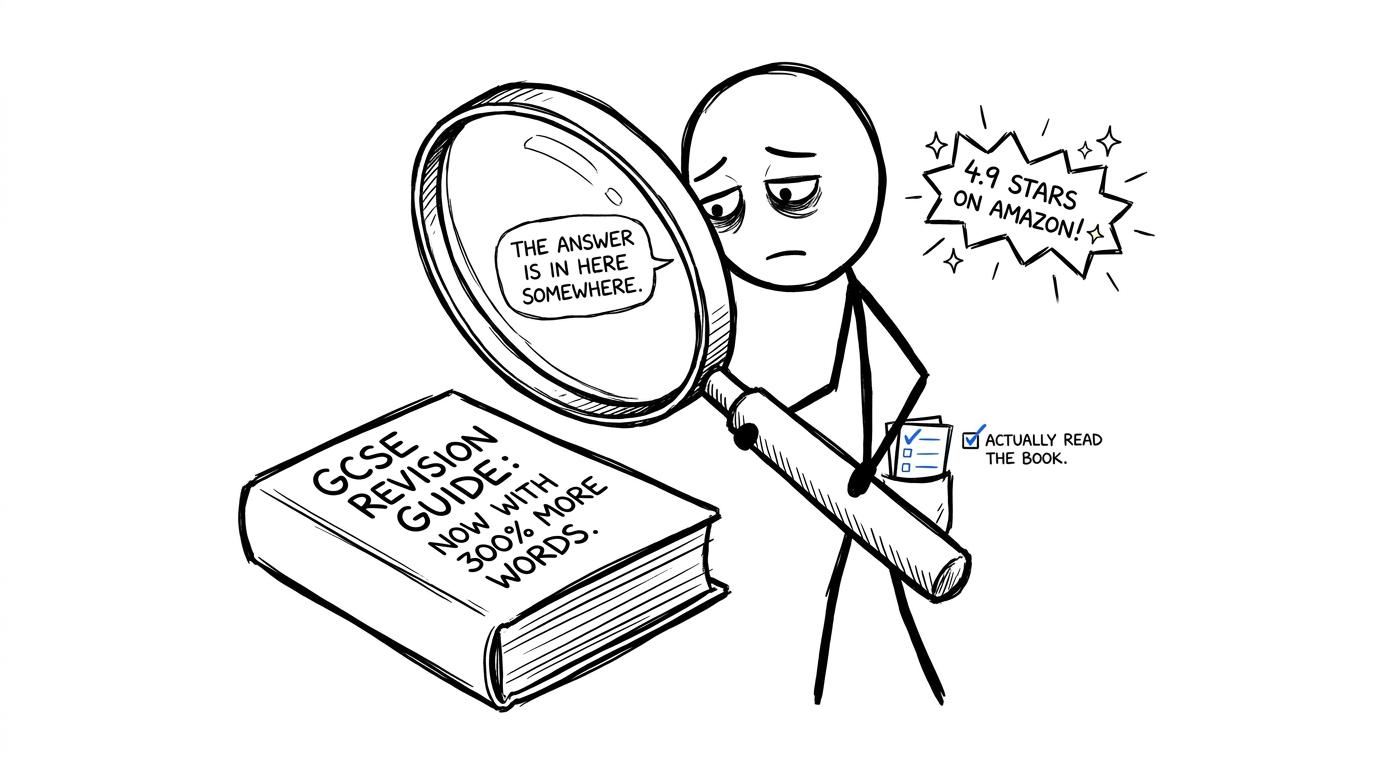 A GCSE student inspecting a revision guide rather than being distracted by its star rating
What GCSE chemistry revision book reviews can tell you
Reviews are useful for discovering practical details that a publisher's description may not make obvious. Readers might comment on whether explanations are concise, diagrams are readable, answers contain enough detail or pages feel overcrowded.
Look for patterns across several reviews. One person disliking a writing style tells you about that person. Many independent reviewers reporting missing answers or unclear explanations may reveal a real limitation.
The most helpful reviews tend to answer specific questions:
- Does the guide distinguish higher-only content clearly?
- Are calculations explained in manageable stages?
- Are practical procedures linked to exam questions?
- Do questions resemble the command words and demand of the examination?
- Is there enough space to annotate or work?
Treat vague praise cautiously. “Brilliant book” provides less evidence than a review explaining how the practice questions, answers and layout work.
Reviews also become less reliable when editions are mixed together. A product page may contain comments about an earlier edition, a different exam board or a Combined Science version. Check which exact book each reviewer appears to mean.
Check the exam board before anything else
A revision book should state its board and qualification clearly. AQA GCSE Chemistry is not organised identically to Pearson Edexcel GCSE Chemistry, while OCR offers different science routes. Eduqas has its own specification and assessment structure.
There is substantial chemistry in common, but topic organisation, terminology, required practical expectations and paper structure can differ. “GCSE Chemistry” on the front cover is therefore not enough.
Find your qualification details through your school, teacher or exam-entry information. Then compare the book's title page, edition and publication details with the current official specification. The specification is the authority when a book and an online comment disagree.
Make sure you are not accidentally buying:
- a guide for Combined Science when you take separate Chemistry;
- a separate Chemistry book when you only need the Combined Science content;
- an outdated guide for a previous grading system;
- the correct board but the wrong OCR route;
- a workbook that assumes you already own a separate revision guide.
The same discipline improves maths revision. MathsGenie's guide to GCSE maths topics by exam board and tier explains why knowing your precise course should come before choosing resources.
Make sure the book fits your tier
GCSE single sciences use foundation and higher tiers. Foundation questions target grades 111 to 555, while higher questions target grades 444 to 999. Students normally take all assessments for the qualification at the same tier.
Some chemistry guides cover both tiers and label higher-only material. Others are sold as separate foundation and higher books. Either approach can work, provided the labelling is unmistakable.
Open several pages rather than trusting the cover. Higher-only material should be easy to identify without making foundation students feel that half the book is an unexplained detour. Higher-tier students, meanwhile, need complete coverage rather than a foundation summary with a few harder boxes added.
If your tier has not been settled, ask your teacher before buying. A purchasing decision should not become an accidental tier decision.
Test the maths coverage inside the chemistry guide
Chemistry is not a maths examination in disguise, but numerical fluency affects a meaningful share of the marks. Official GCSE Chemistry requirements include ratios, fractions, percentages, standard form, significant figures, means, graphs, substitution and rearranging equations.
A useful guide should support relationships such as:
percentage yield=actual yieldtheoretical yield×100\text{percentage yield}=\frac{\text{actual yield}}{\text{theoretical yield}}\times 100percentage yield=theoretical yieldactual yield×100and
amount in moles=massrelative formula mass.\text{amount in moles}=\frac{\text{mass}}{\text{relative formula mass}}.amount in moles=relative formula massmass.The point is not merely whether these equations appear. Check whether the book explains units, significant figures, proportional reasoning and how to recognise which relationship is needed. It should also show students how to extract values from tables and interpret the gradient of a graph where the specification requires it.
This is where chemistry and maths revision can support each other. If standard form or ratio is causing errors in chemistry, repair the underlying skill rather than memorising one chemistry question. MathsGenie's free GCSE and A Level maths revision hub and revision resources provide lessons, exam questions, solutions, mini tests and papers for targeted practice.
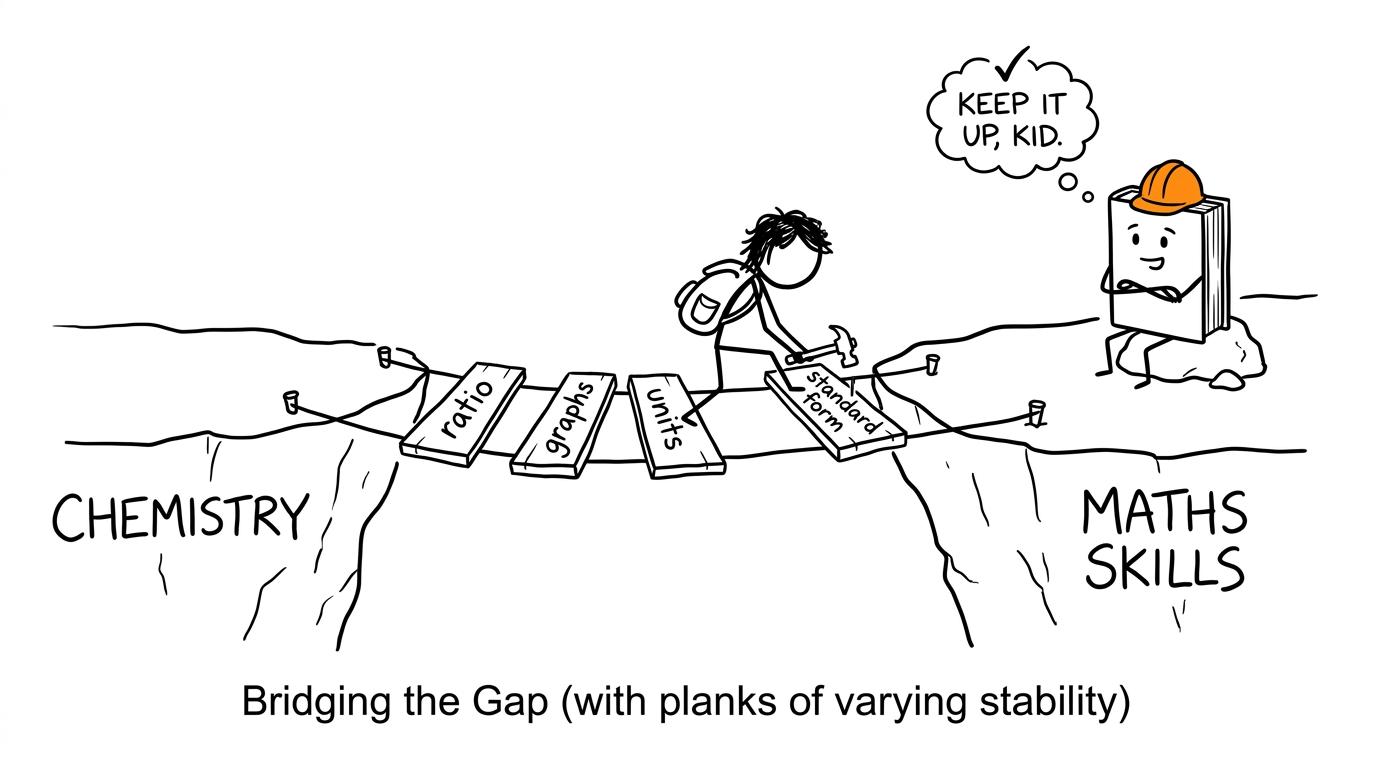 A student building a bridge between chemistry and maths skills
Inspect the questions, answers and practical coverage
A revision guide can be accurate yet too passive. Reading polished summaries often creates familiarity: the page makes sense while it is open, but the idea becomes difficult to retrieve when the book closes.
Look for frequent questions that require recall, application, analysis and evaluation. Current GCSE Chemistry assessment objectives give substantial weight to applying knowledge, not simply repeating facts. Questions should include unfamiliar contexts, data, practical methods and extended responses as well as short factual checks.
Required practicals deserve close inspection. A strong book should address variables, apparatus, observations, risks, measurements, graphs, uncertainties and possible improvements. A colourful photograph of laboratory equipment is not a substitute for explaining how practical understanding is assessed in a written paper.
Answers matter just as much as questions. A bare final answer can confirm whether you were right, but it may not reveal why you lost a method mark, used the wrong unit or failed to answer the command word. Ideally, the resource offers worked reasoning, marking guidance or a clear route to fuller solutions.
Apply the same principle in maths: practise, mark and repair. MathsGenie's advice on finding your weakest GCSE topics shows how to turn lost marks into specific actions rather than vague revision goals.
Decide whether you need a guide, workbook or both
A revision guide mainly explains and condenses content. A workbook mainly provides questions. Some products combine both, but the balance varies sharply.
Choose according to the gap you need to close:
- If class notes feel confusing, prioritise clear explanations and diagrams.
- If you understand lessons but struggle to retrieve facts, look for self-testing and concise summaries.
- If calculations fail under pressure, prioritise graded practice and detailed answers.
- If exam responses are weak, choose exam-style questions with marking guidance.
Preview pages whenever possible. A short sample often tells you more than dozens of star ratings. Read one explanation, attempt one question without looking back, and inspect its answer. You are testing the revision process, not the cover design.
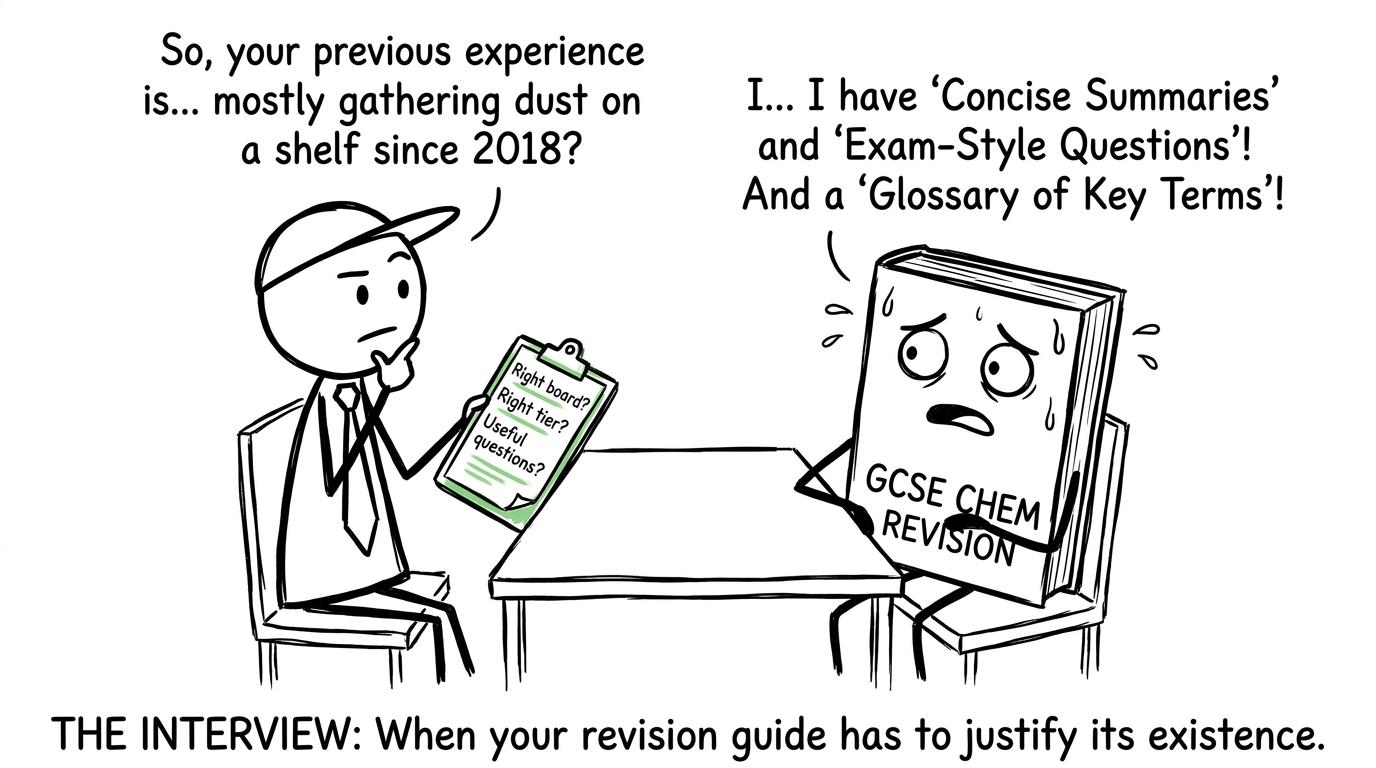 A chemistry revision guide being interviewed by a student with a practical buying checklist
Consider value beyond the purchase price
A cheaper book is poor value if it remains unopened. An expensive bundle is no better if it duplicates resources your school already provides.
Before buying, check your school library, department resources and any digital access supplied with your course. Ask whether your teacher recommends a particular edition. If buying second-hand, confirm that pages are present, answer sections have not been removed and the edition still matches the specification.
Also consider the hidden cost of fragmentation. Five overlapping books can create more decisions without creating more practice. One suitable chemistry guide, used alongside official past papers and purposeful maths support, may be enough.
MathsGenie's one-week GCSE maths revision plan illustrates a useful wider principle: a small number of resources used in a clear cycle often beats a large collection used randomly.
Common mistakes when choosing a chemistry revision book
Buying from the average rating alone
Star ratings combine different readers, editions and expectations. Read recent, detailed comments and verify every essential feature yourself.
Confusing separate Chemistry with Combined Science
The courses overlap, but they are not interchangeable. Match the exact qualification shown on your exam entry or confirmed by your teacher.
Ignoring the publication edition
A clean second-hand copy may still reflect an old specification. Check the edition against the current exam-board information before paying.
Choosing concise notes without enough practice
Short summaries feel efficient, but examinations reward recall, application and analysis. Make sure the book requires you to answer questions without copying from the facing page.
Treating calculation errors as chemistry-only problems
A mistake involving percentages, ratio, rearranging, graphs or standard form may expose an underlying maths gap. Use topic practice to fix that gap. The revision cycle in GCSE maths topics that come up every year offers a practical learn, practise and test structure.
Collecting resources instead of using them
Buying a new book can feel like progress because it is concrete. Real progress begins when you attempt a question, mark it honestly and revisit the weakness. The same is true when deciding when to start GCSE past papers: the review after the paper matters as much as completing it.
A better way to make the final decision
Yes, it is worth reviewing a GCSE Chemistry book before buying it. But review the book as an examiner would review evidence.
Confirm the board, qualification, tier and edition. Compare its contents with the current specification. Inspect its calculations, practical coverage, questions and answers. Then ask whether its layout will encourage active recall and regular practice.
Once your chemistry resource is chosen, keep your wider revision system simple. Use the book for chemistry knowledge and exam practice, and use MathsGenie to strengthen the mathematical skills that cross into science. Begin with revision lessons, move to practice questions and mini tests, and then use past papers, predicted papers, mark schemes and video solutions to expose what still needs attention.
A book should not merely look complete on your desk. It should help you become more complete without it open.