GCSE Chemistry Half-Term Revision That Gets Done
GCSE chemistry half-term revision made manageable: build a focused plan, use active recall, repair weak maths skills and still enjoy a proper break.
Half-term often begins with an optimistic thought: I finally have time to catch up. Then the first morning disappears, the revision list grows in your head, and chemistry starts to feel too large to begin.
Effective GCSE chemistry half term revision does not require sacrificing the whole break. The practical answer is to choose a small number of weak areas, complete short sessions built around recall and exam questions, mark your work, and revisit your mistakes later in the week. Protect your free time by deciding in advance when revision stops.
This article gives you a realistic structure. It also shows you how to strengthen the maths inside chemistry calculations using MathsGenie's free GCSE maths revision resources.
Your half-term revision checklist
Before building a detailed timetable, keep the essentials visible:
- Confirm your exam board and whether you study combined science or separate chemistry.
- Use your specification, teacher guidance and recent assessments to identify gaps.
- Select three or four priority topics rather than promising to revise everything.
- Schedule short, specific sessions with a clear finishing time.
- Recall information before reopening your notes.
- Complete exam questions and use the mark scheme immediately.
- Record mistakes by type, not merely by topic.
- Revisit difficult material on another day.
- Leave substantial parts of the break free.
The goal is not to finish chemistry. Nobody finishes a subject in a week. The goal is to return to school with fewer fragile areas and a clearer idea of what to do next.
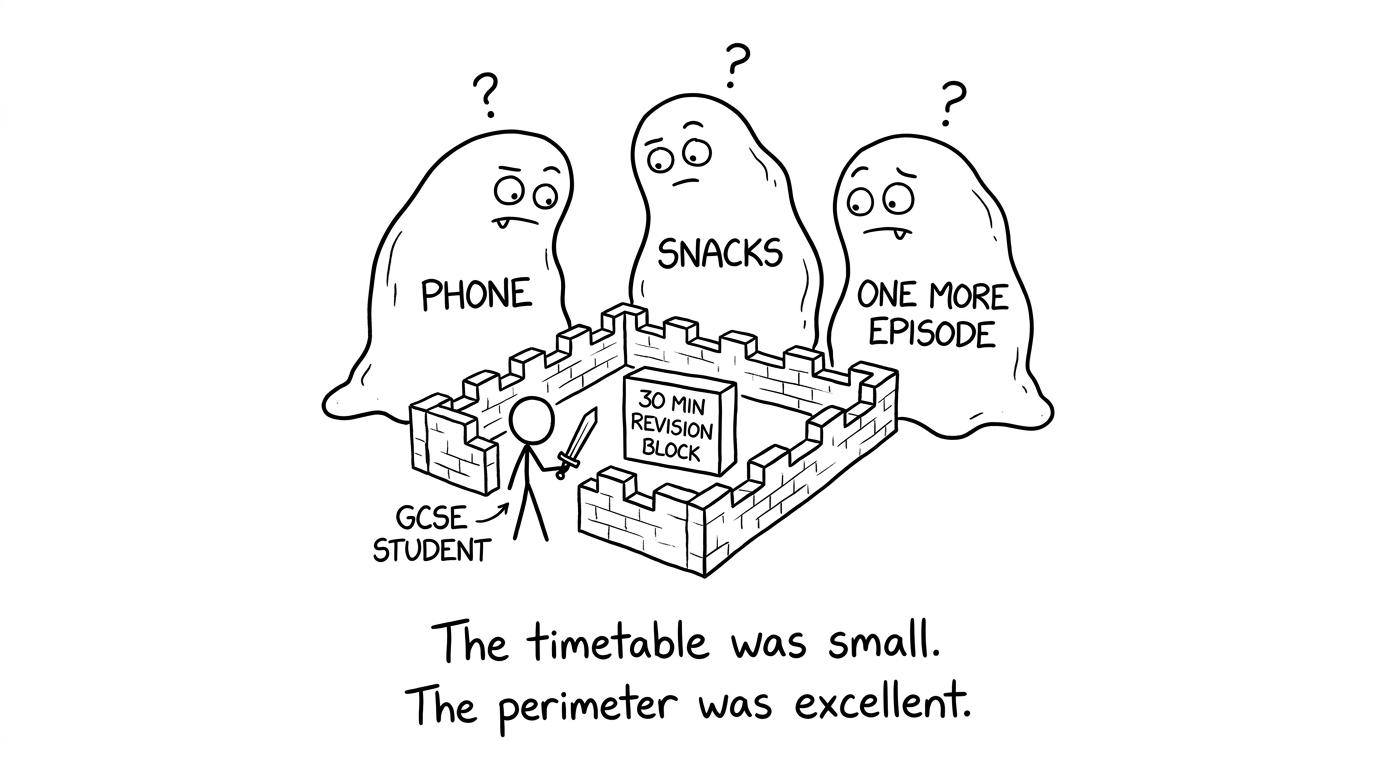 A student protecting a small revision block from distractions
Begin with evidence, not guilt
Revision plans often fail because they are built around vague feelings. A student thinks, I am bad at chemistry, then writes “revise chemistry” across five afternoons. That instruction is too broad to produce action.
Use evidence instead. Look through a recent test, homework, topic checklist or set of exam questions. Sort each weak area into one of four categories:
- Knowledge: you could not recall a fact, definition or process.
- Application: you knew the content but could not apply it in an unfamiliar context.
- Exam writing: your response lacked the precise scientific explanation required.
- Maths: the difficulty came from units, ratios, rearranging, graphs or calculator use.
Now turn broad topics into precise targets. “Revise quantitative chemistry” might become “practise rearranging concentration equations” or “check units before substitution”. “Revise rates” might become “interpret rate graphs and explain changes using collision theory”.
If your current grade feels stuck, the diagnostic approach in GCSE chemistry revision when you are stuck on a pass can help you separate content gaps from calculation and exam-writing problems.
Build a plan that leaves room for half-term
A useful timetable is not the one containing the most hours. It is the one you will still follow when the weather is good, friends make plans or you simply need a slower morning.
Choose a repeatable daily window. For many students, one focused block of roughly 303030 to 505050 minutes is more manageable than an undefined afternoon. You might add a second block on one or two days, but it should be deliberate rather than driven by guilt.
A balanced seven-day rhythm could look like this:
- Opening day: complete a short diagnostic and choose priorities.
- Next two revision days: repair one content topic each day.
- Middle of the break: take a full day away from chemistry.
- Following revision day: focus on chemistry calculations and graphs.
- Later session: complete a mixed set under light time pressure.
- Final session: correct mistakes and prepare the next-school-week list.
Move the days around to suit your plans. The sequence matters more than the calendar: diagnose, repair, practise, mark and return.
If organising revision is the hardest part, adapt the principles in the MathsGenie revision timetable guide. Its central idea works across subjects: weak areas deserve scheduled attention, while marking and correction need their own time.
Give every session a finish line
“Revise bonding” has no natural ending. “Recall bonding models, answer six questions and correct them” does.
Before starting, write one outcome that can be observed. Good session targets include:
- retrieve key definitions without notes;
- label and explain a required practical method;
- answer one short group of questions on a single topic;
- correct the calculation errors from a recent assessment;
- create five questions to test again in two days.
When the outcome is complete, stop. A trustworthy stopping rule prevents one session from swallowing the day.
Use a revision loop rather than rereading
Rereading can feel smooth because the page is familiar. An exam is different: the notes are closed, the wording changes and you must produce the knowledge yourself.
Use this loop for each priority topic:
Retrieve
Close your materials and write what you can remember. Include definitions, diagrams, practical steps, observations and cause-and-effect explanations. This first attempt is allowed to be incomplete. Its purpose is to expose what is genuinely available from memory.
Check
Compare your recall with your class materials, specification and an exam-board-appropriate revision source. Add only what was missing or inaccurate. Do not copy an entire page because one sentence was weak.
Apply
Complete exam questions on that exact area. Chemistry questions often place familiar knowledge inside an unfamiliar experiment or context, so recall alone is not enough.
Mark and repair
Use the mark scheme carefully. Identify the missing knowledge, logic, terminology or calculation step. Rewrite an answer only after you understand why it lost marks.
Return
Test the same idea later in half-term without looking at the correction first. The second attempt tells you whether the repair lasted.
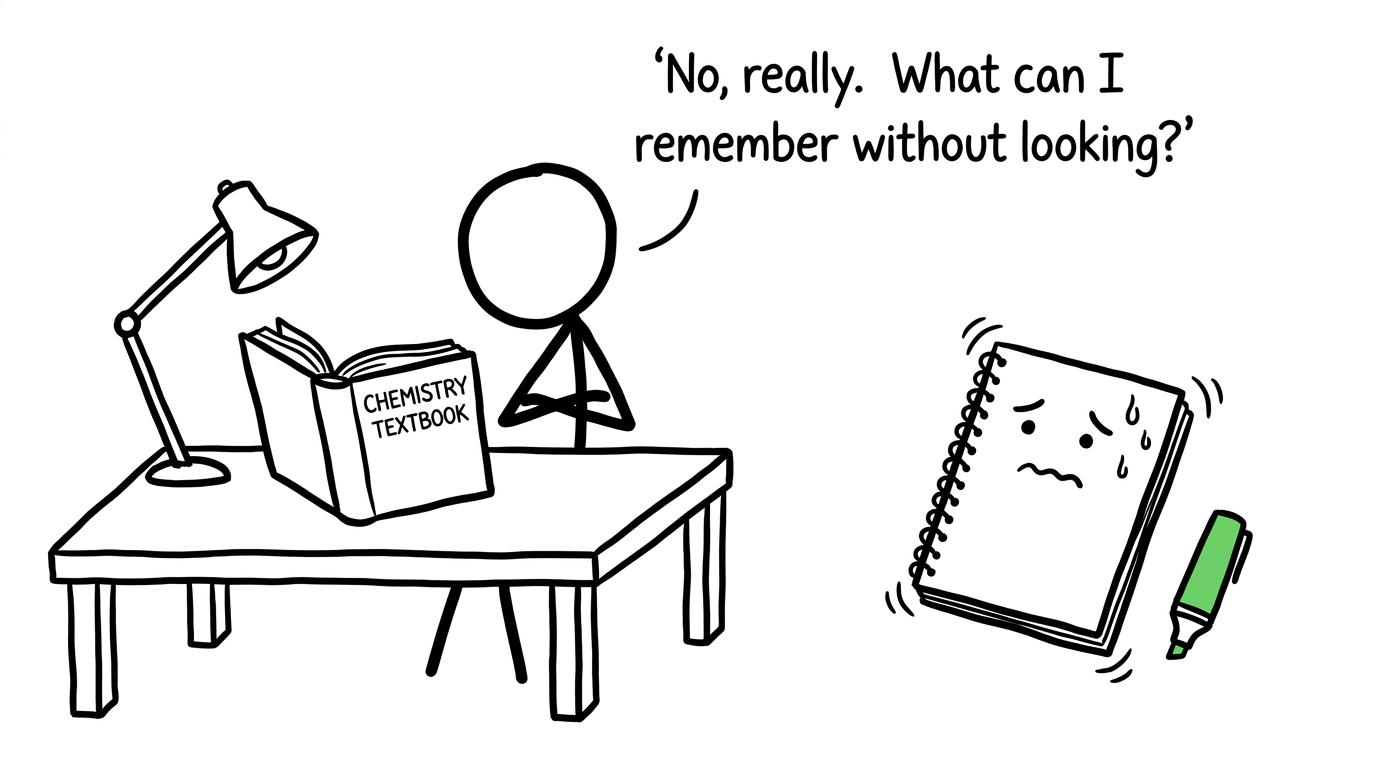 A student testing what they can recall without looking
Do not ignore the maths inside GCSE chemistry
Students sometimes respond to a difficult chemistry calculation by revising more chemistry content. Yet the obstacle may be a mathematical skill hiding underneath the scientific language.
Depending on your course and exam board, useful skills can include:
- substituting into and rearranging equations;
- working with ratios and proportional relationships;
- converting units;
- using standard form;
- calculating percentages;
- reading scales and plotting data;
- interpreting gradients and trends;
- selecting sensible precision for an answer.
For example, concentration relationships may be represented in the form
concentration=amount of solutevolume of solution.\text{concentration}=\frac{\text{amount of solute}}{\text{volume of solution}}.concentration=volume of solutionamount of solute.The chemistry tells you what the quantities mean. The maths determines whether you can choose the correct operation, rearrange the relationship and handle units accurately.
Do not build a separate, enormous maths programme during chemistry week. Create a short “chemistry maths” list from actual mistakes. Then use the GCSE MathsGenie learning hub to find revision lessons, practice questions, worksheets, videos and flashcards for the underlying skill.
The same principle applies to graphs. Ask whether you can read an awkward scale, recognise a proportional relationship and explain what a gradient represents in context. MathsGenie's guide to predicted GCSE topics and core maths skills highlights areas such as ratio, standard form and graph interpretation that can also support science calculations.
Make exam questions useful
Completing questions is only half the job. The marks improve when the feedback changes what you do next.
After marking a set, keep a concise error log with four details:
- the topic or micro-skill;
- why the mark was lost;
- the correction;
- when you will retest it.
Be specific. “Silly mistake” teaches you nothing. “Converted the volume after substituting instead of before” gives you a behaviour to change. “Did not link higher temperature to more successful collisions” identifies a missing reasoning chain.
You do not need to complete a full chemistry paper every day. Topic questions are better while rebuilding understanding. A timed section becomes useful once you can answer the underlying questions accurately. The broader paper-mark-repair rhythm explained in the MathsGenie one-month revision plan can be adapted for chemistry using your school's board-specific papers and mark schemes.
Protect concentration before demanding motivation
Motivation is unreliable. Environment is easier to arrange.
Put your phone outside reach, open the exact resources you need and set a visible timer. Begin with a tiny action such as writing the topic heading and recalling three facts. Starting reduces the weight of the session because the task is no longer imaginary.
Plan breaks before you begin. Revision should fit inside half-term, not spread across it like background noise. A morning session followed by a genuinely free afternoon is often calmer than carrying an untouched task around all day.
If you miss a planned block, do not double the next one automatically. Move the highest-priority task and discard something less important. A revision plan should respond to reality rather than punish you for it.
Common GCSE chemistry half-term revision mistakes
Trying to cover the whole specification
Breadth feels ambitious but often produces shallow contact with many topics. Choose the areas that currently cost you marks and finish those sessions properly.
Producing attractive notes without testing recall
Condensed notes can be useful, but only if they lead to retrieval and questions. Presentation is not evidence that the knowledge can be produced in an exam.
Marking work as simply right or wrong
A mark scheme is diagnostic. Look for missing scientific vocabulary, incomplete reasoning, unit errors and ignored command words.
Spending every day on the favourite topic
Comfort creates the appearance of productivity. Start with a weak but manageable area, then use a stronger topic later if you need variety.
Treating calculation errors as chemistry failures
If the science is understood but algebra, ratio or graphs cause the problem, repair that mathematical skill directly. Students taking Edexcel can use the workflow in revising GCSE maths without wasting time, while OCR students can adapt the OCR GCSE revision efficiency guide.
Removing all rest from the timetable
A plan that assumes endless concentration is not demanding; it is fragile. Decide what “enough” means for each day, then allow the break to remain a break.
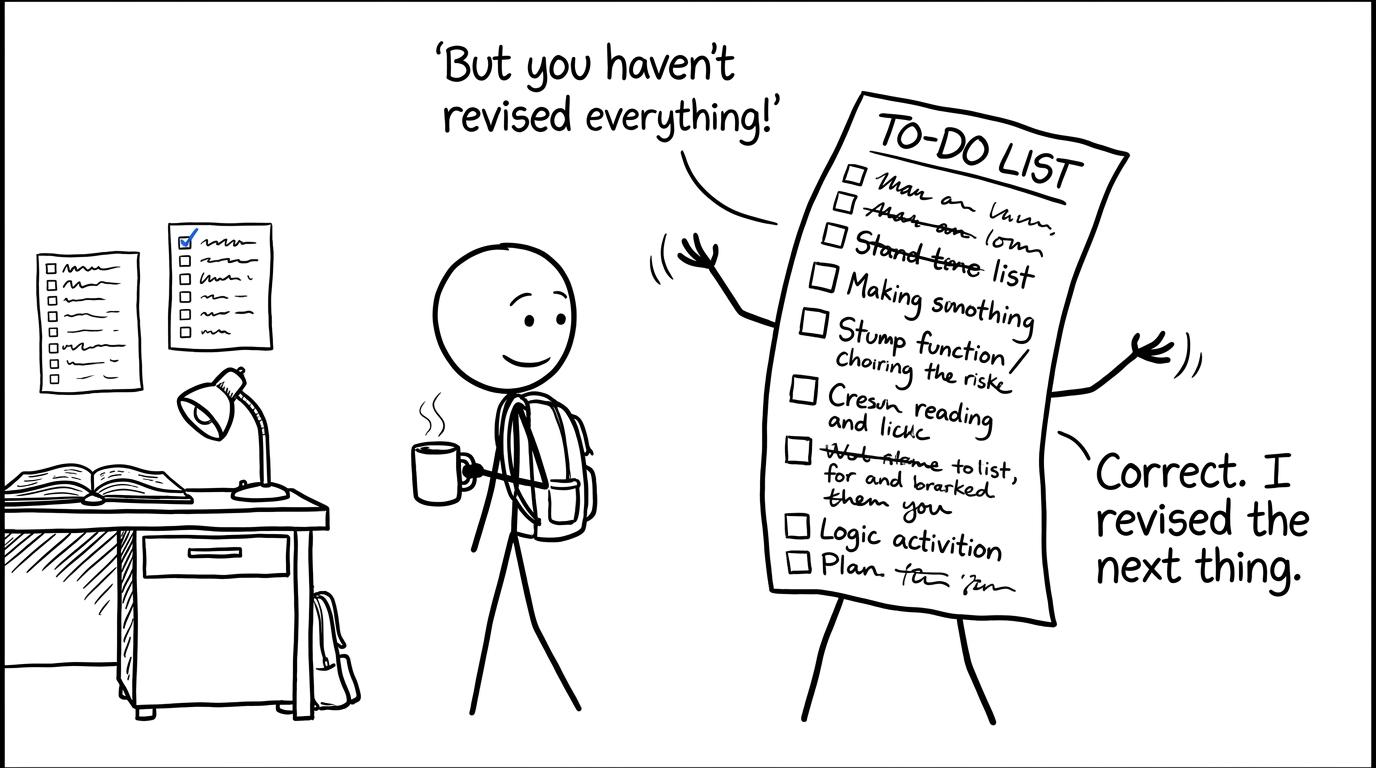 A student calmly leaving an unfinished master list
Finish half-term with a smaller next step
The best outcome is not a dramatic pile of completed pages. It is a short list of things you now understand, mistakes you have corrected and topics that still need attention.
On your final revision day, review the error log and choose the first two tasks for the following school week. That creates continuity. Half-term becomes one useful stage in revision rather than an isolated burst followed by silence.
For the mathematical side of chemistry, make MathsGenie your free revision base. Use revision lessons and practice questions to repair specific skills, mini tests to check them, and past papers, predicted papers, mark schemes and video solutions to build exam confidence in GCSE maths. Start with one chemistry calculation you recently found difficult, identify the maths beneath it, and fix that skill today.