GCSE Chemistry Edexcel Grade Boundaries Explained
GCSE chemistry Edexcel grade boundaries explained with the latest 2025 marks, tier differences and a calm checklist for GCSE results day 2026.
Results day has a peculiar ability to make one number feel larger than it is. If you are searching for GCSE chemistry Edexcel grade boundaries, the essential answer is simple: your marks across both Chemistry papers are added together, and your total is compared with the boundary for your tier. The exact 2026 boundaries will not be known until GCSE results day on Thursday 20 August 2026.
Until then, the June 2025 boundaries are the latest official comparison. They are useful context, but they are not predictions.
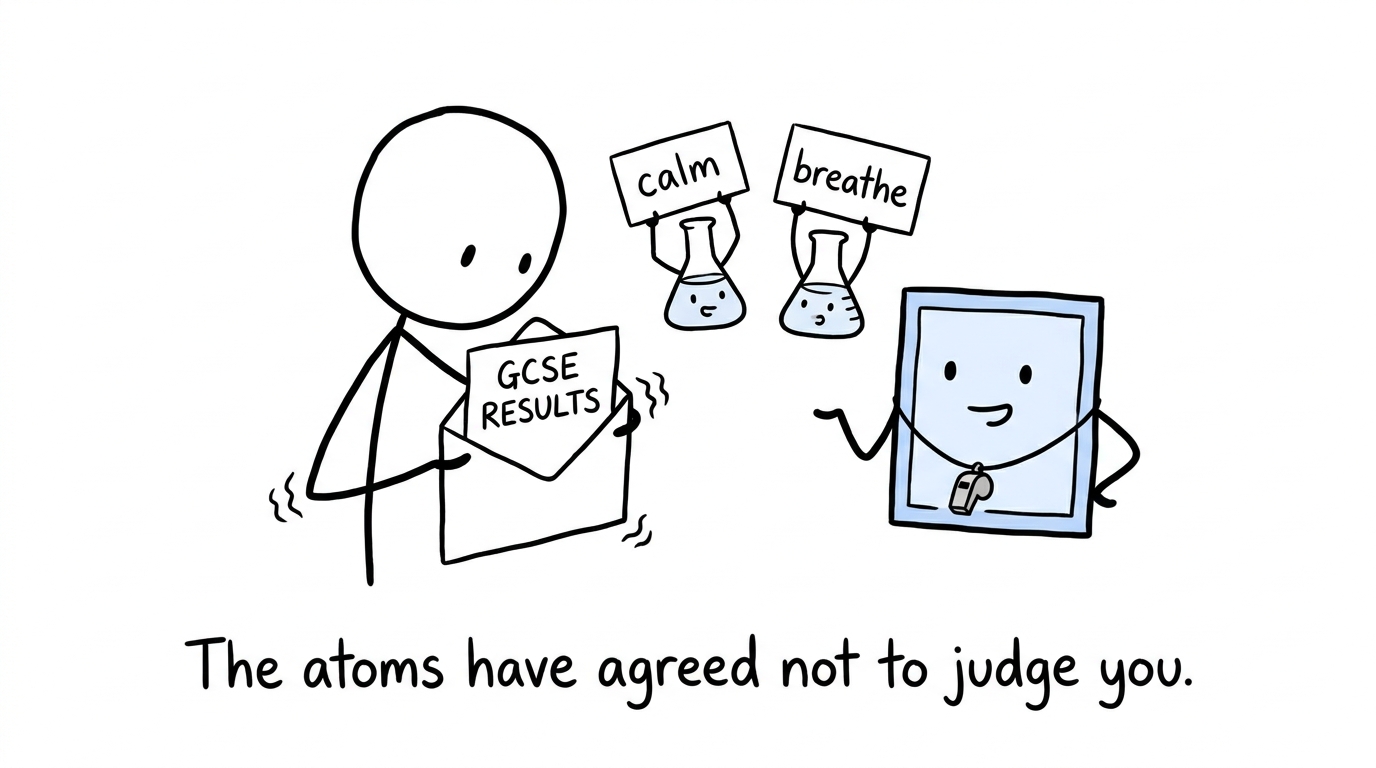 A student opening a results envelope while friendly chemistry beakers offer moral support
GCSE chemistry results day checklist
Before interpreting your result, check these details:
- Confirm that your qualification is Pearson Edexcel GCSE Chemistry, code 1CH0, rather than Combined Science or International GCSE Chemistry.
- Check whether you sat foundation papers 1F and 2F or higher papers 1H and 2H.
- Use the boundaries from your own examination series, not an earlier year.
- Remember that the final grade comes from your combined subject mark.
- Speak to your school if you need your component marks or want to discuss a review of marking.
Students taking Combined Science receive two GCSE grades and must use the Combined Science boundaries. The table below applies only to separate GCSE Chemistry.
Latest Edexcel Chemistry grade boundaries
Pearson Edexcel GCSE Chemistry consists of two equally weighted papers. Each is worth 100100100 marks, giving a total of:
100+100=200 marks 100+100=200\text{ marks} 100+100=200 marksThese were the official overall boundaries for the June 2025 series, the latest available boundaries before the 2026 results are released.
| Grade | Foundation minimum mark | Higher minimum mark |
|---|---|---|
| 999 | Not available | 161161161 |
| 888 | Not available | 144144144 |
| 777 | Not available | 128128128 |
| 666 | Not available | 106106106 |
| 555 | 124124124 | 848484 |
| 444 | 104104104 | 626262 |
| 333 | 787878 | 515151 |
| 222 | 525252 | Not available |
| 111 | 272727 | Not available |
A boundary is the minimum mark required for that grade. In 2025, for instance, the higher-tier grade 777 boundary was 128128128 out of 200200200. A total below that but at least 106106106 fell within the grade 666 range.
This is not a worked prediction for 2026. Boundaries can move substantially: the higher-tier grade 777 boundary was 109109109 in 2024 and 128128128 in 2025.
Why Edexcel Chemistry boundaries change
Grade boundaries are not fixed percentages chosen before the examinations. Once marking is nearly complete, exam boards use statistical evidence and expert judgement to maintain comparable standards between years. Senior examiners also review work around proposed boundaries.
If a paper proves more demanding, a boundary may be lower. If students generally find it more accessible, it may be higher. Ofqual confirms that there is no quota limiting how many students can receive a particular grade.
That is why a remembered rule such as “a grade 777 is always 70%70\%70%” is unreliable. The relevant figure is the official raw-mark boundary for your board, subject, tier and series.
Foundation and higher tier explained
Foundation tier normally awards grades 111 to 555. Higher tier normally awards grades 444 to 999, although Pearson’s specification allows a grade 333 when a candidate falls a small number of marks below the higher-tier grade 4/34/34/3 boundary. A lower result is unclassified.
The higher-tier grade 333 is therefore a limited safety net, not a complete extension of grades 111 to 333. Likewise, a strong foundation performance cannot produce a grade 666, because grade 555 is the highest available foundation grade.
Individual papers do not receive final grades. Pearson may publish notional component boundaries for Paper 1 and Paper 2, but these are intended to support teaching and mock assessment. Your certificated grade is based on the combined mark across both papers.
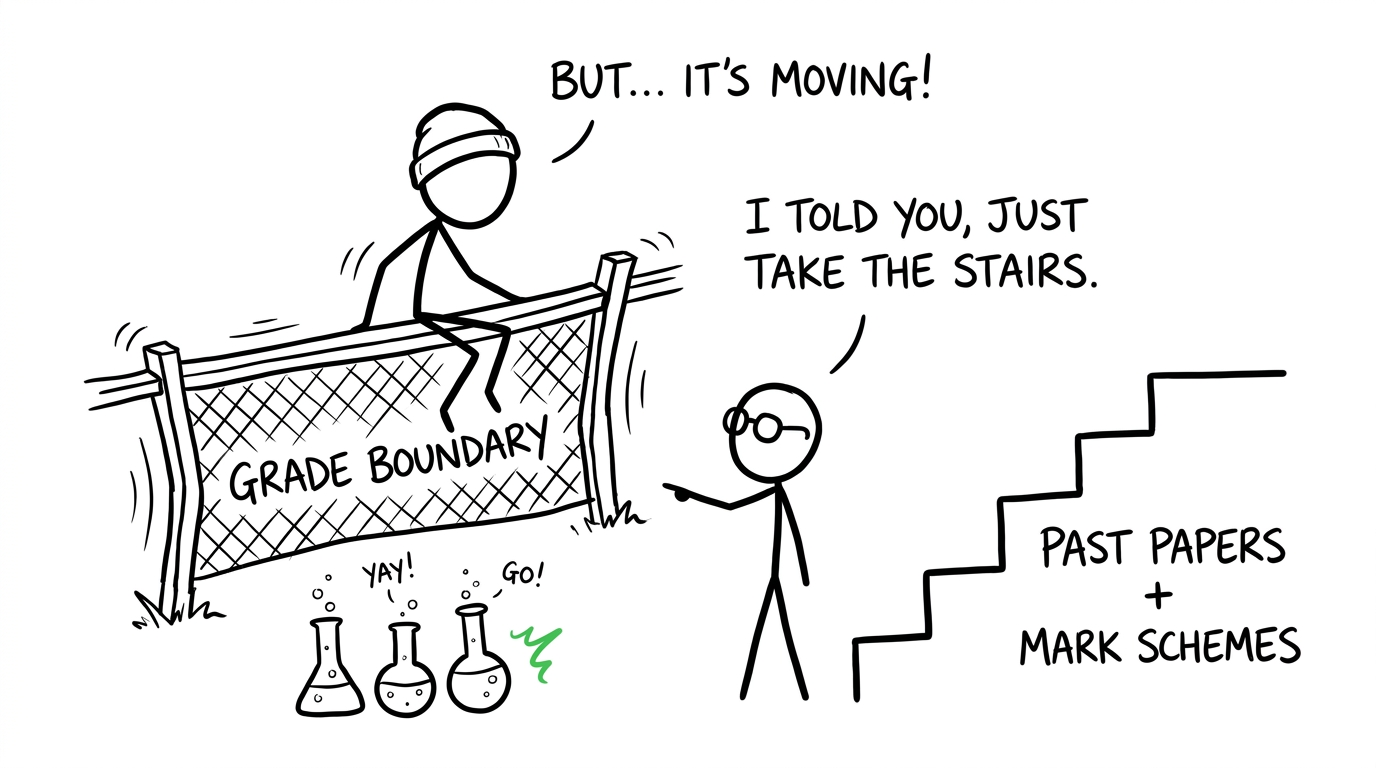 A student chooses a staircase of past papers instead of chasing a moving grade-boundary fence
What to do when you receive your result
First, pause. A grade tells you where your total landed relative to a boundary; it does not explain which topics or question types cost marks.
If your grade affects a sixth-form, college or apprenticeship offer, contact the relevant institution promptly. If the result is unexpected or close to an important boundary, ask your exams officer or Chemistry teacher for your marks. Your centre can explain Pearson’s post-results services, possible fees, deadlines and the risk that a reviewed mark can stay the same, rise or fall.
Do not compare an Edexcel mark with AQA, OCR or Eduqas boundaries. Each board sets boundaries for its own assessments.
Using boundaries during revision
Boundaries can provide context for a completed past paper, but they should not become the revision plan. A moving threshold is difficult to control. Better knowledge, calculation accuracy and exam technique are controllable.
Start with the Edexcel GCSE Chemistry revision hub, then complete Edexcel Chemistry past papers under timed conditions. Mark them carefully and identify whether each lost mark came from knowledge, method, units or interpretation.
For targeted repair, use the quantitative analysis revision guide, ionic bonding revision guide and rates of reaction revision guide. The wider GCSE Chemistry resource centre also brings together revision guides, questions, flashcards and predicted papers.
Chemistry calculations reward many of the same habits as maths: rearrange carefully, retain units and show a clear method. Strengthen those foundations through Edexcel GCSE Maths revision and the Edexcel maths revision guides.
Common grade-boundary mistakes
- Using Combined Science boundaries: separate Chemistry and Combined Science are different qualifications.
- Looking at the wrong tier: foundation and higher have separate tables.
- Treating old boundaries as predictions: previous figures show history, not the next result.
- Grading each paper separately: only the combined subject total determines the final grade.
- Assuming one mark always changes a grade: it matters only when that mark crosses a boundary.
- Comparing different exam boards: Edexcel boundaries cannot be applied to AQA, OCR or Eduqas papers.
A boundary is information, not a verdict
On GCSE chemistry results day, use the correct Edexcel table, check your tier and focus on the combined mark. Then decide what the result requires from you, rather than letting one number write a larger story.
For future examination practice, make MathsGenie your next step. Use the free revision lessons, practice questions, mark schemes, past papers, predicted papers and mini tests to turn each lost mark into a specific action. If Chemistry currently feels stuck, follow the practical routine in GCSE Chemistry revision when you are stuck at a pass, then return to another paper and measure what changed.