6.2.1 Concentration in mol dm⁻³ and titration calculations
Concentration in mol dm⁻³ counts the moles in each cubic decimetre
Concentration
The mass or amount of a solute dissolved in a given volume of solution.
Mole
The amount of a substance that contains the Avogadro constant of particles, and which has a mass in grams equal to its relative particle mass.
- A concentration in mol dm−3\text{mol dm}^{-3}mol dm−3 states the amount of solute dissolved in each dm3\text{dm}^3dm3 of solution.
- The relationship between amount, volume and concentration is: concentration=amount of solute in molvolume in dm3\text{concentration} = \frac{\text{amount of solute in mol}}{\text{volume in dm}^3}concentration=volume in dm3amount of solute in mol
- Rearranged to give the amount present: amount in mol=concentration×volume in dm3\text{amount in mol} = \text{concentration} \times \text{volume in dm}^3amount in mol=concentration×volume in dm3
- Volumes measured in cm3\text{cm}^3cm3 are divided by 100010001000 to convert them to dm3\text{dm}^3dm3.
- A more concentrated solution holds more solute in the same volume.
- Using a volume in cm3\text{cm}^3cm3 without converting makes the answer one thousand times too large.
- 25.0 cm325.0\ \text{cm}^325.0 cm3 is 0.0250 dm30.0250\ \text{dm}^30.0250 dm3, and that is the figure the equation takes.
Converting between g dm⁻³ and mol dm⁻³
Relative formula mass
The sum of the relative atomic masses of all the atoms shown in the formula of a substance, given the symbol Mr.
- A concentration in g dm−3\text{g dm}^{-3}g dm−3 states the mass of solute in each dm3\text{dm}^3dm3 of solution.
- Dividing by the relative formula mass converts a mass to an amount: concentration in mol dm−3=concentration in g dm−3Mr\text{concentration in mol dm}^{-3} = \frac{\text{concentration in g dm}^{-3}}{M_r}concentration in mol dm−3=Mrconcentration in g dm−3
- Multiplying reverses the conversion: concentration in g dm−3=concentration in mol dm−3×Mr\text{concentration in g dm}^{-3} = \text{concentration in mol dm}^{-3} \times M_rconcentration in g dm−3=concentration in mol dm−3×Mr
- Sodium hydroxide has an MrM_rMr of 404040, so 4.0 g dm−34.0\ \text{g dm}^{-3}4.0 g dm−3 is 0.10 mol dm−30.10\ \text{mol dm}^{-3}0.10 mol dm−3.
- The conversion factor is the MrM_rMr of the solute, so it changes from one solution to another.
The same solution can be quoted either way, so checking the unit comes before any calculation.
A titration measures the volume that exactly reacts
Titration
A method that finds the exact volume of one solution that reacts with a measured volume of another.
Indicator
A substance that changes colour to show whether a solution is acidic, neutral or alkaline.
- A pipette delivers a fixed, accurately known volume of one solution into a conical flask.
- A burette adds the second solution a little at a time, with its volume read to 0.05 cm30.05\ \text{cm}^30.05 cm3.
- A few drops of a suitable indicator show when the reaction is exactly complete.
- The end point is the first permanent colour change, and the burette reading is taken there.
- The volume added is the titre, and concordant titres are averaged before any calculation.
- Method: pipette 25.0 cm325.0\ \text{cm}^325.0 cm3 of alkali into a conical flask, add a few drops of indicator, then add acid from a burette until the colour just changes.
- Rough then accurate: a first quick titration finds the approximate volume, and later runs are added dropwise near that point.
- Concordant results: titres within 0.10 cm30.10\ \text{cm}^30.10 cm3 of one another are averaged, and the rough titre is left out.
- Indicator choice: phenolphthalein or methyl orange gives a sharp change, while litmus changes too gradually.
A worked titration calculation
- 25.0 cm325.0\ \text{cm}^325.0 cm3 of sodium hydroxide of concentration 0.100 mol dm−30.100\ \text{mol dm}^{-3}0.100 mol dm−3 needs 20.0 cm320.0\ \text{cm}^320.0 cm3 of hydrochloric acid.
- First find the amount of the solution whose concentration is known: n(NaOH)=0.100×0.0250=2.50×10⁻³ moln(\text{NaOH}) = 0.100 \times 0.0250 = 2.50 \times 10^{-3}\ \text{mol}n(NaOH)=0.100×0.0250=2.50×10⁻³ mol
- The balancing numbers in the equation are one to one, so the acid supplies the same amount.
- Then divide by the volume of acid, converted to dm3\text{dm}^3dm3: c(HCl)=2.50×10−30.0200=0.125 mol dm−3c(\text{HCl}) = \frac{2.50 \times 10^{-3}}{0.0200} = 0.125\ \text{mol dm}^{-3}c(HCl)=0.02002.50×10−3=0.125 mol dm−3
- The three steps are always the same: amount, ratio, then divide by the other volume.
- Ratio that is not one to one: with H2SO4+2NaOH\text{H}_2\text{SO}_4 + 2\text{NaOH}H2SO4+2NaOH, the amount of acid is half the amount of alkali.
- The balancing numbers in the equation are what set that ratio, so the equation is written down first.
Finding an unknown volume instead
- The same three steps give a volume when the two concentrations are known.
- A titration of 25.0 cm325.0\ \text{cm}^325.0 cm3 of 0.100 mol dm−30.100\ \text{mol dm}^{-3}0.100 mol dm−3 sodium hydroxide against 0.200 mol dm−30.200\ \text{mol dm}^{-3}0.200 mol dm−3 acid gives n=2.50×10⁻³ moln = 2.50 \times 10^{-3}\ \text{mol}n=2.50×10⁻³ mol of each.
- Dividing the amount by the concentration gives the volume: V=2.50×10−30.200=0.0125 dm3V = \frac{2.50 \times 10^{-3}}{0.200} = 0.0125\ \text{dm}^3V=0.2002.50×10−3=0.0125 dm3
- Multiplying by 100010001000 converts the answer back to 12.5 cm312.5\ \text{cm}^312.5 cm3.
- A more concentrated acid needs a smaller volume, which is a useful check on the answer.
- Writing the balanced equation first fixes the ratio before any numbers are used.
- Every volume is converted to dm3\text{dm}^3dm3 at the start, so no factor of 100010001000 is left over.
- A final answer carries the unit, either mol dm−3\text{mol dm}^{-3}mol dm−3 or cm3\text{cm}^3cm3.
- What does a concentration of 0.50 mol dm−30.50\ \text{mol dm}^{-3}0.50 mol dm−3 tell you?
- How is a concentration in g dm−3\text{g dm}^{-3}g dm−3 converted to mol dm−3\text{mol dm}^{-3}mol dm−3?
- What is meant by the end point of a titration?
- 20.0 cm320.0\ \text{cm}^320.0 cm3 of 0.100 mol dm−30.100\ \text{mol dm}^{-3}0.100 mol dm−3 alkali reacts with 25.0 cm325.0\ \text{cm}^325.0 cm3 of acid in a one to one ratio. What is the concentration of the acid?
- Why must volumes be converted before the amount is calculated?
6.2.2 Percentage yield and why actual yield falls short
Theoretical yield is the maximum mass a reaction could give
Theoretical yield
The mass of product that would be made if all of the limiting reactant were converted to product.
Limiting reactant
The reactant that is completely used up in a reaction, and which therefore controls the maximum mass of product formed.
- The maximum mass of product assumes every particle of the limiting reactant is converted.
- It is calculated from the balanced equation, not measured in the laboratory.
- Whichever reactant runs out first sets that ceiling, and it is the only one the calculation uses.
- Any reactant in excess is left over and adds nothing to the mass of product.
- No real reaction reaches this figure, which is why the calculated value is called theoretical.
The theoretical yield is a calculated ceiling, and the measured mass is always below it.
Actual yield is the mass actually collected
- The actual yield is the mass of pure, dry product weighed at the end.
- It is measured on a balance after the product has been separated and dried.
- Product still wet with solvent weighs too much, so the sample is dried to constant mass.
- Product left in the apparatus or lost in filtering never reaches the balance.
- Both yields are masses, so both are quoted in grams.
Weighing a damp product gives an actual yield that is too high, sometimes above the theoretical value.
Percentage yield compares the two
Percentage yield
The actual yield of a reaction expressed as a percentage of the theoretical yield.
- The actual yield is expressed as a percentage of the theoretical yield: percentage yield=actual yieldtheoretical yield×100\text{percentage yield} = \frac{\text{actual yield}}{\text{theoretical yield}} \times 100percentage yield=theoretical yieldactual yield×100
- Both masses must be in the same unit, so the units cancel and the answer is a pure number.
- The answer carries no unit, and the %\%% sign is part of the number rather than a unit.
- A value above 100%100\%100% is impossible and points to an impure or damp sample.
- A high percentage yield means the process wastes little of the starting material.
Percentage yield says nothing about how fast a reaction runs, only how much product was recovered.
A worked percentage yield
- A reaction has a theoretical yield of 8.0 g8.0\ \text{g}8.0 g and gives 6.0 g6.0\ \text{g}6.0 g of dry product.
- Substituting into the expression gives: 6.08.0×100=75%\frac{6.0}{8.0} \times 100 = 75\%8.06.0×100=75%
- Three quarters of the possible product was recovered, so a quarter was lost or never formed.
- Rearranging finds a missing figure, so 75%75\%75% of 8.0 g8.0\ \text{g}8.0 g gives the actual yield.
- Dividing the actual yield by the percentage and multiplying by 100100100 recovers the theoretical yield.
- Actual 4.5 g4.5\ \text{g}4.5 g, theoretical 5.0 g5.0\ \text{g}5.0 g: the percentage yield is 90%90\%90%.
- Actual 2.0 g2.0\ \text{g}2.0 g, theoretical 8.0 g8.0\ \text{g}8.0 g: the percentage yield is 25%25\%25%.
Why the actual yield falls short
- The reaction may be incomplete, leaving some reactant unreacted when the mixture is worked up.
- A reversible reaction reaches equilibrium, so it can never convert all of the reactants.
- Practical losses occur at every transfer, in filtering, and as product left on the glassware.
- Side reactions use up reactants to make substances other than the one wanted.
- Purifying the product removes impurities but removes some product along with them.
- What does the theoretical yield assume?
- Why can a percentage yield never exceed 100%100\%100%?
- A reaction with a theoretical yield of 20 g20\ \text{g}20 g gives 15 g15\ \text{g}15 g. What is the percentage yield?
- Give three reasons why the actual yield is lower than the theoretical yield.
- Why must the product be dried before it is weighed?
6.2.3 Atom economy of a reaction
Atom economy measures how much of the product mass is wanted
Atom economy
The mass of the desired product as a percentage of the total mass of product formed.
- A reaction usually makes more than one product, and only one of them is the desired product.
- Atom economy compares the mass of that product with the mass of everything formed: atom economy=Mr of the desired productsum of the Mr of all products×100\text{atom economy} = \frac{M_r \text{ of the desired product}}{\text{sum of the } M_r \text{ of all products}} \times 100atom economy=sum of the Mr of all productsMr of the desired product×100
- The masses come from the balanced equation, with each MrM_rMr multiplied by its balancing number.
- A high atom economy means little of the starting material ends up as waste.
- The answer is a percentage and carries no unit.
Atom economy is fixed by the equation alone, so it is the same however carefully the reaction is carried out.
Working out an atom economy step by step
- Write the balanced equation and identify which product is wanted.
- Find the MrM_rMr of that product and multiply it by its balancing number.
- Do the same for every other product, then add all the products together.
- Divide the desired figure by the total and multiply by 100100100.
- The reactants never enter the calculation, since conservation of mass makes their total the same.
- Leaving a by-product out of the total gives an atom economy that is falsely high.
- A balancing number multiplies the MrM_rMr before anything is added.
A worked atom economy: extracting iron
- The equation for reducing iron(III) oxide with carbon monoxide is: Fe2O3+3CO→2Fe+3CO2\text{Fe}_2\text{O}_3 + 3\text{CO} \rightarrow 2\text{Fe} + 3\text{CO}_2Fe2O3+3CO→2Fe+3CO2
- The desired product is iron, of ArA_rAr 565656: 2×56=1122 \times 56 = 1122×56=112
- The only by-product is carbon dioxide, of MrM_rMr 444444: 3×44=1323 \times 44 = 1323×44=132
- The atom economy follows from the two totals: 112112+132×100=45.9%\frac{112}{112 + 132} \times 100 = 45.9\%112+132112×100=45.9%
- Less than half the mass formed is iron, and the rest leaves the process as carbon dioxide.
- One product only: an addition reaction that makes a single product has an atom economy of 100%100\%100%.
- Two products of similar mass: the atom economy lands near 50%50\%50%.
Why a high atom economy matters
- A reaction with a low atom economy converts much of its raw material into waste.
- That waste has to be separated, treated or disposed of, which costs money.
- Raw materials are often finite, so wasting them shortens the supply.
- A route with a higher atom economy is usually more sustainable for the same product.
- A useful by-product softens the objection, because the waste can be sold rather than discarded.
Atom economy and percentage yield measure different things, and a reaction can score well on one and badly on the other.
Comparing two routes to the same product
- Two reactions that give the same product can have very different atom economies.
- The route that forms fewer by-products keeps more of the mass in the wanted product.
- An addition reaction, which joins everything into one product, scores highest of all.
- A route with a lower atom economy may still be chosen if it is faster or cheaper to run.
- Comparing routes fairly means quoting both figures and the reason for preferring one.
- What does the atom economy of a reaction compare?
- Why do the reactants not appear in the calculation?
- What is the atom economy of a reaction that forms only one product?
- Calculate the atom economy for iron in Fe2O3+3CO→2Fe+3CO2\text{Fe}_2\text{O}_3 + 3\text{CO} \rightarrow 2\text{Fe} + 3\text{CO}_2Fe2O3+3CO→2Fe+3CO2.
- Give two reasons why a high atom economy is preferred.
6.2.4 Choosing a reaction pathway
A product can usually be made by more than one route
- Different reactions can lead to the same product from different starting materials.
- Choosing between them means comparing the routes on several measures at once.
- The measures used are atom economy, percentage yield, rate, position of equilibrium and the use made of by-products.
- No single measure decides the choice, because a route can score well on one and badly on another.
- The cost of running the process is what all of these feed into.
A sound comparison names the measure, states which route wins on it, and then says which measures outweigh the others.
Atom economy and percentage yield measure different things
Atom economy
The mass of the desired product as a percentage of the total mass of product formed.
Percentage yield
The actual yield of a reaction expressed as a percentage of the theoretical yield.
- The equation alone fixes atom economy, which says how much of the mass formed is the wanted product.
- Measuring the product gives the percentage yield, which says how much of the possible product was recovered.
- A route can have a high atom economy and a low percentage yield, or the reverse.
- A low percentage yield can sometimes be improved by changing the conditions, while the atom economy cannot.
- Both matter, because raw material is wasted either by becoming a by-product or by never being converted.
The two percentages answer different questions, so one can never be substituted for the other.
Rate and equilibrium position decide how fast and how far
Position of equilibrium
Whether a dynamic equilibrium holds more products or more reactants, described as lying to the right or to the left.
Closed system
A system in which no reactants or products can enter or leave.
- A faster reaction makes more product per hour, so it needs smaller plant for the same output.
- A very slow route may be rejected however good its atom economy.
- A reversible reaction in a closed system settles at an equilibrium that limits how much product forms.
- A position lying well to the right means a large proportion of the reactants is converted.
- A route whose equilibrium lies to the left needs its product removing continually to be worth running.
Rate and position are separate questions, so a fast reaction can still reach a poor equilibrium.
Useful by-products change the economics
- A by-product that can be sold offsets the cost of the raw materials.
- A by-product that must be treated as waste adds a disposal cost instead.
- A by-product that is fed back into the process reduces what has to be bought in.
- Steam produced by an exothermic route can be used to heat another part of the plant.
- A modest atom economy can still be acceptable when the other product has a market.
- Route A: atom economy 85%85\%85%, yield 40%40\%40%, slow, by-product sold.
- Route B: atom economy 55%55\%55%, yield 90%90\%90%, fast, by-product treated as waste.
- The comparison: B converts more of what is fed in per batch and works faster, while A wastes less raw material and earns from its by-product.
Weighing the factors against one another
- A judgement begins by stating which route wins on each measure separately.
- The measures are then weighed, and the weighting depends on what the product is worth.
- Where the raw material is expensive, atom economy and yield carry the most weight.
- Where demand is high and the material cheap, rate matters more than either.
- A conclusion is only sound when the reason for the weighting is given alongside it.
- Data given in the question is quoted as figures, not described in words alone.
- A comparison covers both routes on each measure, rather than praising one in isolation.
- The conclusion names the measure that decided it.
- Name five measures used to compare two routes to the same product.
- How do atom economy and percentage yield differ?
- Why might a route with a high atom economy still be rejected?
- How does a saleable by-product affect the choice?
- When does rate matter more than atom economy?
6.2.5 Molar volume of gases and Avogadro's law
One mole of any gas occupies the same volume
Molar volume
The volume occupied by one mole of any gas, which is 24 dm³ at room temperature and pressure.
Mole
The amount of a substance that contains the Avogadro constant of particles, and which has a mass in grams equal to its relative particle mass.
- At room temperature and pressure, one mole of molecules of any gas occupies the same volume.
- That volume is 24 dm324\ \text{dm}^324 dm3, which is the same as 24 000 cm324\,000\ \text{cm}^324000 cm3.
- Room temperature and pressure means about 20 ∘C20\ ^{\circ}\text{C}20 ∘C and normal atmospheric pressure.
- The identity of the gas makes no difference, so a mole of hydrogen and a mole of carbon dioxide fill the same space.
- For a gas such as helium the particles are single atoms, and a mole of them occupies 24 dm324\ \text{dm}^324 dm3 as well.
Gas particles are so far apart that the size of the particle makes no difference to the volume.
Converting between amount and volume of gas
- The volume occupied by a known amount of gas is: volume in dm3=amount in mol×24\text{volume in dm}^3 = \text{amount in mol} \times 24volume in dm3=amount in mol×24
- Rearranged to give the amount from a measured volume: amount in mol=volume in dm324\text{amount in mol} = \frac{\text{volume in dm}^3}{24}amount in mol=24volume in dm3
- A volume in cm3\text{cm}^3cm3 is divided by 24 00024\,00024000 instead, or converted to dm3\text{dm}^3dm3 first.
- The amount scales the volume directly, so 0.5 mol0.5\ \text{mol}0.5 mol fills 12 dm312\ \text{dm}^312 dm3 and 2 mol2\ \text{mol}2 mol fills 48 dm348\ \text{dm}^348 dm3.
- The figure 24 dm324\ \text{dm}^324 dm3 is given whenever a calculation needs it.
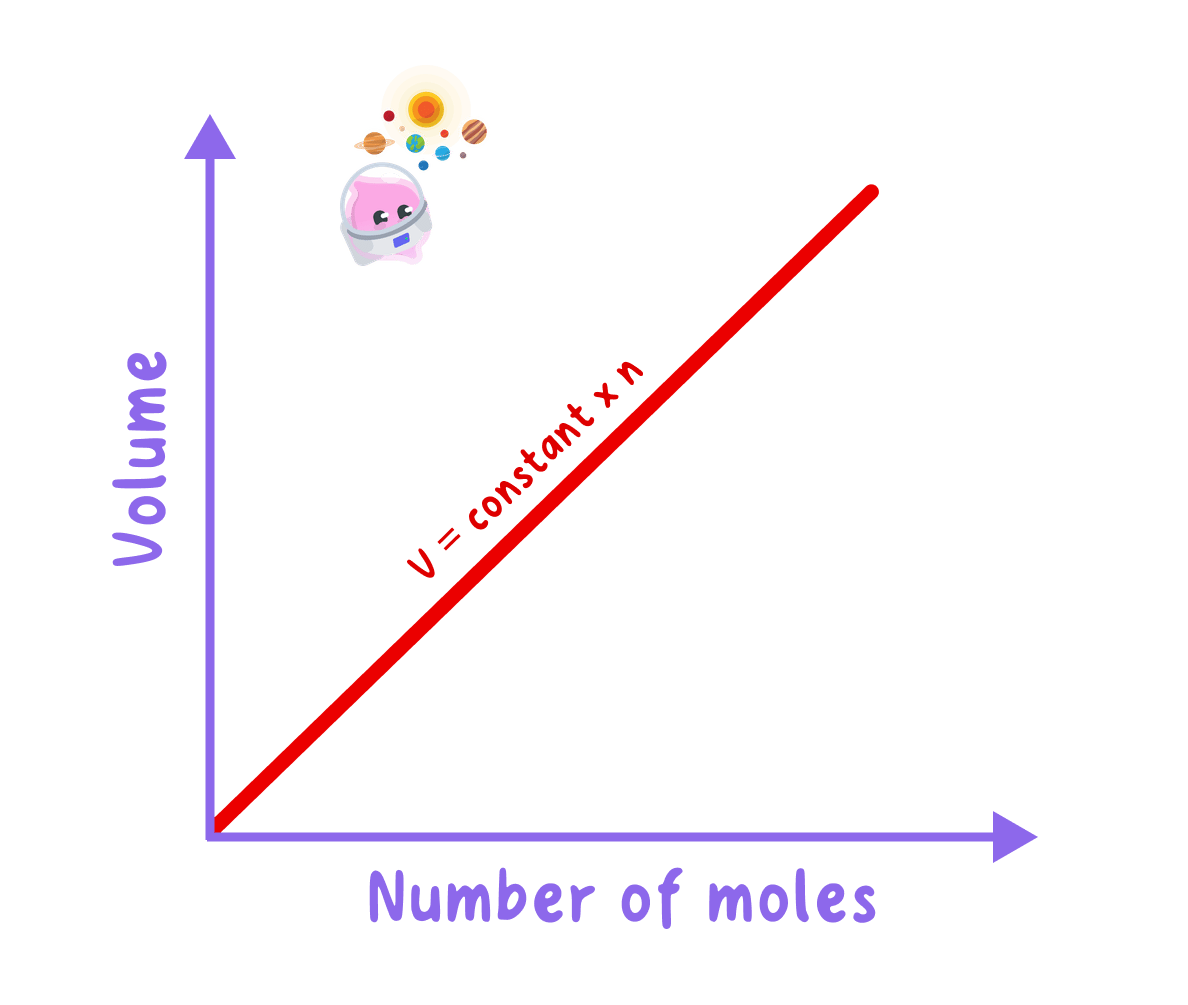
The molar volume applies to gases only, never to a solid or a liquid.
Linking the mass of a solid to the volume of a gas
Relative formula mass
The sum of the relative atomic masses of all the atoms shown in the formula of a substance, given the symbol Mr.
- A mass of solid is converted to an amount by dividing by its relative formula mass.
- The balancing numbers in the equation convert that amount into the amount of gas.
- Multiplying the amount of gas by 242424 gives its volume in dm3\text{dm}^3dm3.
- Heating 10 g10\ \text{g}10 g of calcium carbonate, of MrM_rMr 100100100, gives: n(CaCO3)=10100=0.10 moln(\text{CaCO}_3) = \frac{10}{100} = 0.10\ \text{mol}n(CaCO3)=10010=0.10 mol
- The equation is one to one, so the volume of carbon dioxide is: 0.10×24=2.4 dm30.10 \times 24 = 2.4\ \text{dm}^30.10×24=2.4 dm3
- Mass to volume: divide by MrM_rMr, apply the ratio, multiply by 242424.
- Volume to mass: divide by 242424, apply the ratio, multiply by MrM_rMr.
Avogadro's law relates volumes of gases directly
Avogadro's law
The rule that equal volumes of gases at the same temperature and pressure contain equal numbers of particles.
- Equal volumes of gases at the same temperature and pressure hold equal numbers of particles.
- The ratio of volumes of reacting gases is therefore the ratio of the balancing numbers.
- No relative formula masses are needed, so the volumes are compared directly.
- In the formation of hydrogen chloride the balancing numbers are one, one and two: H2(g)+Cl2(g)→2HCl(g)\text{H}_2(\text{g}) + \text{Cl}_2(\text{g}) \rightarrow 2\text{HCl}(\text{g})H2(g)+Cl2(g)→2HCl(g)
- 30 cm330\ \text{cm}^330 cm3 of hydrogen therefore reacts with 30 cm330\ \text{cm}^330 cm3 of chlorine to give 60 cm360\ \text{cm}^360 cm3 of hydrogen chloride.
- Avogadro's law applies only to the gases in an equation, so a solid or liquid reactant is ignored.
- The volumes all have to be measured at the same temperature and pressure.
- A reversible reaction gives only the ratio the equation allows, never the volumes an equilibrium mixture actually holds.
Common slips in gas calculations
- Dividing by 242424 when the volume is in cm3\text{cm}^3cm3 makes the answer a thousand times too large.
- Applying the molar volume to a solid or liquid gives a meaningless figure.
- Skipping the ratio from the equation is the most frequent error in a mass to volume question.
- Applying the volume ratio to a solid or liquid in the equation is the error, since only the gases have a volume to compare.
- Checking that the final unit is dm3\text{dm}^3dm3 or cm3\text{cm}^3cm3 catches most of these.
- What volume does one mole of any gas occupy at room temperature and pressure?
- What amount of gas occupies 6 dm36\ \text{dm}^36 dm3?
- What volume of carbon dioxide is made by heating 5 g5\ \text{g}5 g of calcium carbonate?
- State Avogadro's law.
- What volume of hydrogen chloride forms from 20 cm320\ \text{cm}^320 cm3 of hydrogen with excess chlorine?
