2.3.1 Ions and the formation of ionic bonds
Losing or gaining electrons turns an atom into an ion
Ion
An atom, or a group of atoms, with an overall electrical charge because it has lost or gained electrons.
Cation
A positively charged ion, formed when an atom or group of atoms loses electrons.
Anion
A negatively charged ion, formed when an atom or group of atoms gains electrons.
- An atom holds equal numbers of protons and electrons, so its charges cancel and it is neutral.
- Removing an electron leaves more protons than electrons, so the particle carries a positive charge.
- Adding an electron leaves more electrons than protons, so the particle carries a negative charge.
- Only electrons move, because the protons sit inside the nucleus and stay there.
- The size of the charge equals the number of electrons lost or gained.
- A sodium atom that loses one electron becomes Na+\text{Na}^{+}Na+, and a chlorine atom that gains one becomes Cl−\text{Cl}^{-}Cl−.
- Charge comes from an imbalance between the protons and the electrons.
- The nucleus is untouched, so an ion has the same proton number as the atom it came from.
Groups 1, 2, 6 and 7 tell you which ion an atom forms
- For groups 111, 222, 666 and 777, the group number gives the number of outer-shell electrons.
- A group 111 atom loses its single outer electron to form a 1+1+1+ ion.
- A group 222 atom loses both outer electrons to form a 2+2+2+ ion.
- A group 666 atom gains two electrons to form a 2−2-2− ion.
- A group 777 atom gains one electron to form a 1−1-1− ion.
- Either route leaves the ion with a full outer shell, which is why these are the ions that form.
- Groups 111 and 222 hold metals that supply electrons, while groups 666 and 777 hold non-metals that accept them.
- Group 6 and group 7 atoms gain electrons, so writing that they lose electrons reverses the chemistry.
- A group 7 ion carries a 1−1-1− charge, not 7−7-7−, because only one electron is gained.
An ionic bond is the attraction between the ions that form
Ionic bond
The strong electrostatic attraction between oppositely charged ions.
- Electron transfer from a metal atom to a non-metal atom produces one positive ion and one negative ion.
- Opposite charges attract, and that attraction is what holds the two ions together.
- The transfer makes the ions, and the attraction that follows is the bond itself.
- Sodium gives one electron to chlorine: Na→Na++e−\text{Na} \rightarrow \text{Na}^{+} + e^{-}Na→Na++e− and Cl+e−→Cl−\text{Cl} + e^{-} \rightarrow \text{Cl}^{-}Cl+e−→Cl−.
- Magnesium gives two electrons to oxygen, forming Mg2+\text{Mg}^{2+}Mg2+ and O2−\text{O}^{2-}O2−.
- The compound as a whole is neutral, because the positive and negative charges inside it balance exactly.
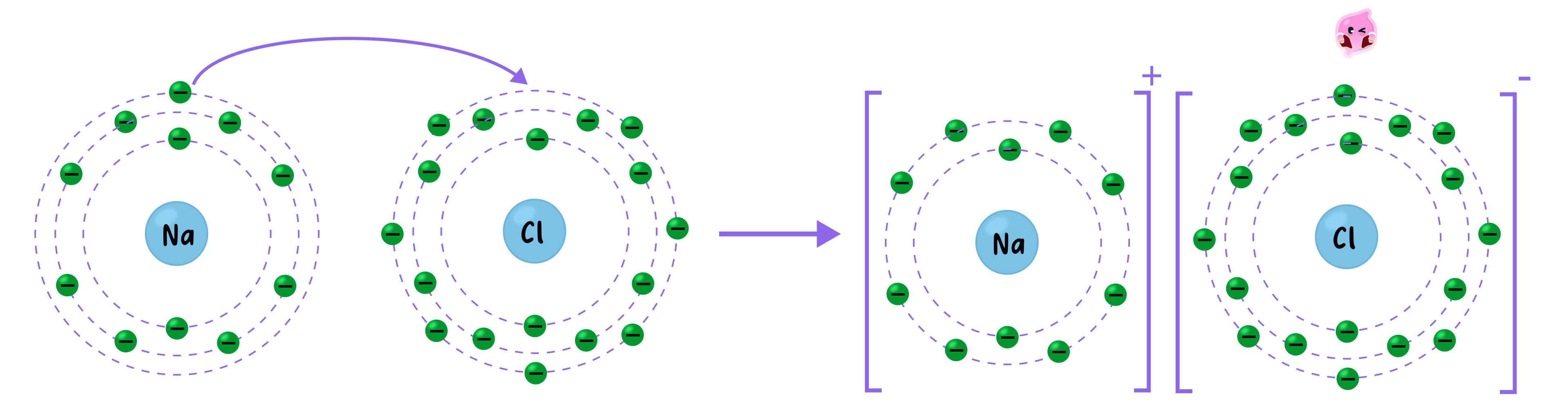
- Sodium chloride: sodium loses one electron and chlorine gains it, giving Na+\text{Na}^{+}Na+ and Cl−\text{Cl}^{-}Cl− in a 1:11:11:1 ratio.
- Magnesium oxide: magnesium loses two electrons and oxygen gains both, giving Mg2+\text{Mg}^{2+}Mg2+ and O2−\text{O}^{2-}O2− in a 1:11:11:1 ratio.
- Magnesium chloride: magnesium loses two electrons, one to each of two chlorine atoms, giving Mg2+\text{Mg}^{2+}Mg2+ and two Cl−\text{Cl}^{-}Cl−.
Dot-and-cross diagrams show which atom supplied each electron
- A dot-and-cross diagram draws the outer-shell electrons of each atom, using dots for one atom and crosses for the other.
- Dots and crosses both stand for electrons, and the two symbols only record where each electron came from.
- Draw both atoms with their outer shells first, then move the transferred electrons across.
- For sodium chloride, chlorine's seven electrons are dots and the single electron from sodium is a cross, giving eight around chlorine.
- Enclose each ion in square brackets and write its charge outside the top right corner.
- The sodium ion is drawn with an empty outer shell and a 1+1+1+ charge, because its outer electron has gone.
- For magnesium chloride, draw one magnesium atom and two chlorine atoms, with one electron moving to each chlorine.
- Dots for one element and crosses for the other, kept consistent, is what makes the transfer readable.
- Brackets and a charge belong on every ion, and a drawing without them shows atoms rather than ions.
Counting protons, neutrons and electrons in an ion
Atomic number
The number of protons in the nucleus of an atom, which is unique to each element.
Mass number
The total number of protons and neutrons in the nucleus of an atom.
- The proton count does not change when an ion forms, so it is still the atomic number.
- The neutron count is the mass number minus the atomic number, and it does not change either.
- For a positive ion, subtract the charge from the atomic number to get the electron count.
- For a negative ion, add the charge to the atomic number to get the electron count.
- Na+\text{Na}^{+}Na+, with atomic number 111111 and mass number 232323, has 111111 protons, 121212 neutrons and 101010 electrons.
- O2−\text{O}^{2-}O2−, with atomic number 888 and mass number 161616, has 888 protons, 888 neutrons and 101010 electrons.
- Both of those ions hold 101010 electrons, the same number as a neon atom.
- An ion question is answered in two moves: decide whether electrons are lost or gained, then count how many.
- The proton count comes from the atomic number and never changes, so only the electron count is adjusted for the charge.
- A dot-and-cross drawing without brackets and charges describes atoms, so those two marks are what finish it.
- Why does an atom become positively charged when it loses an electron?
- Which ion does a group 666 atom form, and how many electrons does it gain?
- What is the difference between the electron transfer and the ionic bond itself?
- How many protons, neutrons and electrons are in Mg2+\text{Mg}^{2+}Mg2+, atomic number 121212 and mass number 242424?
- Why are brackets and a charge drawn around each ion in a dot-and-cross diagram?
2.3.2 Naming and deducing formulae of ionic compounds
Names read positive ion first, then negative ion
Ionic compound
A compound made of positive and negative ions, whose formula shows the smallest whole-number ratio of ions that gives no overall charge.
- The positive ion is named first and the negative ion second, so NaCl\text{NaCl}NaCl is sodium chloride.
- The metal supplies the positive ion, and it keeps its own element name unchanged.
- The negative ion's name carries an ending that identifies which ion it is.
- A finished formula carries no charges, because the positive and negative charges inside it cancel.
- Naming and formula writing are two directions of one step: names give the ions, and charges give the ratio.
- Name order is fixed: positive ion first, negative ion second.
- A formula is the smallest whole-number ratio of ions that leaves no overall charge.
The ending -ide marks an ion made from one element
- An -ide ending shows a negative ion built from a single element.
- Oxygen forms the oxide ion O2−\text{O}^{2-}O2−, so MgO\text{MgO}MgO is magnesium oxide.
- The halogens form halide ions: fluoride F−\text{F}^{-}F−, chloride Cl−\text{Cl}^{-}Cl−, bromide Br−\text{Br}^{-}Br− and iodide I−\text{I}^{-}I−.
- CaCl2\text{CaCl}_2CaCl2 is therefore calcium chloride, whatever the number of chloride ions in it.
- Hydroxide, OH−\text{OH}^{-}OH−, is the exception, because it ends in -ide but contains two elements.
- Oxide and hydroxide are different ions and are never interchangeable in a formula.
- OH−\text{OH}^{-}OH− is not O2−\text{O}^{2-}O2−, so sodium hydroxide is NaOH\text{NaOH}NaOH while sodium oxide is Na2O\text{Na}_2\text{O}Na2O.
- The -ide ending does not change with the ratio, so NaCl\text{NaCl}NaCl and MgCl2\text{MgCl}_2MgCl2 are both named as chlorides.
The ending -ate marks an ion that also contains oxygen
Polyatomic ion
A group of two or more atoms covalently bonded together that carries an overall charge and behaves as a single ion.
- An -ate ending shows a negative ion that contains oxygen alongside another element.
- Nitrate is NO3−\text{NO}_3^{-}NO3−, carbonate is CO32−\text{CO}_3^{2-}CO32− and sulfate is SO42−\text{SO}_4^{2-}SO42−.
- The atoms inside one of these ions are held by covalent bonds and travel as a single unit.
- The ion keeps both its name and its internal formula inside any compound.
- KNO3\text{KNO}_3KNO3 is potassium nitrate, CaCO3\text{CaCO}_3CaCO3 is calcium carbonate and MgSO4\text{MgSO}_4MgSO4 is magnesium sulfate.
- KNO3\text{KNO}_3KNO3: potassium nitrate, from K+\text{K}^{+}K+ and NO3−\text{NO}_3^{-}NO3− in a 1:11:11:1 ratio.
- CaCO3\text{CaCO}_3CaCO3: calcium carbonate, from Ca2+\text{Ca}^{2+}Ca2+ and CO32−\text{CO}_3^{2-}CO32− in a 1:11:11:1 ratio.
- Na2SO4\text{Na}_2\text{SO}_4Na2SO4: sodium sulfate, from two Na+\text{Na}^{+}Na+ ions and one SO42−\text{SO}_4^{2-}SO42− ion.
Balancing the charges gives the formula
- Write the positive ion with its charge and the negative ion with its charge.
- Find the smallest numbers of each ion that bring the total charge to zero.
- With Am+\text{A}^{m+}Am+ and Bn−\text{B}^{n-}Bn−, taking nnn of A and mmm of B always balances, and the ratio is then simplified if both share a factor.
- Write each count as a subscript, leaving out a subscript of one.
- Put brackets round a polyatomic ion whenever more than one of it is needed.
- Al3+\text{Al}^{3+}Al3+ with O2−\text{O}^{2-}O2− needs two and three, giving Al2O3\text{Al}_2\text{O}_3Al2O3.
- Ca2+\text{Ca}^{2+}Ca2+ with OH−\text{OH}^{-}OH− needs one and two, giving Ca(OH)2\text{Ca(OH)}_2Ca(OH)2.
- Al3+\text{Al}^{3+}Al3+ with NO3−\text{NO}_3^{-}NO3− needs one and three, giving Al(NO3)3\text{Al(NO}_3)_3Al(NO3)3.
- CaOH2\text{CaOH}_2CaOH2 is not Ca(OH)2\text{Ca(OH)}_2Ca(OH)2, because without brackets the subscript applies to hydrogen alone.
- Charges stay in the working, and never appear on the finished formula.
Checking a finished formula
- Multiply each ion's charge by its subscript and add the results, which must come to zero.
- Al2(SO4)3\text{Al}_2(\text{SO}_4)_3Al2(SO4)3 gives (2×+3)+(3×−2)=0(2 \times +3) + (3 \times -2) = 0(2×+3)+(3×−2)=0.
- Confirm that each polyatomic ion still carries its own internal formula.
- Confirm that the ratio cannot be simplified any further.
- Confirm that no charges have been left on the finished formula.
- Crossing the charge numbers over gives a starting ratio, but a shared factor still has to be cancelled, so Mg2+\text{Mg}^{2+}Mg2+ with O2−\text{O}^{2-}O2− gives MgO\text{MgO}MgO rather than Mg2O2\text{Mg}_2\text{O}_2Mg2O2.
- Writing both ions with their charges before anything else turns the formula into a single balancing step.
- The charge check at the end costs a moment and catches a wrong subscript.
- What does an -ide ending tell you about a negative ion?
- Why does hydroxide end in -ide even though it contains two elements?
- What is the formula of the compound formed from Al3+\text{Al}^{3+}Al3+ and O2−\text{O}^{2-}O2−?
- When are brackets needed around a polyatomic ion?
- How do you check that an ionic formula carries no overall charge?
2.3.3 Giant ionic lattices
An ionic compound is one giant lattice, not a set of pairs
Giant ionic lattice
A regular, repeating three-dimensional arrangement of very large numbers of oppositely charged ions held together by ionic bonds.
- A solid ionic compound is a single enormous structure rather than a collection of separate units.
- Positive and negative ions alternate in a fixed, repeating pattern in three dimensions.
- The pattern continues for as long as the crystal does, so even a visible grain contains a vast number of ions.
- The word giant records that the number of ions is not fixed by the formula.
- The formula gives the ratio of the ions present, not how many of them there are.
- A lattice is a repeating arrangement, so every ion sits in the same relationship to its neighbours.
- The formula is a ratio, so NaCl\text{NaCl}NaCl means one Na+\text{Na}^{+}Na+ for every Cl−\text{Cl}^{-}Cl− rather than a pair of ions.
Every ion is held by attractions acting in all directions
Ionic bond
The strong electrostatic attraction between oppositely charged ions.
- Each positive ion is surrounded by negative ions, and each negative ion by positive ions.
- In sodium chloride, every ion has six nearest neighbours of the opposite charge.
- The attractions act in every direction through the structure, not along single lines between chosen pairs.
- Breaking the structure apart means overcoming very many strong attractions at once.
- Larger charges pull harder, so the attractions in MgO\text{MgO}MgO are stronger than those in NaCl\text{NaCl}NaCl.
- The attraction acts between oppositely charged ions, which is the detail that turns a vague force into an ionic bond.
- Six nearest neighbours in sodium chloride is a concrete figure worth carrying into a description.
Describing and drawing a lattice
- A full description names both the arrangement and the force.
- The arrangement is a regular, repeating three-dimensional pattern of oppositely charged ions.
- The force is strong electrostatic attraction between those oppositely charged ions.
- Saying only that the forces are strong leaves the description unfinished, because it does not name them.
- A diagram should show many ions in a repeating grid with their charges marked.
- Drawing sodium chloride as two ions side by side describes a molecule, which an ionic compound does not form.
- What is meant by a giant ionic lattice?
- What holds the ions in the lattice together?
- Why does the formula NaCl\text{NaCl}NaCl not describe a molecule of two ions?
- How many nearest neighbours of opposite charge does each ion have in sodium chloride?
