8.1.1 Measuring and interpreting rates of reaction
Rate is how quickly a reaction gets through its reactants
Rate of reaction
How quickly a reactant is used up or a product is formed.
- A fast reaction uses up its reactants and forms its products in a short time.
- Measuring a rate means following one quantity as the reaction proceeds.
- Either a reactant being used up or a product being formed can be followed.
- The mean rate over a period is found from the change and the time: mean rate=change in the quantitytime taken\text{mean rate} = \frac{\text{change in the quantity}}{\text{time taken}}mean rate=time takenchange in the quantity
- The unit follows the quantity measured, such as cm3/s\text{cm}^3/\text{s}cm3/s for a gas.
Any quantity that changes measurably as the reaction runs can be used to follow its rate.
Choosing what to measure
- A reaction that gives off a gas can be followed by the volume of gas collected.
- The same reaction can be followed by the loss in mass as the gas escapes.
- A reaction that forms a cloudy product can be followed by how long it takes to hide a mark.
- A reaction that changes colour can be followed by how quickly the colour appears or fades.
- The choice depends on what the reaction visibly or measurably changes.
- Marble chips and acid: collect the carbon dioxide in a gas syringe.
- The same reaction on a balance: record the falling mass as the gas leaves.
- Thiosulfate and acid: time how long a cross takes to disappear.
How the measurements are taken
- A gas syringe gives the volume directly, provided the apparatus is gas-tight.
- Collecting gas over water works too, though a soluble gas dissolves and is lost.
- A balance records mass loss, which suits a gas too dense or too soluble to collect.
- Readings are taken at regular intervals and timed from the moment of mixing.
- Repeating the run and taking a mean reduces the effect of a single poor reading.
- Marble chips and acid: measure a fixed volume of dilute hydrochloric acid into a flask, add a fixed mass of chips, fit the bung at once and record the gas volume at set intervals.
- Changing one thing: use different acid concentrations, or the same mass of differently sized chips, keeping everything else the same.
- Thiosulfate and acid: mix fixed volumes over a paper cross and time how long the cross takes to disappear, repeating at several temperatures.
- Relative rate: 1/time1/\text{time}1/time is used as a measure of rate, because the same endpoint means the same amount of sulfur has formed.
- Control the rest: volumes, concentrations, temperature and the observer are kept the same, or the comparison means nothing.
Reading a graph of the reaction
- Plotting the quantity against time gives a curve that rises and then flattens.
- The curve is steepest at the start, when the reactants are at their most concentrated.
- It grows less steep as the reactants are used up and the reaction slows.
- It becomes flat when the reaction has finished and nothing more is changing.
- The gradient at any point gives the rate at that moment.
- A flat line means the reaction has stopped, not that it is running at a steady rate.
- The height the curve levels off at is the total amount formed, which is a different question from the rate.
Comparing two curves on the same axes
- The curve that is steeper at the start belongs to the faster reaction.
- The curve that flattens sooner belongs to the reaction that finished first.
- Two reactions can end at the same height while one gets there much faster.
- The same final height means the same amount of limiting reactant was used in both.
- A curve ending lower means less product formed, which is a difference in amount rather than in rate.
- Give two quantities that can be measured to follow a reaction.
- Why does a balance suit a reaction that gives off carbon dioxide?
- Why is a rate curve steepest at the beginning?
- What does it mean when a rate curve becomes flat?
- Two curves level off at the same height but one rises more steeply. What does that tell you?
8.1.2 Collision theory and the factors affecting rate
A reaction needs a collision with enough energy
Collision theory
The explanation that a reaction happens only when particles collide with enough energy, and that the rate depends on how often and how energetically they collide.
Activation energy
The minimum energy that colliding particles must have for a reaction to happen.
- Particles must collide before they can react with one another.
- Most collisions achieve nothing, because the particles simply bounce apart.
- A collision only leads to a reaction if the particles have at least the activation energy.
- A collision that does lead to a reaction is called a successful collision.
- The rate therefore depends on how often particles collide and how energetically they do so.
Anything that raises the frequency or the energy of collisions raises the rate.
Raising the temperature does both
- Heating gives the particles more kinetic energy, so they move faster.
- Faster particles collide more often, which raises the frequency of collisions.
- A larger proportion of collisions also carry at least the activation energy.
- Both effects push the rate up, which is why temperature has such a large effect.
- The energy effect is the greater of the two, and is the main reason heating speeds a reaction so much.
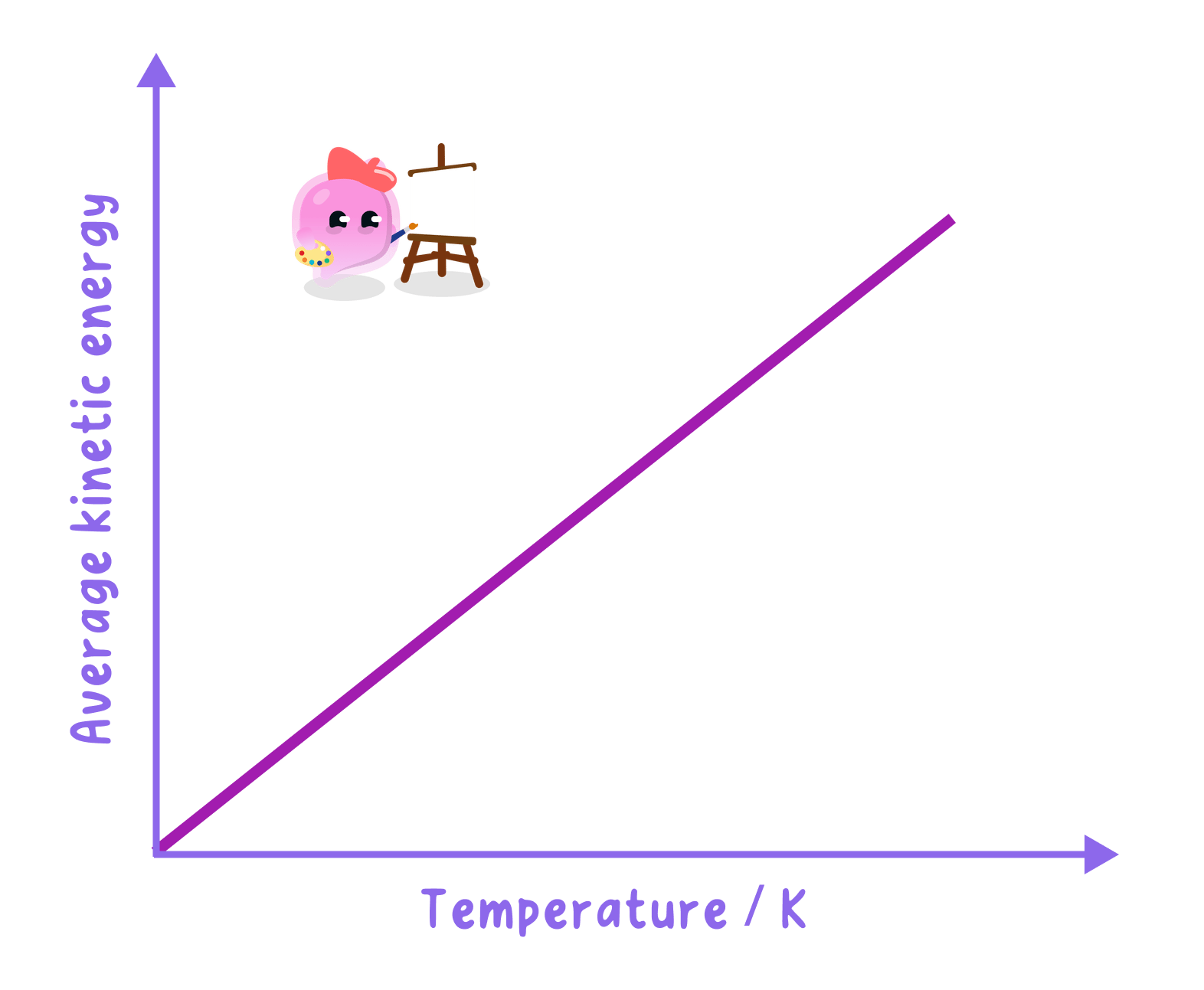
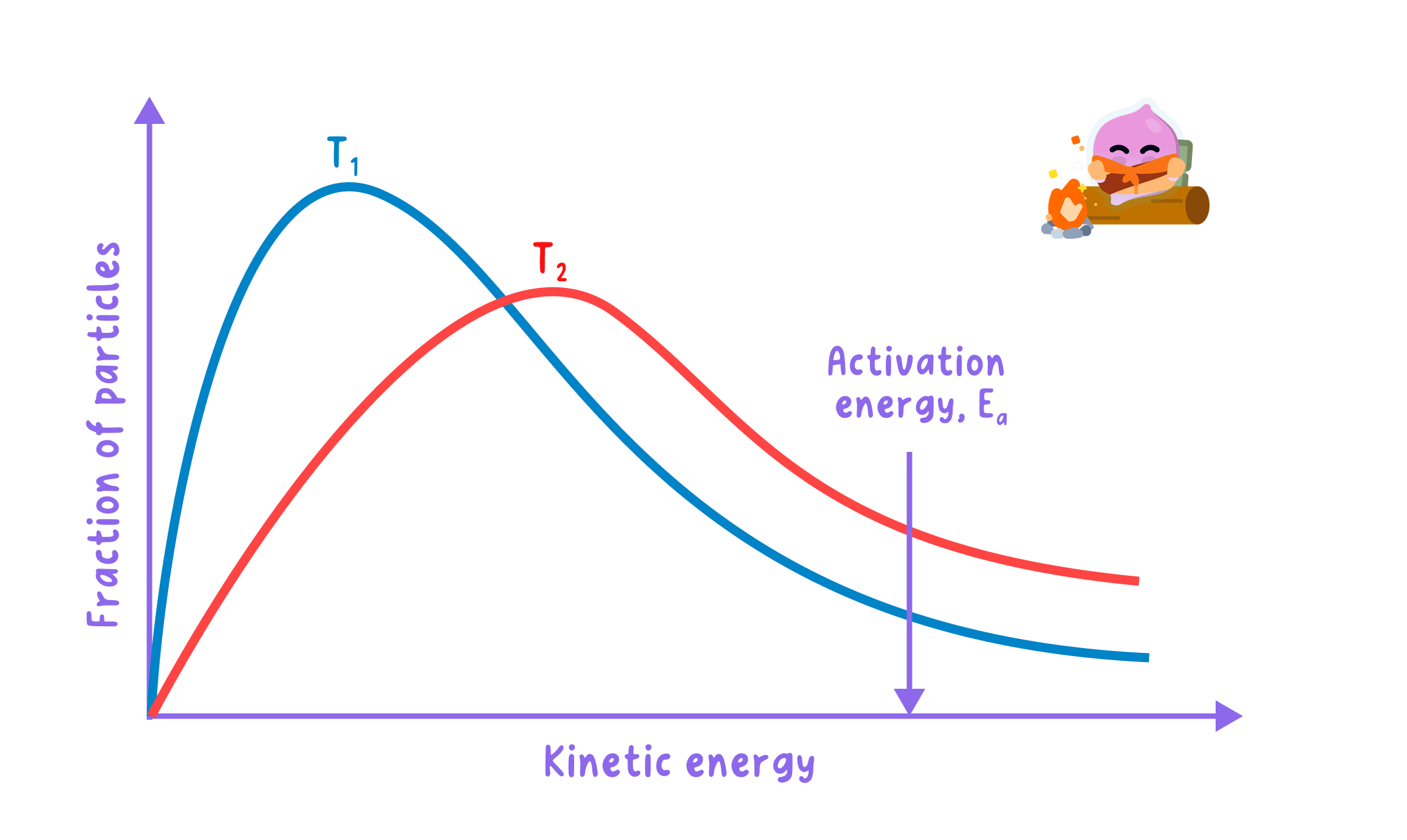
Thiosulfate and acid: the cross disappears in half the time for a rise of about ten degrees.
Concentration and pressure pack the particles closer
Concentration
The mass or amount of a solute dissolved in a given volume of solution.
- A more concentrated solution holds more particles in the same volume.
- Particles that are closer together collide more frequently.
- Raising the pressure of a gas squeezes the same particles into a smaller volume.
- That has the same effect as raising a concentration, so collisions again become more frequent.
- Neither change alters the energy of the particles, only how often they meet.
Pressure changes the rate only for reactions involving gases, since liquids and solids barely compress.
Breaking a solid up exposes more of it
Surface area to volume ratio
The surface area of a solid compared with its volume, which increases as the solid is broken into smaller pieces.
- A reaction with a solid can only happen at the solid's surface.
- Breaking the solid into smaller pieces exposes more surface for the same mass.
- The surface area to volume ratio rises as the pieces get smaller.
- More exposed surface means more particles are in a position to collide.
- A powder therefore reacts much faster than a single lump of the same mass.
A powder reacts faster, but the same mass still gives the same amount of product in the end.
Which factor changes frequency and which changes energy
- Concentration, pressure and surface area all act on the frequency of collisions.
- Temperature acts on the frequency and on the energy, which is why its effect is largest.
- An explanation is complete only when it names which of the two has changed.
- Saying that particles collide more is not enough on its own, since the reason is what carries the point.
- Every one of these factors leaves the activation energy itself unchanged.
- An explanation runs in three steps: what changes, how it affects collisions, then the effect on rate.
- Only temperature changes the proportion of collisions with enough energy.
- Faster is not the same as more product, so the two questions are answered separately.
- What two conditions must a collision meet for a reaction to happen?
- Why does raising the temperature have a larger effect than raising the concentration?
- Why does raising the pressure speed up a reaction between gases?
- Why does a powder react faster than a lump of the same mass?
- Which of these factors changes the activation energy?
8.1.3 Catalysts and enzymes
A catalyst speeds a reaction without being used up
Catalyst
A substance that speeds up a reaction without being used up in the reaction.
- Adding a catalyst lets a reaction reach the same point in a shorter time.
- Nothing uses it up, so all of it is still there when the reaction has finished.
- Being unchanged chemically, it can be recovered and used again.
- Its mass at the end is the same as its mass at the start.
- A small mass of catalyst can therefore serve a reaction many times over.
Being neither reactant nor product, it appears on neither side of the equation.
A catalyst lowers the activation energy
Activation energy
The minimum energy that colliding particles must have for a reaction to happen.
- A catalyst provides a different route from reactants to products.
- That route has a lower activation energy than the uncatalysed one.
- A lower activation energy means a larger proportion of collisions is successful.
- More successful collisions in the same time means a faster reaction.
- The particles themselves are unchanged, so it is the route that has changed, not their energy.
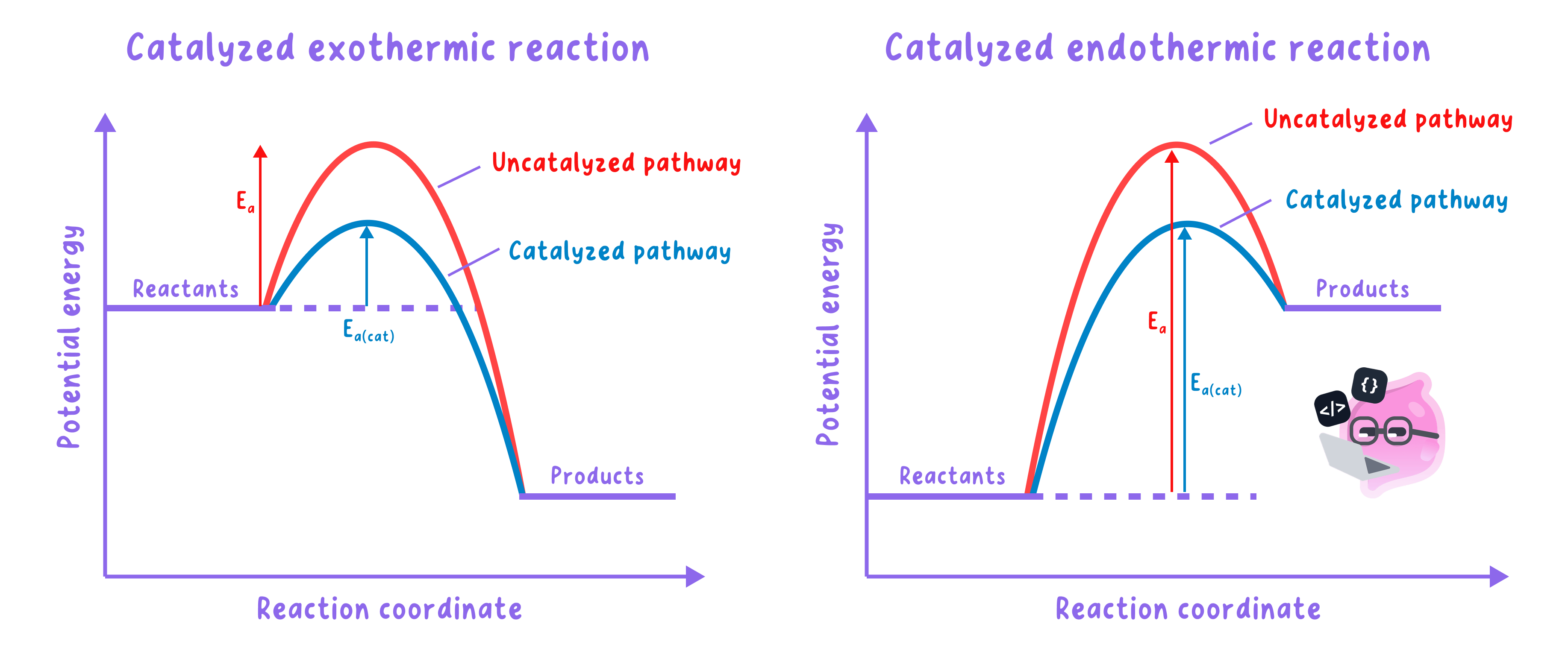
A catalyst does not give the particles more energy; it lowers the bar they have to clear.
A catalyst does not change the products
- The products are exactly the same with a catalyst as without one.
- The amount of product is the same too, because the reactants are unchanged.
- Only the time taken to get there is different.
- On a graph, a catalysed reaction rises more steeply but levels off at the same height.
- Different reactions need different catalysts, so a catalyst is specific to its reaction.
- Iron: catalyses the formation of ammonia in the Haber process.
- Nickel: catalyses the addition of hydrogen to unsaturated oils.
Enzymes are biological catalysts
Enzyme
A biological catalyst that speeds up a reaction in a living organism.
- Living organisms make their own catalysts, and these are called enzymes.
- Enzymes work in the same way as any other catalyst, by lowering the activation energy.
- They are highly specific, so each enzyme catalyses one reaction or one type of reaction.
- They work best within a narrow range of temperature and pH.
- Too high a temperature damages the enzyme and it stops working.
Being damaged by heat is the opposite of the usual rate pattern, so a hotter enzyme reaction can be slower.
Enzymes in the production of alcoholic drinks
- Yeast contains the enzymes that convert sugar into alcohol.
- This process is called fermentation.
- Glucose is converted into ethanol and carbon dioxide: glucose→ethanol+carbon dioxide\text{glucose} \rightarrow \text{ethanol} + \text{carbon dioxide}glucose→ethanol+carbon dioxide
- The carbon dioxide is what makes the fermenting mixture bubble.
- Keeping the mixture warm lets the enzymes work quickly without damaging them.
- Give three things that are true of a catalyst at the end of a reaction.
- How does a catalyst increase the rate of a reaction?
- Does a catalyst change the amount of product formed?
- What is an enzyme?
- Write the word equation for the fermentation of glucose.
