

GCSE Chemistry Revision When You’re Stuck at a Pass
GCSE Chemistry revision plan for students stuck at a pass grade: targeted mistakes, maths-led methods, past papers and routines to climb to 5-7.
If you are stuck at a pass grade in GCSE Chemistry, it rarely means you are “bad at science”. More often, it means you are revising in a way that feels busy but doesn’t move marks. You read, highlight, re-watch videos, and still the paper gives you the same feeling: I sort of know this… but I can’t get it down in exam language.
Here’s the quiet truth: most students at a pass grade aren’t miles away. They are usually a handful of predictable habits away from a higher band of marks. And one of the fastest levers is maths, because GCSE Chemistry is full of calculations, units, rearranging formulae, graphs, and proportional reasoning.
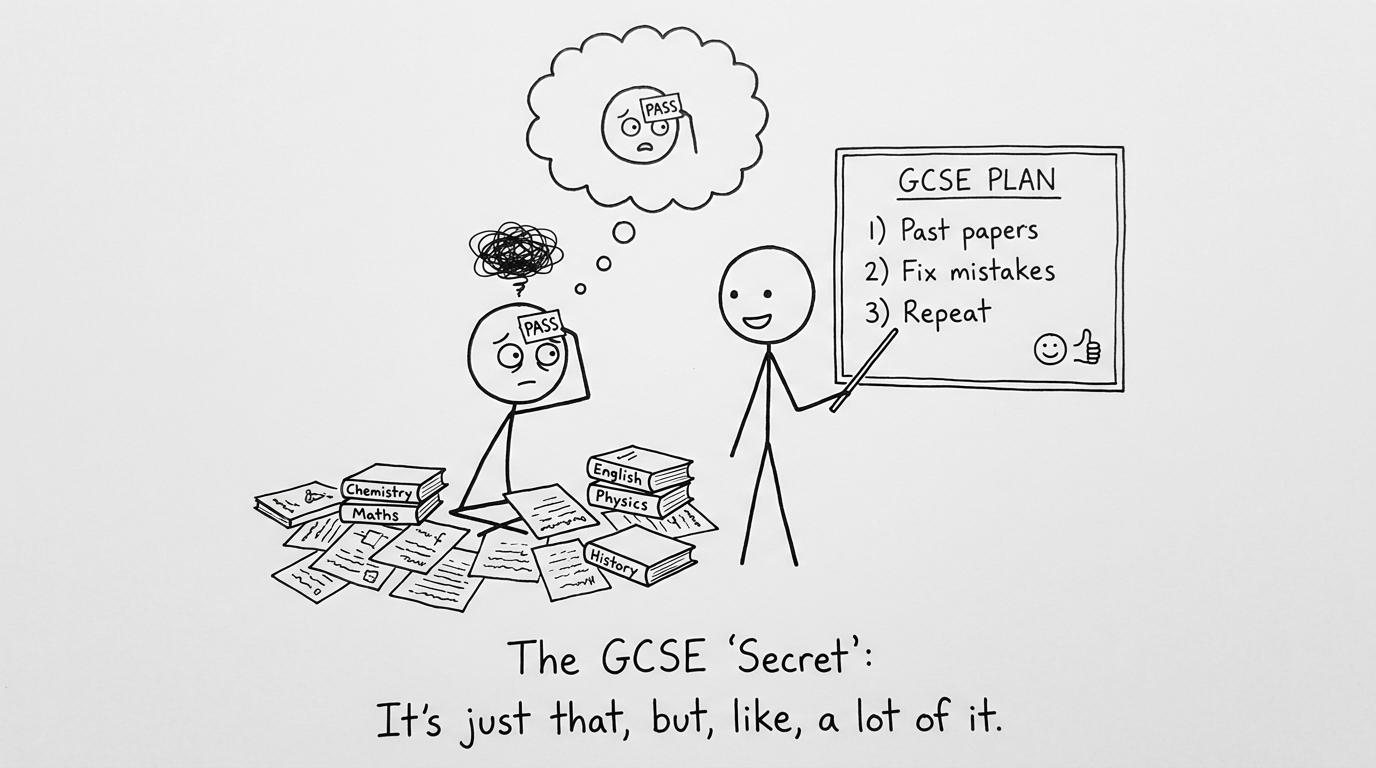 A stressed student finds a simple plan
This guide is written for UK students who use YesGenie for maths revision, but want a practical way to fix GCSE Chemistry too. We will keep it exam-board aware (AQA, Edexcel, OCR, Eduqas), focused on mark schemes, and built around the kind of practice that actually changes outcomes.
A simple checklist to move beyond a pass grade
If you do nothing else, do this for the next 14 days:
- Do a little GCSE Chemistry every day, but make it output-based: questions, not rereading.
- Mark strictly using mark schemes, then create a “mistake list”.
- Convert each mistake into a repeatable rule (a sentence starter, a method, or a unit check).
- Practise the maths bits deliberately: formula triangles are not enough; you need rearranging and unit fluency.
- Do timed sections twice a week so your brain learns pace, not just content.
To support the maths side (which often caps Chemistry grades), keep these YesGenie pages open during your revision:
- GCSE Past Papers
- Resources (Predicted Papers, Mini Tests and more)
- Edexcel GCSE Maths Revision
- Edexcel GCSE Maths Past Papers
- Edexcel GCSE Maths Predicted Papers
- Edexcel GCSE Maths Revision Guides
- OCR GCSE Maths
- A Level Maths Past Papers (for stretching your algebra confidence)
Yes, these are maths links. That is intentional: if you are stuck at a pass in GCSE Chemistry, your quickest gains often come from tightening the calculation marks you are currently donating.
Why you get stuck at a pass grade in GCSE Chemistry
A pass-grade plateau tends to come from three things.
You revise “information” instead of “performance”
Reading a topic makes you feel calm. Answering a six-mark question makes you feel exposed. The exam rewards the second.
You lose marks in predictable mark-scheme ways
GCSE Chemistry mark schemes are repetitive. If you keep losing the same marks (state symbols, units, precision, definitions, controlling variables), you are not failing content; you are failing execution.
Your maths is quietly limiting your chemistry
Many students can describe a reaction but panic when asked to calculate concentration, percentage yield, or energy changes. Those are high-frequency GCSE marks.
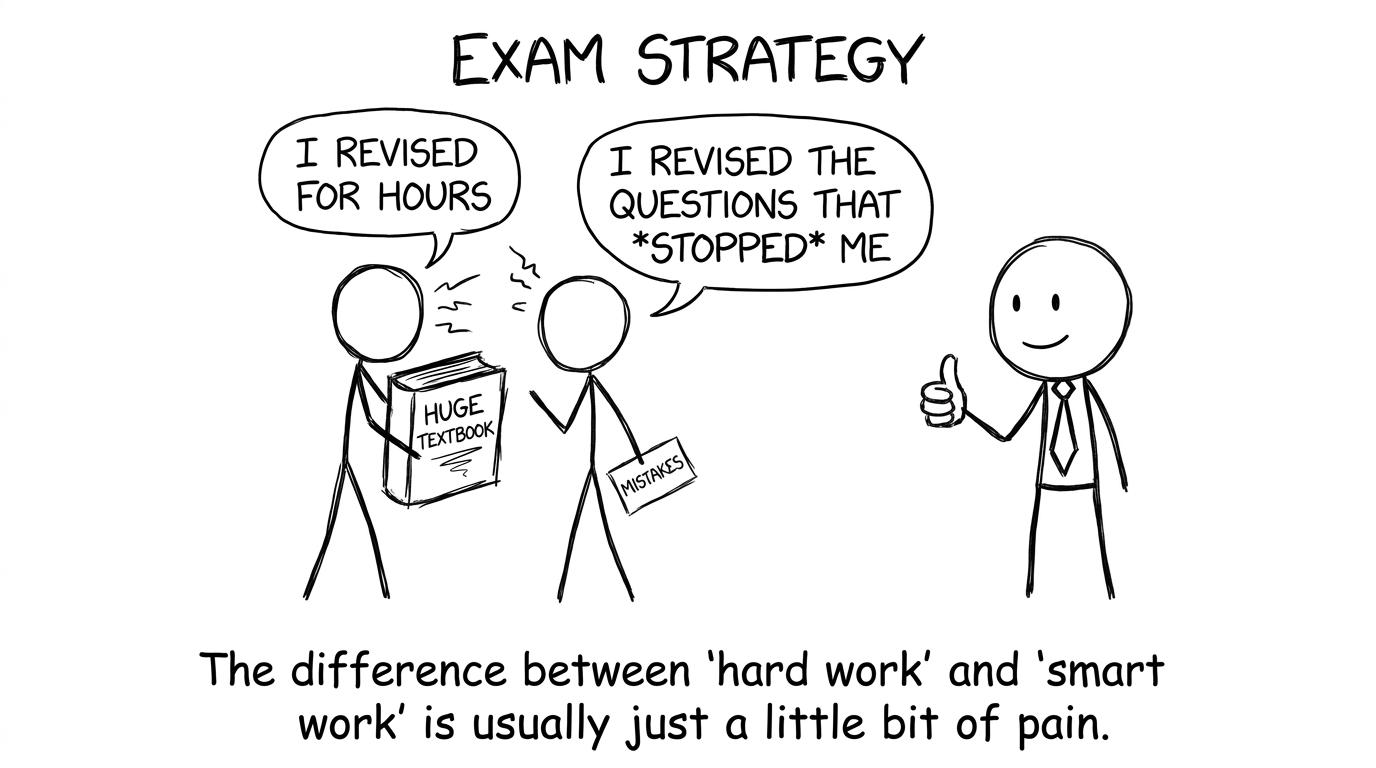 Rereading vs fixing mistakes
The revision method: “Past paper loops” (and why it works)
If you are stuck at a pass grade, you do not need an endless checklist of topics. You need a loop.
Step 1: Do short exam-style sets
Pick 20 to 30 minutes of GCSE Chemistry questions (mixed if possible). If you do not have a bank handy, use your school booklet or your exam board’s past questions.
Step 2: Mark it like the examiner
Be strict. If the mark scheme says “any two of these points”, you need two distinct points. If it says “must include reference to ions”, you cannot swap in a vague sentence about “particles”.
Step 3: Build a “mistake list” you actually reuse
Your mistake list should not be a diary of pain. It should be a set of reusable tools, like:
- “When asked about rate, mention collision frequency and successful collisions.”
- “When asked for a conclusion, link the pattern to the variable and use the data.”
- “When calculating, write the formula, substitute with units, then state the answer with units.”
Do this loop four to five times a week. That is how you climb from “pass” to “secure pass” and then to grades 5-7.
GCSE Chemistry calculations: the marks you can reliably win
GCSE Chemistry calculations are not there to trick you. They are there because the subject is quantitative. If your algebra and unit handling are shaky, you can fix that quickly with deliberate maths practice.
Use YesGenie to tighten the core skills behind Chemistry calculations:
- Rearranging and substitution practice via Edexcel GCSE Maths Revision Guides
- Timed accuracy via Edexcel GCSE Maths Predicted Papers
- Real exam discipline via Edexcel GCSE Maths Past Papers
Worked example: concentration
A common GCSE Chemistry relationship is:
c=nV c = \frac{n}{V} c=Vnwhere ccc is concentration in mol dm−3\text{mol dm}^{-3}mol dm−3, nnn is moles, and VVV is volume in dm3\text{dm}^3dm3.
Question: A student has 0.250.250.25 moles of sodium chloride dissolved in 500 cm3500\text{ cm}^3500 cm3 of water. Find the concentration.
Step 1: Convert units You must convert 500 cm3500\text{ cm}^3500 cm3 to dm3\text{dm}^3dm3.
500 cm3=0.5 dm3 500\text{ cm}^3 = 0.5\text{ dm}^3 500 cm3=0.5 dm3Step 2: Substitute
c=0.250.5=0.5 c = \frac{0.25}{0.5} = 0.5 c=0.50.25=0.5Answer: 0.5 mol dm−30.5\text{ mol dm}^{-3}0.5 mol dm−3.
What changes grades is not the formula. It is writing the unit conversion clearly so you do not throw away a mark.
Worked example: percentage yield
Percentage yield appears across AQA, Edexcel, OCR and Eduqas specifications.
Percentage yield=actual yieldtheoretical yield×100 \text{Percentage yield} = \frac{\text{actual yield}}{\text{theoretical yield}} \times 100 Percentage yield=theoretical yieldactual yield×100Question: The theoretical yield is 12 g12\text{ g}12 g. The actual yield is 9 g9\text{ g}9 g. Find the percentage yield.
912×100=0.75×100=75 \frac{9}{12} \times 100 = 0.75 \times 100 = 75 129×100=0.75×100=75Answer: 75%75\%75%.
A pass-grade student often stops at 912\frac{9}{12}129 or writes 0.75%0.75\%0.75%. A higher-grade student finishes, labels, and checks the result is sensible (less than 100%100\%100% because actual is less than theoretical).
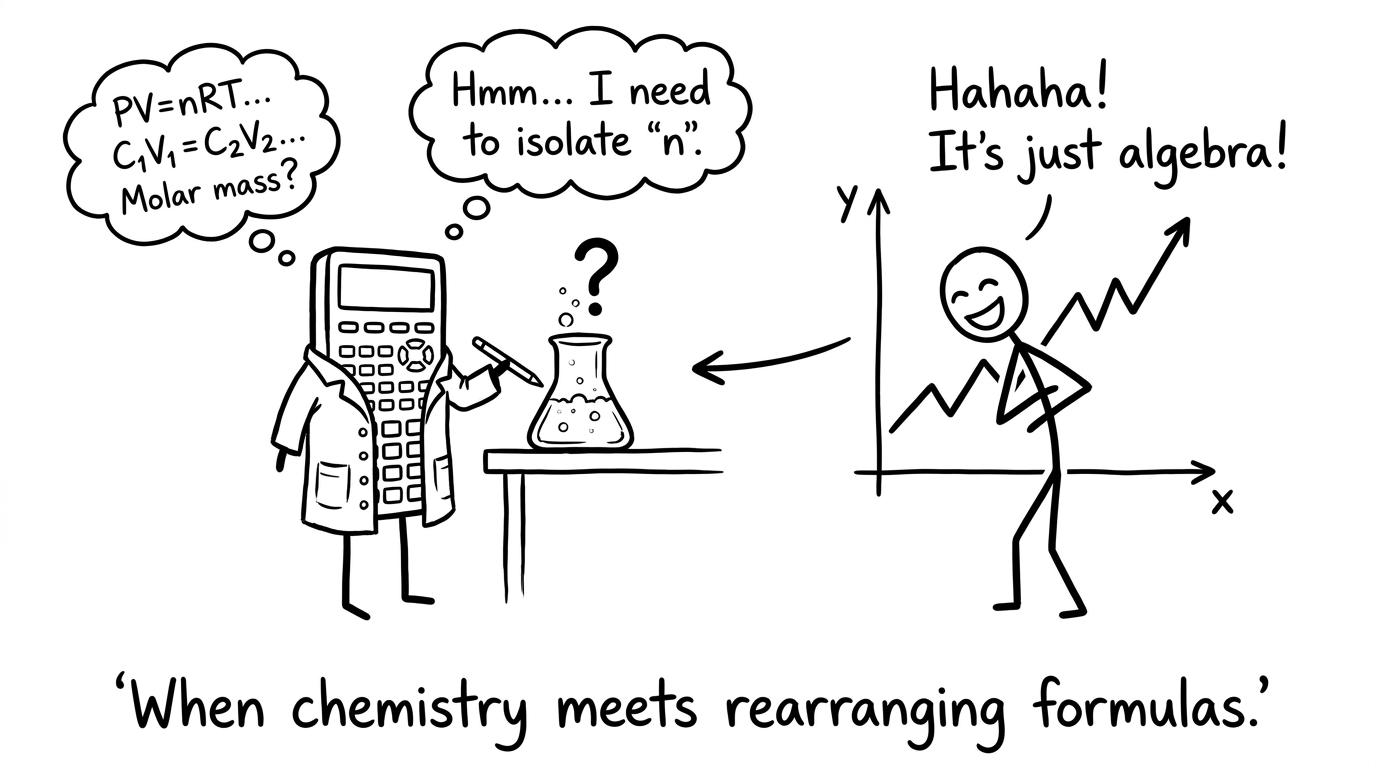 Chemistry meets rearranging formulas
Worked example: energy changes (specific heat capacity style)
Some GCSE Chemistry papers include calculations linked to heating curves or energy changes. A common structure is:
E=mcΔT E = mc\Delta T E=mcΔTQuestion: A 200 g200\text{ g}200 g sample of water is heated from 20∘C20^{\circ}\text{C}20∘C to 45∘C45^{\circ}\text{C}45∘C. Use c=4.2 J g−1∘C−1c = 4.2\text{ J g}^{-1}{}^{\circ}\text{C}^{-1}c=4.2 J g−1∘C−1. Find the energy transferred.
ΔT=45−20=25 \Delta T = 45 - 20 = 25 ΔT=45−20=25 E=200×4.2×25=840×25=21000 E = 200 \times 4.2 \times 25 = 840 \times 25 = 21000 E=200×4.2×25=840×25=21000Answer: 21000 J21000\text{ J}21000 J.
Notice the quiet discipline: calculate ΔT\Delta TΔT first, track units, and multiply in a clean order. That is GCSE exam technique, not genius.
The “language marks” that keep you at a pass grade
Even if your calculations improve, GCSE Chemistry still demands precise phrasing. At a pass grade, students often write sentences that sound scientific but do not hit mark-scheme keywords.
Use sentence starters that mirror mark schemes
For six-mark questions, you often need a structure:
- State the pattern from the data.
- Explain why using particles/collisions/energy ideas.
- Link to the variable you changed.
- Conclude clearly.
For required practicals:
- Name the independent variable, dependent variable, and control variables.
- Describe how you improve accuracy (repeat and average, avoid parallax, calibrated equipment).
- Describe how you improve reliability (repeats, anomalies).
This is where “stuck at a pass” becomes “consistently a 5”: you stop improvising and start using reusable patterns.
How to use maths revision to support GCSE Chemistry (without losing time)
You are a maths student using YesGenie. Good. Leverage that identity.
Do micro-sprints of maths that map to chemistry
Twice a week, do 20 minutes on:
- rearranging formulae,
- ratio and proportion,
- standard form,
- unit conversions.
Then return to GCSE Chemistry questions immediately, while your brain is in “method mode”.
Use:
Train your exam stamina with paper strategy
If your school does combined science, you might be doing three papers per science across the season. Stamina matters.
For that, copy what works in maths revision:
- Do one timed section.
- Mark it.
- Re-do only the missed question types.
You can practise the timing habit using GCSE Past Papers and YesGenie’s predicted-paper rhythm from maths: Edexcel GCSE Maths Predicted Papers.
Common mistakes that keep GCSE Chemistry at a pass
- Ignoring units or writing the correct number with the wrong unit (especially cm3\text{cm}^3cm3 vs dm3\text{dm}^3dm3).
- Not converting before substituting into a formula.
- Rounding too early, then drifting away from the mark scheme’s final answer.
- Mixing up keywords like “oxidation” and “reduction”, or “endothermic” and “exothermic”, without linking to electrons or energy transfer.
- Writing vague practical descriptions without naming variables and controls.
- Leaving out the conclusion sentence that directly answers the question.
- Not using data in required practical evaluation questions (you must reference the numbers/pattern).
Each of these is fixable. Each of these appears repeatedly in GCSE mark schemes. Each of these is a reason to revise by questions, not by vibes.
A final word: you are closer than you think
Being stuck at a pass grade in GCSE Chemistry can feel like pushing a door that will not open. But most of the time, the door is not locked; you are just pushing in the wrong place. Shift your revision from reading to performing, from hoping to marking, and from “covering content” to closing your specific gaps.
Keep your maths sharp alongside it. Use YesGenie as your daily engine: revision lessons when you need clarity, practice questions when you need repetition, and exam practice when you need confidence under time pressure. Start with GCSE Past Papers to build the habit, then strengthen your method using Edexcel GCSE Maths Revision and timed practice like Edexcel GCSE Maths Predicted Papers.
If you want one simple plan for tomorrow: do 25 minutes of GCSE Chemistry questions, mark them strictly, fix three mistakes, then do 15 minutes of the maths skill that caused the most damage. Repeat that loop. That is how a pass becomes a platform, not a ceiling.










