

GCSE Biology Grade and Sixth Form Entry
GCSE biology grade sixth form entry explained: learn when Biology matters, how requirements vary and why your Maths grade may be equally important.

A single grade can feel as if it is carrying your whole future. You look at Biology, look at a sixth-form prospectus, and wonder whether one difficult paper could quietly close a door.
The short answer to the GCSE biology grade sixth form entry question is reassuring: sixth forms and colleges care most about your Biology grade when you want to take A Level Biology or another science-heavy course. For unrelated A Levels or vocational courses, it is usually one part of your overall GCSE profile rather than the deciding factor.
There is no single UK-wide GCSE Biology grade required for sixth-form entry. Each institution sets its own general and subject-specific conditions, so the published requirements for the courses you want are what matter.
The quick entry-requirements checklist
Before worrying about one result, check these five things:
- the institution's general GCSE entry requirement
- the specific requirement for each course you want
- whether it treats Separate Biology and Combined Science differently
- whether it also requires particular Maths or English grades
- what alternatives it offers if you narrowly miss a condition
Requirements can change between admissions cycles. Save the current prospectus or course page, but check it again before applying and before confirming your place on results day.
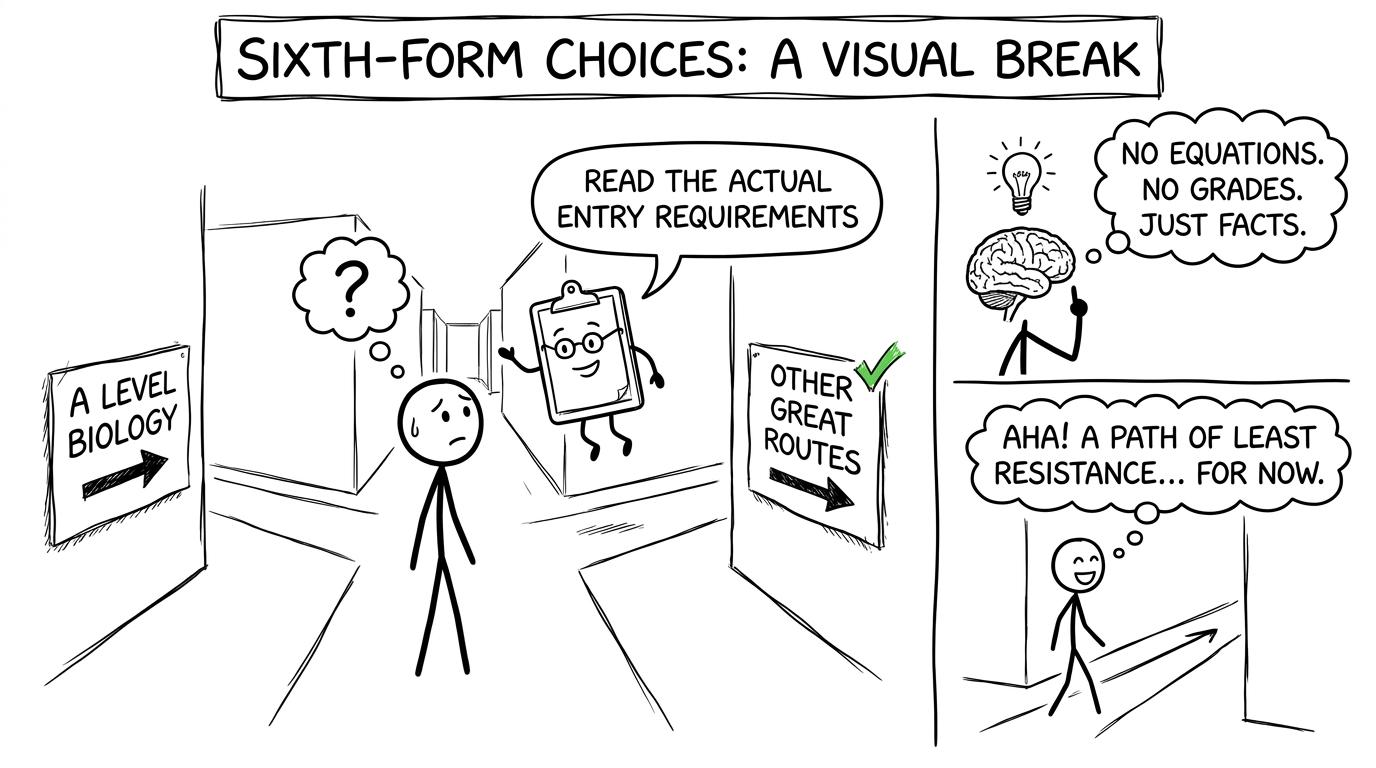 A student choosing between A Level Biology and other routes while a friendly clipboard recommends checking the requirements
How much weight does your GCSE Biology grade carry?
Its weight depends on the course. Think of the grade as playing one of four different roles.
It can be a direct entry gate
If you apply for A Level Biology, the grade may be a firm subject-specific condition. Published requirements for 2026 entry show genuine variation between institutions. Some accept grade 555 or 666 in Biology or Combined Science, while more selective courses may ask for grade 777 or higher. Combined Science conditions may be expressed as paired grades such as 666-666 or 777-777.
Some providers also require a particular Chemistry or Maths result. That is because A Level Biology builds on wider scientific knowledge and uses numerical skills, not because one national admissions rule tells every school to use the same threshold.
Read the wording carefully. “Grade 666 in Biology” is not automatically equivalent to “grade 666-666 in Combined Science”, and a condition referring to “all sciences” may require the stated grade in every relevant science result.
For more detail on the step beyond GCSE, read MathsGenie's guide to choosing A Levels after GCSE Biology.
It can be supporting evidence
For A Level Chemistry, Psychology, PE or Geography, Biology might strengthen your academic profile even where it is not a formal condition. A provider may use it as evidence that you can recall detailed content, interpret information and apply ideas to unfamiliar contexts.
However, supporting evidence is not the same as a compulsory threshold. If the course page asks for Chemistry and Maths but says nothing about Biology, do not invent an extra rule for yourself.
It can contribute to your overall GCSE profile
Many sixth forms set a general entry standard based on a collection of GCSE results. They might ask for a certain number of grades at 444, 555 or above, or calculate an average from your best subjects. In that situation, Biology matters because it contributes to the wider profile.
One lower result may therefore be balanced by stronger grades elsewhere, provided you still meet every subject-specific condition. Conversely, a strong Biology grade cannot compensate automatically for missing a compulsory Maths, English or course requirement.
It may carry relatively little weight
If you plan to take subjects such as History, Art, English Literature or a vocational course with no science condition, your Biology result is less likely to determine entry. The institution may still consider it among your GCSEs, but the most relevant subject grades normally carry greater weight.
That distinction matters. “They will see the grade” and “the grade will decide my application” are not the same statement.
Why requirements vary between sixth forms and colleges
Exam boards including AQA, Edexcel, OCR and Eduqas set qualification specifications and assessments. They do not impose one universal sixth-form admissions threshold.
Individual schools and colleges choose requirements based on their curriculum, course demands, available places and admissions policy. Recent published criteria illustrate the range: one provider may accept grade 555 for A Level Biology, another may require grade 666 alongside Maths, and another may set the threshold at grade 777 with additional science conditions.
This means advice from a friend applying elsewhere may be accurate for them and wrong for you. The institution's current admissions policy outranks general internet advice.
 A student juggling Biology, Maths and English grades as an admissions clipboard considers the whole application
Your Maths grade may matter more than you expect
Students sometimes treat A Level Biology as a subject made entirely of facts. It is not. You may need to handle ratios, percentages, standard form, graphs, rates of change and statistical ideas within scientific contexts.
That helps explain why some Biology courses specify a GCSE Maths grade, often alongside the science requirement. The exact threshold is local, but published course criteria commonly include Maths at grade 555 or 666.
More broadly, Maths and English have a special place in post-16 education in England. Under the Department for Education's condition-of-funding rules, eligible students who have not yet achieved grade 444 or above in GCSE Maths or English must continue appropriate study in the subject they still need. This is a funding and study requirement, not a universal promise of admission to every course.
So if Biology is your future plan, strengthening Maths is not a distraction from it. It protects more choices. Start with the free GCSE Maths revision hub, where you can select your exam board and work through revision lessons, exam questions and papers.
What if you studied Combined Science?
Combined Science does not automatically prevent you from taking A Level Biology. Many sixth forms accept it, but they may ask for a paired result such as 666-666 or 777-777 rather than a separate Biology grade.
Check three details:
- whether the course accepts Combined Science
- which pair of grades it requires
- whether it adds conditions in Maths, English or another science
Do not try to convert your Combined Science result into an imaginary standalone Biology grade. Use the qualification and grade format printed on your results, then compare it directly with the institution's wording.
If anything is ambiguous, contact admissions. A short, precise question is better than months of guessing.
What happens if you miss the required grade?
Missing a published condition can matter, particularly for a popular A Level science course, but it does not tell you the final decision by itself.
On results day, the provider may consider available places, your other grades and its admissions policy. It might maintain the condition, exercise discretion, suggest a different subject combination or offer another Level 333 route. None of these outcomes should be assumed in advance.
Your practical response should be:
- speak to the sixth form or college directly
- ask whether the threshold is firm for that year
- take your complete results profile with you
- discuss alternative courses rather than focusing on one missing grade
- ask your school about a review of marking only where there is a valid reason
A GCSE Biology resit is not the standard post-16 requirement in the way continued Maths or English study may be in England. Whether a science resit is available or useful depends on the provider, examination arrangements and your intended route.
How to protect your options before results day
The strongest application strategy is not to predict one grade repeatedly. It is to create several workable routes.
Compare real course pages
Choose at least two institutions and record their general requirements, Biology or Combined Science condition, Maths condition and application deadline. Add one alternative course at each provider.
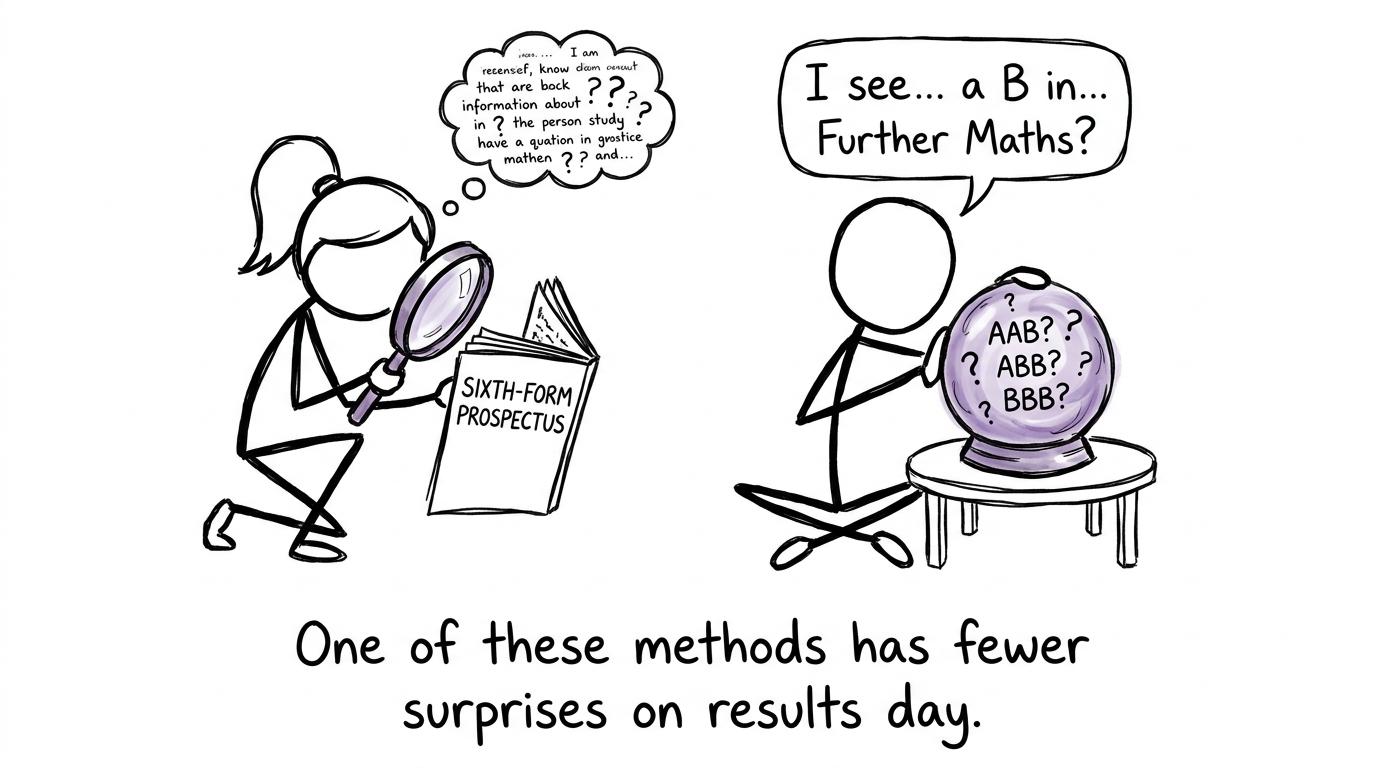 One student checks a prospectus with a magnifying glass while another guesses entry requirements using a crystal ball
Treat Maths as an option-preserving subject
A stronger Maths result can support entry to Biology, Chemistry, Physics, Economics and A Level Maths itself. Use Edexcel GCSE Maths mini tests if that is your board, or select the appropriate board through the main revision hub.
Short tests are useful because they reveal specific gaps without consuming an entire evening. Then use this revision loop:
- attempt a focused set
- mark it honestly
- identify the skill behind each lost mark
- return to the relevant revision lesson
- practise fresh questions
- retest after a short gap
The guide to using GCSE past papers properly explains how to turn marking into improvement. If exams are approaching, the one-month GCSE Maths revision plan can give that work a weekly structure.
Keep your plan flexible
Your preferred route might be A Level Biology, but it should not be your only imagined future. Depending on the provider, alternatives may include Applied Science, another Level 333 qualification or a different A Level combination.
An alternative is not automatically a lesser choice. It is only useful, however, if it supports your longer-term plans. Check university or apprenticeship requirements before changing direction.
Common mistakes when judging your chances
Assuming every sixth form uses the same grade
There is no universal GCSE Biology threshold for A Level Biology. Compare current policies rather than relying on a national-sounding rule.
Looking only at the Biology condition
A course may also specify Maths, English, Chemistry, another science or an overall GCSE profile. Read the complete entry section.
Confusing application with enrolment
Receiving an offer may mean you still need to achieve stated grades in the summer. Keep the written offer conditions and check what must be met.
Treating a predicted grade as a final result
Predicted grades may support an application, but enrolment decisions can depend on achieved results and the provider's policy. Use predictions to guide revision, not to declare the outcome settled.
Giving up on Maths because you want Biology
Numerical confidence supports science courses and can be a separate entry condition. Begin past-paper work while there is still time to respond to your mistakes; MathsGenie's guide on when to start GCSE past papers can help you pace that process.
Your grade matters, but its context matters more
A GCSE Biology grade can carry substantial weight when it is a stated condition for A Level Biology. It can carry moderate weight as part of an overall GCSE profile, and much less weight for courses unrelated to science. The honest answer is therefore not simply yes or no. It is: which course, at which institution, under which current policy?
Check those requirements now. Then put your energy into the grades you can still influence.
For Maths, make MathsGenie's free GCSE revision resources your starting point. Use revision lessons and practice questions to repair weak topics, mini tests to check recall, and past papers or predicted papers to build exam confidence. Mark everything carefully with the mark schemes and use video solutions when a method still feels uncertain.
The prospectus tells you where the door is. Consistent, well-directed revision gives you the best chance of walking through it.










