

GCSE Biology Grade 9 Meaning: A Clear Guide
GCSE biology grade 9 meaning explained: discover what the highest grade represents, how it compares with the old A* and what top answers require.
A grade can look deceptively simple. One number appears on results day, yet behind it sit two papers, dozens of decisions and months of revision. If you are searching for the gcse biology grade 9 meaning, the short answer is this: grade 9 is the highest GCSE Biology grade available in England. It represents exceptional performance across biological knowledge, application, practical understanding, mathematical skills and the analysis of unfamiliar information.
It is not simply the new name for an old A*. The numbered system was designed to distinguish more clearly between the strongest performances, with grades 777, 888 and 999 covering the territory previously occupied by grades A and A*. A grade 9 therefore identifies achievement at the very top of that wider range.
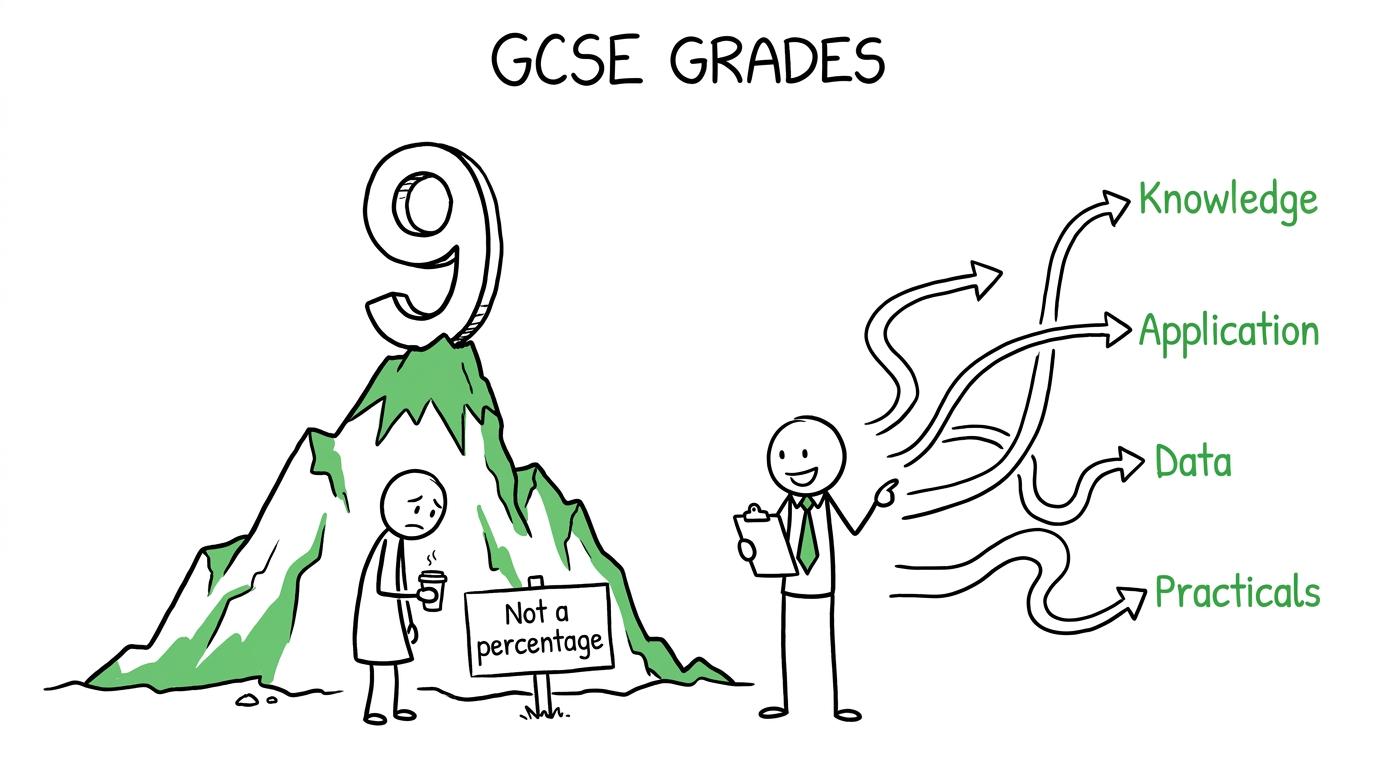 A student discovers that grade 9 is a mountain with several paths
GCSE Biology grade 9 meaning at a glance
A grade 9 means that you have:
- achieved the highest numbered grade in GCSE Biology;
- performed strongly across the whole assessed specification, not merely one topic;
- demonstrated detailed scientific knowledge and accurate terminology;
- applied biology to familiar and unfamiliar situations;
- interpreted data, evaluated methods and formed justified conclusions;
- handled the mathematical and practical demands of the course confidently;
- exceeded the grade 9 boundary set for your examination series.
It does not mean that you answered every question correctly. Nor does it correspond to one permanent percentage. Grade boundaries can change between exam boards and examination series because papers vary in difficulty.
What ability does a grade 9 actually represent?
A grade 9 reflects more than a large store of remembered facts. Strong recall matters, but GCSE Biology examinations also ask whether you can use that knowledge when a question changes the setting.
Across the reformed specifications, the assessment objectives broadly examine three abilities:
- AO1: demonstrating knowledge and understanding of scientific ideas, techniques and procedures;
- AO2: applying that knowledge and understanding;
- AO3: analysing and evaluating information, drawing conclusions and improving experimental procedures.
For example, AQA gives these objectives approximate overall weightings of 40%40\%40%, 40%40\%40% and 20%20\%20% respectively. The exact paper structure depends on your board, but Edexcel, AQA, OCR and Eduqas all assess the same broad blend of knowledge, application and analysis.
That balance explains why memorising a revision guide is not enough. A student aiming for grade 9 must know the content, recognise which idea a new question is testing and communicate a precise response using the evidence provided.
Comprehensive biological understanding
At the highest level, knowledge is secure enough to be connected. Cells are not remembered in isolation from tissues and organs. Enzymes connect to digestion, metabolism and practical investigations. Natural selection connects inheritance, variation and ecology.
This does not mean writing everything you know. It means selecting what is relevant. In a two-mark response, precision is usually more valuable than a paragraph of loosely connected facts.
Application in unfamiliar contexts
Many demanding questions place familiar biology inside an unfamiliar organism, investigation or data set. The surface details may look new, but the underlying principle is still on the specification.
A grade 9 student is increasingly able to strip away the story and identify that principle. They might recognise diffusion inside a new medical context, use ideas about selection to explain an unfamiliar population, or apply homeostasis to results they have not seen before.
This is one reason finding your weakest GCSE topics is more useful than repeatedly revising comfortable material. Weaknesses often hide not in factual recall, but in the transition from knowing to applying.
Analysis, evaluation and practical judgement
High-level performance also involves treating evidence carefully. You need to distinguish correlation from causation, identify variables, consider reliability and validity, notice anomalies and judge whether a conclusion is supported.
Required practicals matter because examination questions assess your understanding of methods and evidence, even though the final qualification is assessed through written papers. Learning a method as a script is fragile. Understanding why each step is used makes it easier to evaluate changes, limitations and sources of uncertainty.
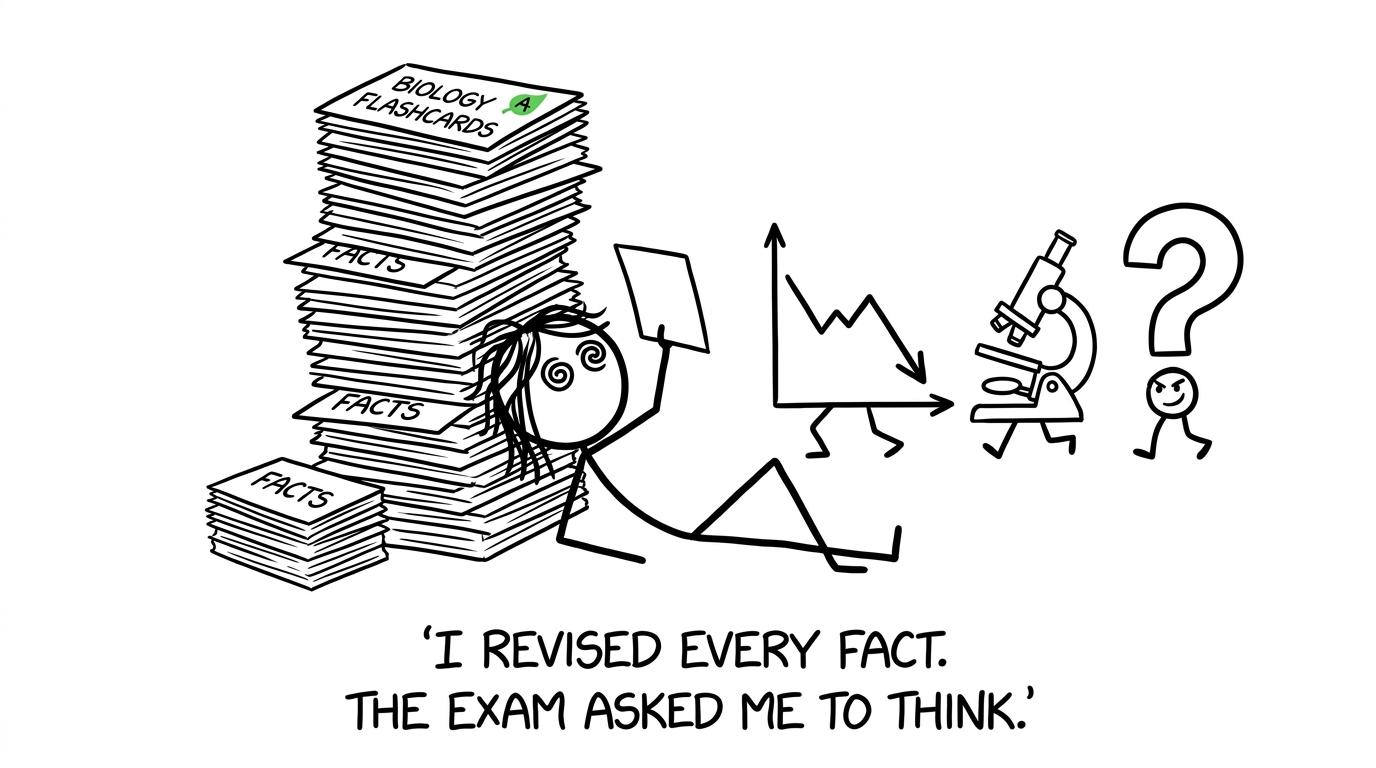 A student learns that memorising every fact does not answer every question
Is grade 9 equivalent to an old A*?
Not exactly. Ofqual states that the old and current scales do not have a complete one-to-one conversion. There are official comparison points:
- the bottom of grade 777 is comparable to the bottom of the old grade A;
- the bottom of grade 444 is comparable to the bottom of the old grade C;
- the bottom of grade 111 is comparable to the bottom of the old grade G.
Grades 777, 888 and 999 together cover the range previously represented by A and A*. Grade 9 was introduced to provide extra differentiation at the top, so it is commonly described as being above the old A* threshold. However, saying that grade 999 simply “equals A*” loses the reason the additional grade exists.
A more accurate interpretation is:
- grade 777 begins at a standard comparable with the old grade A threshold;
- grades 888 and 999 divide the highest achievement more finely;
- grade 999 represents the strongest performance within that top group.
This comparison applies to GCSEs graded 999 to 111 in England. GCSE arrangements in Wales and Northern Ireland can use different grading systems, so students should check the qualification and exam board shown on their entry.
A grade 9 is not a fixed percentage
One of the most persistent myths is that a particular percentage automatically guarantees grade 9. It does not.
A grade boundary is the minimum mark required for a grade in a specific examination series. Exam boards set boundaries after the papers have been sat and marked, using evidence about the difficulty of the assessments and the quality of student work. A more demanding paper may have a lower boundary than an easier one.
Your result can be expressed as:
Percentage mark=marks achievedtotal available marks×100\text{Percentage mark}=\frac{\text{marks achieved}}{\text{total available marks}}\times 100Percentage mark=total available marksmarks achieved×100But that percentage only becomes a grade when it is compared with the correct boundaries for your board, qualification and examination series. A boundary from another year is useful for rough practice-paper feedback, not as a promise.
This is similar to good maths revision: the total matters, but the location of lost marks matters more. Use a mark scheme to ask whether each loss came from knowledge, application, data handling, practical understanding or imprecise wording.
Why maths matters in GCSE Biology
GCSE Biology is a science qualification, but quantitative reasoning is part of biological competence. Specifications can assess percentages, ratios, means, graphs, significant figures, standard form, probability, rates, areas, volumes and the rearrangement of simple equations.
Students pursuing grade 9 should be comfortable with:
- calculating and interpreting percentage change;
- using ratios, fractions and proportions;
- calculating a mean and identifying anomalous results;
- translating between tables, graphs and written conclusions;
- using standard form for very large or small quantities;
- selecting suitable units and significant figures;
- interpreting gradients and rates;
- rearranging a supplied biological equation.
MathsGenie's fractions, decimals and percentages questions can strengthen one of the most common cross-curricular foundations. The GCSE Maths self-assessment sheet is also useful for identifying gaps in ratio, standard form, graphs and other skills that reappear in science.
Do not treat these marks as separate from biology. A calculated result still needs a biological interpretation. Clear working protects method marks, while a final sentence should explain what the value suggests in context.
How to revise towards grade 9
The most productive question is not “How many hours have I revised?” but “What can I now do that I could not do before?” Grade 9 preparation needs evidence.
Begin with the specification
Use the specification for your exact exam board. Separate the course into content, required practicals, mathematical skills and command words. Traffic-light each area honestly, then test your judgement with questions. Confidence without evidence is only a feeling.
Turn mistakes into categories
After completing an exam-style set, label each lost mark:
- missing knowledge;
- weak application;
- misunderstood command word;
- mathematical error;
- poor data interpretation;
- practical-method weakness;
- vague scientific language;
- timing or incomplete response.
This converts a disappointing mark into a revision plan. MathsGenie's guide to redoing past papers effectively explains why marking, repairing and later retesting is stronger than repeating a paper immediately.
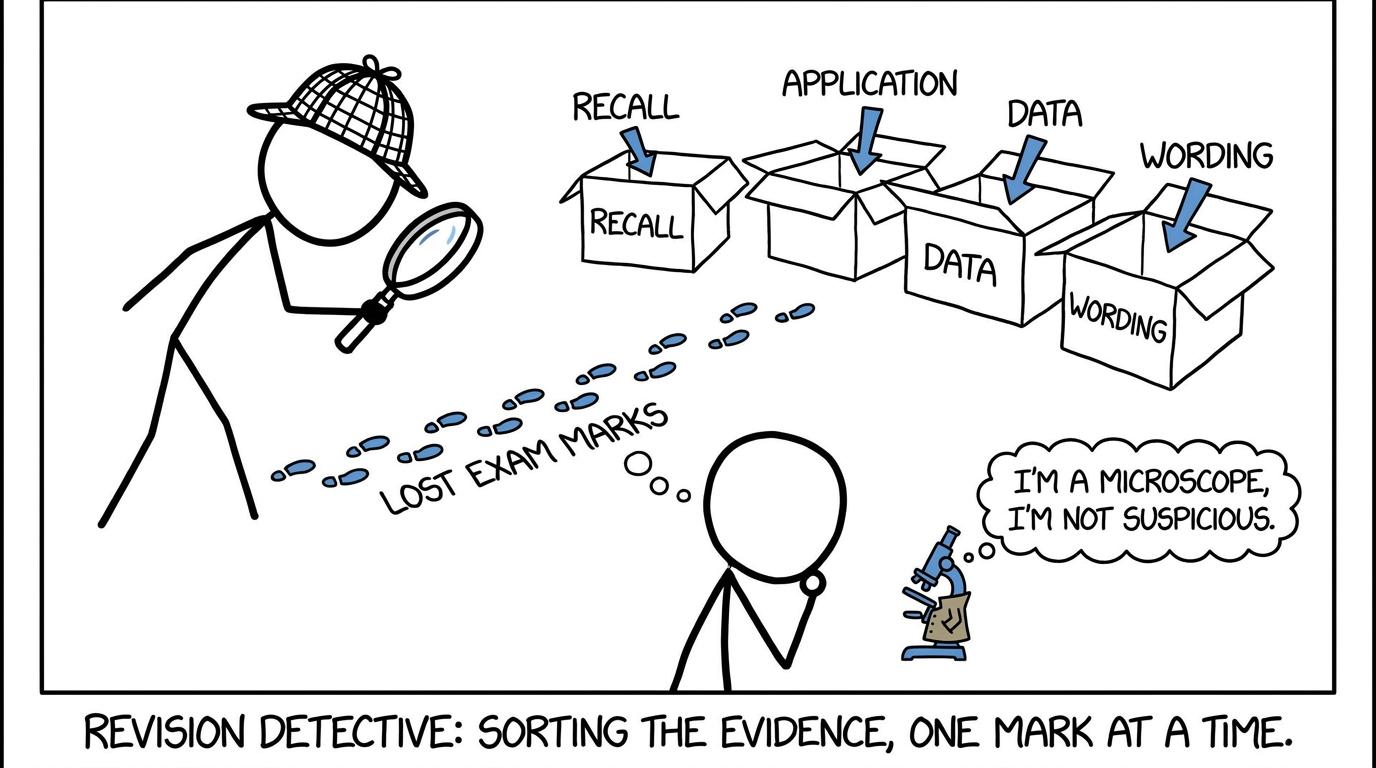 A revision detective investigates where the marks disappeared
Move from recall to application
Flashcards and retrieval questions are useful for building knowledge. Once recall is secure, spend more time on questions that ask you to explain, suggest, compare, evaluate and calculate.
Mark schemes reveal the precision examiners reward, but they should not become scripts to memorise. Read the question again and ask why each marking point answers it. Then attempt a different question testing the same principle.
Use papers as diagnosis, not prediction
Official past papers show how your board combines topics and skills. Predicted papers can provide fresh practice, but they cannot guarantee what will appear. The sensible sequence is topic revision, targeted questions, timed papers, strict marking and repair.
That principle is explored in MathsGenie's guide to using predicted topics without guessing. For your mathematical fluency, GCSE predicted papers provide timed practice supported by solutions and marking resources.
Common mistakes when aiming for grade 9
Treating grade 9 as a memorisation award
Detailed knowledge is necessary, but application and analysis carry substantial weight. Revision should include unfamiliar data and extended reasoning, not only definitions.
Using last year's boundary as a target
Boundaries vary. Aim to collect every accessible mark rather than deciding that a remembered percentage is “enough”.
Writing more instead of writing precisely
Long responses can still be vague. Follow the command word, use correct biological terminology and link each statement to the question.
Ignoring units and mathematical working
A correct-looking answer may lose marks if the unit, conversion or level of precision is wrong. Show the calculation clearly and check whether the result is biologically sensible.
Revising only the hardest content
Top grades can be lost through ordinary errors on accessible questions. Secure the foundations while developing higher-level application. MathsGenie's overview of recurring GCSE maths topics can help protect the numerical skills that support science answers.
Leaving exam technique until the final evening
Timing, interpretation and answer selection improve through repeated practice. A calm GCSE night-before plan is useful precisely because the real learning should already have happened.
What grade 9 should mean for your revision
Grade 9 is not proof of perfection. It is evidence of exceptional performance across a demanding GCSE Biology assessment. It says that your knowledge was broad, your application was adaptable and your interpretation of scientific evidence was consistently strong enough to cross that year's highest boundary.
The number matters, but the habits behind it matter more: retrieve knowledge, attempt unfamiliar questions, show quantitative working, mark honestly and repair each weakness.
MathsGenie can help you strengthen the mathematical side of that journey for free. Use the revision lessons to rebuild uncertain methods, practise with topic questions and mini tests, then test your accuracy through past papers, predicted papers, mark schemes and video solutions. Start with one weakness today. Improvement becomes much less mysterious when every lost mark tells you what to do next.










