

GCSE Biology Grade 8 Meaning: A Clear Guide
GCSE Biology grade 8 meaning explained: discover the ability it represents, how it compares with old A* grades, and what it says about your skills.
Opening a results envelope can make one number feel heavier than it is. You see a grade 8 in Biology, know it is excellent, but still wonder what it actually says about your ability.
The GCSE Biology grade 8 meaning is straightforward: it represents a very high level of performance. A grade 8 student typically demonstrates comprehensive biological knowledge, applies it accurately in familiar and unfamiliar contexts, handles complex scientific calculations, analyses data critically and evaluates experimental methods. It sits within the territory previously occupied by the old A* grade, although there is no exact one-to-one conversion.
That last point matters. A grade is not simply a percentage or a label attached to how clever you are. It is the outcome of your performance across particular papers, assessed against boundaries set for that exam series.
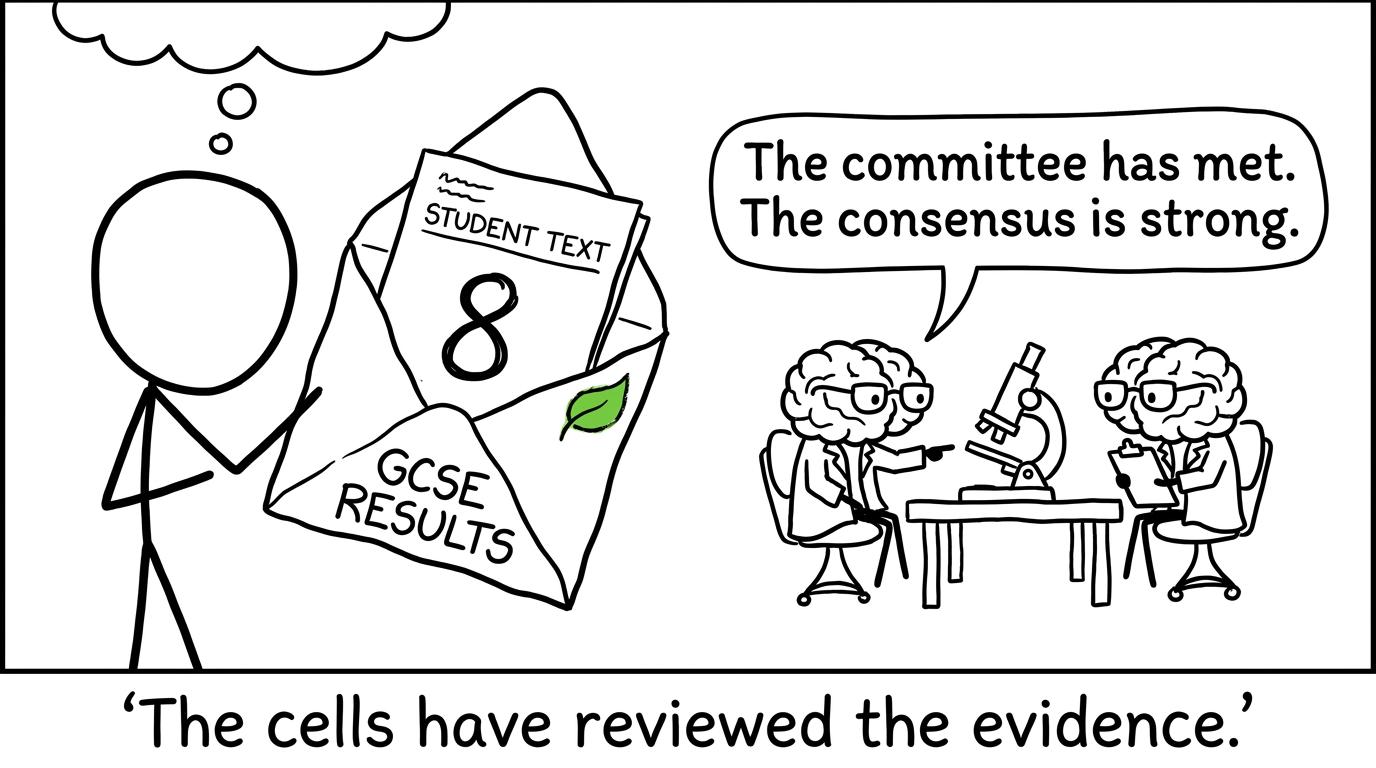 A student opens a grade 8 result while brain cells review the evidence
Grade 8 in GCSE Biology at a glance
A grade 8 usually indicates that you can:
- recall detailed biological knowledge accurately;
- connect ideas from different areas of the specification;
- apply knowledge to unfamiliar situations rather than merely repeat facts;
- interpret graphs, tables and experimental results;
- perform demanding calculations with appropriate units;
- reach logical conclusions supported by evidence;
- evaluate methods, limitations and scientific claims;
- communicate explanations using precise scientific terminology.
It is one grade below grade 9 and above grade 7. In separate GCSE Biology, it is a single qualification grade. In Combined Science, results are reported as paired grades such as 8-8 or 8-7 because Combined Science counts as two GCSEs.
What ability does a Biology grade 8 represent?
Ofqual's grade descriptor for the sciences describes the typical performance found at grade 8. It is not a checklist used mechanically to award every individual answer, but it provides a useful picture of the standard.
Comprehensive knowledge, not perfect memory
At this level, your knowledge is broad, relevant and usually accurate. You understand major biological ideas such as cell biology, organisation, infection, bioenergetics, homeostasis, inheritance and ecology, according to your exam board's specification.
However, grade 8 does not mean knowing every sentence in a textbook. Strong performance comes from selecting the right knowledge for the question. An answer about osmosis needs the relevant ideas expressed precisely; adding unrelated facts about cells does not make it stronger.
This is one reason active revision matters. Knowledge becomes useful when you can retrieve it without prompts and recognise where it belongs.
Application in unfamiliar contexts
The jump towards the highest grades is often less about learning extra facts and more about using familiar principles in unfamiliar settings.
An exam might describe an organism, treatment or experiment you have never encountered. The underlying biology will still come from the specification. A grade 8 response identifies the relevant principle, follows the information in the question and builds a justified answer instead of being unsettled by unfamiliar wording.
The same habit supports higher-tier maths. A question may look new while relying on familiar skills. MathsGenie's guide to the best order for learning GCSE maths topics can help you build those underlying skills systematically.
Confident analysis of evidence
Grade 8 performance includes more than describing a graph's overall shape. You may need to quote suitable data, compare changes, identify anomalies, judge whether evidence supports a conclusion or explain why the available results are insufficient.
Good analysis stays close to the evidence. It distinguishes what the results show from what you assume they show. That restraint is a sign of scientific maturity.
Evaluation that is specific
Weak evaluations often rely on stock phrases such as “repeat the experiment” or “use more participants”. Stronger answers explain why a limitation matters and how a realistic improvement would address it.
At grade 8, you are expected to think critically about variables, measurements, sample sizes, repeatability, validity and the strength of conclusions. The OCR Biology practical skills revision guide is particularly useful for reviewing variables, rates, graphs, sampling and experimental evaluation.
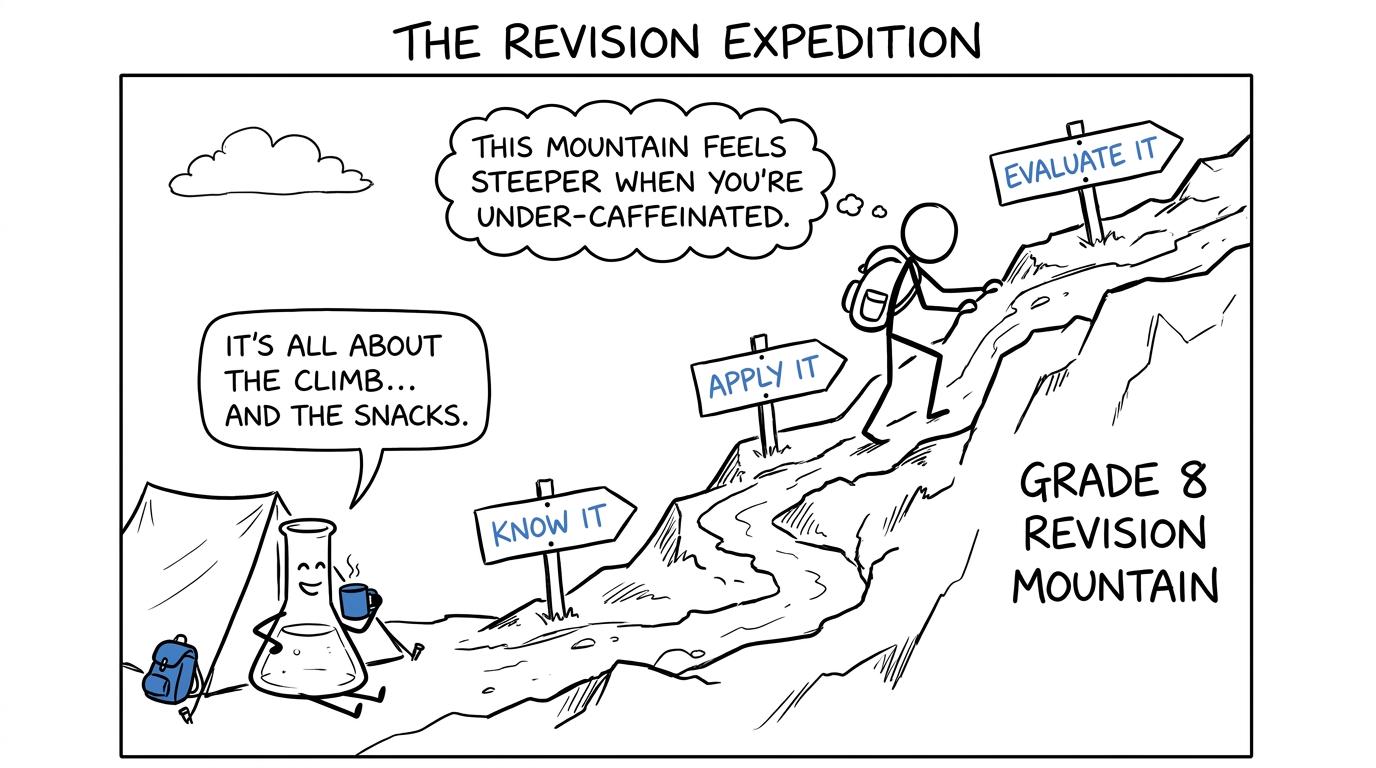 A student climbs a revision mountain using know, apply and evaluate signposts
How does grade 8 compare with the old letter grades?
It is tempting to translate every numerical grade directly into a letter. The official comparison is more careful than that.
When GCSEs in England moved from the old A* to G system to the 9-1 scale, Ofqual established clear alignment at certain boundaries. The bottom of grade 7 aligns broadly with the bottom of the old grade A. Grades 8 and 9 provide greater differentiation among performances that would previously have occupied the top end of the scale.
The most accurate summary is:
- grade 7 begins around the old grade A standard;
- grades 8 and 9 sit within the area associated with the old A*;
- grade 9 identifies particularly exceptional performance at the top of the reformed scale.
So a grade 8 is commonly described as equivalent to an A*, but it is better to say it is within old A territory*. It is not officially defined as an exact replacement for one specific letter-grade interval.
This distinction prevents two common misunderstandings. Grade 8 is not merely the old A, and grade 9 is not the only grade that corresponds broadly with former A* performance.
Does grade 8 require a fixed percentage?
No. There is no permanent national percentage that always produces a grade 8 in GCSE Biology.
Grade boundaries are set after papers have been marked. They can differ between exam boards and exam series because papers vary in difficulty. The boundary for AQA in one year therefore cannot be treated as a prediction for Edexcel, OCR or Eduqas, or even for the next AQA series.
A boundary is the minimum total mark needed for a grade in that particular qualification and series. It does not mean that a student only understood that proportion of the course. GCSE papers are designed to distinguish between different levels of performance, so demanding questions and deliberately tight mark schemes can produce boundaries well below the percentages students associate with classroom tests.
Use published boundaries retrospectively when marking a past paper, but do not build your revision around a supposed universal percentage. Your more useful question is: which types of marks am I repeatedly losing?
The MathsGenie guide to finding your weakest GCSE topics explains how to turn marked papers into a focused list of next actions.
Why maths matters for a Biology grade 8
Biology is not a maths qualification, but high-grade performance requires secure numerical reasoning. Depending on the specification and question, you may need to work with:
- ratios, fractions and percentages;
- rates and averages;
- unit conversions and magnification;
- standard form;
- significant figures;
- areas, volumes and scale;
- probability and sampling;
- graphs, gradients and quantitative data.
The difficulty is often not the calculation alone. You must decide what the data mean biologically, select the correct values, retain units and judge whether the answer is sensible.
Students preparing for both subjects can use the MathsGenie GCSE maths revision hub for free lessons, question banks, worksheets, videos and exam-board resources. In particular, standard form revision supports work involving cell sizes and very small measurements.
A strong numerical foundation also matters if you are considering A Level Biology. Before making that choice, read the guide to choosing A Levels after GCSE Biology and check the entry requirements published by your own school or sixth form. Requirements are set locally and are not identical everywhere.
How to turn grade 7 performance into grade 8 performance
The difference is rarely solved by reading the same notes for longer. Progress comes from improving the quality of retrieval, application and feedback.
Separate knowledge gaps from skill gaps
After marking a question, identify why the mark was lost. Possible reasons include:
- missing biological knowledge;
- imprecise terminology;
- failure to use information from the question;
- weak mathematical method;
- missing units;
- unsupported evaluation;
- misreading the command word.
These problems need different solutions. A forgotten definition needs retrieval practice. A weak conclusion needs data-analysis practice. Treating both as “revise Biology” makes your next step too vague.
Practise questions that make you think
Straight recall is necessary, but it cannot reveal whether you can transfer knowledge. Include data questions, practical evaluations and extended responses. Mark them closely, then rewrite incomplete answers while the feedback is fresh.
If Biology and maths exams are close together, the GCSE exam-week Biology and maths checklist offers a calm way to divide your time without abandoning either subject.
Use a repeatable feedback loop
A useful revision cycle is:
- retrieve a topic from memory;
- answer exam-style questions;
- mark against the scheme;
- classify each lost mark;
- repair the smallest identifiable weakness;
- return to a different question later.
This is less dramatic than a long revision session. It is also more revealing. Grade 8 performance grows when mistakes stop recurring.
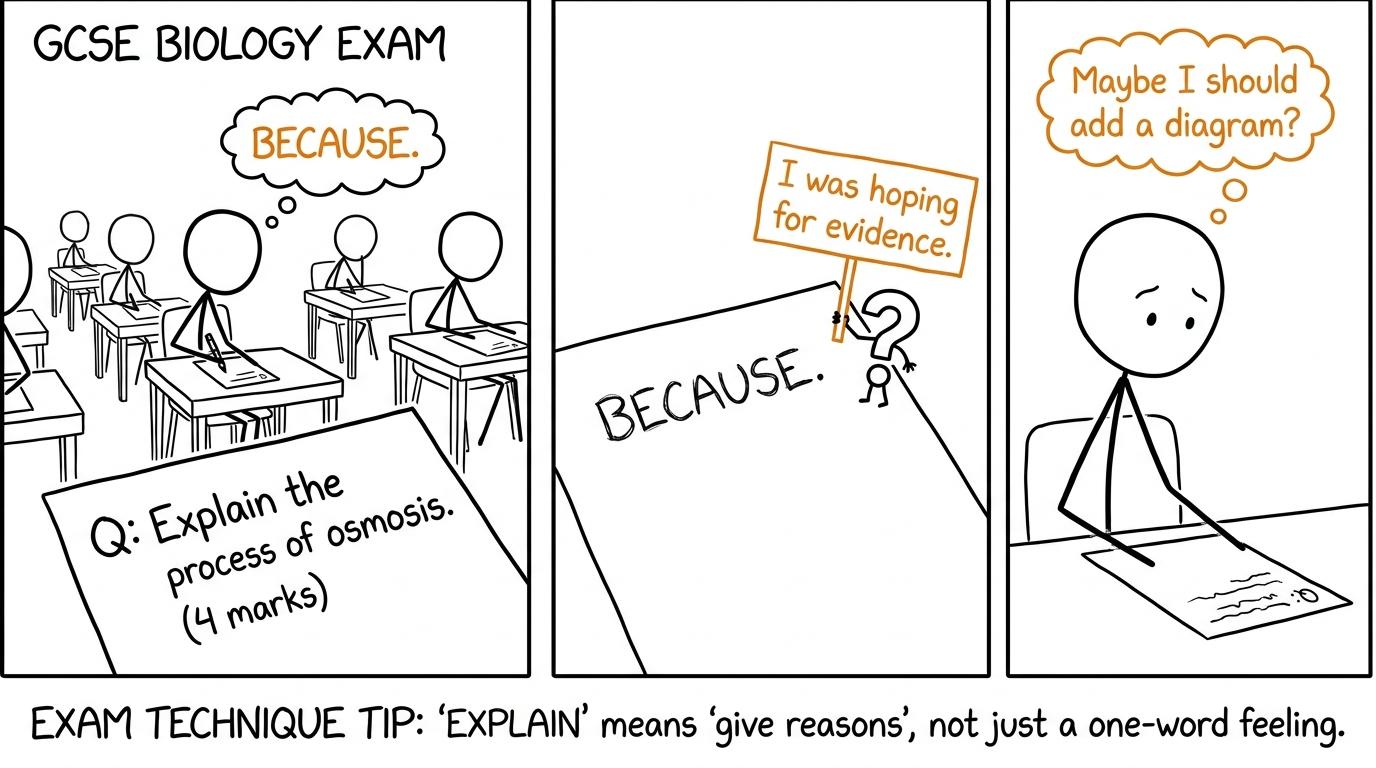 An exam question politely asks a student for evidence
Common mistakes when interpreting or aiming for grade 8
Treating grade 8 as a fixed percentage
Boundaries vary by board and exam series. A mark that achieved grade 8 on one paper is evidence about that paper, not a guaranteed target for a future exam.
Assuming it requires perfection
Grade 8 is an excellent result, but it does not require every answer to be correct. Students can lose marks and still achieve it. What matters is the total performance across the qualification.
Memorising model answers without understanding
Questions change context. Memorised wording becomes fragile when the organism, variable or data set changes. Learn the biological relationship behind the answer.
Ignoring command words
“Describe”, “explain”, “compare”, “calculate” and “evaluate” ask for different forms of response. Accurate knowledge can still earn limited credit if it does not answer the task set.
Revising only content
Grade 8 also depends on application, calculations, data analysis and practical evaluation. Content notes should be paired with questions and honest marking.
Comparing separate and Combined Science grades carelessly
A grade 8 in separate GCSE Biology is a single subject grade. Combined Science reports two grades for the whole double award. An 8-8 is therefore not simply a Biology grade repeated twice.
A grade is evidence, not an identity
A grade 8 says something meaningful: across the assessed papers, you demonstrated a high level of biological knowledge and scientific reasoning. It can support progression to A Level Biology, subject to your sixth form's own requirements, and it reflects skills that travel well into maths and other sciences.
But the number is a summary, not a complete portrait. It cannot show the difficult topic you eventually mastered, the calculation error you learned to catch or the discipline required to evaluate evidence carefully.
Make those habits your next target. Use MathsGenie's free GCSE revision resources to strengthen the mathematical skills behind science questions, then test them with practice questions, mini tests and past papers. As exams approach, use Edexcel predicted papers, mark them strictly and return to the revision lessons and video solutions for every weakness you uncover.
The aim is not to chase a mysterious number. It is to build the knowledge, application and judgement that make that number possible.










