

GCSE Biology 6 to 9: Changes That Lift Grades
GCSE biology 6 to 9: learn the revision, exam-technique and data skills that turn secure knowledge into grade 9 answers and more marks.

A grade 666 often feels confusing. You know plenty of biology, recognise most topics and can explain ideas in class. Yet unfamiliar questions, practical evaluations and small calculation errors keep pulling your marks down.
The GCSE Biology 666 to 999 journey is not mainly about learning three times as many facts. It is about making several precise changes: retrieving knowledge without prompts, applying it in unfamiliar contexts, linking causes to effects, using data accurately and answering exactly what the question asks. In short, you must turn knowledge into dependable exam performance.
This guide explains what separates the two grade bands and how to close the gap.
Your grade 666 to grade 999 checklist
Use this as a quick diagnosis before changing your revision:
- Check your exam board and specification: AQA, Edexcel, OCR or Eduqas.
- Replace repeated reading with closed-book retrieval.
- Practise applying familiar biology to unfamiliar situations.
- Learn practical methods as investigations, not scripts.
- Strengthen percentages, ratios, graphs, standard form and units.
- Use command words and mark allocations to control each answer.
- Keep an error log based on lost marks.
- Reattempt weak questions without notes.
- Complete timed past-paper sections before progressing to full papers.
The important shift is from asking, “Have I revised this?” to asking, “Can I earn the marks when this appears differently?”
What separates a grade 666 from a grade 999 in GCSE Biology?
There is no permanent score that guarantees a particular grade. Grade boundaries are set for each examination series and can vary between exam boards and papers. Your aim should therefore be stronger performance across the whole specification, not a guessed boundary.
A grade 666 student usually has sound knowledge but may depend on familiar wording. A grade 999 student is more likely to select relevant knowledge, connect several ideas and adapt them to new evidence.
| Secure grade 666 performance | Grade 999 performance |
|---|---|
| Recalls the main process | Explains the process as a linked sequence |
| Answers familiar questions well | Transfers knowledge into unfamiliar contexts |
| Identifies a pattern in data | Describes the pattern precisely and supports it with evidence |
| Knows a practical method | Explains variables, accuracy, validity and improvements |
| Attempts calculations | Uses the correct formula, units, conversions and rounding |
| Writes everything remembered | Selects only material relevant to the command word |
| Checks the final answer | Reviews reasoning, terminology and whether every mark has been addressed |
This difference is important because GCSE Biology does not assess recall alone. Ofqual’s assessment objectives, used across the main exam boards, give approximately 40%40\%40% to knowledge and understanding, 40%40\%40% to application, and 20%20\%20% to analysis and evaluation. AQA and OCR specifications reflect this 40:40:2040:40:2040:40:20 balance, while Pearson Edexcel uses the same overall weighting.
So recall matters enormously, but recall by itself cannot carry a grade 999 performance.
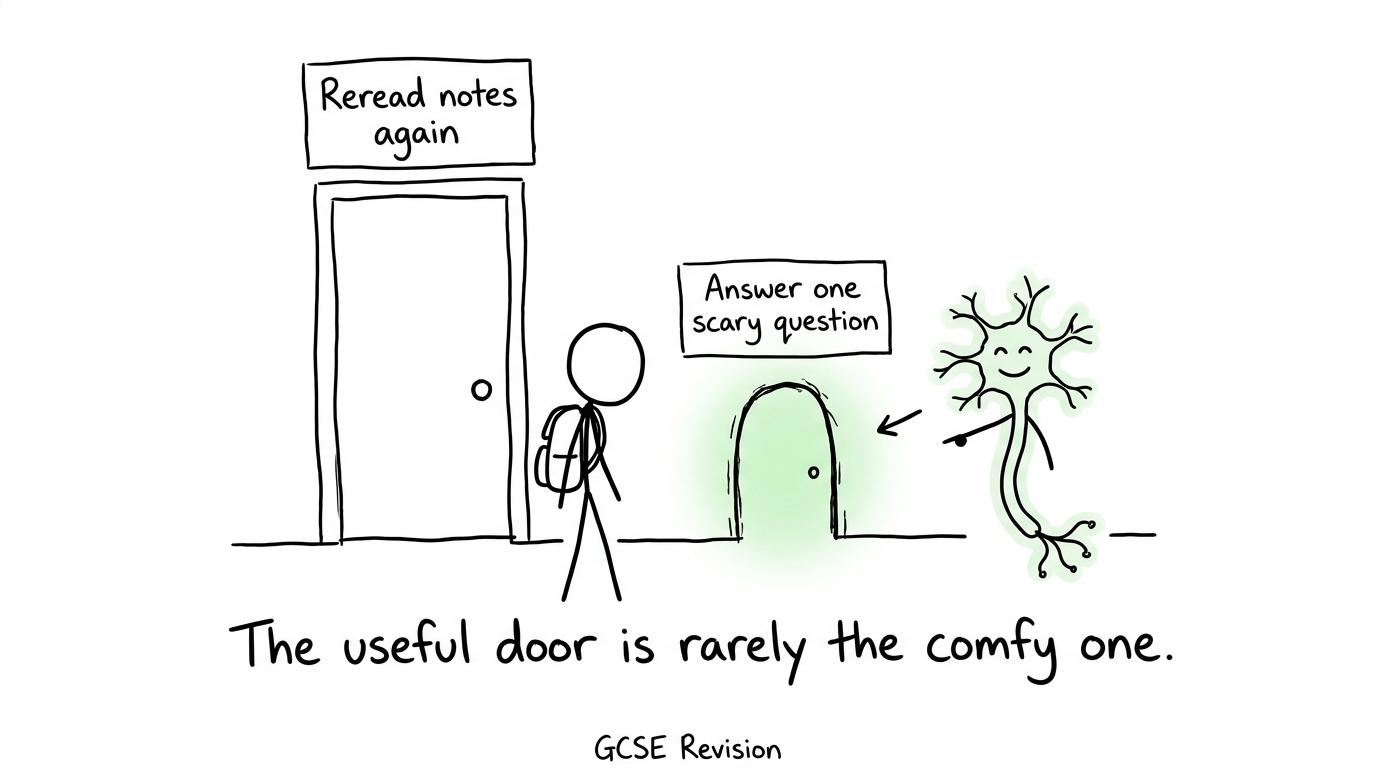 A student choosing between rereading notes and answering a challenging question
Change from recognising content to retrieving it
Recognition is generous. The textbook heading, highlighted sentence and diagram all provide clues. An examination paper does not.
After revising a section, close everything and reconstruct it from memory. You might write the stages of mitosis, sketch and label a cell, state the factors affecting photosynthesis, or explain how negative feedback maintains stable conditions. Then compare your response with the specification or trusted notes.
Keep retrieval focused. “Revise ecology” is too broad. Better prompts include:
- How does a quadrat produce an estimate of abundance?
- Why can antibiotic resistance become more common in a population?
- How are villi adapted for absorption?
- What happens when blood glucose concentration rises?
Return to missed material after a short delay rather than immediately copying it. That effort is useful: it reveals what your memory can actually produce.
A revision planner can schedule these returns so that difficult topics reappear across several weeks. The best order for learning GCSE maths topics also explains how short retrieval, topic practice and later paper practice can form one repeatable revision cycle.
Change from isolated facts to biological chains
Higher-grade answers often depend on connected reasoning. A fact is one link; an explanation is the chain.
Train yourself to think in this structure:
change →\rightarrow→ biological mechanism →\rightarrow→ consequence
For every process, ask:
- What changes first?
- Which structure, molecule or organism is involved?
- Why does the next event happen?
- What measurable outcome follows?
Precise vocabulary matters here. “It helps the cell” is vague. Terms such as diffusion, concentration gradient, enzyme-substrate complex, selective breeding and genetic variation communicate particular biological ideas. However, technical language earns marks only when it forms a correct explanation. A collection of impressive terms is not a causal chain.
Also practise links between specification areas. Examiners can combine mathematical and practical skills with content, or draw several biological ideas into one response. Photosynthesis may appear through limiting factors and graph interpretation; ecology may involve sampling, means and percentage change; inheritance may be tested through probability and unfamiliar family information.
Change from topic practice to unfamiliar application
A student can memorise every paragraph about enzymes and still struggle when the question places an enzyme in an unfamiliar industrial or medical setting. That is an application problem rather than proof that the revision failed.
When facing an unfamiliar context:
- Identify the underlying topic before reacting to the story.
- Underline the variable that changed.
- Find the evidence supplied in the graph, table or passage.
- Recall the relevant biological principle.
- Connect that principle directly to the context.
Do not search your memory for an identical question. Search for the same underlying mechanism.
Begin with topic questions, then mix several topics so you must decide which knowledge applies. Eventually, use timed sections and full papers. The method described in how to use GCSE past papers properly transfers well to Biology: attempt, mark, diagnose, repair and retest.
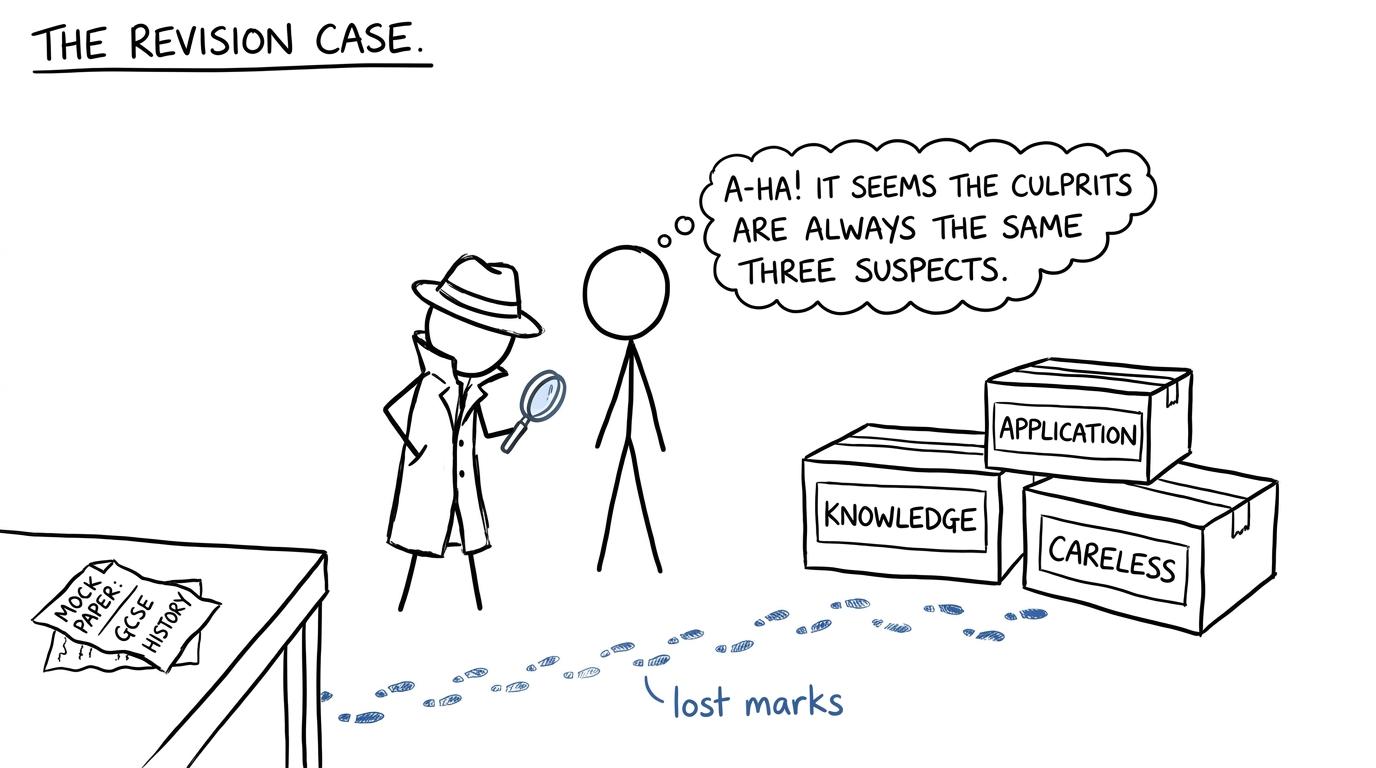 A student detective following lost-mark clues
Treat required practicals as a source of grade 999 marks
Practical work is not separate from the written examination. For example, AQA states that questions drawing on practical knowledge and understanding account for at least 15%15\%15% of the qualification. Your own board’s specification identifies its required or core practical activities and apparatus requirements.
For every practical, be able to explain:
- the independent, dependent and control variables;
- the equipment and sequence of the method;
- how measurements are made accurately;
- why repeats are used and how a mean may help;
- relevant hazards and proportionate precautions;
- possible sources of random or systematic error;
- whether the evidence supports the conclusion;
- one specific, workable improvement.
Avoid memorising methods as unexamined recipes. Ask what each step protects. Controlling temperature, for example, matters only if you can explain how temperature could influence the measured biological process.
Evaluation should also be specific. “Use better equipment” says little. Name the instrument, the measurement it improves and why the resulting data would be more useful.
Make mathematical skills automatic
Biology includes quantitative reasoning. AQA’s mathematical requirements include decimals, standard form, ratios, fractions, percentages, significant figures, means, probability, equations, graphs, gradients, areas and volumes. These skills must be applied within biological contexts.
Useful relationships include:
percentage change=final value−initial valueinitial value×100\text{percentage change}=\frac{\text{final value}-\text{initial value}}{\text{initial value}}\times 100percentage change=initial valuefinal value−initial value×100and
magnification=image sizeactual size.\text{magnification}=\frac{\text{image size}}{\text{actual size}}.magnification=actual sizeimage size.Grade 999 calculation habits are uncomplicated but consistent:
- Write the relationship before substituting.
- Convert units carefully.
- Keep extra calculator digits until the final line.
- Round only when requested or when sensible.
- Include units where appropriate.
- Check whether the scale and sign of the answer make biological sense.
MathsGenie can help you repair the underlying skills through free percentage revision and practice, ratio revision, standard form resources and scatter graph lessons. Choose the page matching your maths board where possible, but the core numerical skills remain valuable in Biology.
Write answers that match the command word
The mark allocation is a clue about the required depth. A short question rarely needs a paragraph, while an extended response needs an organised argument rather than disconnected facts.
Pay attention to these distinctions:
- State: give a concise fact.
- Describe: say what happens or identify a pattern.
- Explain: give biological reasons.
- Compare: refer to both items using comparative language.
- Calculate: show an appropriate method and final answer.
- Evaluate: weigh evidence, limitations and relevant improvements before reaching a judgement.
For data questions, quote values when they strengthen the response. Include units, compare like with like and avoid claiming that correlation proves causation.
In longer answers, pause briefly before writing. Select the relevant biology, place it in a logical order and check that each sentence advances the explanation.
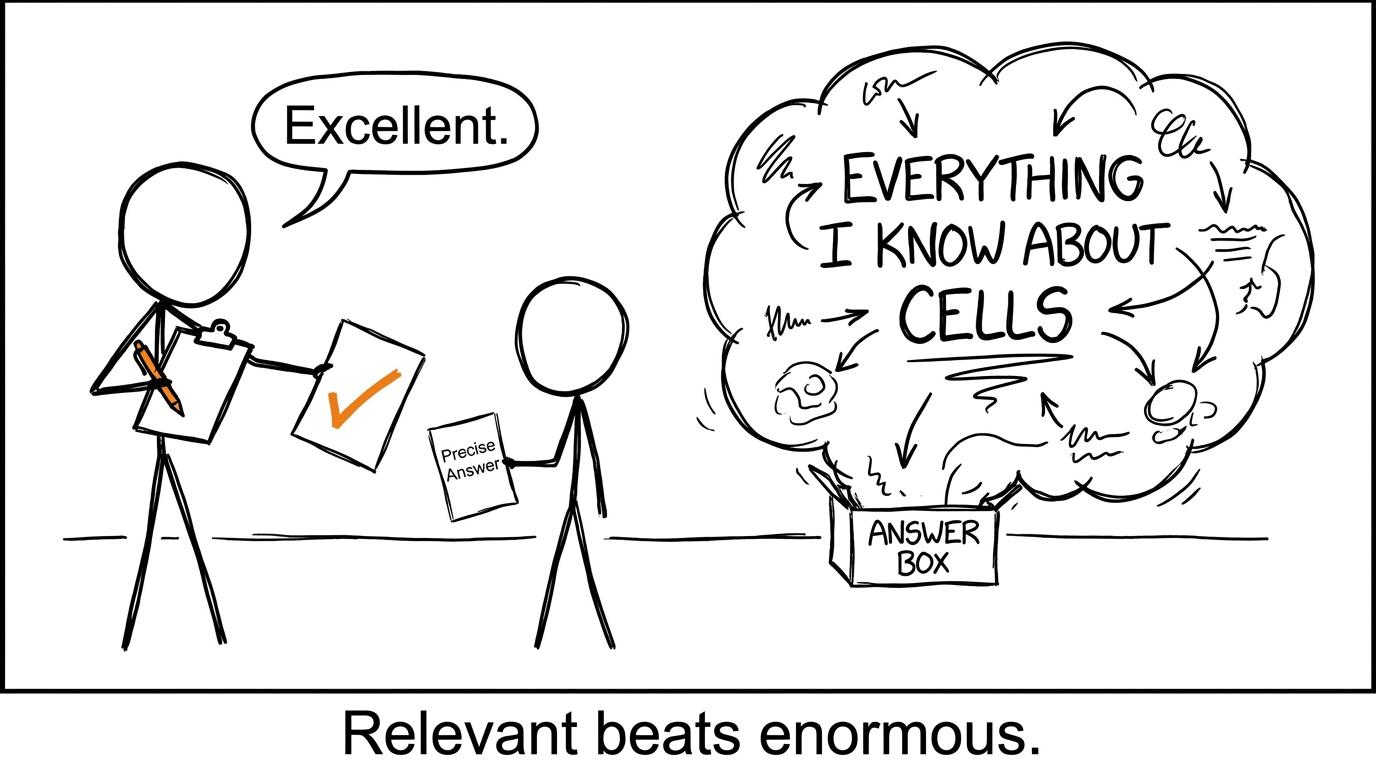 An examiner choosing a precise answer over a giant cloud of facts
Build a marks-leak revision system
A mock-paper total tells you where you are. It does not tell you what to do next.
Classify every lost mark:
- Knowledge: the fact or process was missing.
- Application: you knew the topic but could not use it in context.
- Practical reasoning: variables, validity or improvements were weak.
- Mathematics: formula, graph, unit or rounding error.
- Communication: vague terminology or an incomplete chain.
- Exam management: misread instruction, poor timing or omitted question.
Then attach one action to each error. Relearn the missing idea, answer a related question and reattempt the original later without notes.
Do not merely collect more papers. A useful rhythm is:
- one session for retrieval and repairing content;
- one for application and practical questions;
- one for biological calculations and data;
- one timed mixed section;
- one review session based entirely on mistakes.
MathsGenie’s guide to when to start GCSE past papers explains why paper practice works best when there is still time to act on what it reveals.
Common mistakes that keep students at grade 666
Revising only favourite topics
Comfortable revision creates confidence without coverage. Use your specification as a checklist and give weak topics more time than strong ones.
Rewriting notes instead of answering questions
Neat notes can support initial learning, but they do not test retrieval or application. Close the notes and produce an answer.
Giving generic practical improvements
“Repeat it” and “be more accurate” are incomplete. Explain what should be repeated, how the results are processed and which measurement would improve.
Ignoring units and graph scales
A correct method can be undermined by an incorrect conversion, axis reading or unit. Practise these separately through the GCSE Maths revision hub, which includes revision lessons, questions and solutions across exam boards.
Treating mark schemes as answer sheets
A mark scheme shows what is creditworthy. Compare its wording with yours, identify the missing idea and rewrite your answer before moving on.
Predicting topics instead of securing the specification
Predictions should never replace complete revision. Fresh papers can help with timing and unfamiliar combinations, but every assessable area remains possible. The same principle underpins MathsGenie’s guidance on using predicted topics without guessing.
Make the next change small and measurable
The distance from grade 666 to grade 999 is rarely crossed by one heroic weekend. It is crossed by repeated corrections: one vague explanation made precise, one weak practical understood, one graph read carefully and one forgotten topic retrieved again.
Start with your latest Biology paper. Classify every lost mark, choose the three most expensive weaknesses and build your next week around them. For the numerical side of science, make MathsGenie your free revision base: use revision lessons to rebuild a skill, practice questions and mark schemes to make it reliable, mini tests to check retention, and GCSE predicted papers or past papers to develop calm exam technique.
A grade 999 is not produced by knowing everything at once. It grows from knowing what your next correction should be and making it.










