

GCSE Biblical Hebrew Easter Holiday Revision Guide
GCSE Biblical Hebrew Easter holiday revision: balance language, literature and maths while protecting rest, family time and steady exam progress.
Easter can make revision feel strangely limitless. Without the school bell, every unfinished vocabulary list, set text and maths topic seems capable of occupying the whole day. Yet productive GCSE Biblical Hebrew Easter holiday revision does not require sacrificing the entire break. The better approach is to plan a small number of focused sessions, divide them between language and literature, keep maths moving, and protect genuine time off.
The short answer is simple: revise Biblical Hebrew on four or five days each week, usually in blocks of around 303030 to 505050 minutes, and alternate those blocks with targeted GCSE maths practice. Use active recall, exam questions and careful marking rather than spending hours rereading. Leave several evenings and at least one full day each week free.
Your Easter revision checklist
Before the holiday begins, make these decisions:
- Confirm your Biblical Hebrew specification, current set texts and examination requirements with your teacher.
- List your weakest language areas, including vocabulary, morphology, syntax, comprehension and translation.
- Divide each literature set text into manageable passages.
- Identify three or four maths topics currently costing you marks.
- Choose fixed revision blocks and equally fixed stopping times.
- Include retrieval, timed practice, marking and later re-testing.
- Protect sleep, family commitments, religious observance, exercise and proper rest.
The aim is not to fill every available hour. It is to give each hour a clear purpose.
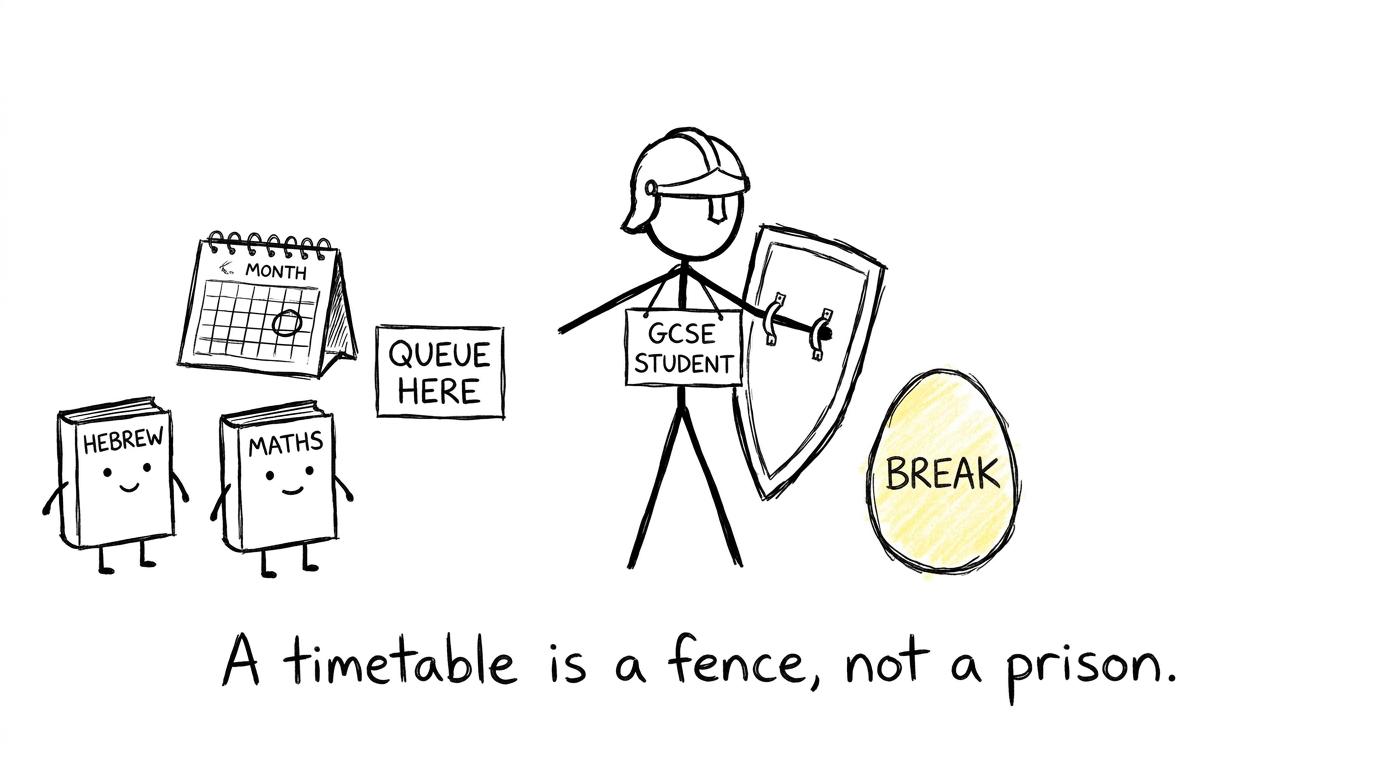 A student protects an Easter break while revision books queue beside a calendar
Start with the examination, not your notes
A revision plan becomes useful when it reflects the paper you will actually sit. For the current Pearson Edexcel GCSE (9(9(9 to 1)1)1) Biblical Hebrew qualification, students complete two externally examined components: Language and Literature. Each lasts two hours, carries 100100100 marks and contributes 50%50\%50% of the qualification. It is a linear course, so assessment takes place at the end rather than through coursework.
The Language component assesses comprehension and translation of unseen Biblical Hebrew. It also includes a choice involving either grammar questions or translation of short English sentences into pointed Biblical Hebrew. The Literature component tests knowledge, understanding, analysis and evaluation of the prescribed texts.
For examinations from 202620262026 to 202820282028, Pearson lists Genesis chapters 414141 to 434343, concerning Joseph’s rise to power, and Kings chapters 444 to 777, concerning the miracles of Elisha. Set texts can change between examination cycles, so use the version named by your teacher and the current specification rather than an older online checklist.
This structure suggests three distinct revision jobs:
- Language recall: vocabulary, roots, forms, syntax and grammatical recognition.
- Language application: unseen comprehension and translation under time pressure.
- Literature preparation: secure textual knowledge followed by evidence-based analysis.
Simply writing “Hebrew revision” in a timetable hides these differences. Give every session one of these jobs.
Build a balanced Easter timetable
A good timetable has boundaries. Decide when revision begins, but also when it ends. Otherwise a short morning task can cast a shadow over the whole afternoon.
A balanced day might contain two focused blocks:
| Revision block | Main purpose |
|---|---|
| First block | Biblical Hebrew language or literature |
| Second block | GCSE maths topic practice or a mini test |
| Short review | Mark work and record the next action |
You do not need two blocks every day. On family days, festivals, trips or days when you are tired, one short retrieval session may be enough. On another day, you might complete a longer timed section. Balance should be judged across the holiday, not hour by hour.
A practical weekly rhythm is:
- Two language days: vocabulary retrieval, grammar and unseen passages.
- Two literature days: set-text recall, context, themes and analytical planning.
- Three or four short maths blocks: selected using evidence from recent assessments.
- One mixed or timed session: followed by marking and correction.
- At least one full day away from formal revision.
For maths, begin with the GCSE Maths revision hub. It lets you choose resources for your board and makes it easier to keep maths revision contained rather than allowing it to expand across the day.
Use short sessions that require you to think
Rereading feels smooth because the page supplies the knowledge. An examination does not. You must retrieve vocabulary, recognise forms and construct an answer without seeing your notes first.
Research on learning supports spacing practice over time and actively retrieving material. That does not mean every self-test will transform a grade. It means that repeated, effortful recall with feedback is generally more useful for long-term retention than repeatedly looking over the same page.
For Biblical Hebrew, a focused language block could follow this sequence:
- Recall a small vocabulary set without notes.
- Check it immediately and separate secure words from uncertain ones.
- Identify forms or grammatical features in a short passage.
- Complete a small amount of unseen comprehension or translation.
- Record one recurring error to revisit after a gap.
A literature block should also move beyond rereading. Close the text and recall the sequence of events, speakers, important details, literary features and relevant ideas. Then check the text. Finally, plan how selected evidence could support an analytical response.
Do not try to memorise an essay as a single script. An unfamiliar question can make a memorised answer difficult to adapt. Secure knowledge and flexible evidence are safer.
Keep maths progressing without letting it take over
Students preparing for Biblical Hebrew are usually balancing several GCSE subjects. Maths deserves regular attention because methods can become less fluent when practice disappears for two weeks. It does not, however, need to consume every morning.
Use a small diagnostic task before choosing what to revise. A mini test or selected past-paper questions can reveal whether your next block should address fractions, algebra, graphs, geometry, probability or another topic. The GCSE maths topics by board and tier guide can help you organise that evidence for Edexcel, AQA, OCR or Eduqas and for Foundation or Higher tier.
Then use this loop:
- Learn or refresh one method.
- Answer exam-style questions without copying a solution.
- Mark the work immediately.
- Write the precise reason for each lost mark.
- Re-test the topic later in the holiday.
If you study Edexcel, the Edexcel GCSE Maths revision area brings together lessons, questions and revision tools. When time is tight, the twenty-minute GCSE maths revision routine provides a useful structure for keeping a topic active without turning it into a full morning.
This is the central balancing principle: Biblical Hebrew and maths both benefit from frequent contact, but neither requires constant contact.
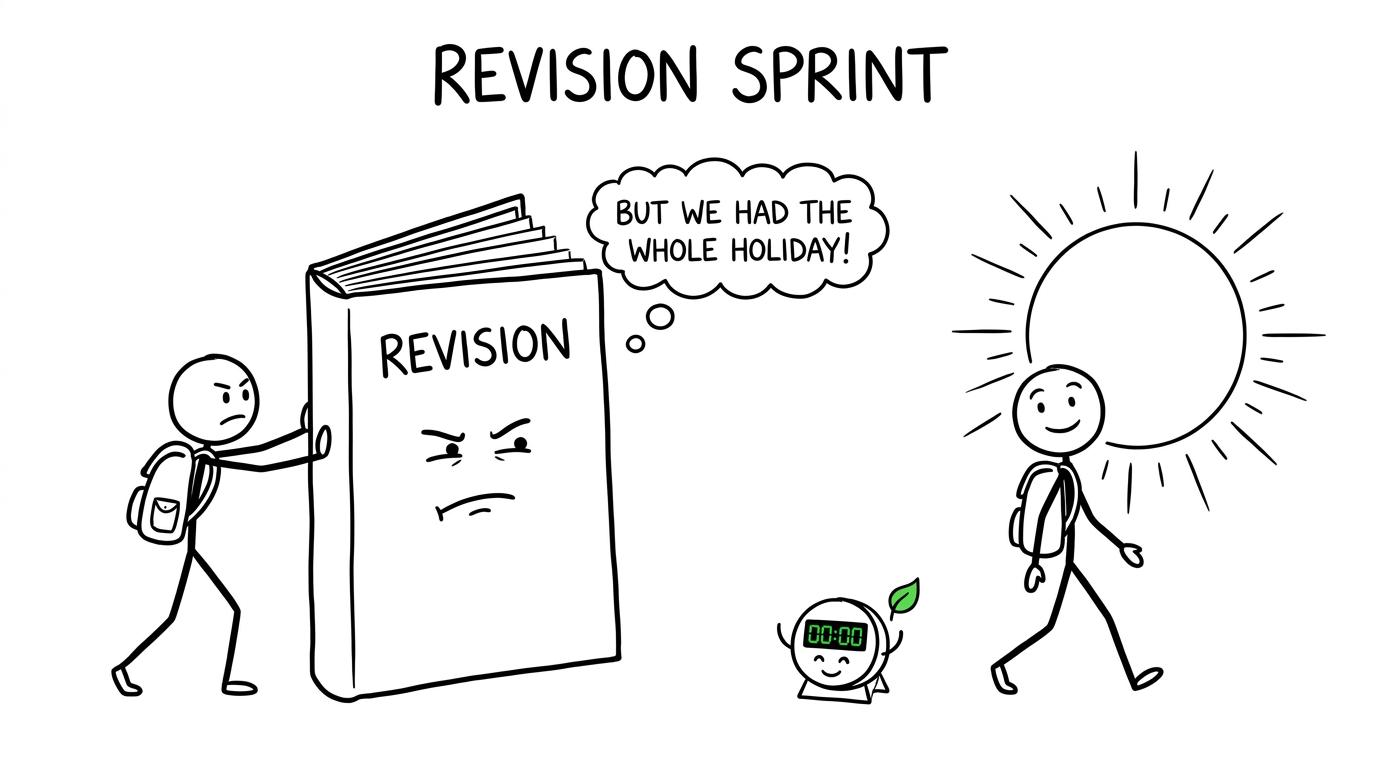 A giant revision book objects as a student stops on time and walks into the sunshine
Separate learning, practice and checking
Many revision sessions fail because three different activities become blurred together.
Learning repairs something you do not yet understand. This might mean reviewing a grammatical construction, clarifying a literary passage or watching a maths revision lesson.
Practice asks you to produce an answer independently. In Biblical Hebrew, that may involve retrieval, comprehension, translation or planning a literature response. In maths, it means completing questions without leaning on the solution.
Checking compares your answer with reliable feedback. A mark scheme does more than announce that an answer is wrong. It shows the required precision, acceptable alternatives and where credit is awarded.
For maths, Edexcel GCSE past papers and mark schemes are valuable once you are ready for mixed practice. The guide to using GCSE past papers properly explains how to turn each paper into an error log and a targeted follow-up plan.
Apply the same discipline to Biblical Hebrew using the official materials supplied by your examination board or school. Do not merely count a paper as “done”. Mark it, identify why marks were lost, and schedule the correction.
Create an error log that stays small
An error log should reduce uncertainty, not become another enormous revision project. Use four brief columns:
| Area | What happened | Corrective action | Re-test |
|---|---|---|---|
| Hebrew language | Misidentified a form | Review the relevant rule and find further examples | Later this week |
| Hebrew literature | Evidence was too vague | Revisit the passage and record a precise reference | Next literature block |
| Maths | Method was known but applied incorrectly | Complete focused questions and check each step | After a short gap |
Patterns matter more than isolated slips. If several unseen passages expose the same grammatical weakness, that weakness deserves a session. If a maths paper repeatedly shows uncertainty with percentages, use targeted practice before attempting another full paper.
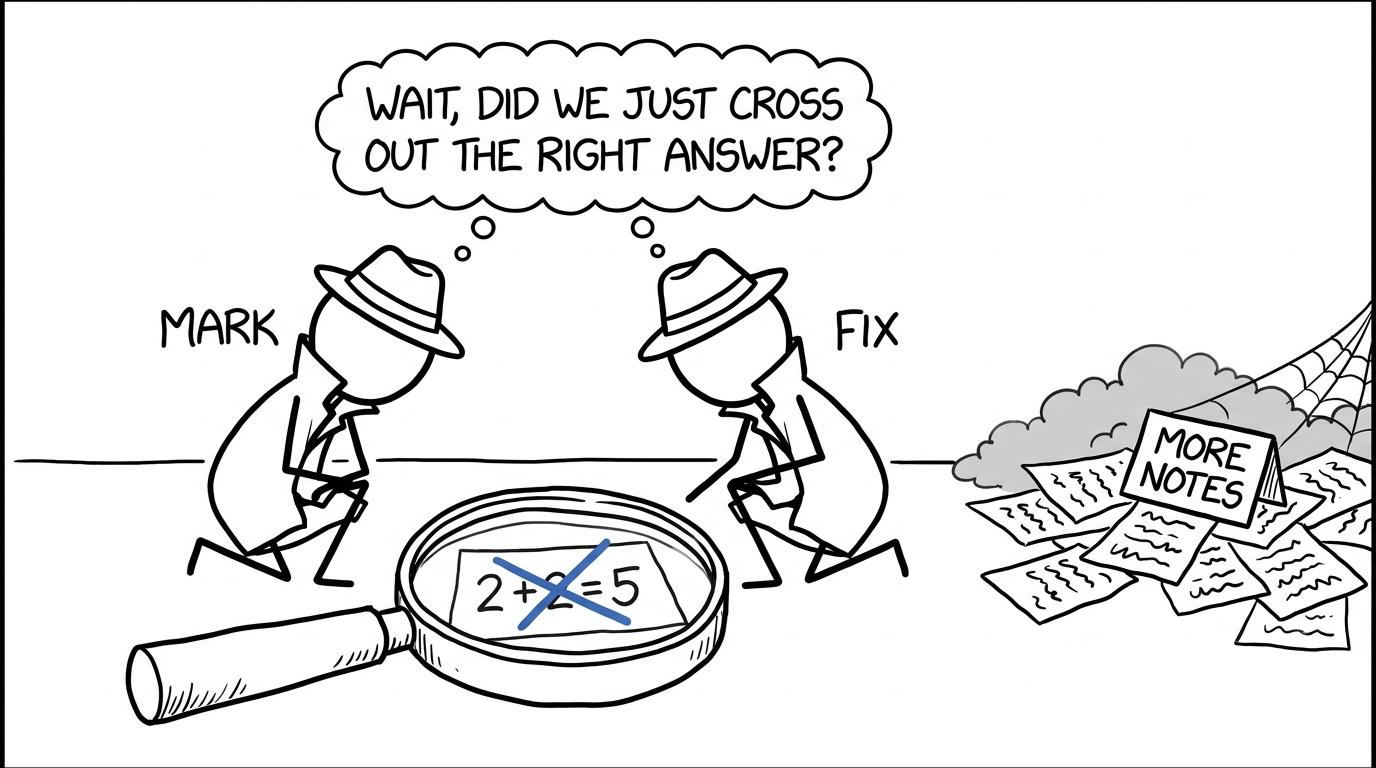 Two revision detectives investigate an error while unused notes gather dust
Common mistakes during Easter revision
Planning every hour
A packed timetable looks impressive until one interruption causes the entire plan to collapse. Schedule fewer blocks than you think you can complete and leave spare time for unfinished work.
Revising only the comfortable material
Familiar vocabulary and favourite maths topics provide reassurance, but weak areas produce the greatest opportunity for improvement. Use test evidence to choose tasks.
Treating rereading as complete revision
Reading has a place when rebuilding understanding. It should normally be followed by closed-book recall, questions or an explanation produced from memory.
Completing papers without reviewing them
The learning often happens after the attempt. Use mark schemes, teacher feedback and video solutions where available, then reattempt the questions that exposed a gap.
Using predicted papers as forecasts
Predicted papers are fresh exam-style practice, not promises about what will appear. MathsGenie’s guide to predicted GCSE topics explains why broad specification coverage and past papers should remain central.
Removing all rest
A holiday timetable that ignores sleep, family life and breaks is unlikely to remain productive. Set a stopping time and keep it. Rest is not a reward for finishing every possible task; it is part of a plan you can sustain.
Finish Easter with evidence, not exhaustion
At the end of the holiday, ask what is now more secure. Can you retrieve vocabulary that was previously uncertain? Can you explain a difficult form? Can you select precise set-text evidence? Have your weakest maths topics changed after re-testing?
That is a better measure than hours spent at a desk.
Your final Easter session should be a short review of the error log and a plan for the first week back at school. Carry forward only the most important unfinished actions. Everything else can wait.
For maths, make MathsGenie your free revision base. Use revision lessons to repair methods, practice questions and mini tests to build accuracy, past papers to develop timing, and mark schemes or video solutions to understand lost marks. Add predicted papers nearer the examination as fresh practice. Then close the page at the time you planned and enjoy the part of Easter that revision was designed to protect.










