

Is GCSE Bengali Useful Without A-level?
GCSE Bengali useful without A-level? Discover its value for college entry, communication and future choices, plus how to balance maths revision.
A subject can feel important while you are revising it, then strangely disposable once the exam is over. If Bengali will not appear among your A-level choices, it is reasonable to wonder whether the work still counts.
The short answer is yes: GCSE Bengali is useful without A-level study. It gives you a recognised GCSE grade, can contribute towards general sixth-form or college entry requirements, and demonstrates listening, speaking, reading and writing skills. It may also strengthen communication with family and wider communities.
It will not usually replace specific requirements such as a strong GCSE maths grade for A-level Mathematics. But usefulness is not the same as necessity. Some qualifications open one particular door; others make your overall academic profile broader and more convincing.
The quick answer: what GCSE Bengali gives you
GCSE Bengali may give you:
- a recognised qualification within your grades 999-111 GCSE profile;
- another subject that may count towards a college's required number of GCSE passes;
- assessed ability in listening, speaking, reading and writing;
- experience of translation, accurate communication and responding under time pressure;
- evidence of sustained bilingual or multilingual ability;
- a stronger foundation for using Bengali in family, community or employment settings;
- the option to return to language learning later, even without taking Bengali at A-level.
Its precise value depends on your grade, the qualification you are taking and the entry rules of the sixth form, college or course you want. Always check those details rather than relying on a general promise that every GCSE is treated identically.
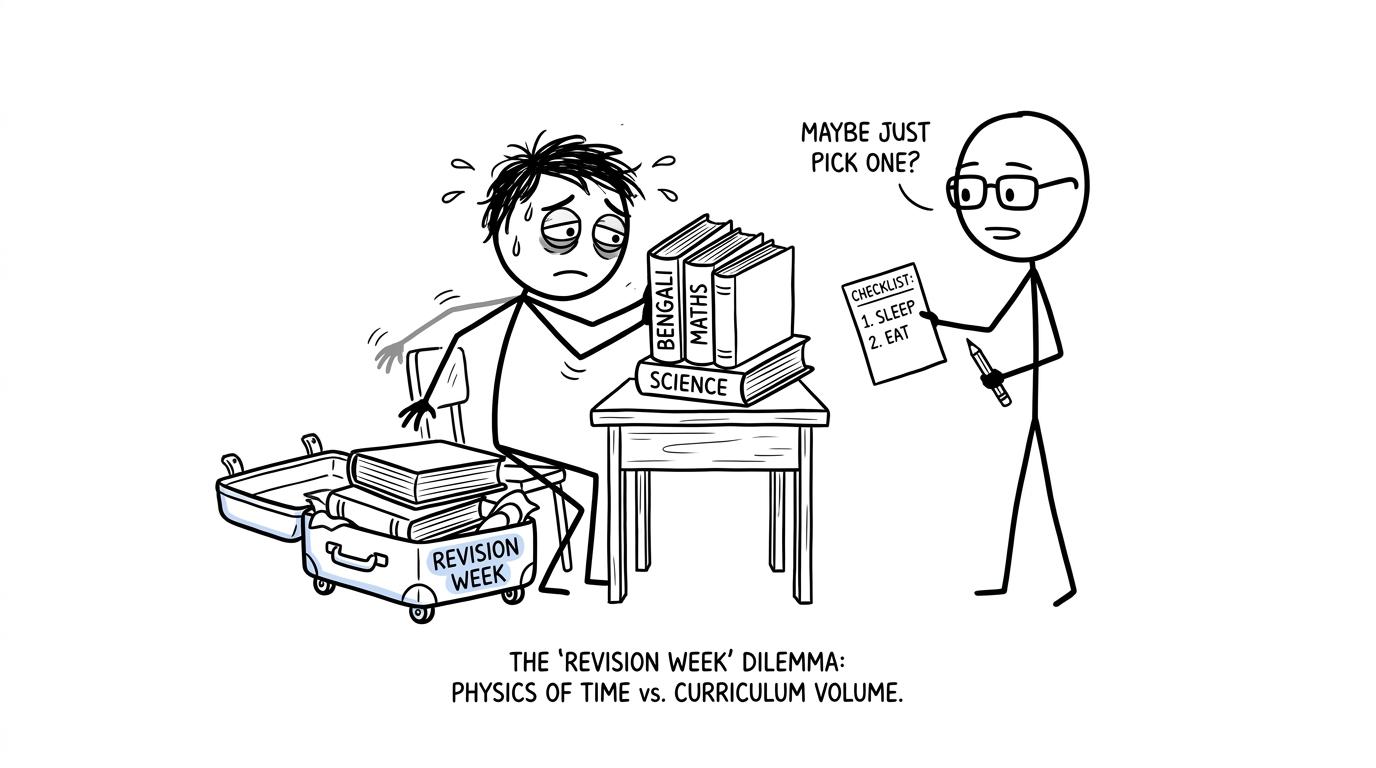 A student trying to fit Bengali, maths and science into a revision-week suitcase
GCSE Bengali is still a complete qualification
Not continuing a subject does not make the GCSE incomplete. GCSEs are designed as qualifications in their own right, not merely as auditions for A-level courses.
Under the current AQA GCSE Bengali specification, students are assessed in four areas: listening, speaking, reading and writing. Each assessment objective contributes one quarter of the qualification. Students enter either foundation tier, covering grades 111-555, or higher tier, covering grades 444-999, and take all four components at the same tier.
That matters because the certificate represents more than conversational fluency. It shows that you could understand spoken and written material, communicate for different purposes and work accurately within an assessed specification.
Some students instead take an International GCSE in Bangla or Bengali. Its assessment structure may differ. Pearson's International GCSE, for example, has placed particular emphasis on reading, writing and translation. Check the exact title, awarding body and specification on your entry documents before comparing it with another course.
How it can help with sixth-form and college entry
Many sixth forms and colleges publish general entry requirements based on a certain number of GCSEs at particular grades. A Bengali GCSE can potentially be one of those qualifications, provided the institution accepts it and you achieve the required grade.
This is where the qualification can be practically valuable even when Bengali is absent from your next timetable. If a course asks for five GCSEs at grade 444 or above, for example, an accepted Bengali GCSE may contribute to that total.
However, published requirements vary significantly. Some institutions ask for grades 444 or 555 in English Language and maths alongside several other GCSEs. More selective A-level programmes may require a larger group of grades 555 or 666, while individual subjects often impose their own conditions.
A-level Mathematics commonly has a specific GCSE maths requirement, often higher than the institution's general minimum. Sciences, economics, computer science and psychology may also specify maths, science or English grades. Bengali can support your overall GCSE profile, but it does not normally cancel a subject-specific condition.
A college-entry checklist
Before deciding how much the qualification matters for your plans, check:
- whether the institution counts your exact GCSE or International GCSE;
- the minimum number of accepted qualifications;
- the grades required in English Language and maths;
- any additional grade needed for your chosen course;
- whether short courses or equivalent qualifications are treated differently;
- whether the rules apply to your intended year of entry.
Admissions policies can change, so use the current prospectus or ask the admissions team directly. The tiny print is more useful than assumptions.
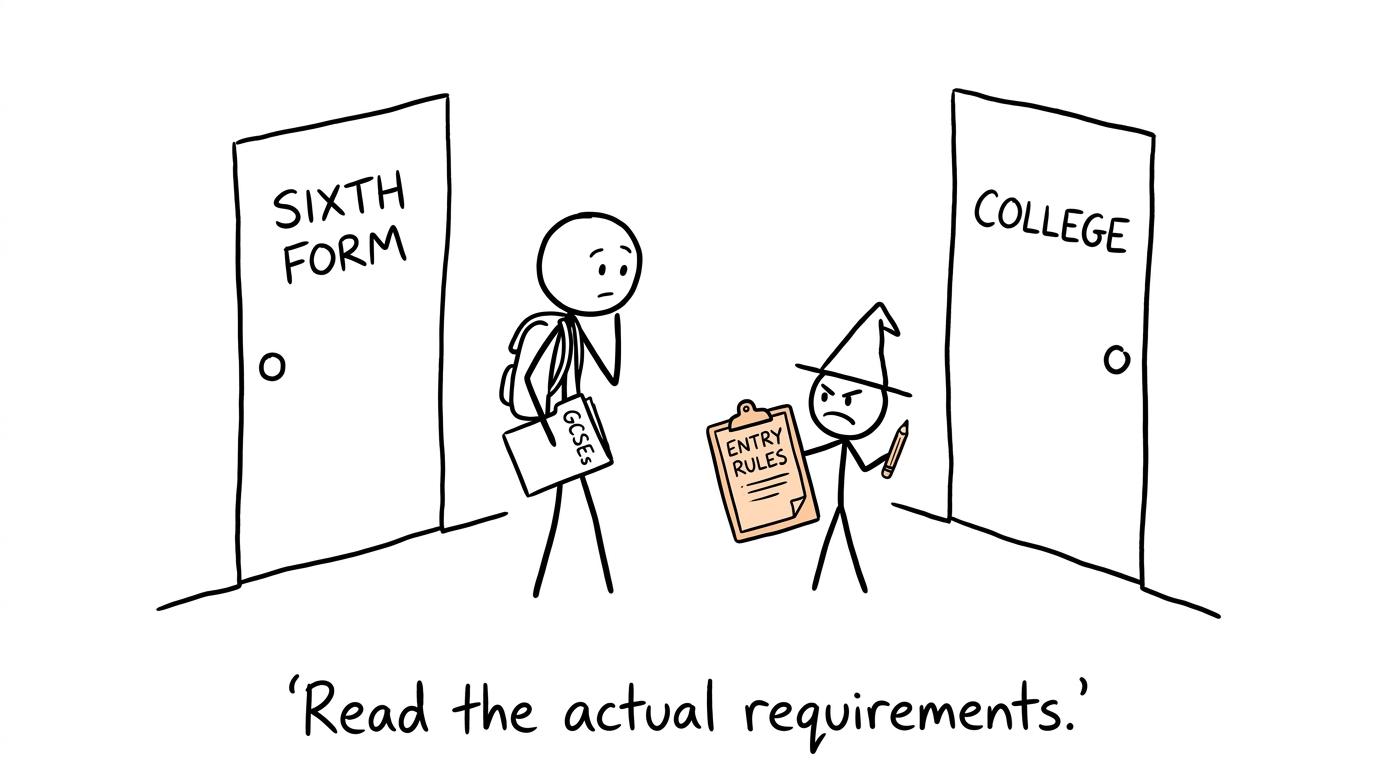 A student meeting a very serious gatekeeper at the sixth-form and college doors
The skills remain useful after the final exam
A qualification can disappear from your timetable without disappearing from your life.
Communication across different settings
Speaking informally at home is not identical to discussing education, employment, social issues or future plans in an assessment. GCSE preparation encourages you to adapt vocabulary, tone and detail to the situation.
That can make communication more precise. You may become better able to explain an idea, understand formal language or move between everyday and more structured Bengali.
Reading and writing with greater accuracy
Reading messages is one skill. Understanding extended material, recognising opinions and producing organised writing are deeper ones. Those skills can be useful when reading community information, writing to relatives or engaging with Bengali media and literature.
The certificate does not mean that learning is finished. It does show that your literacy was tested against stated criteria rather than judged only by confidence in conversation.
Translation and attention to meaning
Translation is not simply replacing one word with another. You must preserve meaning, notice context and decide how an idea should be expressed naturally.
That habit has wider academic value. In maths, students also translate between forms: a written problem becomes a diagram, equation or sequence of operations. The subjects are different, but both reward careful reading and resistance to rushed assumptions.
Cultural and personal continuity
For some students, Bengali is connected to family history, identity or community. A formal qualification can help preserve skills that might otherwise become less secure after childhood.
This benefit is personal rather than an admissions guarantee, but that does not make it trivial. Education has practical value and private value. The best qualifications often carry both.
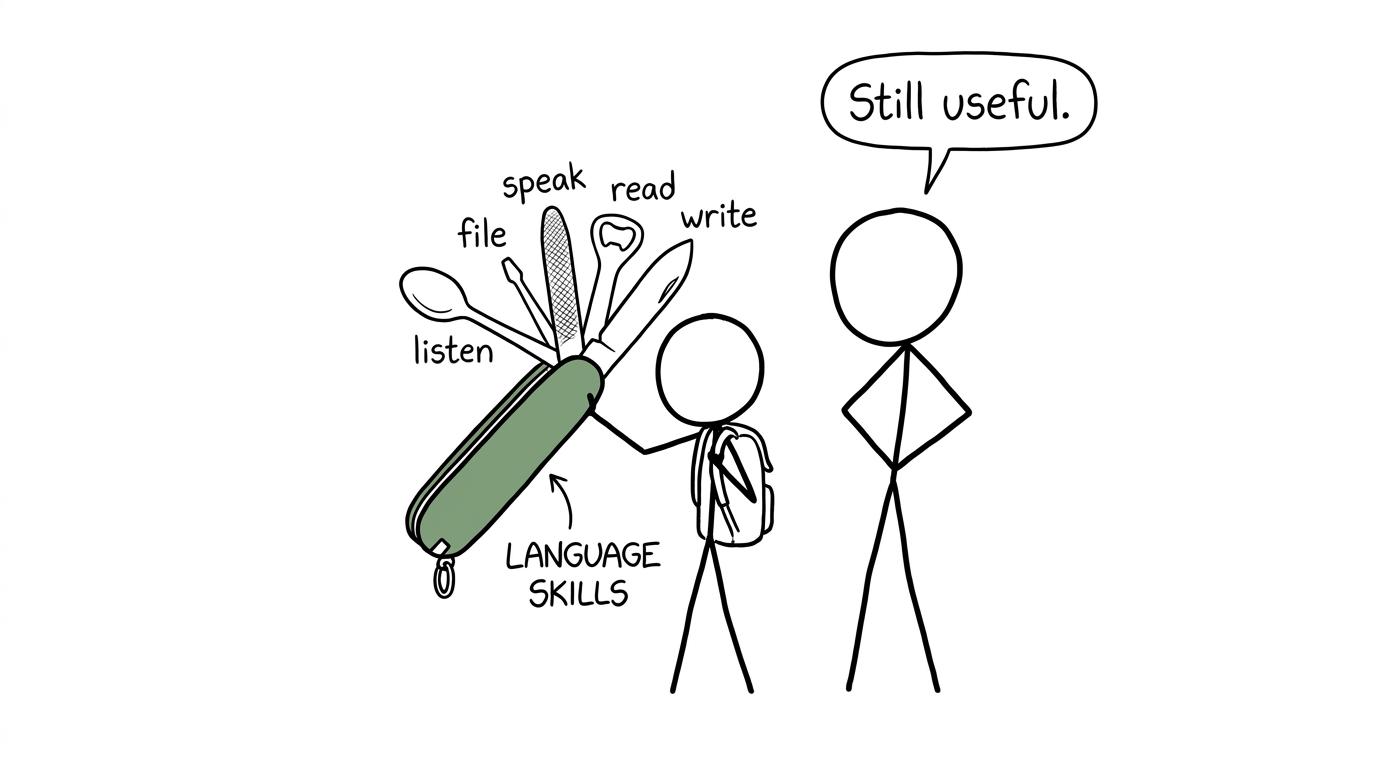 A student holding a language-skills tool with listening, speaking, reading and writing attachments
Does it help with university or employment?
GCSE Bengali alone is unlikely to determine a university offer or secure a job. Universities and employers consider qualifications in context, and their requirements differ.
Still, the grade may add evidence to your application. It can demonstrate language ability, commitment and communication across more than one language. In roles involving multilingual communities, customers or families, the underlying skill may be relevant even where Bengali is not listed as an essential requirement.
Be accurate when describing it. A GCSE is evidence of assessed achievement, not automatic proof that you can interpret specialist legal, medical or technical conversations. If an application asks about language ability, distinguish between your qualification, current fluency and real experience.
The same principle applies to maths. A GCSE grade is important, but what you can reliably do with number, data and problem-solving continues to matter. If your next course has a maths condition, use the GCSE Maths Revision hub to choose your exam board and find suitable lessons, exam questions and papers.
How to balance Bengali with GCSE maths revision
The danger is not taking Bengali. The danger is allowing one comfortable subject to absorb time from a compulsory subject where you are losing marks.
Start with requirements. If your chosen sixth form needs a particular maths grade, that target deserves protected revision time. Use a short diagnostic test, identify the topics costing you marks, and revise those rather than repeatedly reviewing familiar material.
A sensible weekly pattern is:
- one focused Bengali session for the weakest language skill;
- several shorter maths sessions based on specific topics;
- one timed maths test or paper section;
- immediate marking and correction;
- a catch-up slot so one busy evening does not ruin the plan.
MathsGenie's guide to building a GCSE revision timetable you can stick to helps turn vague intentions into named tasks. If time is tight, the twenty-minute GCSE maths revision routine keeps practice manageable.
For quick diagnosis, try the Edexcel GCSE Maths mini tests. Nearer the exams, Edexcel GCSE Maths predicted papers provide fresh timed practice, while the guide to using GCSE past papers properly explains how to turn lost marks into targeted revision.
Common mistakes when judging the qualification
Assuming it only matters if you take Bengali at A-level
Progression is one kind of value, not the only kind. A completed GCSE can contribute to your qualification profile and preserve useful language skills without leading to further formal study.
Treating it as a guaranteed easy grade
Home or community familiarity may help, but GCSE assessment can demand formal vocabulary, accurate writing, translation and performance across several skills. Revise the specification you are actually taking.
Assuming every college counts it in the same way
Institutions set their own entry requirements. Check whether your exact qualification is accepted and whether subject-specific grades are also required.
Neglecting English and maths
A good Bengali grade is valuable, but many post-161616 routes explicitly require English Language and maths. Protect time for those subjects, particularly if your intended course has a higher maths threshold.
Revising what already feels comfortable
Students often practise the skill that gives quick reassurance. Better revision starts with evidence. Test yourself, identify the weakest area and spend the next session repairing it. The same logic underpins MathsGenie's one-month GCSE maths revision plan.
The qualification's value depends on what you do next
So, is GCSE Bengali useful if you are not taking it at A-level? Yes. It remains a recognised qualification, may contribute to general college entry requirements and records achievement across valuable language skills. Its personal value may last even longer than its admissions value.
But it should sit inside a wider plan. Confirm your college requirements, understand your exact Bengali specification and give compulsory subjects the time their importance demands.
For maths, begin at the MathsGenie GCSE revision hub. Choose your board and tier, learn through free revision lessons, practise with topic questions and mini tests, then build exam confidence using past papers, predicted papers, mark schemes and video solutions. One qualification can broaden your profile. A thoughtful revision plan helps the whole profile hold together.











