

GCSE Bengali Time Pressure Mistakes to Avoid
GCSE Bengali time pressure mistakes can cost easy marks. Learn how to manage listening, reading, writing and speaking tasks calmly and accurately.
A student can know the right vocabulary, understand the passage and still lose marks because the clock changes how they behave. They skim an instruction, miss a bullet point or leave a translation unfinished. The most damaging GCSE Bengali time pressure mistakes are rarely dramatic. They are small decisions made too quickly.
The immediate solution is to use a planned order: read the task precisely, secure every accessible mark, move on when progress stops and reserve time for targeted checking. You are not trying to write or translate at maximum speed. You are trying to make each minute produce something the examiner can reward.
This guide focuses on AQA GCSE Bengali (8638), which assesses listening, speaking, reading and writing. Each skill contributes approximately a quarter of the qualification. If you are taking Pearson Edexcel International GCSE Bangla, check your specification carefully because its assessment structure is different.
Your time-pressure checklist
Before looking at each paper, remember these principles:
- Confirm your exam board, tier and paper format with your teacher.
- Read the command and every bullet point before answering.
- Match your time to the available marks and task demands.
- Answer directly before trying to sound sophisticated.
- Leave space and move on if a question blocks you.
- Reserve a final checking period for omissions, not cosmetic rewriting.
- Practise under the real time limit before the examination.
- Keep an error log showing why marks disappeared.
Maths students may recognise this process. The same discipline used to sit a timed paper from the GCSE maths revision hub can improve language-exam control: attempt, check, move on and return deliberately.
 A student racing a clock that has tripped over its own shoelaces
Know where the clock creates pressure
For AQA GCSE Bengali, the listening paper lasts 35 minutes at foundation tier and 45 minutes at higher tier, including five minutes of reading time. The reading paper lasts 45 minutes at foundation and one hour at higher. Writing lasts one hour at foundation and one hour 15 minutes at higher.
The speaking assessment creates a different kind of pressure. Foundation students have a session lasting 7-9 minutes, while higher students have 10-12 minutes. Both tiers receive 12 minutes of supervised preparation time. These details matter because a useful strategy must fit the actual assessment rather than a generic idea of a language exam.
Do not assume that equal marks always mean equal minutes for every individual question. Translation, extended writing and detailed comprehension can require more thought than short selections. Instead, use the marks and task type to set rough checkpoints before practising. Your teacher can help you adapt these to your tier.
Listening mistakes when there is no rewind button
Wasting the reading time
The five-minute reading period is part of the AQA listening examination. Treating it as waiting time is one of the easiest ways to increase later pressure.
Use it to scan the paper, identify what each answer requires and mark clues such as names, time references, opinions and negative wording. Notice whether the response must be in English, Bengali or a non-verbal form. You are building a map so the recording does not arrive as a surprise.
Writing too much after hearing the answer
A short-answer question usually needs a short, precise response. Continuing to write can make you miss the beginning of the next extract. Record the necessary information, then look ahead.
Trusting the first familiar word
A familiar word is not always the answer. The speaker may correct an earlier statement, contrast two opinions or mention several possible choices. Listen for the complete meaning, especially negatives, changes of mind and tense.
If one answer is lost, make the best supported attempt and reset your attention. Carrying uncertainty into the next question turns one difficult moment into several lost opportunities.
Reading mistakes that consume minutes
Translating every word before answering
Comprehension does not always require a complete translation of the passage. First read the question, then locate the relevant section and identify the meaning needed for the answer. Translating line by line can consume time without producing additional marks.
For unfamiliar vocabulary, use context. Look at surrounding words, connectives, tense and whether the sentence expresses a positive or negative view. One unknown word should not erase everything you do understand.
Answering in the wrong language
A correct idea written in the wrong response language may not satisfy the task. AQA reading papers contain sections with different response requirements, including a translation into English. Check the instructions at every transition rather than relying on what the previous question required.
Spending too long proving one interpretation
If the evidence supports a concise answer, give it. Repeatedly rereading the entire passage can feel responsible, but it may be an expensive use of time. Mark uncertain questions, continue and return after securing the rest of the paper.
This is the language equivalent of the first-pass strategy described in MathsGenie’s guide to using GCSE past papers properly: collect the marks you can access, then revisit the demanding parts.
Writing mistakes that lose avoidable marks
Missing a compulsory bullet point
Under pressure, students sometimes produce an impressive response to only part of the task. Coverage comes first. Before writing, turn each compulsory bullet point into a tiny planning prompt. As you complete it, tick it on the question paper.
At foundation tier, the AQA writing paper includes a photo task, a response of approximately 40 words, translation into Bengali and a response of approximately 90 words. At higher tier, students complete responses of approximately 90 and 150 words before translating a short passage into Bengali. Follow the current paper instructions because recommended lengths and task choices matter.
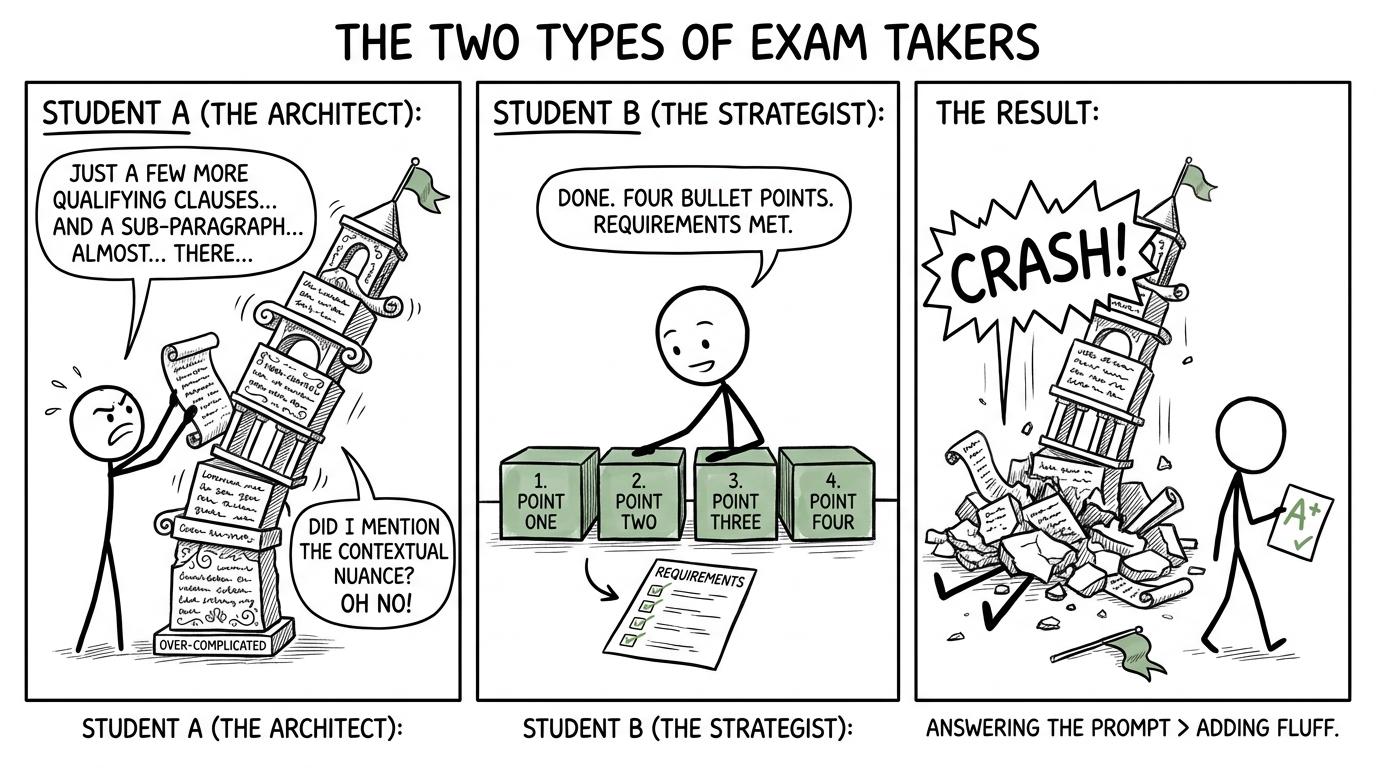 A simple four-block answer survives while an elaborate sentence tower collapses
Choosing complexity over control
An ambitious sentence is useful only if it communicates clearly. When time is short, several controlled sentences can be safer than one complicated construction that becomes unfinished or confusing.
That does not mean avoiding range. It means using language you can control: justified opinions, relevant detail, suitable time frames and accurate structures. Add sophistication after every part of the task has been addressed.
Writing first and planning later
A brief plan feels slow because it delays the first sentence. In reality, it prevents repetition and omissions. Note the required content, the order of ideas and the time frame needed for each point. Then begin.
Leaving translation until there is almost no time
Translation exposes small gaps in vocabulary, agreement, spelling and sentence structure. If you leave the entire task to the final minutes, there is no room to solve those gaps calmly. Set a checkpoint for beginning it and obey that checkpoint during practice.
If one expression will not come, preserve the meaning using Bengali you know. A clear alternative is better than a blank space or an unfinished sentence.
Speaking mistakes caused by rushing
Speaking pressure can make students answer too briefly or talk so quickly that clarity suffers. The aim is communication, interaction and appropriate development, not maximum words per minute.
During the 12-minute preparation period, organise prompts rather than trying to script an entire performance. For the role play, identify every required detail. For the photo card, prepare direct observations and ideas for development. In the general conversation, practise extending responses with a reason, detail or opinion.
If you need a moment, pause naturally. If you do not understand a question, asking for repetition appropriately is usually more productive than guessing at speed. Keep listening to the exact question so that a rehearsed answer does not replace a relevant one.
Common GCSE Bengali time pressure mistakes
The mistakes below are especially costly because they can happen even when your Bengali knowledge is strong.
Ignoring the marks and task size
A low-mark item should not absorb the time needed for an extended response. Before the exam, practise allocating rough time blocks and adjust them using evidence from completed papers.
Leaving blanks too early
Write the most plausible supported answer, unless the task format makes that inappropriate. In writing or translation, communicate what you can with simpler language. A blank gives the examiner nothing to assess.
Checking everything equally
A final check should be selective. Look first for unanswered questions, missed bullet points, wrong response language, incomplete sentences and obvious errors in tense or meaning. Recopying a neat paragraph while another task remains blank is not useful checking.
Revising knowledge without rehearsing timing
Vocabulary revision can improve knowledge without improving decision-making under pressure. Timed practice is where you discover whether you read instructions carefully, hesitate too long or rush the final task.
MathsGenie’s free past-paper platform includes timers, mark schemes and saved attempts for maths. Although it does not provide Bengali papers, its timed-paper method is transferable: reproduce exam conditions, record where the clock affected you and change one behaviour before the next attempt.
Recording only the total mark
A score tells you how the attempt ended, not why. Label each lost opportunity as knowledge, misreading, timing, accuracy or omission. Then fix the cause.
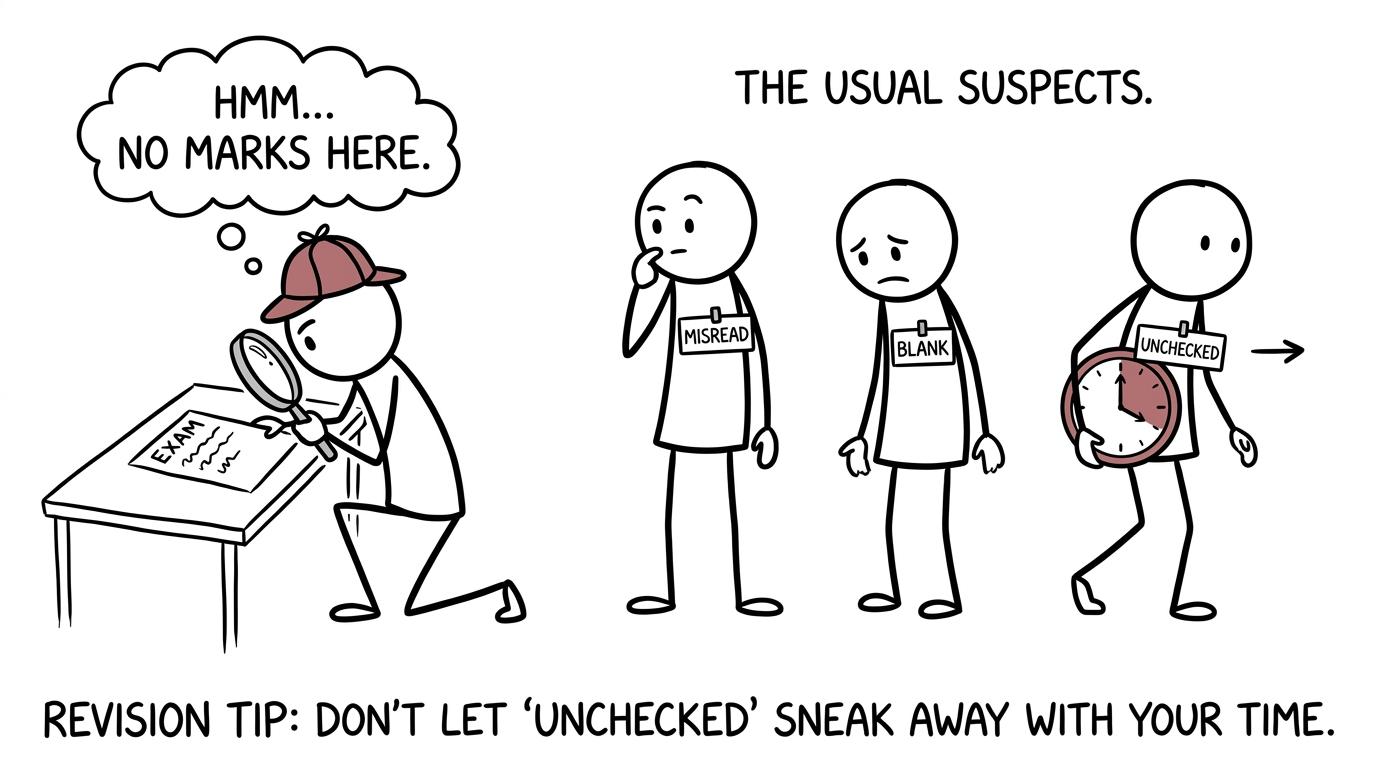 A student detective investigates the suspects misread, blank and unchecked
Build a routine that survives exam pressure
Complete one section under time, mark it using the official materials supplied by your school or exam board, and write three short notes:
- What did I know but fail to show?
- Where did I spend too long?
- What will I do differently next time?
Then repeat the same paper skill with a fresh task. Do not practise speed by simply shortening the timer. First make the process accurate, then make it efficient.
You can build the wider habit through MathsGenie. The 20-minute GCSE revision routine shows how to combine focused questions with immediate review. The GCSE revision timetable guide helps you schedule spaced and timed work, while the night-before GCSE plan is useful when the temptation is to replace calm preparation with a late panic.
For maths itself, use GCSE predicted papers as timed rehearsals after topic revision. Predicted papers should supplement, not replace, official past papers. The deeper lesson applies across both subjects: performance becomes more reliable when you practise making decisions under realistic conditions.
Turn the clock from threat into structure
Time pressure feels personal, but it is usually procedural. You do not need to become a completely different student. You need a repeatable sequence: read, prioritise, answer, move on and check what matters.
Start with one timed Bengali section this week and track the moments when marks leak away. Then use MathsGenie as your free revision base for the maths side of your GCSE preparation. Work through revision lessons and practice questions, test yourself with mini tests, past papers and predicted papers, and learn from mark schemes and video solutions. The objective is not merely to finish before the clock stops. It is to make the work you finish count.











