

GCSE Bengali Mock Results: Turn Marks into a Plan
GCSE Bengali mock results become useful when you diagnose lost marks, set priorities and build a focused maths revision plan with free MathsGenie resources.
A mock result can change your mood in seconds. A grade above your target feels reassuring; one below it can make months of revision seem wasted. Neither reaction tells you what to do next.
Your GCSE Bengali mock results become useful only when you look beyond the grade and identify why marks were lost. Review each Bengali component, separate knowledge gaps from exam technique, and turn the evidence into specific revision tasks. Then apply the same diagnostic process to maths: practise a weak skill, mark it, correct it and retest it.
A mock is not a verdict. It is an early map of where your marks are currently leaking.
Your mock-results checklist
Before beginning more revision, collect your marked papers and work through this checklist:
- Confirm the exam board, tier and papers used by your school.
- Record the mark for listening, speaking, reading and writing separately.
- Compare marks only with boundaries or grading information supplied by your teacher.
- Label every lost mark by its likely cause.
- Choose no more than three priorities for the next fortnight.
- Create short practice tasks for each priority.
- Retest the same skills under timed conditions.
- Use the process to improve how you revise for GCSE maths too.
This turns a result from something you receive into something you can use.
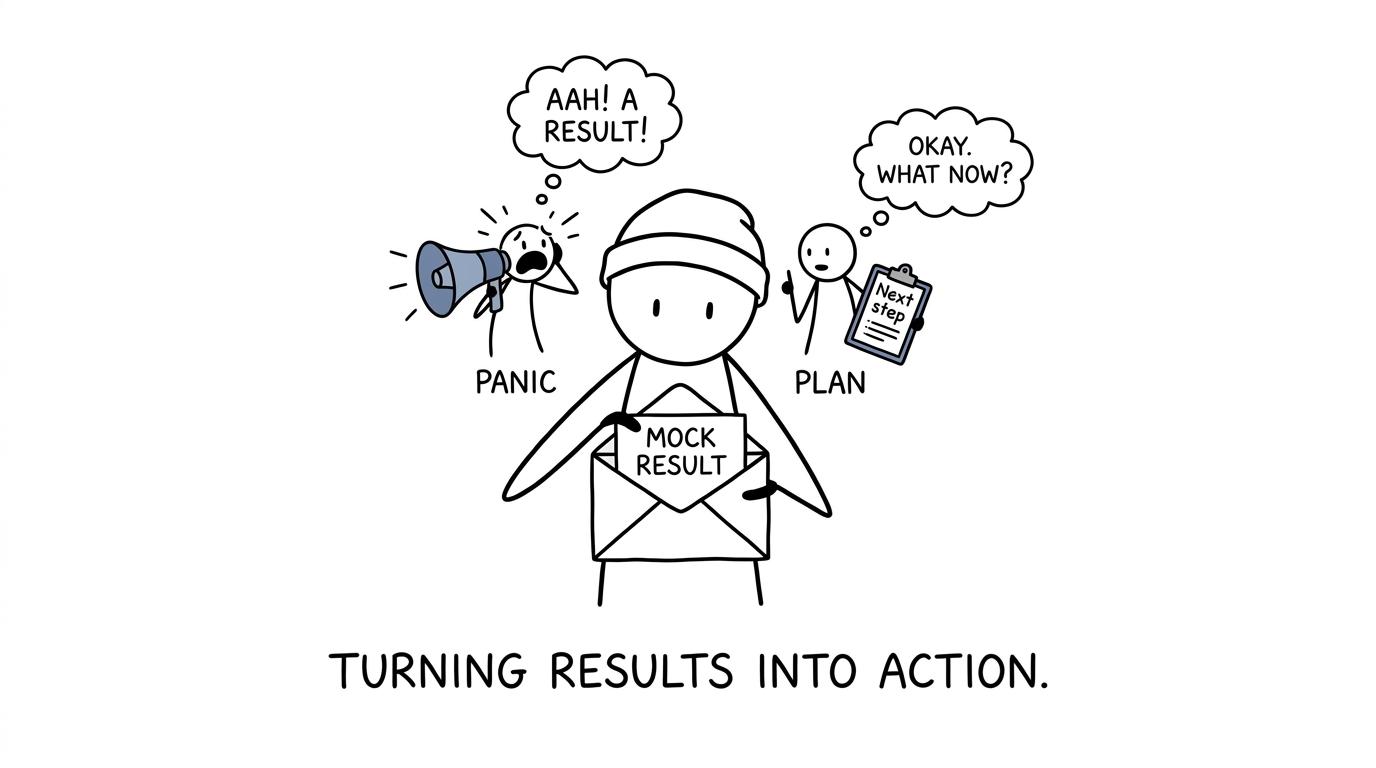 A calm plan competes with panic after mock results
Read your GCSE Bengali mock results in context
GCSE Bengali is currently available through AQA. Its assessment covers four language skills: listening, speaking, reading and writing. Each contributes approximately 25%25\%25% of the qualification, although raw marks can be scaled so that the components carry equal weight in the final total.
The qualification has foundation and higher tiers. Foundation targets grades 111 to 555, while higher targets grades 444 to 999, with an allowed grade 333 available in limited circumstances under higher-tier grading rules. Students take all four assessments at the same tier.
However, a school mock does not necessarily reproduce the complete qualification. Your school may use selected past-paper questions, shorten a listening paper or assess speaking separately. Ask your teacher:
- Was this a complete or shortened assessment?
- Were all components included and weighted correctly?
- Which grade boundaries were used?
- Did the conditions match the real examination?
- Is the reported grade intended as a rough indication or a formal school prediction?
These details matter. A percentage from one shortened component is not the same thing as a final GCSE grade.
Treat a mock grade as an estimate
Official grade boundaries are set after an examination series and can change because papers vary in difficulty. This means a boundary from an earlier series is useful context, not a guaranteed prediction of the boundary for your eventual examination.
You can inspect historical AQA GCSE Bengali grade boundaries on MathsGenie, but use the boundaries chosen by your school when interpreting its mock. The wider GCSE grade boundaries hub also shows why comparing marks across different subjects, boards or years requires care.
A grade is therefore the summary. The component marks and teacher comments contain the instructions.
Break the total into four different stories
A single total can conceal very different needs. Record each component using both marks and percentages:
Component percentage=marks awardedmarks available×100\text{Component percentage}=\frac{\text{marks awarded}}{\text{marks available}}\times 100Component percentage=marks availablemarks awarded×100Do not stop at ranking the percentages. Each paper tests a different form of performance.
| Component | What to investigate |
|---|---|
| Listening | Vocabulary recognition, pace, distractors, note-taking and whether answers matched what was actually heard |
| Speaking | Development of answers, pronunciation, spontaneity, accuracy and response to unexpected questions |
| Reading | Vocabulary, inference, translation, careful reading and selection of relevant information |
| Writing | Task coverage, range of language, accuracy, organisation, translation and checking |
Two students with the same overall mark may need entirely different plans. One might understand Bengali well but lose marks by overlooking instructions. Another might manage familiar topics confidently but lack the vocabulary needed for unfamiliar passages.
That is why the question is not simply, “Which paper was lowest?” Ask, “Which repeated weakness caused the lowest paper?”
Diagnose every lost mark before revising
Go through your script with the mark scheme and teacher feedback. Place each error into one of four categories.
Knowledge gap
You did not know the required vocabulary, grammar, structure or meaning. In maths, the equivalent might be forgetting a formula or not knowing how to begin a topic.
The response is focused relearning followed by questions completed without notes.
Retrieval gap
You had learnt the material but could not recall it during the mock. Recognition can create false confidence: a word or method looks familiar in your notes, yet cannot be produced independently.
The response is closed-book recall, spaced repetition and later retesting.
Technique gap
You knew enough Bengali but did not answer in the form required. Perhaps you missed part of an instruction, gave insufficient detail or failed to address every bullet point.
In maths, this resembles omitting working, answering a different question or rounding too early. The response is exam-style practice with close use of the mark scheme.
Timing or checking gap
You rushed, left a section unfinished or made a correctable slip. The answer is not necessarily more content revision. You may need timed sections, a clearer order of attack or a deliberate final checking routine.
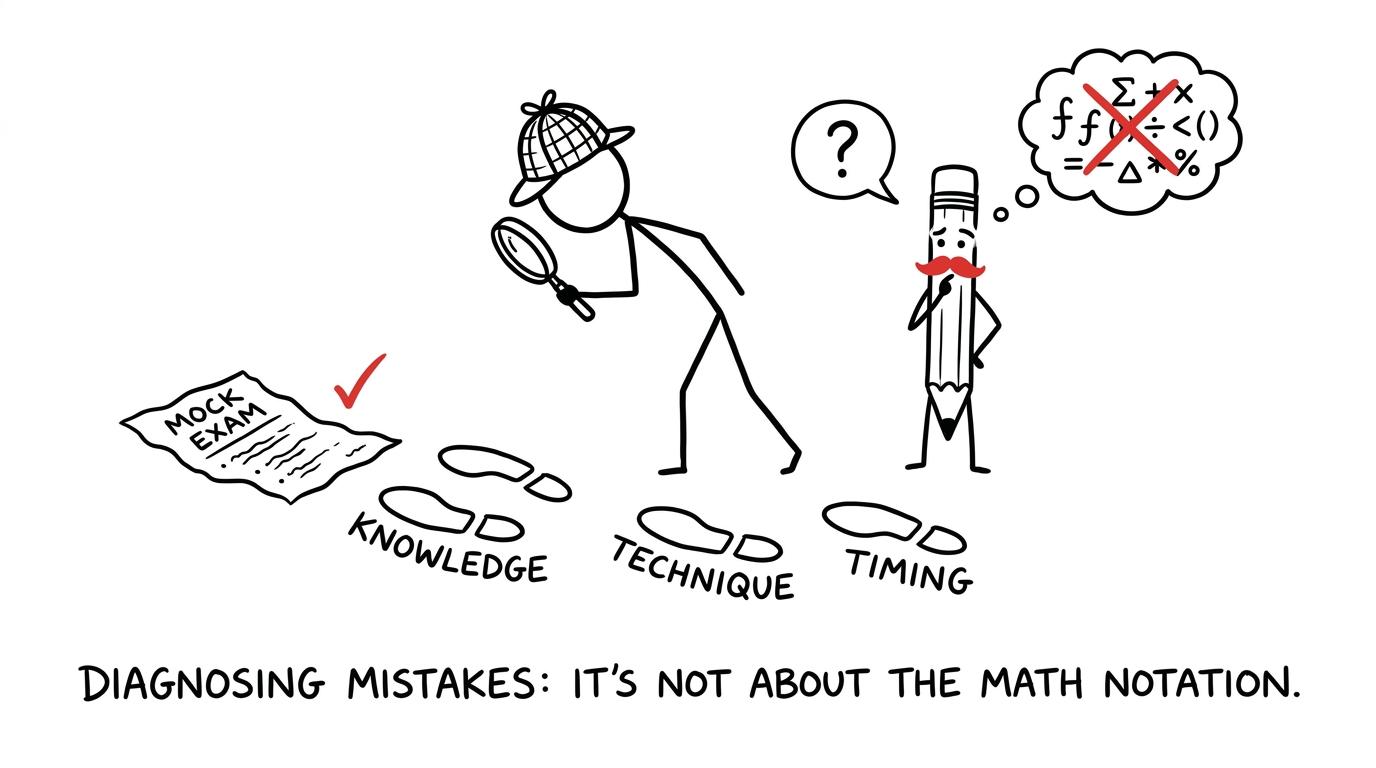 A mock-paper detective investigates knowledge, technique and timing
Keep an error log with four short entries: the paper, the lost skill, the cause and the next action. “Reading was bad” is too vague. “Could not infer meaning when unfamiliar vocabulary appeared; practise two short passages and justify each inference” can guide a session.
Turn the diagnosis into a revision plan
The temptation after disappointing results is to revise everything. That feels responsible, but it spreads attention across material you already know.
Choose up to three weaknesses that are repeated, costly or likely to recur. Give each one a precise action and a retest date. A useful cycle is:
Diagnose→relearn→practise→mark→retest\text{Diagnose}\rightarrow\text{relearn}\rightarrow\text{practise}\rightarrow\text{mark}\rightarrow\text{retest}Diagnose→relearn→practise→mark→retestA strong revision task names both the skill and the evidence that will show improvement. Instead of “revise writing”, plan to complete one timed response, check that every content point has been covered, mark language errors and rewrite the weakest paragraph without notes.
Retesting matters because reviewing a correction is not proof that you can now perform the skill independently. Return to a similar task after several days. If the same error remains, adjust the method rather than merely increasing the time spent.
For a manageable structure, adapt the rhythm in MathsGenie’s one-month GCSE maths revision plan: diagnose first, focus on selected weaknesses, complete regular retrieval and review marked work.
Use the result to improve GCSE maths revision
Your Bengali marks do not identify which algebra or geometry topics you need. They can, however, reveal weaknesses in the way you approach examinations.
If you ran out of time across several Bengali components, investigate timing in maths rather than assuming every unfinished question reflects missing knowledge. If you repeatedly misread Bengali instructions, circle command words and required answer forms in maths. If familiar vocabulary disappeared under pressure, test whether maths formulae and methods can be recalled without prompts.
Now repeat the diagnostic process with a maths paper:
- Use the correct exam board and foundation or higher tier.
- Complete a suitable section under timed conditions.
- Mark it carefully rather than recording only the total.
- Classify mistakes by topic and cause.
- Use a revision lesson to repair the method.
- Complete focused practice questions.
- Retest with a mini test or another paper section.
MathsGenie’s GCSE grade boundaries explanation helps separate a historical boundary from the practical job of gaining more marks. For short, repeatable sessions, follow the 20-minute GCSE maths revision routine.
When your topic skills are more secure, move into mixed practice. Past papers test selection, timing and stamina, while predicted papers can provide additional unseen questions. The important part is the review afterwards. The guide to using GCSE past papers effectively explains why one carefully analysed paper is more valuable than several rushed attempts.
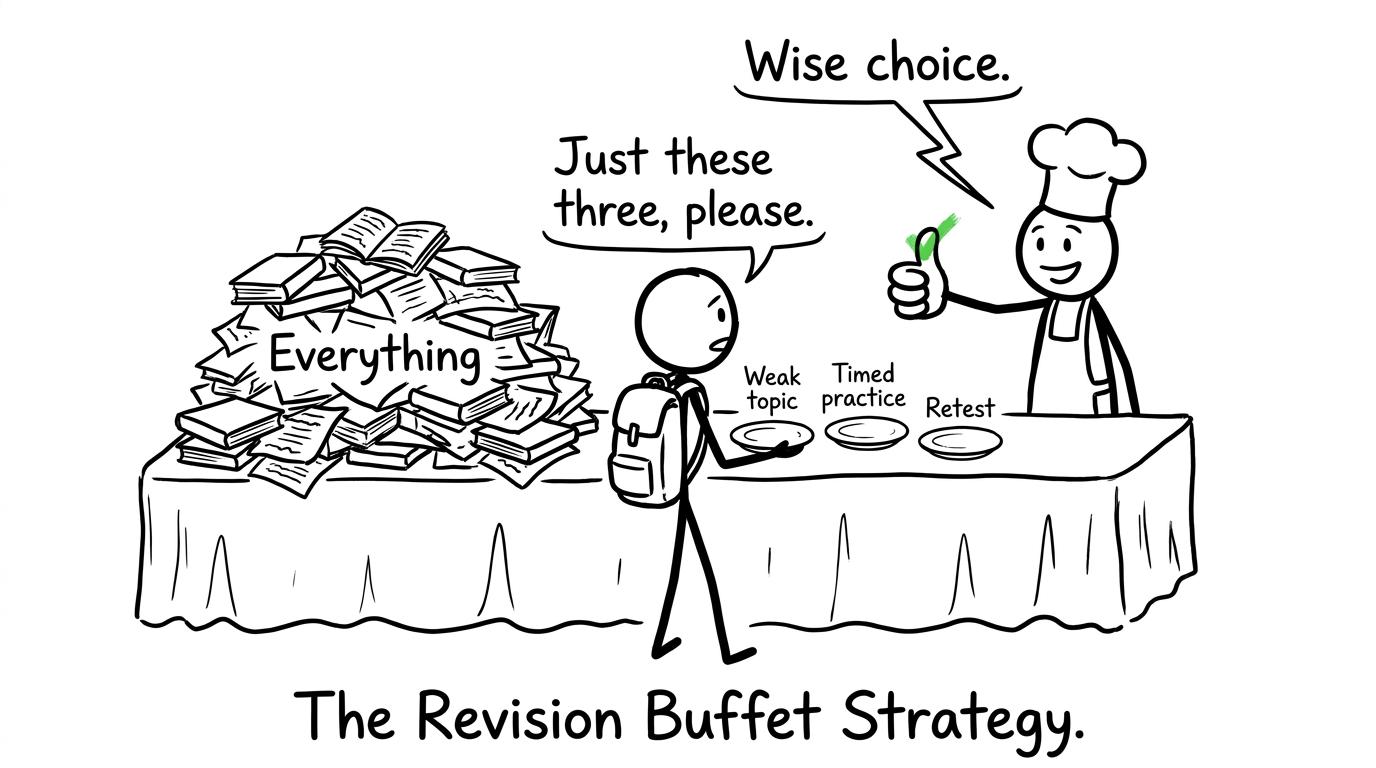 A student chooses focused revision instead of trying to revise everything
Common mistakes when reviewing mock results
Fixating on the grade
A grade compresses several papers and many decisions into one symbol. Record it, then move quickly to component marks, question-level feedback and repeated error patterns.
Treating historical boundaries as predictions
Boundaries can change between examination series. They also may not fit a shortened school mock. Read the school’s grading method before drawing conclusions.
Comparing yourself with friends
Another student may have taken a different tier, prepared for different topics or lost marks for different reasons. Their total cannot design your revision plan.
Revising the whole subject equally
Equal time is not always intelligent time. Give more attention to repeated weaknesses while continuing brief retrieval of stronger areas.
Reading corrections without retesting
A mark scheme can make an answer feel obvious after the event. Close it, wait, and attempt a similar task independently.
Doing endless papers without repair work
Practice exposes a weakness; it does not automatically fix it. Insert focused lessons and topic questions between mock papers. MathsGenie’s revision approach for reluctant students offers a simple learn, practise, mark and correct loop.
Make the next result less surprising
Good revision does not guarantee that every mock feels comfortable. It does make your performance more explainable. You know which skills have been tested, which errors have been repaired and which weaknesses still need attention.
Read your GCSE Bengali mock results as evidence, not identity. Separate the components, diagnose the cause of each important error and schedule a retest. Then bring the same discipline to maths.
Start your next revision cycle with MathsGenie. Use the free revision lessons to understand weak methods, practice questions and mini tests to make them reliable, then past papers and predicted papers to test them under pressure. Mark with the available mark schemes and video solutions, update your revision planner, and let each result decide the next useful action, not your confidence for the rest of the day.











