

GCSE Bengali Early Entry: Is It a Good Idea?
GCSE Bengali early entry can free time in Year 11, but only if all four skills are secure. Weigh readiness, tier, workload and resit risks first.
A qualification finished early can feel like a future burden removed. One less subject in Year 111111. One more result already secured. More room for maths, English and science when the timetable becomes crowded.
But GCSE Bengali early entry is a good idea only when you are genuinely ready across listening, speaking, reading and writing, not simply because you speak Bengali confidently at home. Before agreeing, check your performance under timed exam conditions, the proposed tier, the effect on your other subjects and what would happen if the result disappointed you.
The short answer is simple: take it early if the evidence says you are ready. Wait if the decision depends mainly on hope, convenience or conversational fluency.
The early-entry checklist
Before you or your family agrees, ask these questions:
- Which qualification and exam board will you be entered for?
- Can you complete timed listening, speaking, reading and writing tasks successfully?
- Are you equally confident with formal Bengali and everyday conversation?
- Is the proposed foundation or higher tier appropriate?
- Will preparation reduce the time available for GCSE maths or other priorities?
- Has the school explained its policy on resits and first-entry rules?
- Who will teach, assess and organise the speaking component?
- Do recent mock results support entering early?
If several answers are unclear, the decision is not ready yet.
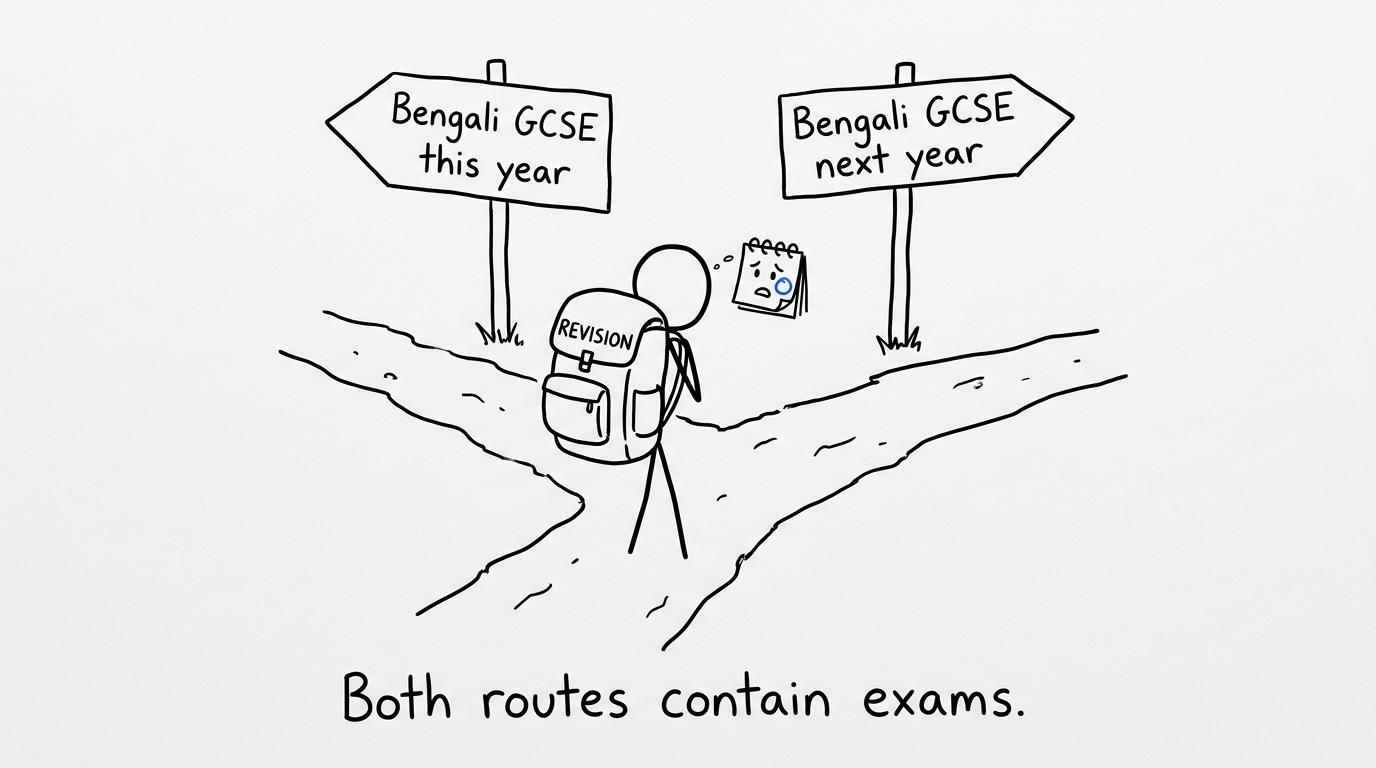 A student choosing between taking Bengali GCSE this year or next year
What GCSE Bengali actually assesses
Students discussing early entry are usually referring to AQA GCSE Bengali, specification 863886388638. It is a linear qualification, so all assessments are completed at the end of the course and in the same exam series.
There are four assessed skills:
- listening
- speaking
- reading
- writing
Each contributes approximately 25%25\%25% of the qualification. That balance matters. Being particularly strong in one area cannot completely compensate for being unprepared in another.
AQA offers foundation tier, covering grades 111-555, and higher tier, covering grades 444-999. Students must take all four components at the same tier. The choice should therefore be based on evidence across the complete course rather than performance in a favourite skill.
The qualification is normally available in the summer series. It is not something to approach as though you can casually try one paper and complete the rest later. Your school should confirm the current specification, entry arrangements and deadlines before making a final decision.
Why speaking Bengali at home is not enough
Home fluency is a valuable advantage. You may understand natural speech quickly, possess a wide vocabulary and feel comfortable expressing opinions. Those strengths can make early entry realistic.
Yet an examination measures particular forms of communication. A student might speak effortlessly with family but have had less practice with:
- reading unfamiliar formal passages
- spelling and grammatical accuracy
- translating meaning precisely
- responding to every bullet point in a writing task
- discussing unfamiliar themes under speaking-test conditions
- recognising vocabulary used in education, employment or global issues
This is not a judgement on anyone's command of Bengali. It is a distinction between living with a language and performing within an assessment system.
The same distinction appears in maths. Understanding a teacher's explanation is not identical to producing a complete solution under timed conditions. MathsGenie's guide to using past papers properly explains why realistic assessment gives better evidence than familiarity alone.
When taking GCSE Bengali early can make sense
You are secure in all four skills
Strong evidence might include consistently successful timed papers, accurate extended writing and confident speaking responses to unfamiliar prompts. One good classroom task is not enough. Look for a pattern.
Early entry is most sensible when your teacher believes you have already covered the specification and can perform reliably without an unsustainable burst of last-minute preparation.
It could create useful space in Year 11
Completing Bengali in Year 101010 may leave more revision time the following year. That can help if maths, English or science requires sustained attention.
The benefit, however, only exists if Bengali preparation is manageable now. Moving pressure from one year to another does not automatically reduce it.
Use a real weekly timetable rather than saying that you will somehow fit everything in. Include lessons, homework, travel, sleep and rest. Then decide where Bengali practice would go. If your maths needs regular attention, a short structure such as the 20-minute GCSE maths revision routine can protect continuity without overwhelming the week.
The school can support the complete entry
A suitable centre must manage the exams and speaking assessment correctly. Private candidates need to pay particular attention to whether a centre can supervise and authenticate the speaking component.
Ask who is responsible, when practice assessments will happen and how feedback will be provided. Administrative uncertainty is a reason to pause, not a small detail to ignore.
When waiting is probably wiser
Writing is well behind speaking
This is perhaps the clearest warning sign. Everyday fluency can make the qualification look easier than it is, while weaknesses in spelling, register, translation or extended writing remain hidden.
Waiting another year may give you time to turn natural language knowledge into reliable examination technique. An early grade is not automatically better than a stronger grade achieved at the usual time.
Preparation is taking marks away from core subjects
GCSE maths and English have particular importance for post-161616 progression. Bengali can be a valuable qualification, but the timing should fit the whole academic picture.
If you are regularly dropping marks in maths because essential topics have not been secured, diagnose those gaps before adding another examination deadline. The MathsGenie guide to finding weak GCSE topics offers a practical way to identify where marks are being lost, while the main GCSE maths revision hub brings together board-specific papers, questions and revision resources.
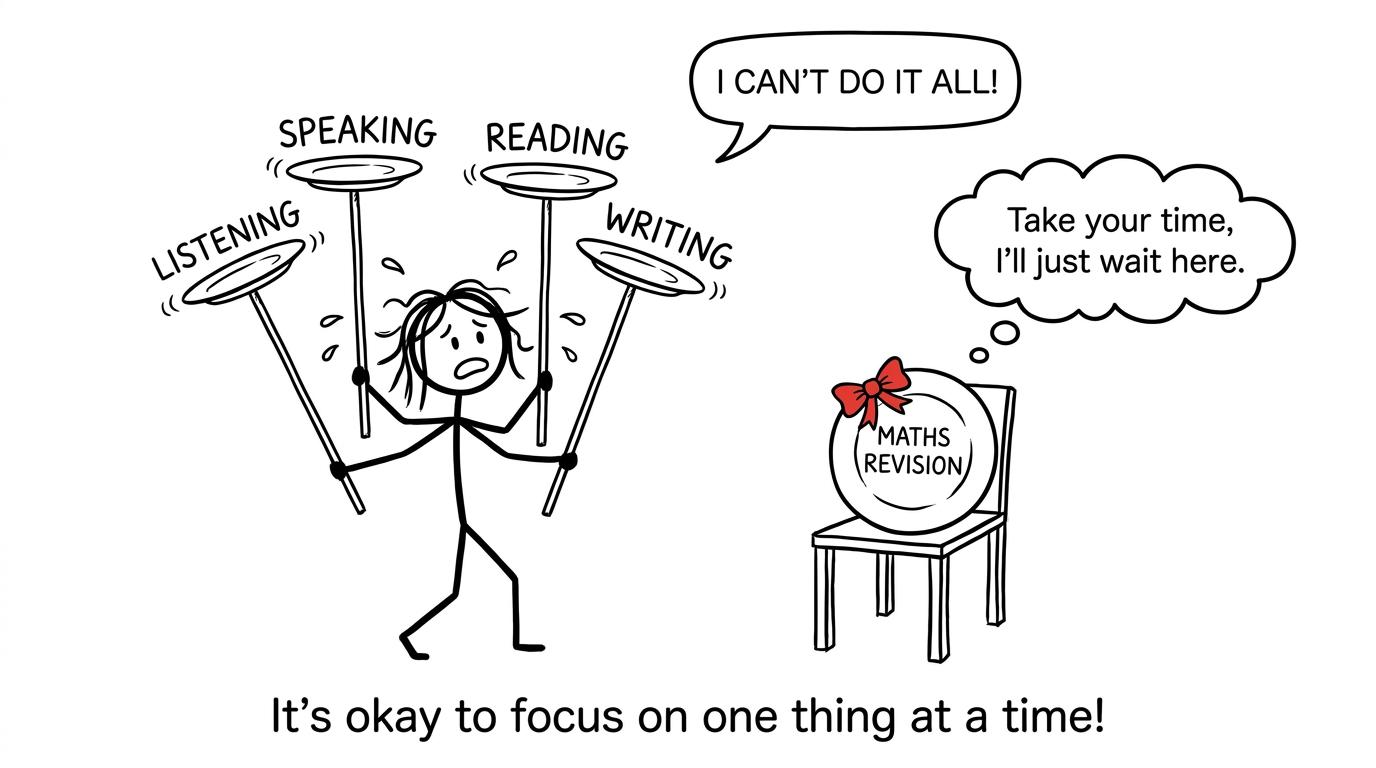 A student balancing the four Bengali skills while maths revision waits nearby
The tier decision is uncertain
Foundation tier can award up to grade 555, while higher tier covers grades 444-999. Entering too early may force a cautious tier decision before your full potential is clear.
Do not choose higher merely because it sounds more ambitious, and do not choose foundation simply to finish early. Ask your teacher which tier is supported by results across all four components.
You are relying on a later resit
A planned resit is not a harmless safety net. AQA GCSE Bengali is linear, so a future attempt would involve the qualification's required components again rather than simply repairing one weak written paper.
There is also a school-accountability issue. Department for Education early-entry rules generally mean that the first qualification taken in the same subject is the one used for the school's performance measures. That is not the same as saying you are forbidden from retaking, but it can affect the school's entry decision. Ask the exams officer how the current rules apply to your circumstances.
How early entry could affect maths revision
The real cost of an extra qualification is rarely the examination day. It is the collection of small sessions leading to it.
Suppose Bengali requires three focused sessions each week. Those sessions must come from somewhere. If they replace unfocused screen time, the trade-off may be reasonable. If they replace sleep, maths lessons or recovery time, it is not.
Protect maths with a minimum weekly routine:
- one topic-repair session using a revision lesson and practice questions
- one short retrieval check using GCSE maths mini tests
- one timed paper section followed by careful marking
- a written list of errors to revisit
The purpose is not to spend every evening revising. It is to prevent a new deadline from silently interrupting the practice that keeps maths knowledge available.
If your schedule is already crowded, turning notes into active recall can make each session more purposeful. Retrieval, questions and feedback usually tell you more than repeatedly reading a revision guide.
A sensible decision process
Get a four-skill assessment
Ask for a realistic assessment in listening, speaking, reading and writing. It should use material appropriate to the specification and proposed tier. The result should identify weaknesses, not just produce an overall grade estimate.
Review the evidence with the right people
The conversation should include you, your parent or carer, the Bengali teacher or tutor, and the school's exams team where necessary. Useful questions include:
- What evidence shows that I am ready now?
- Which component is currently weakest?
- Which tier is recommended, and why?
- How much weekly preparation is expected?
- What is the plan if my next mock is below target?
- How would a resit be handled?
A calm decision is usually better than an immediate yes.
Run a timetable trial
Follow the proposed Bengali and maths timetable for two or three weeks before the entry is finalised. This reveals whether the plan works on ordinary school days, not just on an optimistic Sunday evening.
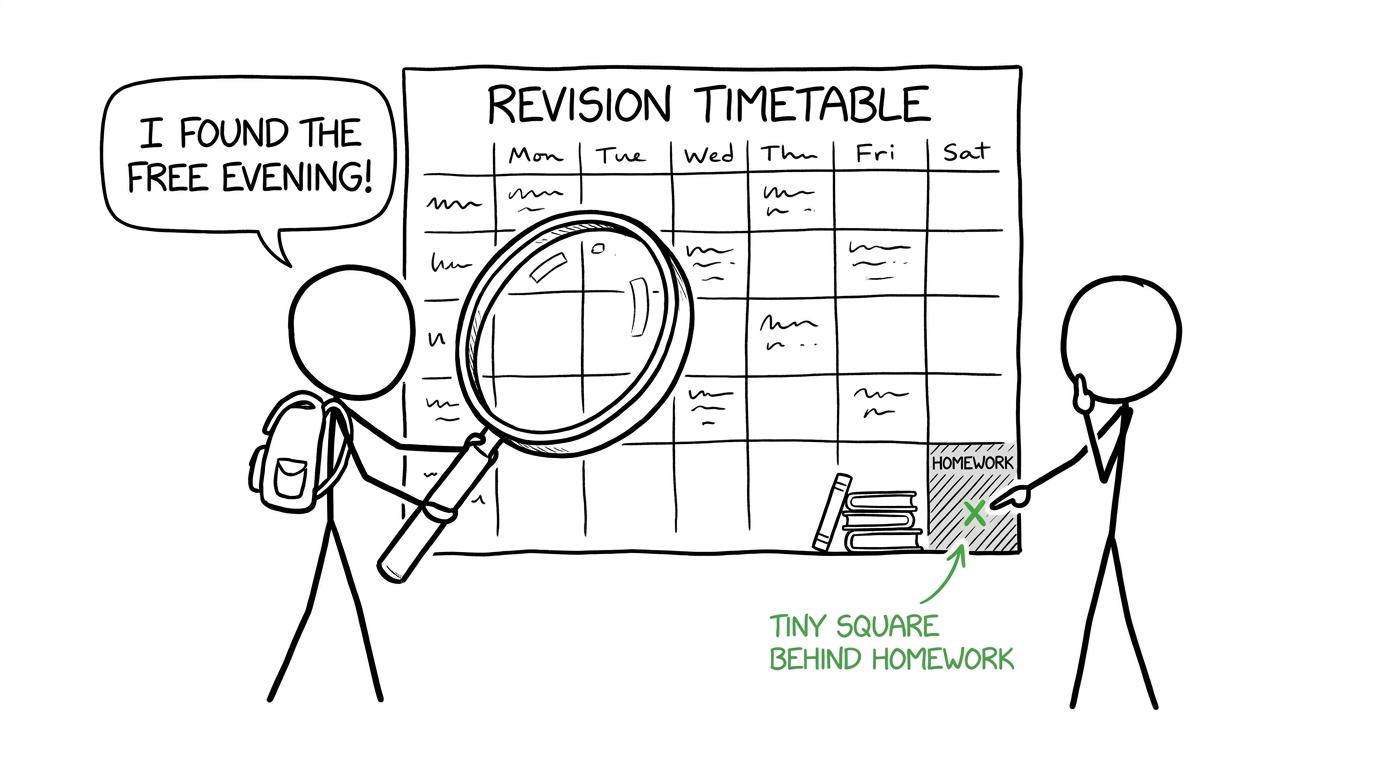 Students searching a crowded revision timetable for free time
Set a decision deadline
Agree on a date when teachers will review the evidence. This prevents the choice drifting forward until entry deadlines or late fees create unnecessary pressure. Exact dates vary by series and centre, so obtain them directly from your exams officer.
Common mistakes with GCSE Bengali early entry
Treating age as proof of readiness
Being younger does not make the entry impressive by itself. The useful outcome is a grade that reflects your ability without damaging progress elsewhere.
Judging readiness from conversation alone
Speaking at home is strong preparation, but it does not test the complete specification. Reading, formal writing, translation and exam technique need separate evidence.
Ignoring the weakest component
Because each skill contributes around 25%25\%25%, a significant weakness matters. Base the decision on the least secure component as well as the strongest.
Planning revision without testing the plan
A timetable can look balanced on paper and fail during a normal week. Trial it before committing. MathsGenie's one-month GCSE maths revision plan can help you organise focused practice around other responsibilities.
Assuming an early attempt has no consequences
Resits require more time, may involve repeating the linear assessment and can interact with first-entry rules for school performance measures. Ask before entering, not after receiving the result.
Make the decision from evidence, not momentum
Taking GCSE Bengali a year early can be worthwhile. For a student who is secure across all four skills, has appropriate teaching support and can protect the rest of their timetable, it may create valuable space in Year 111111.
But waiting is not failure. Another year can improve writing accuracy, widen vocabulary, clarify the correct tier and preserve attention for maths and other GCSEs. The best date is the one that produces a strong, sustainable performance.
While you assess the Bengali decision, keep maths moving with MathsGenie. Use the free revision lessons and practice questions to repair individual topics, mark your work with mark schemes and video solutions, then test progress through mini tests, past papers and predicted papers. If examinations are close, the one-week GCSE maths revision plan gives you a focused starting point.
Start with the MathsGenie GCSE maths resources, choose your exam board and tier, and build a revision plan that leaves room for ambition without asking you to carry everything at once.











