GCSE Astronomy 4 to 6: A Practical Grade Plan
GCSE astronomy 4 to 6 revision advice: improve calculations, explanations, data analysis and observational evaluation with a focused exam plan.
A grade 4 answer often shows that you know the basic astronomy. A grade 6 answer does something more: it selects accurate knowledge, applies it to an unfamiliar situation, completes multi-step calculations and uses evidence to justify conclusions.
That is the central lesson in moving from GCSE astronomy 4 to 6. You do not need to memorise the universe twice. You need to make your existing knowledge more precise, mathematical and useful under exam conditions.
Pearson Edexcel's current GCSE Astronomy specification is untiered. It has two externally examined papers, each lasting 111 hour 454545 minutes and carrying 100100100 marks. Paper 1 covers naked-eye astronomy; Paper 2 covers telescopic astronomy. Your final grade comes from the combined total, not a separate grade on each paper.
Your grade 6 checklist
To move towards grade 6, focus on these changes:
- replace broad descriptions with accurate astronomical terminology;
- connect causes to effects when a question says explain;
- become dependable with units, formulae and multi-step calculations;
- interpret unfamiliar graphs, images and tables rather than merely describing them;
- use specific evidence when drawing conclusions;
- evaluate observational methods with realistic improvements;
- practise under time pressure and study the mark scheme afterwards.
This matters because the qualification gives 40%40\%40% of its marks to knowledge and understanding, 40%40\%40% to applying knowledge and understanding, and 20%20\%20% to analysis and evaluation. Recall alone therefore leaves a large part of the paper untouched.
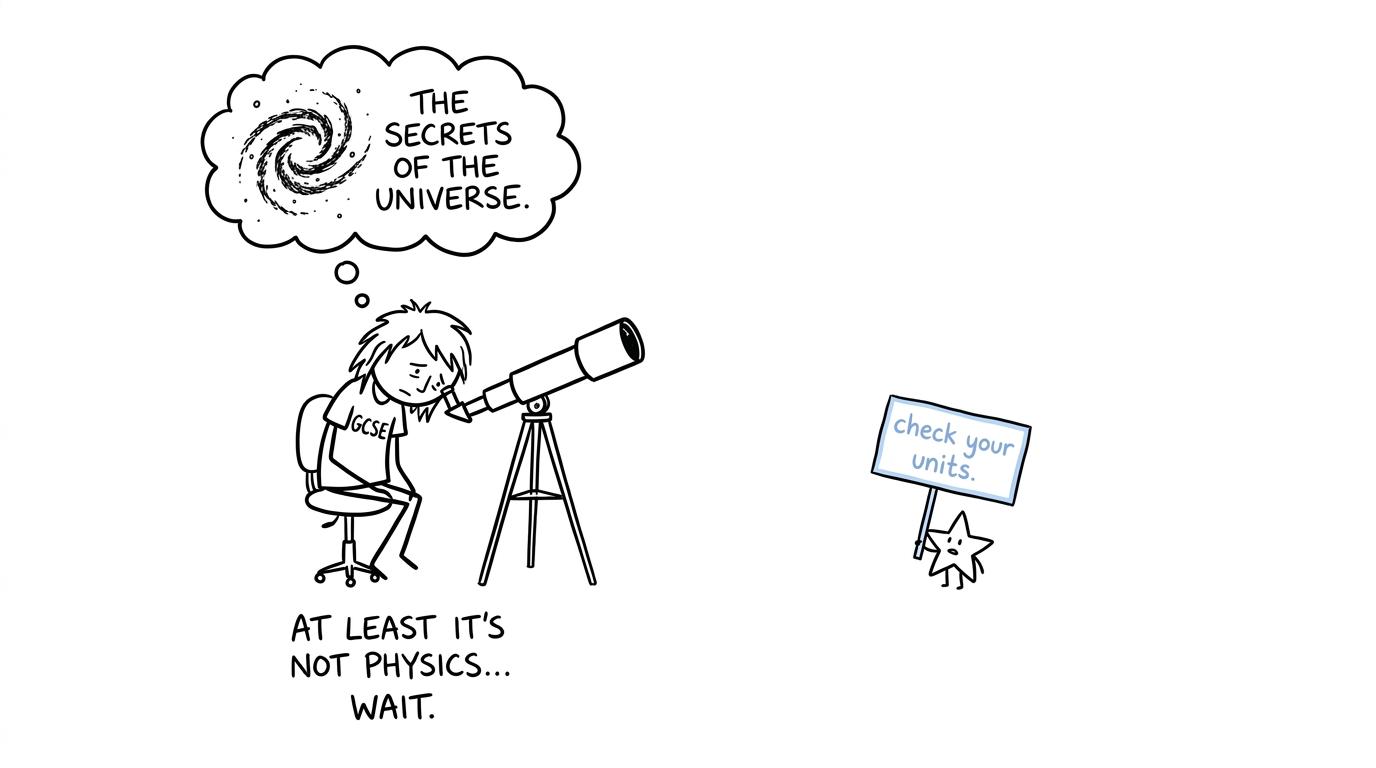 A student discovers that the universe also cares about units
What separates a grade 4 from a grade 6?
Official grade descriptors do not promise that one particular answer will receive a particular grade. They describe performance across the qualification. They are still useful because they reveal the direction of travel.
| Grade 4 performance | Grade 6 performance |
|---|---|
| Some accurate and appropriate knowledge | Largely accurate and appropriate knowledge |
| Some correct astronomical terminology | Largely accurate terminology used consistently |
| Explanations work in some contexts | Ideas are explained across familiar and unfamiliar contexts |
| Some multi-step calculations are completed | A range of multi-step calculations is handled successfully |
| Conclusions are plausible and supported by some evidence | Conclusions are accurate and supported by a range of evidence |
| Improvements to methods may be suggested | Methods are evaluated and improvements are justified |
The difference is consistency. A grade 4 student may show a grade 6 skill occasionally. A grade 6 student shows those skills often enough, across both papers, for the performance to become reliable.
Grade boundaries are set after each examination series, so there is no permanent number of marks that always guarantees grade 6. Use past boundaries to understand past outcomes, not as a target that is certain to remain unchanged.
Turn knowledge into complete explanations
Many students revise astronomy as a collection of nouns: phases, parallax, redshift, nebulae, eclipses and galaxies. Exams reward relationships between those ideas.
For each specification statement, test yourself at three levels:
- Recall: Can I state the relevant fact or definition?
- Connection: Can I explain the cause and effect?
- Application: Can I use the idea in a new diagram, observation or set of data?
If a question asks why an observation changes, naming the phenomenon is usually only the beginning. A stronger response identifies what changes, explains the relevant geometry or physical process, and links it directly to what the observer detects.
Command words matter here. State normally requires a concise fact. Describe requires relevant features or a sequence. Explain needs reasons. Compare needs both sides of the comparison. Evaluate requires strengths, limitations and a supported judgement. Treating every command word as “write everything I remember” creates long answers but not necessarily more marks.
Make the mathematics dependable
Mathematical skills account for at least 20%20\%20% of the written assessment. Astronomy calculations may involve angular measurement, scale, standard form, orbital relationships, magnification, data handling and rearranging formulae.
Standard form and scale
Astronomy uses quantities that are extremely large or small. Standard form writes a value as
a×10n,1≤a<10.a \times 10^n, \qquad 1 \leq a < 10.a×10n,1≤a<10.The grade-building skill is not merely converting a number. You must also multiply or divide powers correctly, preserve units and round only when requested. Strengthen this with MathsGenie's standard form revision resources.
Formulae and proportional reasoning
Write the relevant relationship before substituting. For example, average orbital speed follows the general structure
v=dt.v = \frac{d}{t}.v=td.Showing the equation and substitution can make your method visible even if a later arithmetic slip occurs. Check that the units are compatible before using the calculator. The conversions and units revision guide and speed, velocity and acceleration guide can help make this routine automatic.
You should also be comfortable changing the subject of a formula. Work one inverse operation at a time and keep both sides balanced. If that process feels uncertain, use rearranging formulae practice selectively. The astronomy question may look specialised, but the algebra underneath it is often familiar.
Angles and trigonometry
Angular separation, latitude, altitude and observations of the sky all depend on confident angle reasoning. When a right-angled triangle is involved, the relevant relationships are
sin(θ)=oppositehypotenuse,cos(θ)=adjacenthypotenuse,tan(θ)=oppositeadjacent.\sin(\theta)=\frac{\text{opposite}}{\text{hypotenuse}}, \qquad \cos(\theta)=\frac{\text{adjacent}}{\text{hypotenuse}}, \qquad \tan(\theta)=\frac{\text{opposite}}{\text{adjacent}}.sin(θ)=hypotenuseopposite,cos(θ)=hypotenuseadjacent,tan(θ)=adjacentopposite.Practise choosing the relationship from the diagram rather than guessing from memory. MathsGenie's SOHCAHTOA revision page includes lessons, questions, videos and revision guides.
Improve data analysis and observational evaluation
GCSE Astronomy requires students to undertake at least one unaided and one aided observation. The observations are not submitted as coursework marks, but the knowledge and skills developed through them are assessed in the written papers.
A useful evaluation should identify a specific limitation, explain its effect and propose a practical improvement. “Repeat it” is incomplete. A better line of thought asks:
- What measurement varied?
- Was the issue random uncertainty, equipment, weather or observer judgement?
- Would repetition allow a mean to be calculated?
- Could a longer observation period, darker location or more suitable instrument improve the evidence?
- Does the conclusion actually follow from the data?
When analysing a graph, begin with the axes and units. Then identify the pattern, support it with values where appropriate, note anomalies and decide whether the evidence supports the proposed relationship. Description says what the data does. Analysis says what it means.
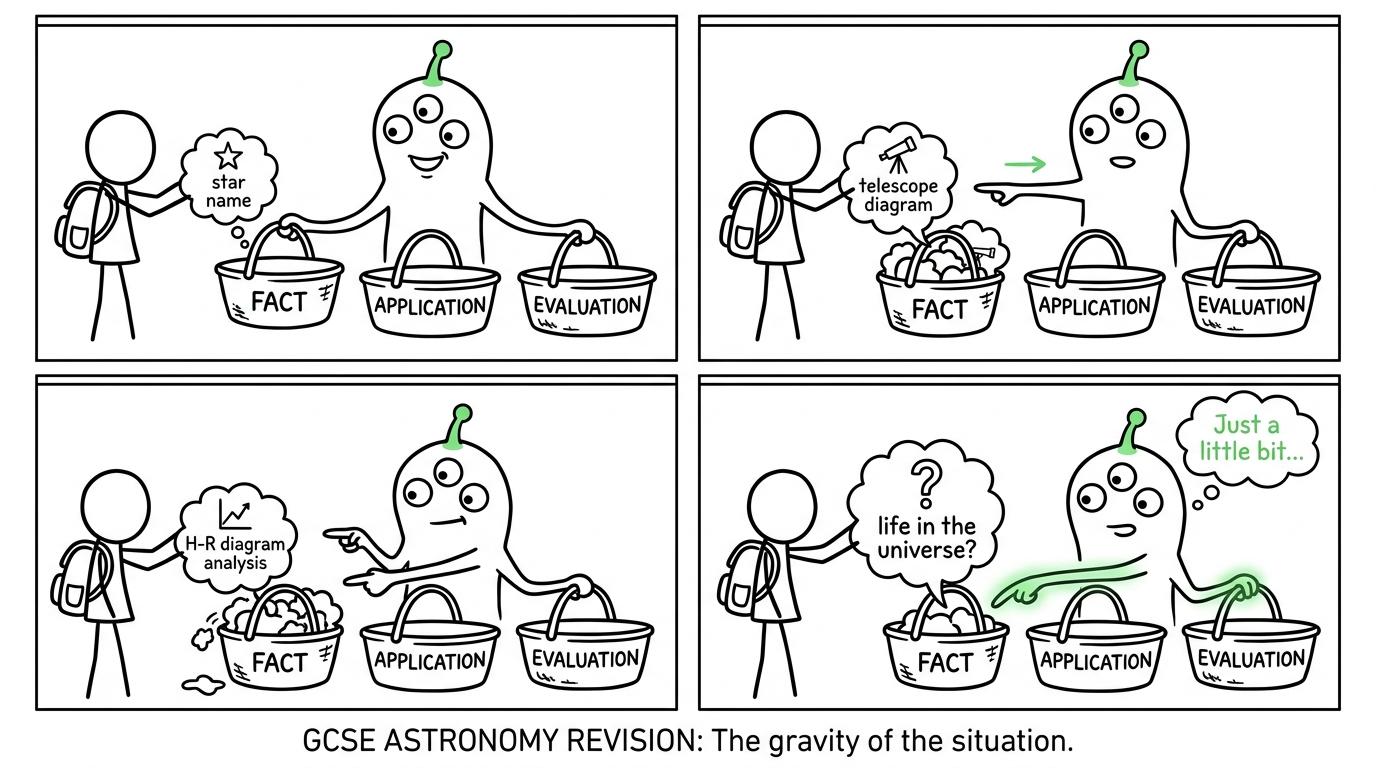 An examiner gently redirects revision towards application and evaluation
Use a revision loop that changes performance
Reading notes can create familiarity without proving that you can answer a question. The more useful loop is short and measurable.
Diagnose the lost marks
Complete a timed section from an official GCSE Astronomy past paper. Mark it strictly and classify every lost mark as one of these:
- missing knowledge;
- imprecise terminology;
- weak application;
- calculation or unit error;
- graph or data interpretation;
- incomplete evaluation;
- misread command word.
MathsGenie's guide to finding your weakest GCSE topics explains how to turn lost marks into a focused action list.
Repair one narrow weakness
Do not write “revise calculations”. Write “convert angular units correctly” or “show substitutions before using the calculator”. Narrow targets are easier to practise and verify.
Study the relevant specification content, retrieve it without notes, answer several exam questions and then mark them. Return to the same skill after a short gap. A correct answer immediately after reading may reflect short-term memory; a correct answer later is stronger evidence of learning.
Retest under pressure
Use another unseen question or paper section. Your score matters, but so does the pattern of mistakes. If the same error returns, the repair was incomplete.
MathsGenie's advice on using past papers properly is written for maths, but its cycle of sitting, marking, diagnosing and reattempting transfers directly to Astronomy. The GCSE predicted papers can separately maintain your maths exam skills; they are maths resources, not substitutes for official Astronomy papers.
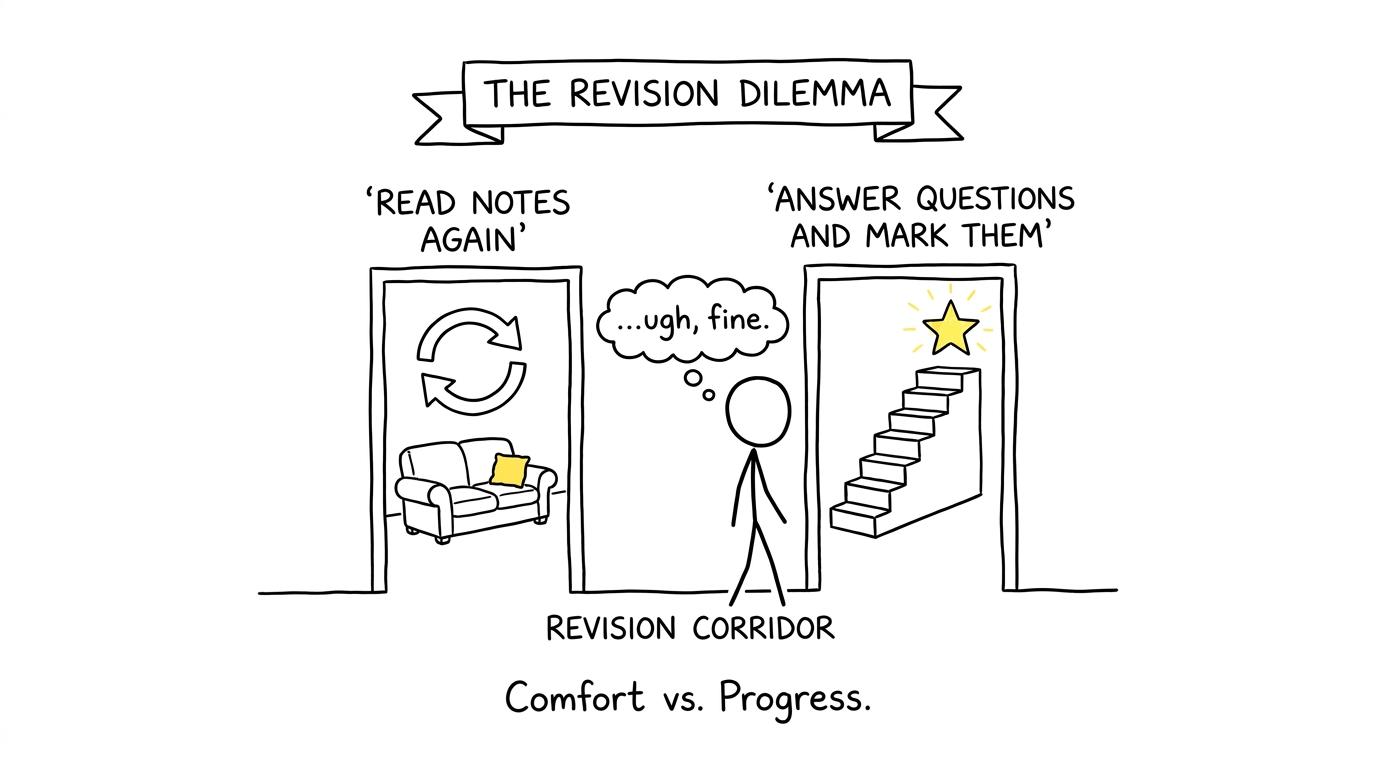 The less comfortable revision route quietly leads upwards
Common mistakes that keep students near grade 4
Memorising definitions without applying them
A correct fact may earn an initial mark, but application questions require you to adapt it to the information provided. After learning each fact, ask how it could appear in a diagram, observation or unfamiliar context.
Giving generic observational improvements
“Use better equipment” does not identify what should improve or why. Name the equipment or method change and connect it to accuracy, reliability, resolution or reduced uncertainty.
Hiding mathematical working
A calculator-only answer makes errors difficult to trace and can lose access to method marks. Write the formula, convert units, substitute, calculate and state the final unit.
Confusing description with explanation
A description identifies a pattern. An explanation gives the reason for it. Use connective language such as “because”, “therefore” and “so the observer detects” only when the scientific link is valid.
Revising Paper 1 more than Paper 2
The night sky may feel more concrete than stellar evolution or cosmology, but each paper contributes 50%50\%50% of the qualification. Diagnose and revise them separately so a comfortable paper does not conceal a weaker one.
A calm route to grade 6
Moving from grade 4 to grade 6 is not one dramatic leap. It is a collection of smaller changes: terminology becomes precise, calculations show complete working, conclusions use evidence, and observational improvements become specific.
Start with one timed Astronomy paper section. Mark it honestly. Choose the two skills costing the most marks and repair them through focused practice. Then retest. Repeat that cycle across both papers.
Alongside your Astronomy revision, use MathsGenie as your free base for the mathematical skills beneath the subject. Revision lessons rebuild methods; practice questions and mini tests expose gaps; mark schemes and video solutions show where marks come from; and past papers and predicted papers build exam stamina. Begin with the skill that cost you marks most recently, then prove, with a fresh question, that it has improved.