GCSE Engineering Grade 4 Meaning Explained
GCSE engineering grade 4 meaning explained clearly: discover what this pass represents, how it compares with an old C and which skills to improve next.
Results slips are unusually good at making one small number feel enormous. You see a 444 beside GCSE Engineering and immediately wonder whether it means success, disappointment or something in between.
The GCSE engineering grade 4 meaning is straightforward: in England, a grade 444 is a standard pass. Its lower boundary is aligned with the lower boundary of the old grade C. It shows that you reached the recognised pass standard across the qualification, although it does not mean you mastered every topic or that every college and apprenticeship must accept it for every course.
That is the short answer. The more useful question is what the grade says about your engineering ability and what it does not say.
Grade 4 at a glance
- A grade 444 is officially recognised as a standard pass.
- It is broadly comparable with the old grade C, specifically at the lower boundary.
- It sits below grade 555, which is described as a strong pass.
- It reflects your combined performance across the assessed parts of your qualification.
- It does not mean that you achieved a fixed percentage in every exam series.
- It does not automatically meet a separate entry requirement for GCSE Maths or English.
- Colleges, sixth forms, apprenticeship providers and employers can set their own subject and grade requirements.
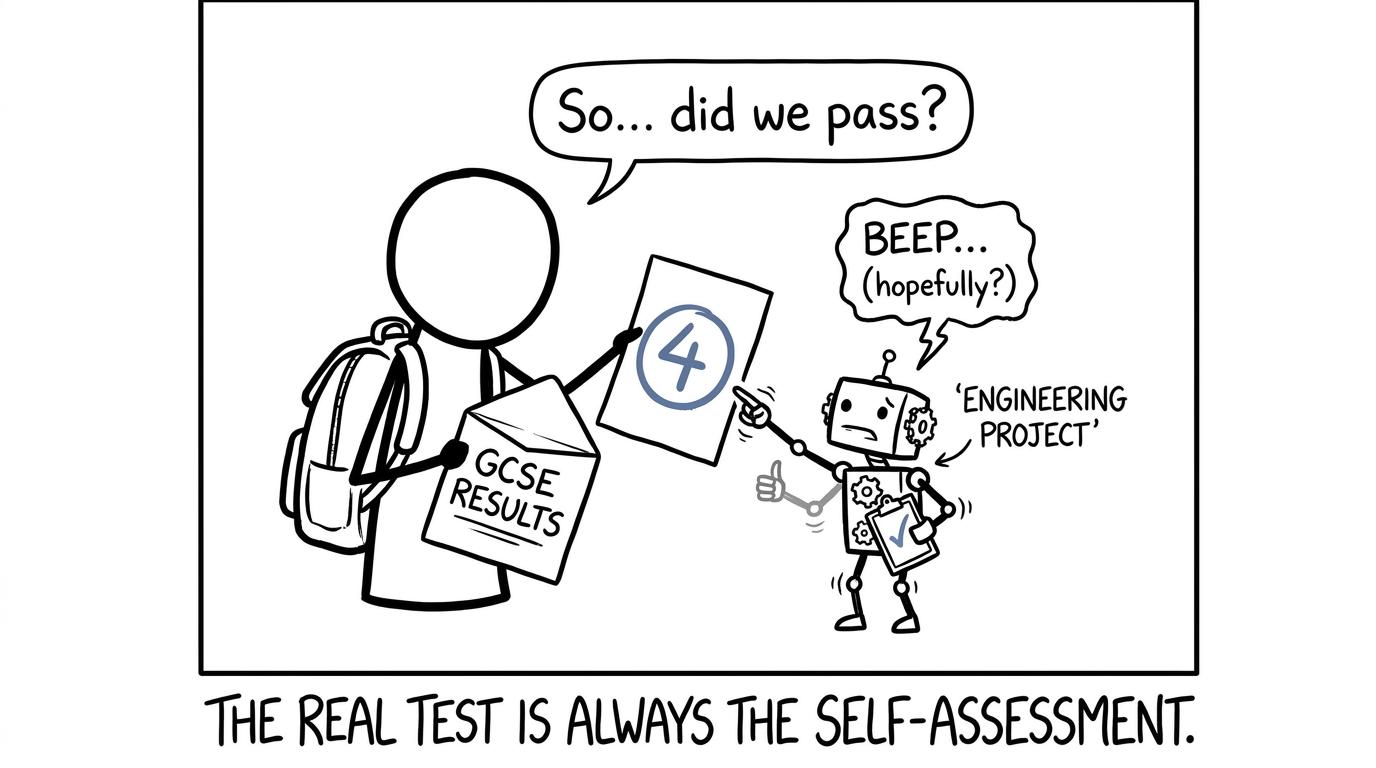 A student and engineering robot celebrate finding a grade 4 on the results slip
What does a grade 4 in GCSE Engineering mean?
A grade 444 means that your overall assessed work met the standard-pass threshold established for that examination series. In practical terms, you demonstrated a sufficient combination of engineering knowledge, application, analysis and evaluation to cross the grade 333/444 boundary.
This is an important distinction: a GCSE grade is based on the total assessed evidence, not on a separate pass or fail judgement for every individual skill.
For example, the current AQA GCSE Engineering specification combines a written paper with non-exam assessment. The written examination is worth 120120120 marks and contributes 60%60\%60% of the qualification. The non-exam assessment is worth 808080 marks and contributes 40%40\%40%. The overall total is therefore:
120+80=200 120 + 80 = 200 120+80=200A student's final grade is determined from the combined total, subject to the grade boundaries for that series. A stronger performance in one component can therefore compensate, to a degree, for a weaker performance in another.
Your school should confirm the exact specification you are taking. Do not assume that assessment arrangements are identical merely because two qualifications contain the word “engineering”. Equally, foundation and higher tier are crucial distinctions in GCSE Maths, but you should not transfer that tier language automatically to Engineering.
What ability does a grade 4 represent?
A grade cannot describe every detail of a student's performance. Two students can earn the same grade through different combinations of strengths. One might be particularly confident with practical manufacture; another might score more highly on written explanations and technical calculations.
Nevertheless, a grade 444 normally indicates that you have shown a credible, developing ability in several broad areas.
Knowledge of engineering principles and processes
You have demonstrated enough knowledge to identify and explain relevant ideas from the specification. Depending on the question or project, this may involve materials, manufacturing methods, systems, components, testing, sustainability, mechanical principles or engineering sectors.
At this level, explanations may not always have the precision or depth found in higher-grade responses. However, the work contains enough correct engineering knowledge to meet the overall pass standard.
Application in engineering contexts
Engineering is not only about recalling facts. You must use knowledge to make decisions, interpret a problem or develop a solution.
AQA's assessment objectives place substantial emphasis on application. In non-exam assessment, this can include developing ideas, producing engineering drawings, planning manufacture, using appropriate processes, applying quality control and creating a prototype that responds to a brief.
A grade 444 therefore represents more than remembering vocabulary. It indicates that you could apply a meaningful amount of what you learned, even if some decisions, justifications or technical details were incomplete.
Analysis, testing and evaluation
Engineering decisions need evidence. A student working around grade 444 standard may be able to test aspects of a product, compare results with a specification, recognise quality issues and suggest sensible improvements.
Higher-grade work is likely to be more systematic, detailed and convincingly justified. At grade 444, analysis and evaluation may be less consistent, but they have still contributed enough evidence towards a passing total.
Mathematical confidence in practical situations
Engineering calculations often turn familiar GCSE Maths into practical decisions. You may need to work with ratio, scale, percentages, graphs, formulae, dimensions, tolerances, area, surface area or volume.
That makes your maths revision directly useful. The GCSE Maths revision hub lets you choose Edexcel, AQA, OCR, Eduqas and other board-specific resources. If scale and proportion cause problems, begin with the GCSE ratio revision guide. For three-dimensional designs and scale factors, the similar shapes, area and volume guide provides focused support.
How grade 4 compares with the old letter grades
The numerical and letter scales are not exact one-to-one translations. Official guidance identifies three principal alignment points:
| Current GCSE scale | Comparable point on the old scale |
|---|---|
| Bottom of grade 777 | Bottom of grade A |
| Bottom of grade 444 | Bottom of grade C |
| Bottom of grade 111 | Bottom of grade G |
For this reason, a grade 444 is best described as broadly comparable with an old grade C. More precisely, the bottom of grade 444 is aligned with the bottom of the former C grade.
It would be misleading to create a rigid conversion in which every numerical grade equals one letter. Grades 444, 555 and 666 provide more differentiation across the broad area previously occupied by grades B and C. Grade 555 is called a strong pass, while grade 444 remains the standard pass.
So if someone says, “A 444 is just a C,” they have the general idea, but not the full picture. The numerical system was designed differently, and only the specified boundary points are formally aligned.
Does a grade 4 mean you passed Engineering?
Yes. A grade 444 in GCSE Engineering is a standard pass.
There is, however, a common source of confusion. In England, students who do not achieve grade 444 in GCSE Maths or English normally have to continue studying those subjects in eligible post-161616 education. That specific continuation requirement does not apply to Engineering simply because it is another GCSE.
A grade 444 in Engineering also cannot replace a required grade 444 in Maths. If an apprenticeship asks for grade 444 or above in both GCSE Maths and English, your Engineering result is an additional qualification rather than a substitute.
Entry requirements vary. Some engineering, construction or technical courses may accept a grade 444 in the subject; others may require grade 555 or above, alongside particular results in Maths, English or science. Always read the published course requirements and ask the provider if the wording is unclear.
Why the number of marks needed can change
There is no permanent rule saying that the same raw mark always produces a grade 444. Exam boards set boundaries for each series so that grades represent a comparable standard when the difficulty of assessments changes.
For AQA GCSE Engineering, the confirmed grade 444 boundary in June 202520252025 was 109109109 marks out of 200200200. That is useful historical context, not a guaranteed boundary for another year. The June 202320232023 boundary, for instance, was different.
This is why treating last year's boundary as an exact revision target can be risky. A safer aim is to build a margin above previous boundaries while improving the quality of your written, mathematical and practical evidence.
The same principle applies to Maths. Use AQA GCSE Maths past papers to measure performance, but do not assume one raw score guarantees the same grade every year.
What should you do if you are currently working at grade 4?
A grade 444 is evidence that you have built a foundation. The next step is not to revise everything from the beginning. It is to find where marks are leaking.
Use this short cycle:
- Complete a suitable assessment or set of exam-style questions.
- Mark it carefully using the mark scheme.
- Separate knowledge gaps from calculation errors and weak explanations.
- Choose two recurring weaknesses rather than ten unrelated topics.
- Relearn each skill, practise it and retest it after a gap.
MathsGenie's guide to finding your weakest GCSE topics helps turn lost marks into a focused revision list. If your revision feels disorganised, use the best order for learning GCSE Maths topics to rebuild number, ratio, algebra, graphs and measures in a sensible sequence.
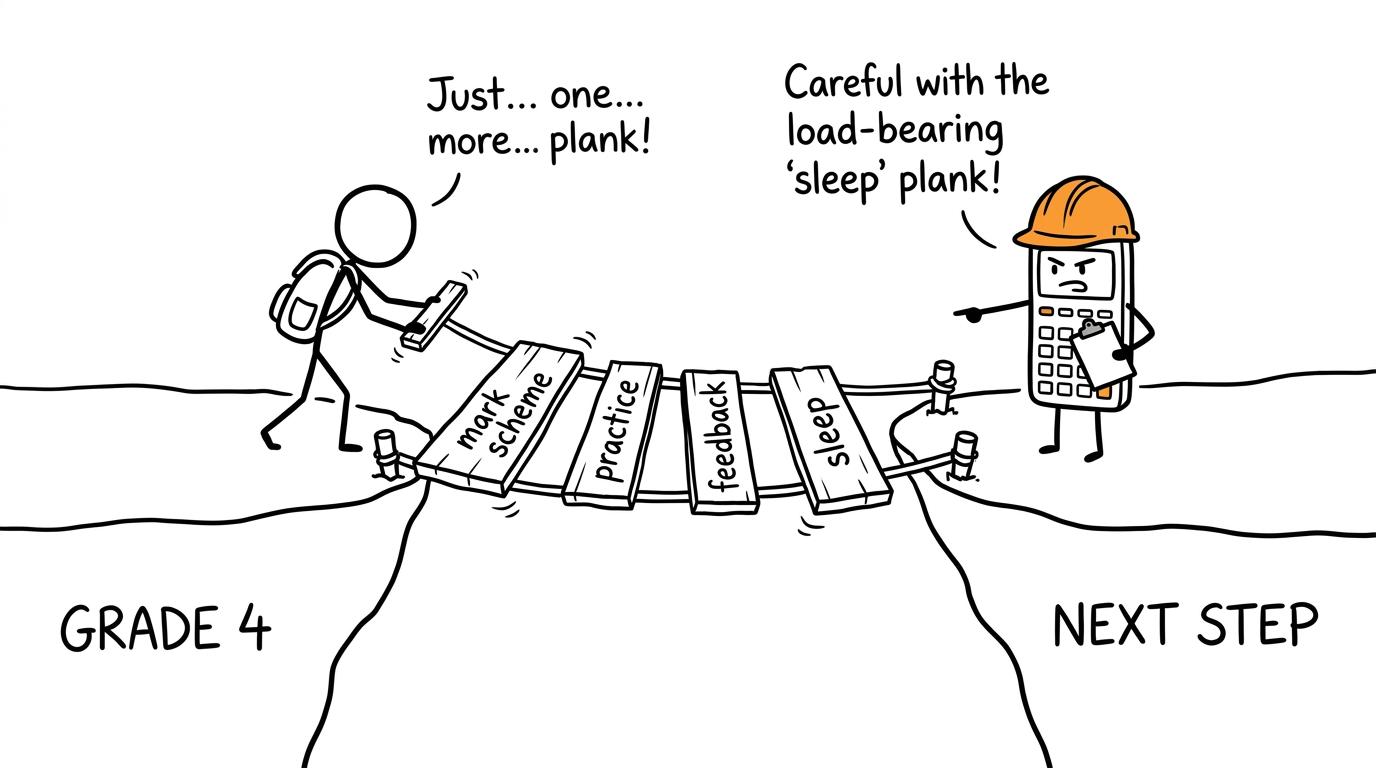 A student builds a revision bridge while a calculator in a hard hat supervises
Maths skills that can support Engineering
For students preparing for GCSE Maths as well as Engineering, the highest-value overlap often includes:
- rearranging and substituting into formulae;
- ratio, proportion and scale;
- percentages and percentage change;
- reading tables, charts and graphs;
- calculating area, surface area and volume;
- converting units correctly;
- rounding to an appropriate degree of accuracy;
- interpreting upper and lower tolerances.
Do not only watch solutions. Attempt questions before checking the method, because recognition is easier than independent recall. Then use a mark scheme to see whether you lost marks through knowledge, method, accuracy, units or communication.
The guide to using GCSE past papers properly explains the paper, mark, repair and retest cycle. Near your maths exams, Edexcel GCSE Maths predicted papers can provide additional specification-matched practice for Edexcel students, but they should supplement official past papers rather than replace them.
Common mistakes when interpreting a grade 4
Calling it a fail because it is below grade 5
Grade 555 is a strong pass, but grade 444 is still a standard pass. The word “strong” does not turn the grade beneath it into a failure.
Treating grade 4 as an exact old C
The lower boundaries are aligned, but the two grading systems are not direct translations at every point. “Broadly comparable with C” is more accurate than claiming complete equivalence.
Assuming the grade proves equal ability in every area
Your result combines evidence from different assessment objectives and components. A grade 444 does not prove that your practical skills, calculations and extended responses were all at exactly the same level.
Using one year's boundary as a guaranteed target
Grade boundaries can move between examination series. Previous boundaries are useful reference points, not promises.
Confusing an Engineering pass with Maths requirements
A grade 444 in Engineering does not replace a required Maths grade. Check every subject named in an apprenticeship, college or sixth-form offer.
A grade 4 is a platform, not a verdict
A grade 444 in GCSE Engineering means you passed at the recognised standard level. It shows a workable foundation in engineering knowledge, application and evaluation, broadly comparable with the old grade C threshold. It does not say that your ability has reached its limit.
The most productive response is to turn the result into information. Identify whether your next marks are likely to come from stronger calculations, more precise technical language, better-supported decisions or more systematic evaluation.
For the maths behind those improvements, make MathsGenie your free revision base. Start with the GCSE Maths revision resources, use revision lessons and practice questions to repair individual skills, then test them through mini tests, past papers and predicted papers. Mark every attempt carefully with the mark schemes and use video solutions when you need to see why a method works.
A grade tells you where your evidence placed you on one assessment. Good revision decides where you go next.