Moving Sets GCSE Arabic: Does It Affect Your Grade?
Moving sets GCSE Arabic explained: learn when a class change matters, how tier entry affects available grades, and how to adapt your revision with confidence.
A change of set can feel like a verdict. Move up, and expectations suddenly seem heavier. Move down, and it may feel as though your final grade has already been decided. But the direct answer to moving sets GCSE Arabic is reassuring: your class set does not appear on your certificate and does not directly determine your grade. Your assessed performance and formal tier of entry matter.
The distinction is crucial. A set is an internal teaching arrangement chosen by your school. A tier is an examination entry with an official grade range. Changing set can influence the pace, challenge and support you experience, so it may affect your preparation indirectly. It does not award or remove marks by itself.
Moving sets GCSE Arabic: the short answer
Keep these points in mind:
- Your set is not an exam result or a permanent judgement of ability.
- Your final grade comes from your performance in the assessed skills.
- For Pearson Edexcel GCSE Arabic, students take listening, speaking, reading and writing assessments.
- You must be entered for one tier across the qualification, rather than mixing Foundation and Higher papers.
- Foundation tier offers grades 111 to 555.
- Higher tier targets grades 444 to 999, with a narrow grade 333 safety net for students who fall just below the grade 444 boundary.
- A move between sets matters most if it changes your likely tier entry, taught content or access to suitable practice.
- The best response is to ask precise questions and build a revision plan from evidence.
You can review how outcomes have varied between examination series on the Edexcel GCSE Arabic grade boundaries page. Historical boundaries are useful for context, but they are not guaranteed targets for a future series.
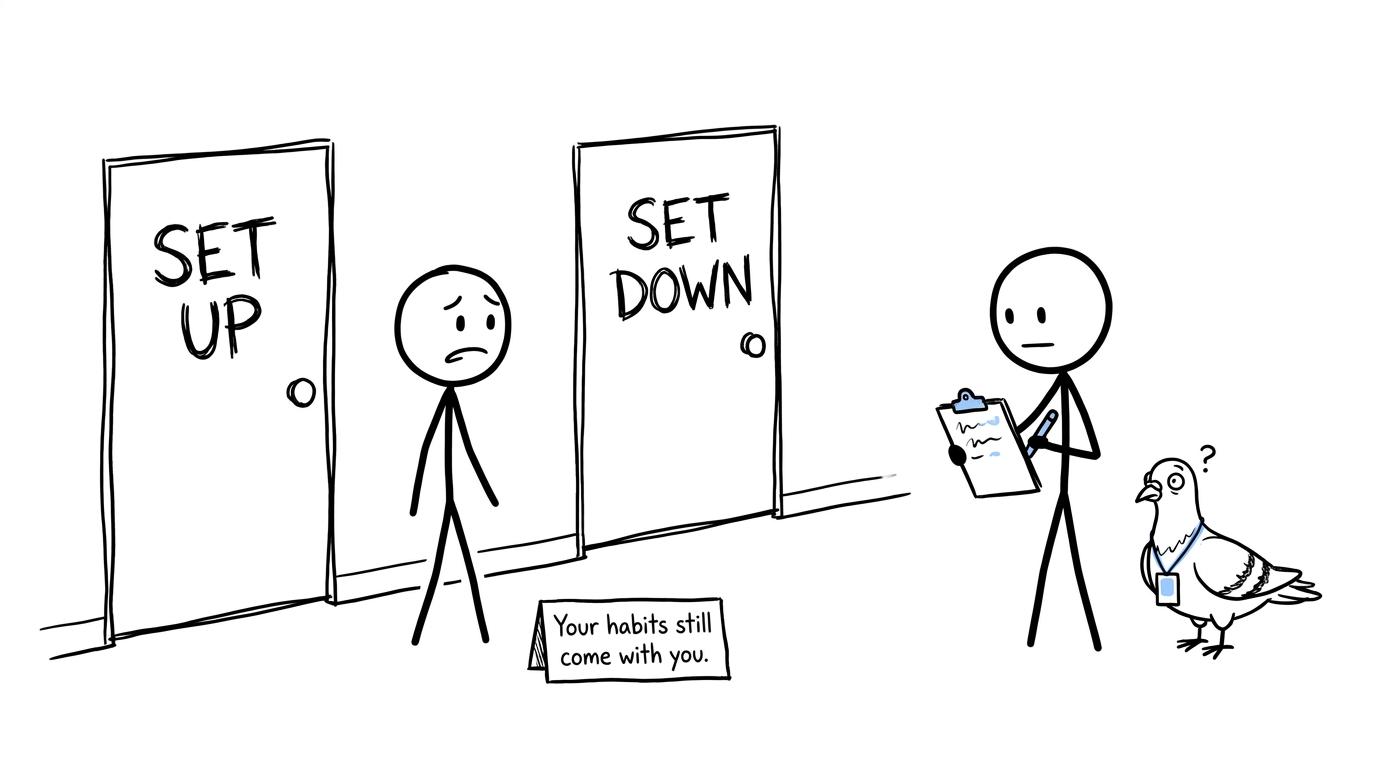 A student choosing between two school sets while their revision habits follow them
A class set and an exam tier are not the same thing
Schools use sets to organise teaching. One class may move through vocabulary more quickly, spend longer on extended writing or practise more demanding listening extracts. Another may provide more repetition, scaffolding and time to secure essential structures. Neither description automatically tells you which tier you will sit.
Tier entry is different because it changes the available grade range. Under the current tiered model for GCSE modern foreign languages, Foundation assessments target grades 111 to 555, while Higher assessments target grades 444 to 999. Grades 444 and 555 are designed to be comparable across the two tiers.
That creates two important conclusions.
First, moving down a set does not necessarily mean moving to Foundation tier. Your school may use several sets while entering students from more than one class for Higher. Second, moving up a set does not guarantee Higher entry. Teachers still need evidence that the tier is appropriate.
Ask your teacher directly:
- Which tier am I currently being prepared for?
- Has my proposed tier changed with my set?
- What evidence will be used to review the decision?
- Which Higher or Foundation content should I practise now?
- When will the school confirm the final entry?
Those questions replace a vague fear with information you can act on.
When moving up a set may help
Moving up can expose you to faster teaching, less familiar vocabulary and more demanding responses. If you are aiming above grade 555, Higher tier is necessary because Foundation is capped at grade 555.
The benefit, however, comes from what you learn rather than the name of the class. A higher set only helps if you keep up with the additional demand. Spend the first couple of weeks identifying differences in:
- vocabulary already covered;
- grammatical structures expected without prompts;
- listening speed and complexity;
- length and independence of written responses;
- speaking questions and follow-up discussion;
- homework and assessment routines.
Do not hide gaps because you are pleased to have moved up. Small gaps become expensive when later learning assumes they have already been closed. Ask for the previous set's recent materials or topic list, then patch missing knowledge in manageable sections.
This is similar to moving from Foundation to Higher in maths. The GCSE Foundation versus Higher Maths guide explains the broader principle: a higher ceiling is useful only when your underlying knowledge is secure enough to reach it.
When moving down a set may help
A lower set is often interpreted emotionally before it is interpreted practically. Yet slower pacing can create more time for retrieval, feedback and correction. If your foundations are uneven, that time may be valuable.
The risk is not the move itself. The risk is allowing the move to reduce your expectations or quietly change your tier without understanding the consequences. If you want a grade above 555, confirm whether Higher entry remains realistic and what evidence your school needs to see.
If your likely outcome is around grades 444 or 555, Foundation may be a sensible entry rather than a lesser one. A grade 444 or 555 has the same value whether earned through Foundation or Higher. Higher also carries more risk for a student whose performance is not yet secure: below its narrow grade 333 safety net, the result is unclassified.
This is why tier decisions should be based on repeatable performance, not pride. One unusually strong test is encouraging, but a pattern across listening, speaking, reading and writing is more informative.
Measure the skills that produce the grade
Your set label is a poor revision target because you cannot practise being “in Set Two”. You can practise recognising vocabulary, understanding spoken language, speaking accurately, extracting meaning from texts and constructing written responses.
Track each skill separately. For a marked task, calculate your percentage using:
percentage score=marks earnedmarks available×100\text{percentage score}=\frac{\text{marks earned}}{\text{marks available}}\times 100percentage score=marks availablemarks earned×100Do not turn this into a homemade grade boundary. Instead, use it to compare your own performance over time under similar conditions. Record:
- the skill assessed;
- whether the task was Foundation or Higher;
- your percentage score;
- mistakes caused by knowledge, technique or timing;
- one action before the next assessment.
A student with strong reading but weak listening needs a different plan from someone whose ideas are good but whose writing loses accuracy. An overall score can conceal that difference.
The same diagnostic habit strengthens maths revision. The MathsGenie GCSE Maths revision hub organises free lessons, exam questions, mini tests and papers so that a broad concern such as “I am falling behind” can become a specific next task.
How to adapt immediately after changing sets
Get the curriculum map
Ask what your new class has covered and what comes next. Compare this with your previous work. Your aim is not to relearn the whole course. It is to find the small number of gaps that could obstruct the next topic.
Protect all four skills
Students often revise the area that feels safest. Reading vocabulary can feel productive while speaking is postponed because it is uncomfortable. GCSE Arabic assesses listening, speaking, reading and writing, so your weekly plan should touch each skill.
A simple cycle is:
- retrieve vocabulary without looking;
- listen and identify both the main message and key details;
- speak aloud in complete responses;
- read for meaning before checking individual words;
- write, check and improve a short response;
- revisit errors later rather than merely reading the correction.
Match practice to your likely tier
If your tier is uncertain, ask your teacher for suitable material from both levels in the overlapping grade range. Do not assume that completing harder questions automatically creates better preparation. Practice must reveal whether you can perform accurately and consistently.
Build a timetable you can repeat
A dramatic weekend of revision rarely compensates for several weeks without retrieval. Short, recurring sessions make changes in set easier to absorb. The structure in the GCSE maths revision timetable guide can be adapted for Arabic: schedule focused skill practice, mixed retrieval and a regular assessment review.
Use feedback as instructions
“More detail” is not yet an action. Ask what detail is missing. “Improve accuracy” is also too broad until you know whether the issue is spelling, agreement, tense, word order or misunderstood vocabulary.
Rewrite feedback as a command you can follow next time. That turns marking into preparation.
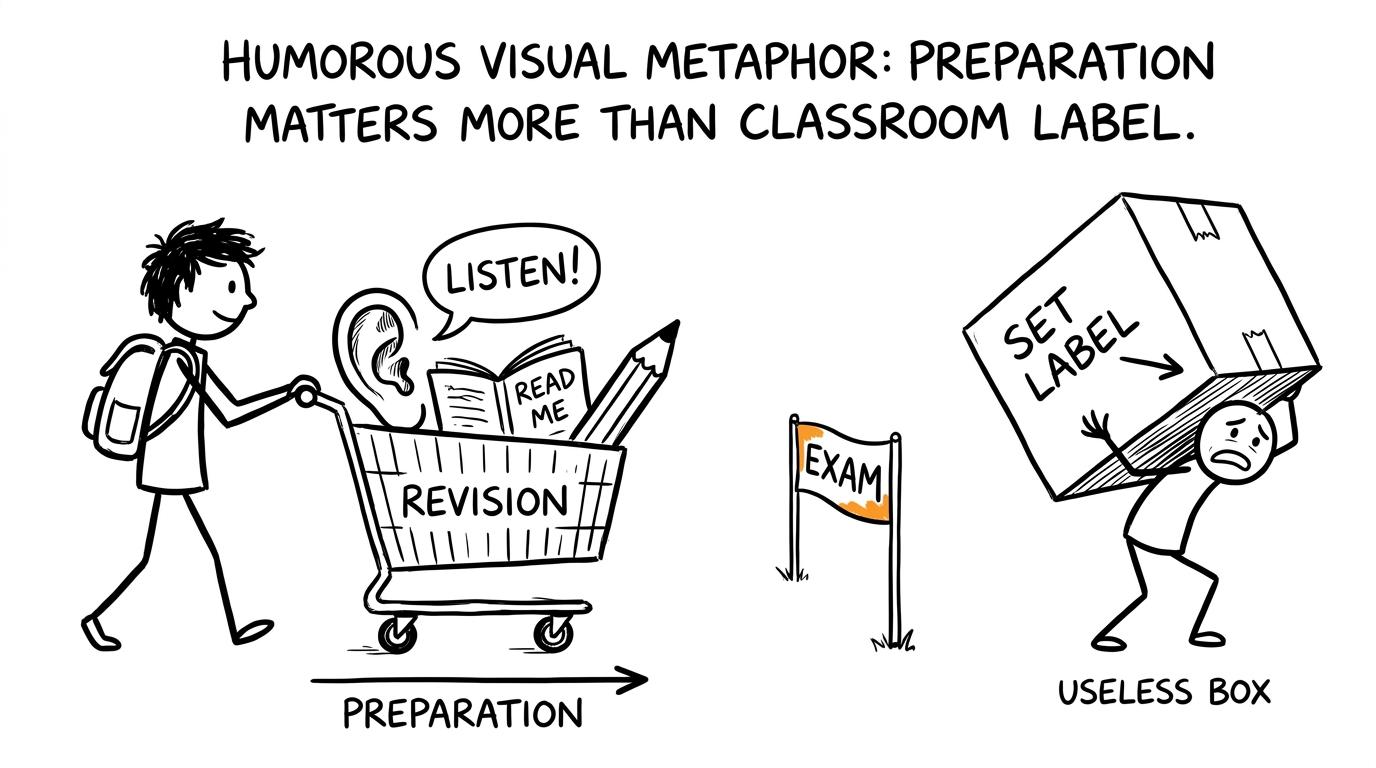 A student carrying useful revision skills while someone else struggles with a giant set label
What to do if the set change happens late
A late change feels urgent, but panic encourages poor decisions. Begin with three checks:
- Confirm your intended tier with your teacher or exams officer.
- Identify content taught by the new class that you have not covered.
- Complete a suitable assessment in realistic conditions to locate genuine gaps.
Then prioritise. Do not copy every missed page or attempt to revise the specification from the beginning. Concentrate on recurring errors and material needed for your actual tier.
Past papers are most useful when there is still time to respond to what they reveal. MathsGenie's guide to when to start GCSE past papers explains this diagnostic approach. Although the available MathsGenie papers focus on maths, the principle transfers: complete, mark, diagnose, repair and retest.
For your maths preparation alongside Arabic, use the Edexcel GCSE Maths past papers with their mark schemes and available solutions. Near the examination period, Edexcel GCSE Maths predicted papers can provide fresh exam-style practice after topic gaps have been addressed.
Common mistakes after moving sets
Treating the move as a final prediction
A set decision reflects a school's judgement at one stage of the course. It is not a grade printed in advance. Respond to the reasons for the move rather than the label.
Confusing set with tier
This is the most consequential misunderstanding. Always ask whether your formal Foundation or Higher entry has changed.
Chasing Higher without considering risk
Higher provides access to grades 666 to 999, but it is not automatically the best entry for every student. Secure, repeated evidence should guide the decision.
Revising only vocabulary lists
Vocabulary matters, but knowing a word in isolation does not guarantee that you can recognise it in speech, use it accurately or understand it in context. Connect vocabulary practice to all four assessed skills.
Using old boundaries as fixed targets
Grade boundaries vary by examination series. Use the GCSE Arabic grade boundaries collection to understand historical outcomes, not to predict the exact marks required in your own exams.
Abandoning other GCSE subjects
A set change can consume attention because it feels personal. Keep your wider revision balanced. MathsGenie's GCSE Maths topics by exam board and tier can help you maintain a clear maths checklist while you adjust your Arabic plan.
Your next step matters more than the label
Moving sets can change your classroom experience, but it does not directly decide your GCSE Arabic outcome. What matters is whether the move alters your tier, whether you understand the resulting expectations and how deliberately you respond.
Speak to your teacher. Confirm your tier. Identify the gaps. Track the four skills separately. Then build a routine that is calm enough to repeat.
For maths, make MathsGenie your free revision base: begin with revision lessons and practice questions, check understanding through mini tests, and move into past papers, predicted papers, mark schemes and video solutions when you are ready. A set tells you where the school has placed you today. Consistent, well-chosen practice shapes what you can do next.