GCSE Astronomy 3 to 5: A Practical Revision Plan
GCSE astronomy 3 to 5: improve maths, application and exam technique to turn partial answers into accurate, evidence-led responses and more marks.
A grade can feel like a label when it is really a collection of habits. A student working at grade 3 may recognise plenty of astronomy, yet lose marks through incomplete explanations, uncertain calculations and conclusions that are not tied to evidence. Moving from gcse astronomy 3 to 5 is therefore not about memorising the entire Universe. It is about becoming more reliable at the skills the examination rewards.
The practical answer is to strengthen four areas: accurate knowledge, application to unfamiliar contexts, multi-step maths and evidence-based evaluation. Then practise them using real GCSE Astronomy questions, mark every response carefully and revisit each weakness until the correction becomes automatic.
Your grade 3 to grade 5 checklist
Use this checklist to guide each week of revision:
- Replace vague statements with accurate astronomical terminology.
- Explain why something happens rather than only describing what happens.
- Practise applying familiar ideas to unfamiliar diagrams, data and observations.
- Show every stage of calculations, including substitutions and units.
- Become fluent in standard form, ratios, graphs, formulae and angular measures.
- Support conclusions with values or patterns from the information given.
- Suggest specific, workable improvements to observational methods.
- Complete timed questions and use mark schemes to diagnose lost marks.
This is not a promise of a particular grade. Grade boundaries vary between examination series and are based on the total qualification mark. It is, however, a direct way to develop the performance associated with the grade 5 descriptor.
What separates grade 3 from grade 5 in GCSE Astronomy?
Current GCSE Astronomy is the Pearson Edexcel qualification, specification code 1AS0. Unlike GCSE Maths, it is not split into foundation and higher tiers. Every candidate takes the same two papers, so progress comes from answering more of the shared paper accurately rather than moving between tiers.
Paper 1 covers Naked-eye Astronomy and Paper 2 covers Telescopic Astronomy. Each paper lasts 111 hour 454545 minutes, carries 100100100 marks and contributes 50%50\%50% of the qualification. Questions include multiple-choice items, short answers, calculations, graphical work and extended responses. A calculator and formula and data sheet are provided.
The assessment objectives reveal where grade improvement comes from:
| Assessment objective | Weighting | What better answers do |
|---|---|---|
| AO1: knowledge and understanding | 40%40\%40% | Recall accurate facts, terminology, techniques and procedures |
| AO2: application | 40%40\%40% | Use that knowledge in familiar and unfamiliar situations |
| AO3: analysis and evaluation | 20%20\%20% | Interpret evidence, judge conclusions and improve observations |
Official grade descriptors describe a grade 5 candidate as using mostly accurate knowledge and terminology, performing multi-step calculations, drawing plausible evidence-supported conclusions and suggesting improvements to observational methods. There is no permanent checklist saying that every grade 3 candidate behaves identically. In practice, grade 3 responses are more likely to be partially correct but inconsistent: knowledge is remembered without enough detail, methods stop early, and evidence is described rather than analysed.
The decisive change is reliability. A grade 5 answer does not merely know more. It does more with what it knows.
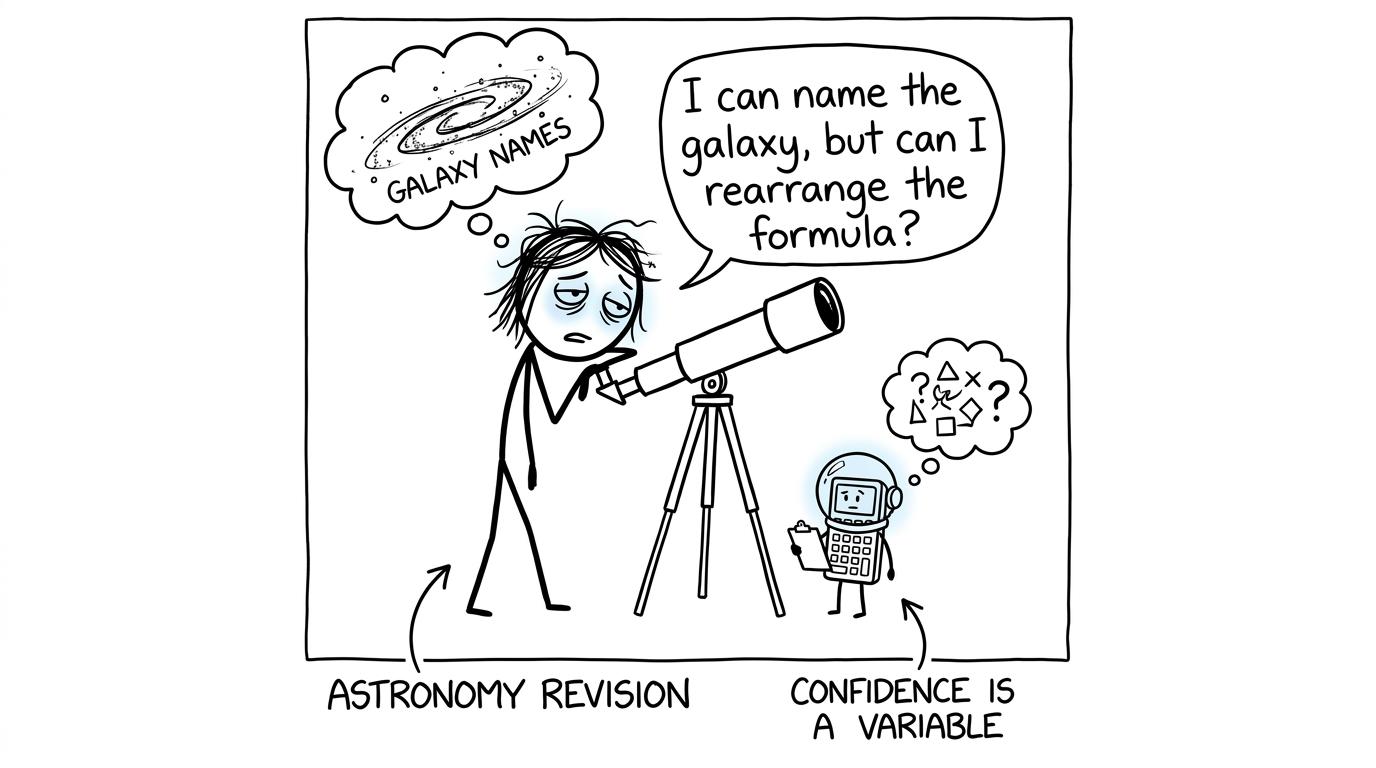 A student and an astronaut calculator consider the real challenge of astronomy revision
Turn recalled facts into complete explanations
At grade 3, a student may recognise phases, redshift, stellar evolution or telescope designs. Recognition is useful, but examination questions often ask for a relationship between ideas.
Build revision cards around three prompts:
- What is it? Give an accurate definition or fact.
- Why does it happen? State the relevant astronomical process.
- What follows from it? Connect the process to the observation or result.
Pay close attention to command words. A description states what is observed. An explanation gives a reason. An evaluation weighs evidence or limitations before reaching a judgement. Pearson examiner guidance repeatedly stresses that an answer to “explain” cannot earn full credit by merely describing, while an evaluation needs a conclusion after considering the evidence.
After revising a topic, close your notes and write a short explanation from memory. Compare it with the specification and mark scheme. Highlight missing technical terms, but do not memorise an elegant paragraph without understanding it. An unfamiliar context will quickly expose that approach.
Make GCSE Astronomy maths dependable
At least 20%20\%20% of the qualification marks reward mathematical skills in an astronomical context. This makes maths one of the clearest opportunities for moving upwards, particularly because the required techniques are defined in the specification.
They include:
- decimals and standard form;
- fractions, ratios, percentages and inverse-square relationships;
- base-101010 logarithms;
- means, significant figures and order-of-magnitude estimates;
- conversions involving kilometres, astronomical units, light years, parsecs and megaparsecs;
- substitution, rearranging formulae and solving simple equations;
- plotting and interpreting graphs, including gradient and intercept;
- degrees, minutes and seconds of arc;
- spherical coordinates, including right ascension and declination.
You do not need to recall the listed astronomical equations because the examination supplies a formula and data sheet. But a supplied formula only helps if you can choose it, rearrange it and handle its units.
Start with the standard form revision guide, then strengthen ratio skills and changing the subject of a formula. The averages revision guide supports observational data, while SOHCAHTOA revision can strengthen the underlying handling of angles and triangles.
For scientific notation and unit discipline together, use MathsGenie’s units, significant figures and standard form revision.
Use a repeatable calculation routine
For every calculation question:
- identify what the question asks you to find;
- select the relevant relationship from the formula sheet;
- convert quantities into compatible units;
- rearrange before substituting if necessary;
- show the substitution clearly;
- keep full calculator accuracy until the end;
- round only when instructed or when appropriate;
- attach the correct unit;
- estimate whether the result has a sensible scale.
This protects method marks. It also makes errors visible when you review the paper. A calculator answer with no working hides whether the problem was the formula, conversion, substitution or final rounding.
Move from describing data to using evidence
A grade 3 response may say that a graph rises. A grade 5 response identifies the trend, refers to relevant data and connects that pattern to an astronomical conclusion.
Use a simple structure:
- Pattern: state what the data show.
- Evidence: quote a relevant value, comparison or feature.
- Meaning: explain what that evidence suggests astronomically.
- Limitation: identify uncertainty where the question requires evaluation.
When reading graphs, check both axis labels, units, scales and whether either axis is logarithmic. When plotting, use the available space, choose a consistent scale and mark points accurately. If asked for a gradient, use a large triangle rather than two neighbouring points.
Observational skills are also significant: at least 15%15\%15% of the total qualification marks assess knowledge and application of observational work. Current requirements include unaided and aided observations during the course. Revision should therefore cover planning, safety, equipment, data collection, analysis and evaluation, not just the objects being observed.
A useful improvement must be specific. “Be more accurate” is not an observational method. Naming the equipment change, repeated measurement, control or timing procedure makes the suggestion testable and relevant.
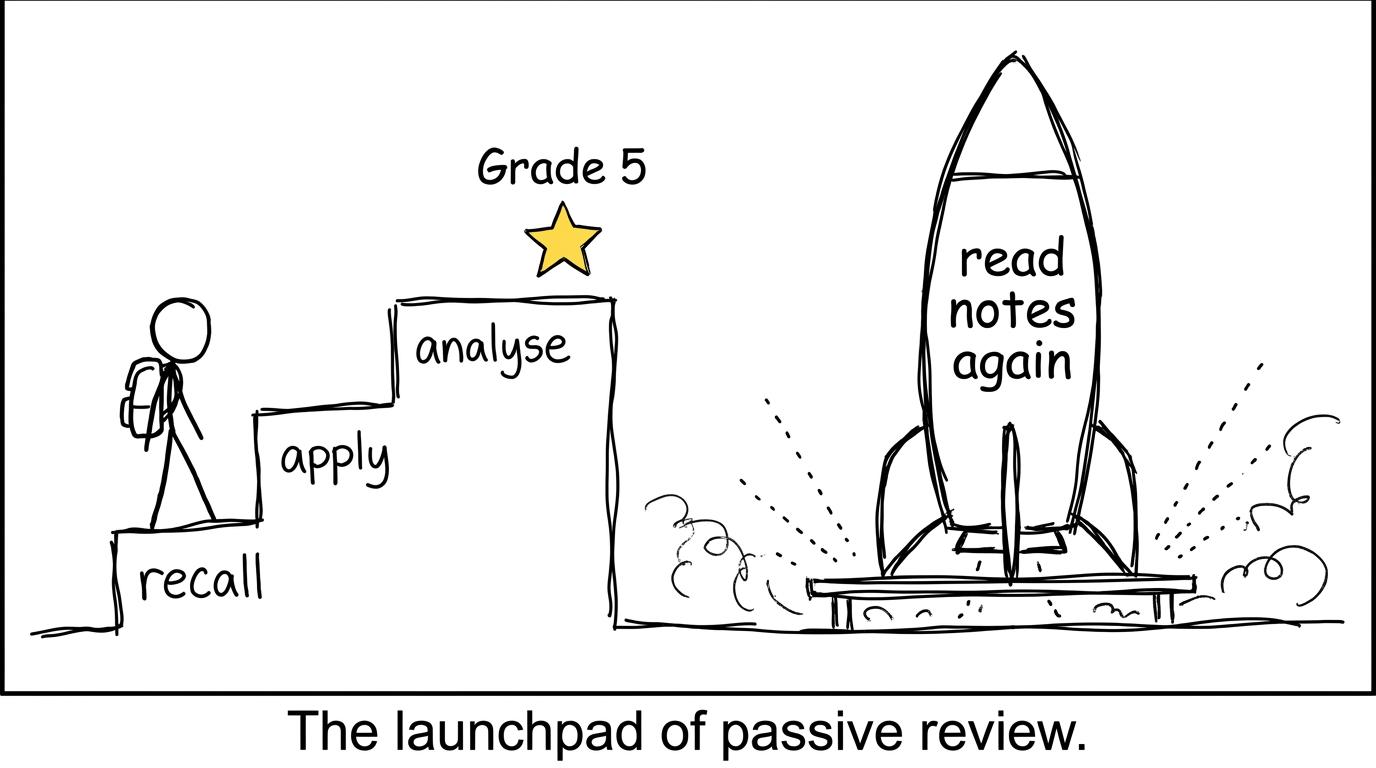 A small staircase of recall, application and analysis reaches grade 5
Use a revision cycle that changes your answers
Reading creates familiarity. Questions reveal whether that familiarity survives the exam.
Use this cycle for each topic:
Learn
Review the relevant specification statements and lesson material. Reduce the topic to definitions, processes, diagrams, observations and mathematical skills.
Retrieve
Close everything and recall the material from memory. Draw required diagrams, define terminology and outline processes without copying.
Apply
Complete examination questions in which the same knowledge appears through data, an unfamiliar observation or a comparison.
Mark and diagnose
Use the mark scheme to identify the exact reason each mark was lost. Classify it as knowledge, application, maths, evidence, command word or timing.
Re-test
Return to the question after a short gap and answer it without looking at your correction. Recognition is not proof that the weakness has been repaired.
MathsGenie’s Edexcel GCSE Maths past papers can build general calculation fluency and timed discipline. Its Edexcel predicted maths papers are useful for pressure-testing mathematical methods, although Astronomy students should use Pearson’s own current specification and Astronomy papers for subject-specific question practice.
A realistic weekly plan
A sustainable plan is better than one heroic weekend. Try four focused sessions:
- Session A: retrieve one Paper 1 topic, then answer short questions.
- Session B: practise one mathematical skill and apply it to Astronomy questions.
- Session C: retrieve one Paper 2 topic, then complete a data or explanation question.
- Session D: complete a timed mixed section, mark it and update your error log.
Every second week, include an extended response and an observational-method question. Alternate the two papers so that confidence in one half of the course does not conceal gaps in the other.
Record marks by skill as well as topic. If several different topics produce lost marks because units were omitted, the real weakness is not astronomy knowledge. It is unit discipline. One targeted correction can then improve many parts of both papers.
Common mistakes that keep students at grade 3
Revising only facts
AO2 carries the same weighting as AO1. Knowing a definition without practising its application leaves a large part of the assessment untouched.
Treating command words as interchangeable
“Describe”, “explain”, “compare” and “evaluate” demand different responses. Underline the command word before answering.
Writing unsupported conclusions
A plausible claim may still lose marks if the question supplies data and you never use them. Refer to a relevant value, trend or comparison.
Hiding all calculator work
Write the formula, substitution and intermediate steps. This makes method marks available even if the final number is wrong.
Mixing units
Convert before calculating and write units beside quantities. Distance units in Astronomy vary enormously, so guessing from the final number is unsafe.
Rounding too early
Keep the full calculator value through intermediate stages. Premature rounding can distort the final answer, especially in multi-step calculations.
Giving vague improvements
“Repeat it” is incomplete unless you explain that repeated measurements can be used to identify anomalies or calculate a more representative mean.
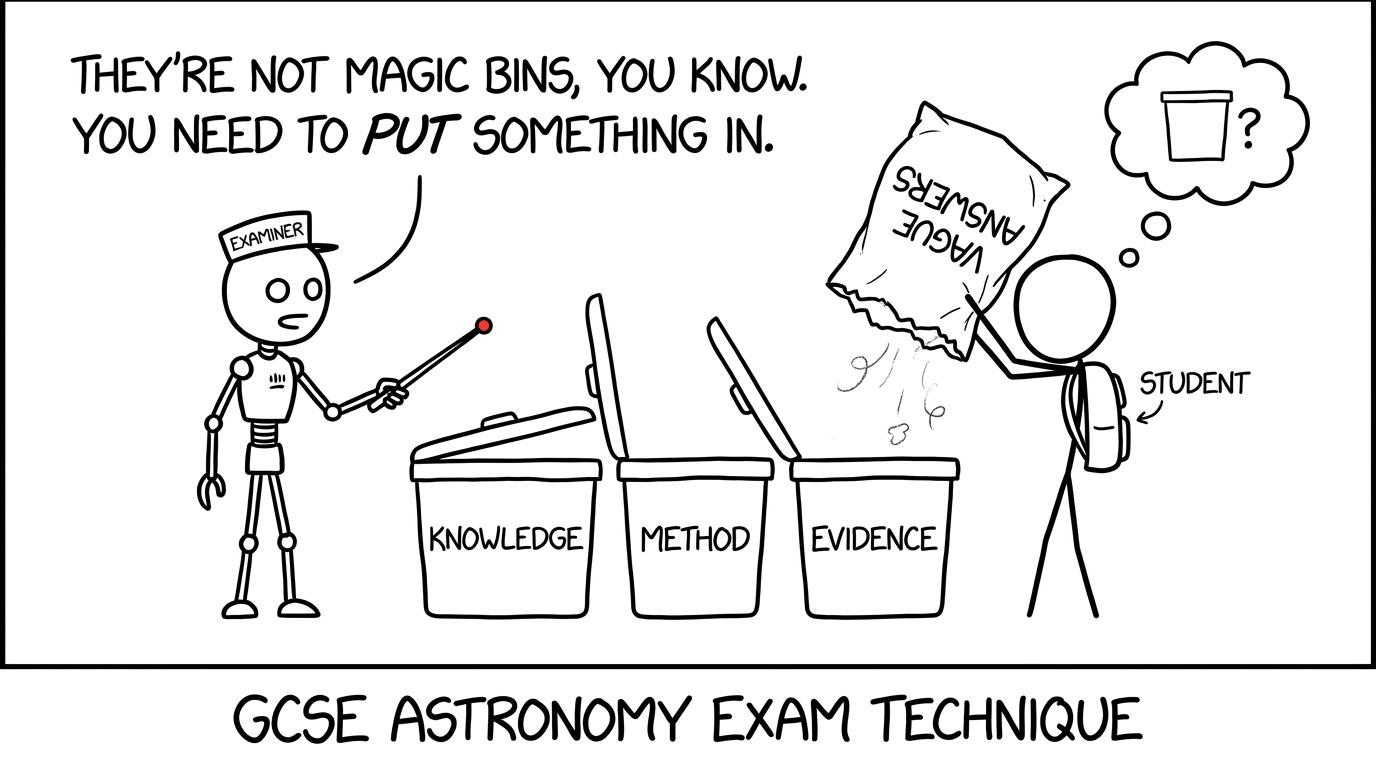 A robot examiner sorts useful marks while vague answers produce an empty bag
Build the next grade one correction at a time
The journey from grade 3 to grade 5 is rarely one dramatic breakthrough. It is a series of smaller changes: one explanation with a genuine reason, one calculation with units, one graph interpreted with evidence and one observation improved specifically.
Begin with your latest marked Astronomy paper. Find the three most common causes of lost marks and choose one mathematical weakness to repair. Use MathsGenie’s free revision resources for clear lessons, practice questions and video-supported methods, then test those skills through the relevant topic pages, mini tests, past papers and predicted maths papers. Return to official Edexcel Astronomy questions for the final subject-specific check.
Do not aim to feel ready before answering questions. Answer questions so that you become ready. That is how knowledge turns into method, method turns into evidence, and a grade boundary stops looking like a wall.