Unit prefixes
Definition
Unit prefix
A unit prefix is a symbol placed before a unit to show that the unit has been multiplied by a power of ten, such as kilo for one thousand or milli for one thousandth.
- Giga, symbol G\text{G}G, means ×109\times 10^{9}×109, so 1 GW=1×10⁹ W1\ \text{GW}=1\times10^{9}\ \text{W}1 GW=1×10⁹ W.
- Mega, symbol M\text{M}M, means ×106\times 10^{6}×106, so 1 MJ=1×10⁶ J1\ \text{MJ}=1\times10^{6}\ \text{J}1 MJ=1×10⁶ J.
- Kilo, symbol k\text{k}k, means ×103\times 10^{3}×103, so 1 km=1×10³ m1\ \text{km}=1\times10^{3}\ \text{m}1 km=1×10³ m.
- Centi, symbol c\text{c}c, means ×10−2\times 10^{-2}×10−2, so 1 cm=1×10⁻² m1\ \text{cm}=1\times10^{-2}\ \text{m}1 cm=1×10⁻² m.
- Milli, symbol m\text{m}m, means ×10−3\times 10^{-3}×10−3, so 1 mA=1×10⁻³ A1\ \text{mA}=1\times10^{-3}\ \text{A}1 mA=1×10⁻³ A.
- Micro, symbol μ\muμ, means ×10−6\times 10^{-6}×10−6, so 1 μC=1×10⁻⁶ C1\ \mu\text{C}=1\times10^{-6}\ \text{C}1 μC=1×10⁻⁶ C.
- Nano, symbol n\text{n}n, means ×10−9\times 10^{-9}×10−9, so 1 nm=1×10⁻⁹ m1\ \text{nm}=1\times10^{-9}\ \text{m}1 nm=1×10⁻⁹ m.
- To remove a prefix, multiply the numerical value by the prefix factor, and to introduce a prefix, divide by that factor.
Example
- A current of 850 mA850\ \text{mA}850 mA is converted using milli =10−3=10^{-3}=10−3.
- 850 mA=850×10−3 A=0.850 A850\ \text{mA}=850\times10^{-3}\ \text{A}=0.850\ \text{A}850 mA=850×10−3 A=0.850 A.
- A power of 2.4×10⁶ W2.4\times10^{6}\ \text{W}2.4×10⁶ W is converted using mega =106=10^{6}=106.
- 2.4×10⁶ W=2.4 MW2.4\times10^{6}\ \text{W}=2.4\ \text{MW}2.4×10⁶ W=2.4 MW.
Converting units
Definition
Unit conversion
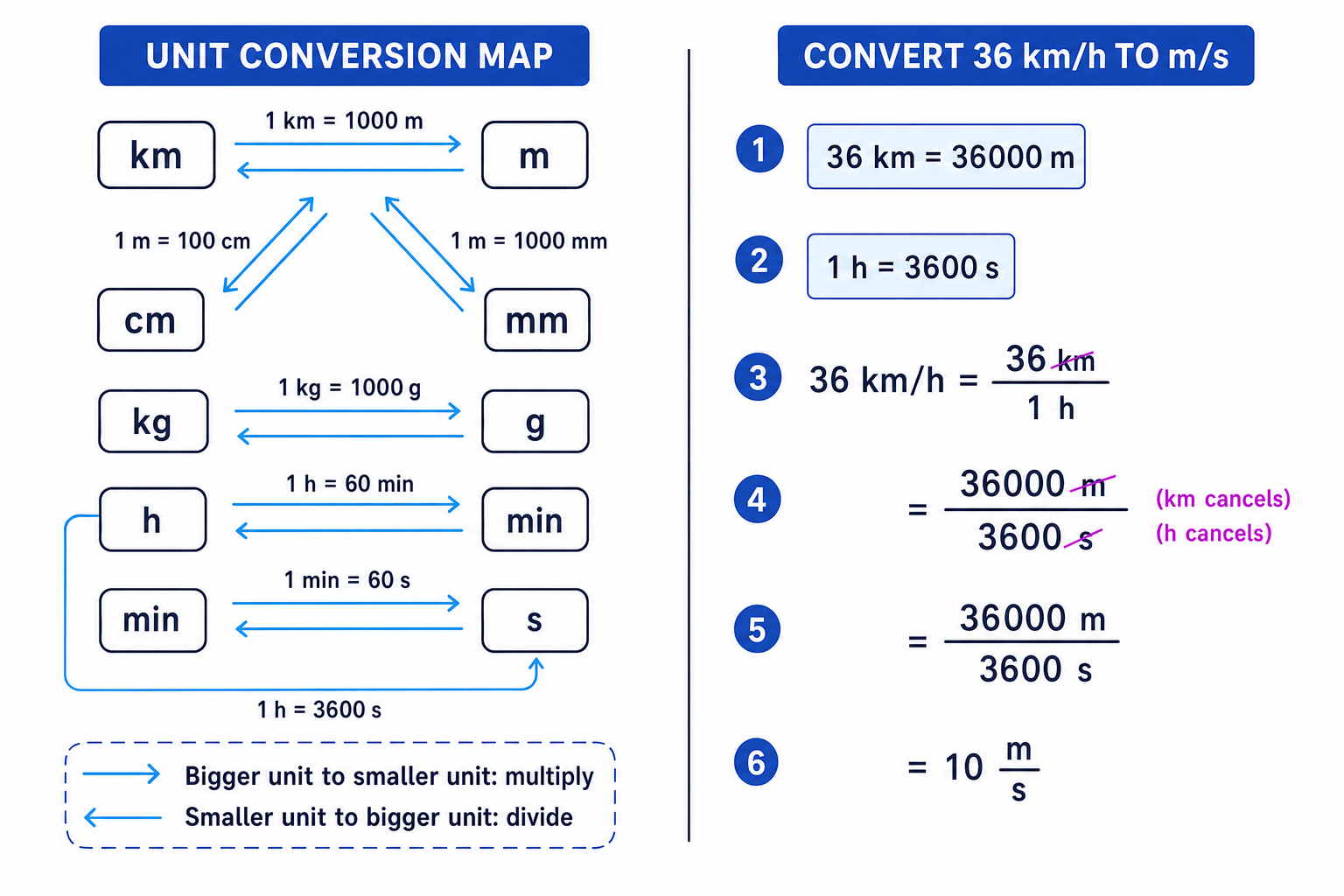
A unit conversion changes the unit used to express a quantity without changing the physical quantity itself.
- Convert values to the units required by the equation before substitution, because a correct equation with inconsistent units gives an incorrect number.
- 1 minute=60 s1\ \text{minute}=60\ \text{s}1 minute=60 s and 1 hour=3600 s1\ \text{hour}=3600\ \text{s}1 hour=3600 s.
- Convert hours to seconds by multiplying by 360036003600, and convert seconds to hours by dividing by 360036003600.
- 1 m=100 cm=1000 mm1\ \text{m}=100\ \text{cm}=1000\ \text{mm}1 m=100 cm=1000 mm.
- 1 kg=1000 g1\ \text{kg}=1000\ \text{g}1 kg=1000 g, so grams are converted to kilograms by dividing by 100010001000.
- Converting to a smaller unit gives a larger numerical value, while converting to a larger unit gives a smaller numerical value.
Converting compound units
- A compound unit contains more than one unit, so every part of the unit must be converted.
- For speed, 1 km/h=1000 m3600 s=13.6 m/s1\ \text{km/h}=\dfrac{1000\ \text{m}}{3600\ \text{s}}=\dfrac{1}{3.6}\ \text{m/s}1 km/h=3600 s1000 m=3.61 m/s.
- Convert kilometres per hour to metres per second by dividing by 3.63.63.6, and convert metres per second to kilometres per hour by multiplying by 3.63.63.6.
- For squared and cubed units, the conversion factor must also be squared or cubed, so 1 cm2=(10−2 m)2=10−4 m21\ \text{cm}^{2}=(10^{-2}\ \text{m})^{2}=10^{-4}\ \text{m}^{2}1 cm2=(10−2 m)2=10−4 m2.
- Likewise, 1 cm3=(10−2 m)3=10−6 m31\ \text{cm}^{3}=(10^{-2}\ \text{m})^{3}=10^{-6}\ \text{m}^{3}1 cm3=(10−2 m)3=10−6 m3.
Example
- A journey time of 1.75 h1.75\ \text{h}1.75 h is converted by multiplying by 360036003600.
- t=1.75×3600=6300 st=1.75\times3600=6300\ \text{s}t=1.75×3600=6300 s.
- A speed of 126 km/h126\ \text{km/h}126 km/h is converted by dividing by 3.63.63.6.
- v=126÷3.6=35.0 m/sv=126\div3.6=35.0\ \text{m/s}v=126÷3.6=35.0 m/s.
Standard form
Definition
Standard form
Standard form writes a number as A multiplied by ten to the power n, where A is between 1 and 10 and n is an integer.
- Move the decimal point until exactly one non-zero digit remains before it, then use the number of places moved as the magnitude of the power.
- A large number has a positive power, such as 6 500 000=6.5×1066\,500\,000=6.5\times10^{6}6500000=6.5×10⁶.
- A number between zero and one has a negative power, such as 0.000 000 45=4.5×10−70.000\,000\,45=4.5\times10^{-7}0.00000045=4.5×10⁻⁷.
- When multiplying standard-form values, multiply the leading numbers and add the powers, then rewrite the result so the leading number lies between 111 and 101010.
- When dividing standard-form values, divide the leading numbers and subtract the powers, then normalise the result.
Example
- (3.0×10⁸)(2.0×10⁻⁶)=(3.0×2.0)×108−6(3.0\times10^{8})(2.0\times10^{-6})=(3.0\times2.0)\times10^{8-6}(3.0×10⁸)(2.0×10⁻⁶)=(3.0×2.0)×108−6.
- The result is 6.0×1026.0\times10^{2}6.0×10².
- 8.4×1072.0×103=8.42.0×107−3\dfrac{8.4\times10^{7}}{2.0\times10^{3}}=\dfrac{8.4}{2.0}\times10^{7-3}2.0×1038.4×107=2.08.4×107−3.
- The result is 4.2×1044.2\times10^{4}4.2×10⁴.
Significant figures
Definition
Significant figures
Significant figures are the digits in a number that show its measured precision, starting from the first non-zero digit.
- All non-zero digits are significant, and zeros between significant digits are also significant.
- Zeros before the first non-zero digit are not significant, so 0.004560.004560.00456 has three significant figures.
- Trailing zeros after a decimal point are significant, so 2.502.502.50 has three significant figures.
- To round to a stated number of significant figures, keep the required digits and inspect the next digit.
- If the next digit is 555 or more, increase the last retained digit by one, and if it is below 555, leave the last retained digit unchanged.
- Keep unrounded calculator values during working and round only the final answer.
Example
- The value 0.0078640.0078640.007864 rounded to three significant figures keeps 777, 888 and 666.
- The next digit is 444, so the rounded value is 0.007860.007860.00786.
- The value 58 74658\,74658746 rounded to three significant figures keeps 555, 888 and 777.
- The next digit is 444, so the rounded value is 58 70058\,70058700, or 5.87×1045.87\times10^{4}5.87×10⁴.
Example
- A train moves at 126 km/h126\ \text{km/h}126 km/h for 1 h 45 min1\ \text{h}\ 45\ \text{min}1 h 45 min.
- Convert the speed: 126÷3.6=35.0 m/s126\div3.6=35.0\ \text{m/s}126÷3.6=35.0 m/s.
- Convert the time: (1×3600)+(45×60)=6300 s(1\times3600)+(45\times60)=6300\ \text{s}(1×3600)+(45×60)=6300 s.
- Use d=vtd=vtd=vt to obtain d=35.0×6300=220 500 md=35.0\times6300=220\,500\ \text{m}d=35.0×6300=220500 m.
- Write the result in standard form and round to three significant figures: d=2.21×10⁵ md=2.21\times10^{5}\ \text{m}d=2.21×10⁵ m.
Common Mistake
- Do not confuse lower-case m\text{m}m for milli with upper-case M\text{M}M for mega.
- Do not treat significant figures as decimal places, because 0.004560.004560.00456 to two significant figures is 0.00460.00460.0046.
- Do not convert cm2\text{cm}^{2}cm2 or cm3\text{cm}^{3}cm3 using only the linear factor.
- Do not round intermediate calculator values, because early rounding can change the final answer.
Exam technique
- Write each conversion on a separate line before substitution so that the method remains clear if later arithmetic is incorrect.
- Check the requested output unit before calculating, because the final conversion may carry a separate mark.
- Give the answer to the stated number of significant figures, or use the precision of the supplied data when the question asks for an appropriate value.
- Include the final unit and use the expected size of the answer as a conversion check.
Self review
- What powers of ten correspond to giga, mega, kilo, centi, milli, micro and nano?
- How are kilometres per hour converted to metres per second?
- What conditions must AAA and nnn satisfy in standard form?
- Which zeros count as significant figures?
- Why should rounding be left until the final line?