

GCSE Art and Design vs Media Studies for Sixth Form
GCSE art and design vs media studies sixth form choices explained: learn what admissions teams value, compare workloads and choose confidently.
Choosing a GCSE can feel strangely permanent. A subject selected in Year 999 appears on an application years later, and it is easy to imagine a sixth-form admissions team silently ranking every choice.
Here is the direct answer to GCSE art and design vs media studies sixth form concerns: neither subject automatically looks better. Sixth forms generally care more about your overall grades, whether you meet their general and subject-specific entry requirements, and whether your choices prepare you for the course you want to take.
Art may be more useful if you intend to study A Level Art, Photography, Textiles or another visual subject. Media Studies may support A Level Media or Film Studies, although many sixth forms also accept students using an English grade. The precise rule varies, so the published entry requirements of your intended sixth form matter more than either subject's reputation.
The short decision checklist
Before choosing, ask:
- Which subject are you more likely to enjoy and complete consistently?
- Are you comfortable managing a substantial practical portfolio?
- Do you prefer visual experimentation or written analysis?
- Which A Level or Level 333 courses might you consider?
- Does your preferred sixth form require GCSE Art for A Level Art?
- What grades does it require in English and maths?
- Will the subject's workload leave enough time for your core GCSEs?
That final question deserves attention. English and maths frequently appear in general sixth-form entry criteria, while particular A Levels may demand higher subject grades. Protecting your performance in these core qualifications is often more valuable than choosing an optional GCSE because it supposedly looks impressive.
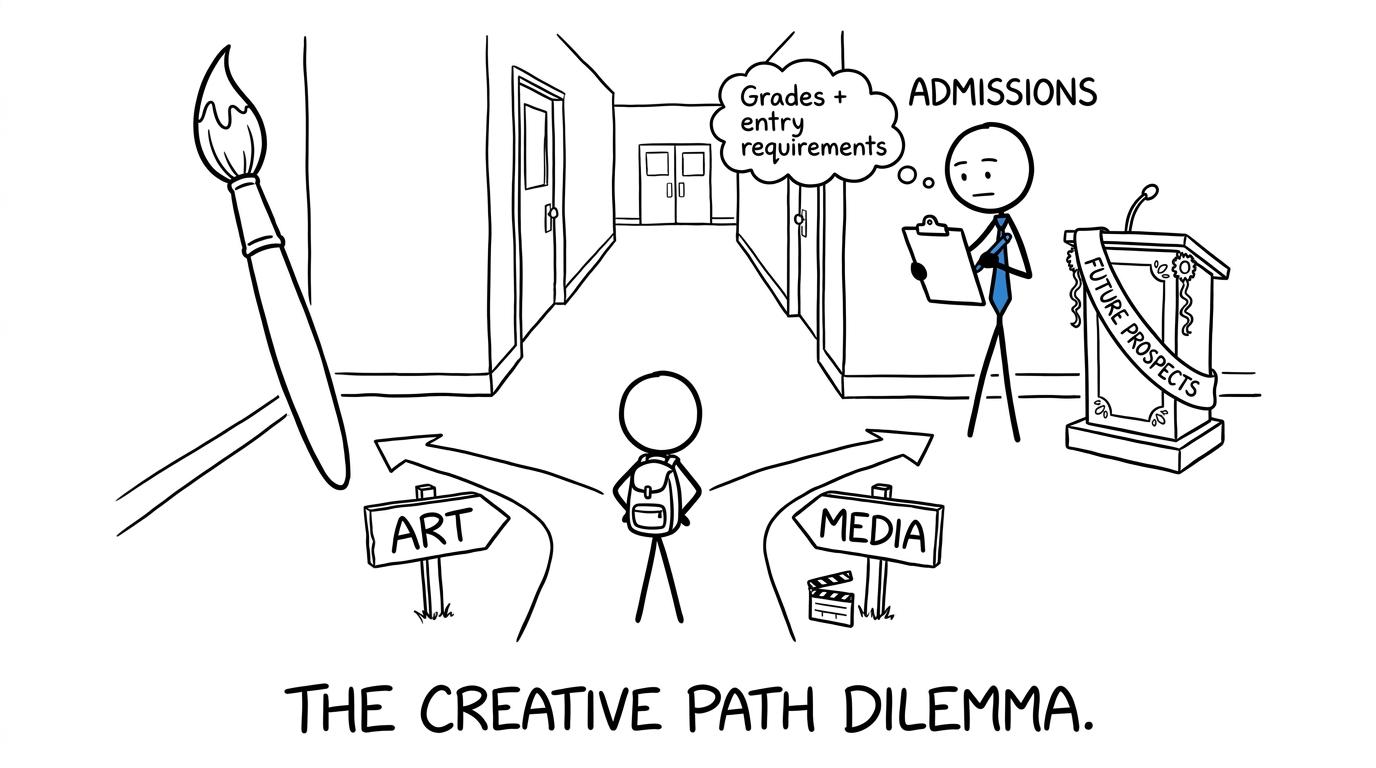 A student discovers that sixth-form admissions is not a GCSE beauty contest
Do sixth forms favour GCSE Art or Media Studies?
There is no universal preference. Current published entry criteria for sixth forms illustrate three important patterns.
First, general admission is usually based on a group of GCSE results. In the policies reviewed for this article, requirements commonly included several passes at grades 444 or 555 and specified grades in English and maths. Requirements vary between institutions, however, and selective sixth forms may set considerably higher thresholds.
Second, subject-specific rules matter. Some sixth forms require GCSE Art at grade 555, 666 or 777 for A Level Art. Others consider applicants without it if they present a suitable portfolio. This makes Art potentially important for a visual-arts pathway, but not automatically more valuable for admission as a whole.
Third, A Level Media Studies is often more flexible. Current entry policies include examples where GCSE Media is accepted if taken, but applicants without it can qualify through English Language or English Literature. Other schools ask for grades in written subjects. Again, this is not a national rule.
The sensible conclusion is simple: sixth forms favour evidence that you can succeed on your intended programme, not one optional GCSE in isolation.
How the two GCSEs differ
Art and Media are both creative subjects, but they ask students to demonstrate creativity differently. Their names conceal very different weekly routines.
| GCSE Art and Design | GCSE Media Studies |
|---|---|
| Develops ideas through visual investigation | Studies how media communicates meanings |
| Requires experimentation, refinement and recording | Requires analysis of media language and representation |
| Produces a sustained portfolio of practical work | Combines written examinations with a creative production task |
| Suits students who enjoy making and improving work over time | Suits students who enjoy analysing texts, audiences and industries |
| Can directly support applications for visual A Levels | Can support Media, Film, English and communication-related courses |
What GCSE Art and Design involves
Exact arrangements depend on the exam board and specification. Under the current AQA structure, the portfolio contributes 60%60\%60% and the externally set assignment contributes 40%40\%40%. The assignment includes preparation followed by 101010 hours of supervised work.
Students are assessed on developing ideas, refining work, recording observations and presenting a personal response. Art is therefore not simply about producing an attractive final piece. The journey, experimentation and evidence behind it matter.
This can reward independence and persistence. It can also create pressure if work is repeatedly postponed. A portfolio grows page by page; it is difficult to repair an entire term of inconsistent work in one evening.
What GCSE Media Studies involves
Media Studies includes analytical and practical work. In the current AQA specification, two written examinations are each worth 35%35\%35%, with non-exam assessment worth the remaining 30%30\%30%.
The course covers media language, representations, industries and audiences. Students may examine forms such as advertising, newspapers, television, radio, magazines, online media and video games, depending on their specification and set products.
The creative element matters, but Media Studies is not merely making videos or designing posters. Strong written explanations, accurate terminology and the ability to analyse unfamiliar material are central to success.
Which subject looks stronger for different sixth-form plans?
If you want to take A Level Art
GCSE Art is usually the safer choice. Some sixth forms explicitly require a particular grade in Art; others allow portfolio entry. Without the GCSE, you may need to prove your practical experience separately, and some providers may not offer that route.
Check whether the course is Fine Art, Art, Craft and Design, Photography, Graphic Communication or Textiles. Similar titles do not guarantee identical entry conditions.
If you want to take A Level Media Studies
GCSE Media can provide helpful background and demonstrate sustained interest. It is not always essential, however. Many published entry criteria allow students to qualify through English grades when GCSE Media was unavailable or not taken.
Media may therefore be useful preparation without being a compulsory gateway. Read the actual course page rather than assuming continuity from GCSE is required.
If you want to take A Level Maths or sciences
Neither option usually has a direct admissions advantage. Your GCSE Maths grade, science results and the provider's subject requirements will carry much more weight.
That makes the workload question important. Choose the optional subject in which you can work steadily without allowing maths revision to disappear beneath portfolio deadlines or unfinished media production.
The GCSE Maths revision hub lets you organise revision by board and topic. If you are unsure what your specification contains, the GCSE maths topics by exam board and tier guide provides a clearer map for Edexcel, AQA, OCR and Eduqas students.
If you do not know your future A Levels
Choose based on fit rather than imagined prestige. A strong grade in a subject you can sustain is generally more useful than a weak grade in one selected to impress an unknown reader.
Keep your broader curriculum in mind. English, maths, science, humanities and languages can preserve different routes, while creative subjects add valuable breadth. Art and Media are full GCSE qualifications, but neither replaces a provider's specific requirement for another subject.
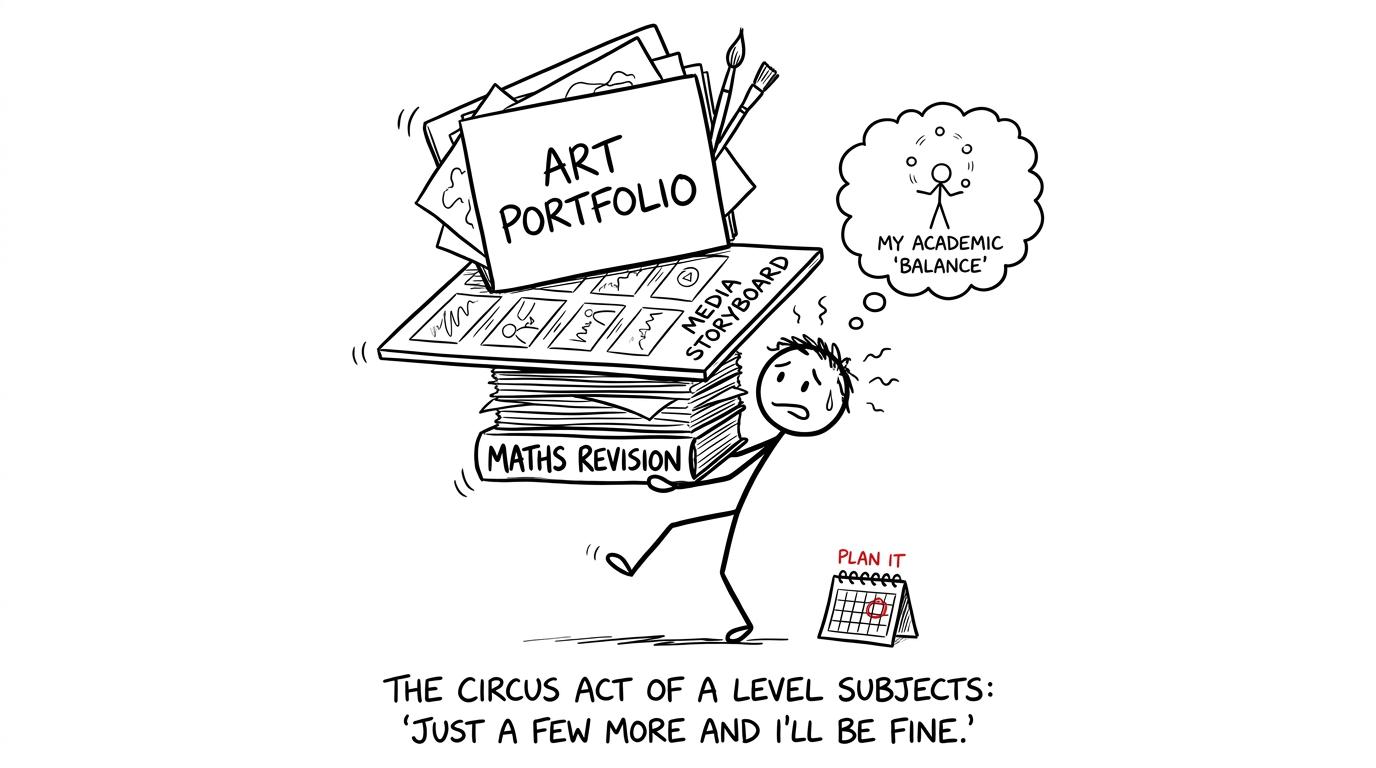 A student balances creative GCSE work with a stack of maths revision
Compare the workload honestly
The best subject is not simply the one that sounds interesting at an options evening. It is the one whose ordinary work you can tolerate on an ordinary Tuesday.
Choose Art cautiously if you enjoy finished artwork but dislike documenting development, annotating decisions or refining ideas. Those processes are part of the assessed course.
Choose Media cautiously if you enjoy films and social media but dislike extended writing, close analysis or learning subject terminology. Being a media consumer is different from studying media critically.
Ask current teachers about:
- the exam board used by your school;
- the balance of lessons, homework and independent work;
- the equipment or software available;
- how deadlines are staged;
- the examination and non-exam assessment structure;
- examples of work at different grades.
Then place that workload beside maths, English, science and your other options. Maths revision becomes much easier when it has a protected place in the week. MathsGenie's GCSE maths revision timetable can help you build a realistic routine, while the one-month GCSE maths plan is useful closer to the examination period.
What admissions teams are more likely to notice
An application is a collection of signals. The optional subject title is only one small piece.
Admissions decisions may consider:
- whether you meet the sixth form's overall GCSE threshold;
- whether you meet each A Level's subject-specific requirements;
- your achieved or predicted grades, depending on the application stage;
- the suitability of your proposed subject combination;
- a portfolio, audition or other evidence where required;
- any published admissions criteria used when courses are oversubscribed.
You should never assume that predicted grades guarantee entry. Offers are often conditional on achieved GCSE results, and policies can change between admission cycles. Check the current prospectus and admissions policy, then ask the sixth form directly if the wording is unclear.
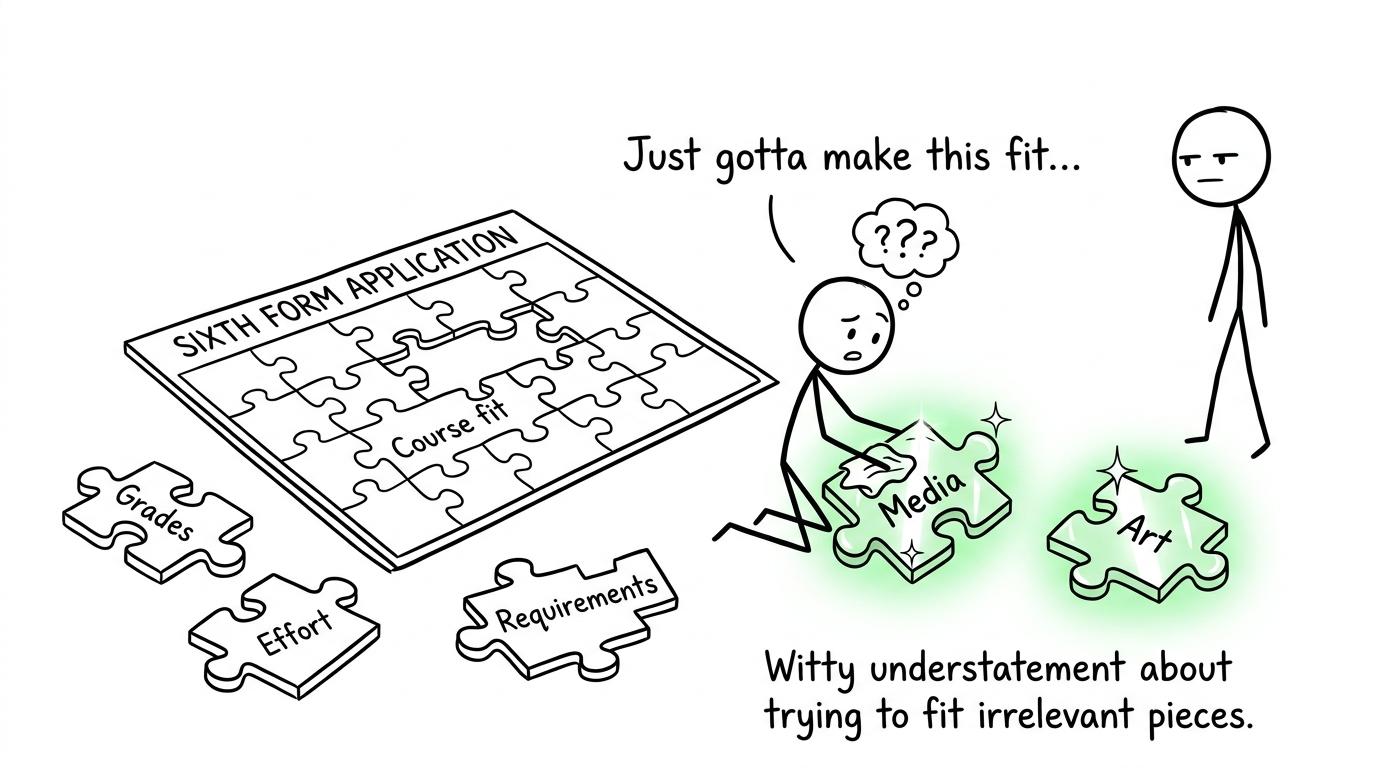 Art and Media appear as equal pieces in a larger application puzzle
Common mistakes when choosing between Art and Media
Choosing the subject that supposedly looks more academic
There is no reliable national hierarchy placing one above the other for sixth-form admission. Course relevance, entry requirements and grades are more useful guides than playground reputation.
Ignoring subject-specific entry requirements
A general offer from a sixth form does not necessarily mean entry to every A Level. Art, maths, sciences and languages may have separate grade requirements. Read both the general admissions policy and individual course criteria.
Underestimating non-exam assessment
Both subjects involve assessed work outside traditional written examinations. Deadlines can overlap with mocks and maths preparation. Plan for that before the pressure arrives.
Picking Art because there is no written exam
Art still requires analysis, annotation, research, development and disciplined evidence. Its assessment may be practical, but it is not effortless.
Picking Media because you enjoy entertainment
The course examines how media products create meaning and operate within industries. It requires critical thinking and structured writing, not just enthusiasm for films or online content.
Letting an optional GCSE weaken core grades
Many sixth forms specify minimum English and maths grades. Keep those subjects visible in your weekly plan. Use active recall for GCSE maths, then move into GCSE past-paper practice instead of relying on rereading.
Make the decision with evidence, not anxiety
Neither GCSE Art and Design nor GCSE Media Studies wins automatically on a sixth-form application. Art has the clearest advantage when it is required for a visual A Level or helps you build a relevant portfolio. Media can be valuable preparation for Media or Film Studies, but many providers also admit students through strong English results.
Compare your likely sixth forms, read their current entry requirements and choose the subject whose work matches your strengths. Then protect the qualifications that appear repeatedly in admissions criteria.
MathsGenie gives you a free place to do that. Start with revision lessons and practice questions, use mini tests to identify gaps, and build towards mark schemes, video solutions and Edexcel GCSE Maths past papers. Nearer the exams, add GCSE predicted papers for fresh practice.
A thoughtful option choice opens one door. Consistent revision keeps the rest open.











