

GCSE Arabic vs Modern Hebrew: What Employers Notice
GCSE Arabic vs Modern Hebrew employers: discover what colleges and recruiters value, how to choose well, and protect your essential maths revision time too.
Choosing a GCSE can feel strangely permanent. A subject name sits on an application for years, so it is natural to wonder whether one language will look more impressive than another. The search phrase gcse arabic vs modern hebrew employers hides a straightforward concern: which qualification will create better opportunities?
The short answer is that most employers and colleges do not automatically prefer GCSE Arabic or GCSE Modern Hebrew. They are more likely to notice the grade achieved, the communication skills behind it and its relevance to the opportunity. Arabic may be useful in one workplace; Modern Hebrew may be useful in another. Neither subject title guarantees an advantage by itself.
For many applications, GCSE English and maths are also more likely to be explicit requirements. Your language choice matters, but it should not quietly consume the revision time needed for these essential subjects.
The quick decision checklist
Before choosing between the two qualifications, ask:
- Which language can you understand, speak, read and write most confidently?
- Which course and exam entry can your school or examination centre genuinely support?
- In which subject are you most likely to earn the stronger grade?
- Does either language connect directly to your family, community or future plans?
- Are you interested enough to continue developing the language after GCSE?
- Can you prepare without weakening your maths and English results?
If one language produces clearer answers to most of those questions, it is probably the better choice. Prestige is a poor substitute for evidence.
What employers actually notice
An employer reading an early-career application usually has several questions before reaching the finer details of an optional GCSE. Does the applicant meet the stated requirements? Can they communicate clearly? Have they shown reliability, initiative and the ability to learn?
For apprenticeships and many entry-level roles, English and maths commonly appear in entry requirements. The exact conditions vary by employer and programme, but those two subjects often act as practical filters. That makes a secure maths result more immediately important than trying to predict which language name sounds more distinctive.
A good grade in Arabic or Modern Hebrew can still strengthen the overall picture. It may suggest sustained effort, listening skills, cultural awareness and an ability to handle unfamiliar structures. Yet a recruiter should not assume that one GCSE proves professional fluency. If the role genuinely requires language skills, the employer may ask about your current ability or assess it directly.
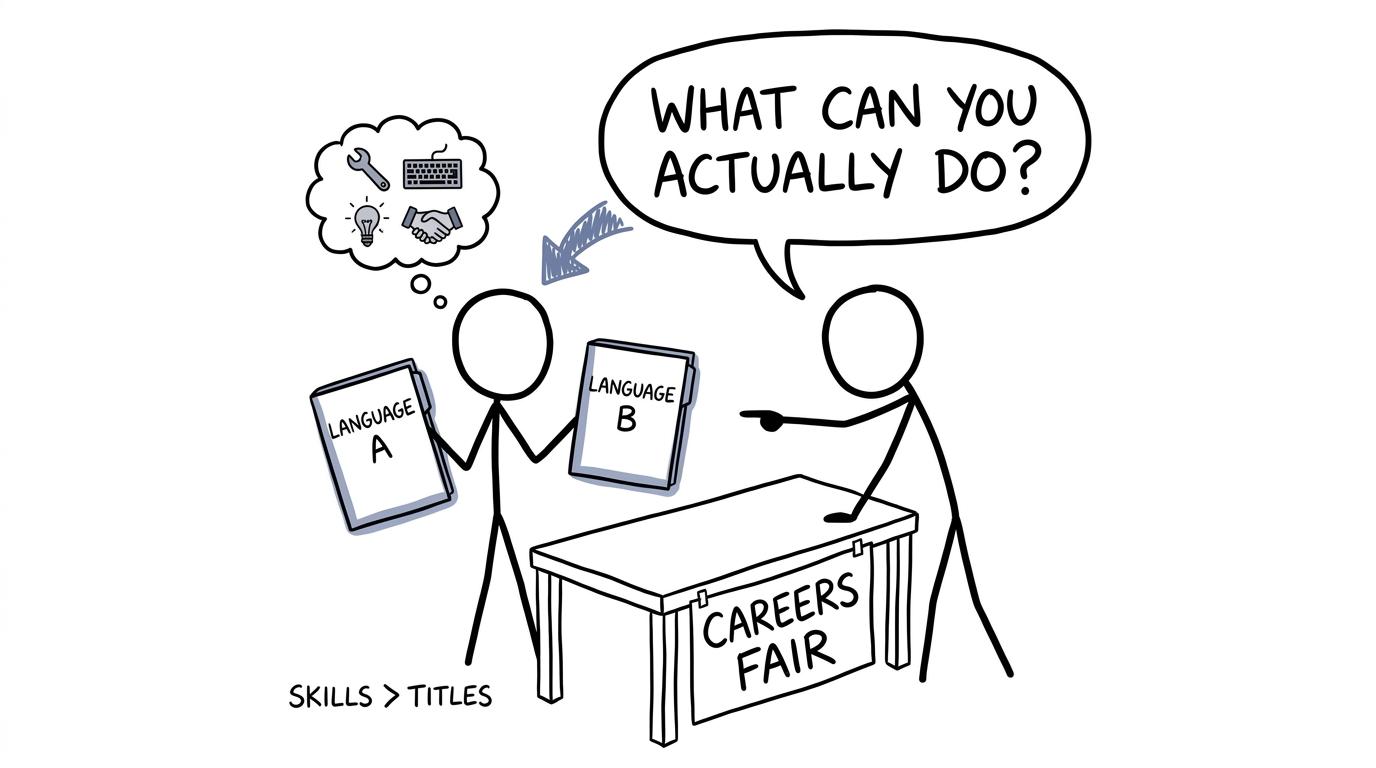 An employer asking what a student can actually do rather than judging two language labels
When Arabic could be particularly relevant
Arabic may attract closer attention where an organisation works with Arabic-speaking customers, communities or international partners. Possible contexts include public services, education, travel, international business and community-facing work.
However, relevance depends on the actual role. Arabic includes different regional varieties, while a GCSE qualification has a defined syllabus and assessment standard. A careful applicant describes their ability honestly rather than presenting a GCSE as proof that they can work professionally in every Arabic-speaking setting.
When Modern Hebrew could be particularly relevant
Modern Hebrew may be directly relevant in organisations serving Hebrew-speaking communities or working with contacts where the language is used. It can also support an application connected to language study, education, cultural work or particular international settings.
Again, context matters more than rarity. A less commonly listed qualification may prompt a conversation, but being unusual is not the same as being preferred. The useful question is not, “Will this stand out?” It is, “Can I explain why this skill matters here?”
Do colleges care which language you take?
Most sixth forms and colleges concentrate on whether you meet their overall GCSE grade profile and the requirements for your intended post-161616 subjects. If you want to take A Level maths, for example, the required GCSE maths grade will usually matter far more than whether your language GCSE is Arabic or Modern Hebrew.
Requirements vary, so check each provider rather than relying on a general rule. A language department may also want evidence that your GCSE prepares you for its particular A Level course.
Universities and higher education colleges set their own entry requirements too. GCSE English and maths are commonly considered, while Level 333 qualifications such as A Levels normally carry greater weight in course offers. Some competitive courses examine the wider GCSE profile more closely, but there is no general admissions rule placing Arabic above Modern Hebrew or the reverse.
Your language GCSE may become more relevant when it supports a coherent future direction. An applicant interested in languages, linguistics, regional studies or international work can use it as one strand of a broader academic story. The story still needs substance: a strong result, continued learning and an informed reason for choosing the subject.
How the two GCSE qualifications compare
At the time of writing, Pearson Edexcel offers GCSE Arabic and AQA offers GCSE Modern Hebrew. Both are regulated GCSE qualifications graded from 999 to 111 and assess the four central language skills. Students are entered for foundation or higher tier across the qualification according to the relevant specification and examination arrangements.
| Feature | GCSE Arabic | GCSE Modern Hebrew |
|---|---|---|
| Current exam board | Pearson Edexcel | AQA |
| Qualification code | 1AA01\mathrm{AA}01AA0 | 867886788678 |
| Main skills | Listening, speaking, reading and writing | Listening, speaking, reading and writing |
| Tiers | Foundation and higher | Foundation and higher |
| General employer status | A recognised GCSE language qualification | A recognised GCSE language qualification |
| Best reason to choose it | Stronger ability, support or genuine relevance | Stronger ability, support or genuine relevance |
This comparison reveals the central point. Both qualifications require real language performance. The stronger application normally comes from doing well and being able to discuss the skill convincingly, not from choosing a label in the hope that it carries hidden status.
Choose the language that produces the strongest evidence
Suppose you have substantial experience using one language at home or in your community. That knowledge may make the qualification a sensible way to validate an existing skill, although you must still prepare for the specification and exam technique. Familiar conversation does not automatically cover formal writing, translation, reading accuracy or timed assessment.
If you are beginning both languages from a similar position, consider the teaching available. A reliable teacher, speaking practice, feedback on writing and access to an approved examination centre can matter more than abstract predictions about employment.
You should also think beyond results day. A GCSE has greater long-term value when it becomes the beginning of continued ability rather than the final time you use the language. Regular reading, conversation, further qualifications or relevant experience can turn a line on a certificate into a skill an employer can trust.
Protect the qualifications that often open the first door
Language revision and maths revision are not rivals, but time is limited. The danger is allowing an interesting optional subject to absorb every evening while a required maths grade remains uncertain.
Start by identifying the evidence. The GCSE maths revision hub provides free lessons, practice questions, worksheets, past papers and board-specific resources for Edexcel, AQA, OCR and Eduqas. Check the GCSE maths topics by exam board and tier so that your work matches your foundation or higher entry.
Then build a simple weekly rhythm:
- Give each session one precise objective.
- Alternate language skills rather than repeatedly revising the easiest one.
- Keep several short maths sessions in the week.
- Mark work promptly and record the reason for each lost mark.
- Revisit weak material after a gap instead of merely rereading notes.
If you are unsure where maths marks are disappearing, use the weak-topic diagnostic routine. A realistic one-month GCSE maths revision plan can also help you divide time without turning every evening into a marathon.
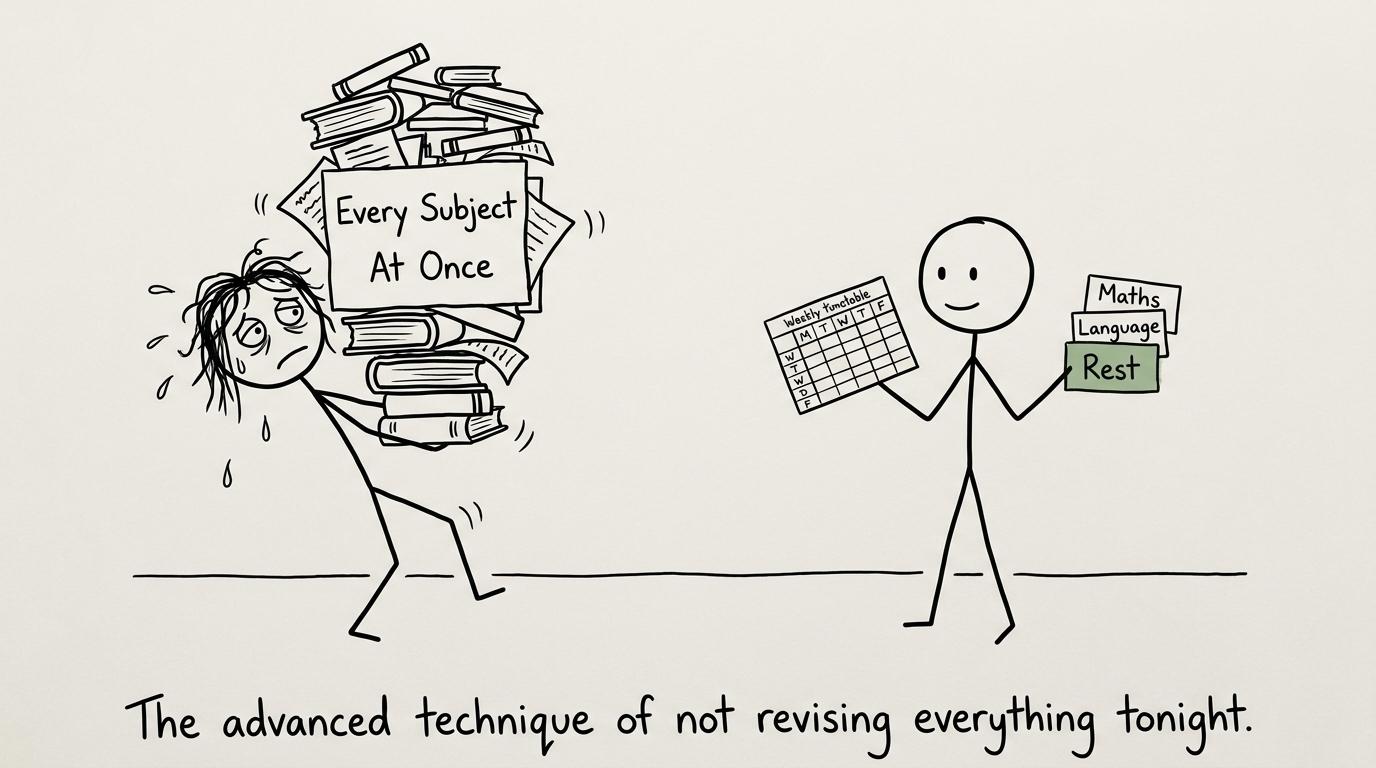 A calm student using a small timetable while another tries to revise every subject at once
How to present the qualification on an application
List the official qualification title, exam board where appropriate, and achieved or predicted grade. Do not describe yourself as fluent unless that accurately reflects your present ability.
Where the language is relevant, add evidence. You might mention sustained use in an appropriate setting, continued learning or a task requiring communication across languages. Keep personal and family information private unless you actively want to include it.
In an interview, be ready to explain three things:
- why you chose the language;
- what the course taught you;
- how you have maintained or applied the skill.
That explanation is often more memorable than the subject name. Qualifications get listed. Skills get demonstrated.
Common mistakes when making the choice
Assuming the rarer GCSE must be more impressive
Distinctiveness can invite a question, but employers recruit for requirements and evidence. Rarity alone does not establish usefulness.
Choosing according to the number of speakers worldwide
Worldwide use can be relevant, but your own competence and the employer's actual needs matter more. A language with a large global reach is not automatically useful in every local role.
Treating home use as complete exam preparation
Every GCSE has a specification. Practise all assessed skills, formal accuracy and timed responses rather than assuming everyday familiarity will cover the paper.
Ignoring exam-centre arrangements
Confirm the board, tier, speaking assessment arrangements, entry deadline and available teaching support with your school or centre before building a plan around the qualification.
Sacrificing maths for a marginal advantage
A language GCSE can enrich an application, but maths may be an explicit threshold. Use past papers properly, learn how to treat mark schemes as revision coaches, and keep both subjects moving forward.
The choice that will still make sense later
There is no universal winner in GCSE Arabic versus GCSE Modern Hebrew. Employers and colleges generally care more about whether you meet their requirements, achieve a strong grade and can demonstrate what the language enables you to do. Specific organisations may value one language because of their customers or work, but that is relevance, not a national ranking.
Choose the language in which you can build the strongest, most honest evidence. Then protect the core results that keep routes open.
MathsGenie can make the maths side of that balance simpler. Use the free revision lessons and practice questions to repair individual topics, the revision planner and mini tests to organise your week, and past papers, predicted papers, mark schemes and video solutions to prepare for the real exam. If A Level maths becomes your next step, the Edexcel A Level maths past papers are ready when you are.










