

GCSE Arabic Tutoring Cost: A UK Price Guide
GCSE Arabic tutoring cost explained: compare realistic UK hourly rates, hidden fees and tutor quality, then decide whether private lessons are worth it.
Private tuition can look simple until you start comparing profiles. One tutor charges pounds 15 an hour, another charges pounds 45, and both describe themselves as Arabic specialists. Which price is reasonable?
A realistic GCSE Arabic tutoring cost in the UK is usually around pounds 20-- pounds 45 per hour. Less-experienced online tutors may charge about pounds 15-- pounds 25, while qualified teachers, established GCSE specialists and tutors with extensive exam experience can charge pounds 45-- pounds 70 or more. Location, lesson format and the tutor's knowledge of the specification all affect the final price.
The useful question, however, is not simply, "How much does the tutor charge?" It is, "What improvement should this lesson produce?" That distinction matters when Arabic tuition must fit beside maths, English and science revision.
GCSE Arabic tutoring cost at a glance
| Type of tuition | Realistic hourly price | What you might receive |
|---|---|---|
| New or student tutor | pounds 15-- pounds 25 | Conversation, vocabulary support and general practice |
| Experienced GCSE tutor | pounds 25-- pounds 45 | Specification-led lessons, exam questions and feedback |
| Qualified teacher or highly experienced specialist | pounds 45-- pounds 70+ | Detailed assessment, structured planning and advanced exam preparation |
| Small-group tuition | Usually less per student | Shared teaching with less individual attention |
These are sensible market ranges, not fixed national prices. Current UK listings vary considerably. Some Arabic marketplaces advertise averages around pounds 14-- pounds 16 per hour, while specialist GCSE platforms display many profiles from approximately pounds 26 to above pounds 50. The cheapest listings may cover general Arabic rather than the precise demands of GCSE Arabic.
Before booking, check:
- whether the tutor teaches the correct qualification and tier;
- whether lessons cover listening, speaking, reading and writing;
- what preparation, marking and resources are included;
- whether there are booking, cancellation or travel charges;
- how progress will be measured;
- whether a trial lesson is available.
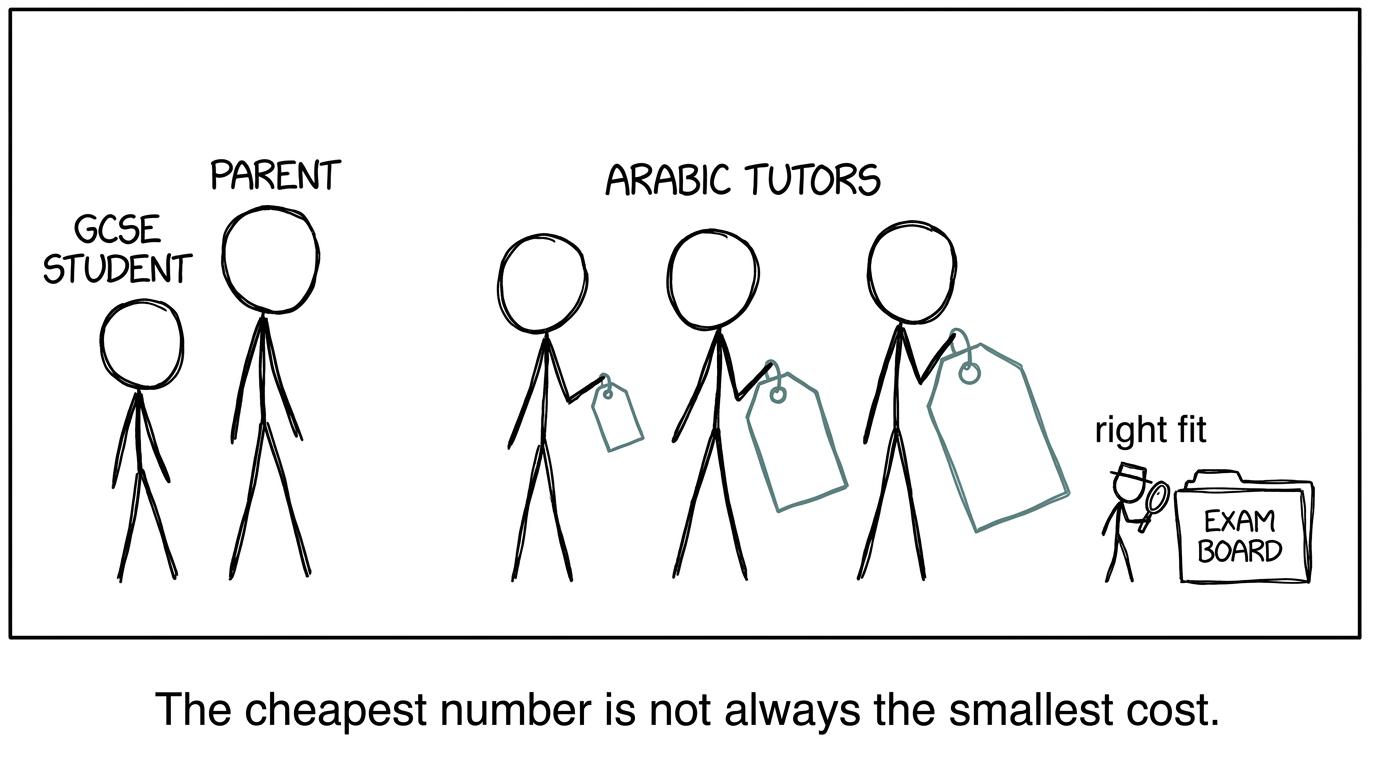 A student and parent comparing tutors by fit rather than price alone
Why Arabic tutoring prices vary so much
Price is often treated as a measure of quality. Sometimes it reflects quality. Sometimes it reflects location, demand or a polished profile. Understanding the difference helps you avoid paying for the wrong thing.
GCSE-specific knowledge
A fluent Arabic speaker is not automatically an effective GCSE Arabic tutor. Fluency matters, but examination teaching requires another layer of knowledge: tier requirements, task formats, timings, assessment objectives and the language expected in mark schemes.
For the current Pearson Edexcel GCSE Arabic qualification, students take listening, speaking, reading and writing assessments. Each skill contributes 25%25\%25% of the qualification, and students enter either foundation or higher tier across all papers. Dictionaries are not permitted in the assessments.
A suitable tutor should therefore be able to identify whether lost marks come from vocabulary, grammar, comprehension, pronunciation, translation, timing or failure to answer every part of a task. General conversation practice alone may not address those problems.
Qualifications and experience
A university student or new tutor will often charge less. This can be good value when a student needs regular speaking practice, vocabulary testing or encouragement.
A qualified teacher or experienced GCSE specialist usually charges more because the price may include lesson planning, assessment, marked writing and familiarity with common examination errors. Former examiner experience can also raise the price, although families should ask what that experience actually adds to the lessons rather than relying on the label.
Online and face-to-face lessons
Online tuition removes travel and makes it easier to search nationally for a GCSE Arabic specialist. It is not always cheaper, however. Recent UK tutoring data has shown that online prices can equal or exceed local face-to-face rates on some platforms.
In-person tutoring may include a premium for travel time, particularly in London and other expensive areas. Ask whether the advertised rate includes travel. A nominally cheaper lesson can become expensive once transport charges are added.
Lesson length and booking arrangements
Some tutors teach for 454545 or 505050 minutes rather than a complete hour. Compare like with like by finding the cost per minute:
Cost per minute=lesson pricelesson length in minutes\text{Cost per minute}=\frac{\text{lesson price}}{\text{lesson length in minutes}}Cost per minute=lesson length in minuteslesson priceAlso check whether the tutor requires a block booking. A discounted package may reduce the hourly rate, but it commits you before you know whether the teaching style works. Read the cancellation terms and find out whether missed lessons can be rearranged.
What should be included in the price?
A strong GCSE lesson is more than an hour-long conversation. The tutor should arrive with a purpose and leave the student with a clear next step.
Good-value tuition may include:
- an initial assessment of all four language skills;
- a plan matched to foundation or higher tier;
- practice using the relevant task formats;
- correction of written Arabic with specific feedback;
- structured speaking practice;
- vocabulary retrieval between lessons;
- review of mistakes from mock or past-paper questions;
- brief progress updates for the student and parent.
Ask whether marking completed outside the lesson is included. If a tutor charges a higher rate but marks writing and prepares tailored resources between sessions, the effective difference may be smaller than it first appears.
The best tutor should also encourage independent revision. Tuition becomes poor value when the student can work only while the tutor is present.
How to judge whether GCSE Arabic tuition is worth it
Private tuition is worth considering when it solves a defined problem that school support and independent practice have not solved.
Begin with a specific learning gap
"I need help with Arabic" is too broad. A clearer need might be difficulty understanding recorded speech, limited higher-tier vocabulary, weak sentence accuracy or anxiety during the speaking assessment.
Ask a prospective tutor what they would diagnose first and how they would respond. A thoughtful answer should connect the weakness to a practical lesson plan.
Agree on evidence of progress
No responsible tutor can guarantee a particular grade. They should, however, be able to show whether the student is becoming more accurate, independent and confident.
Useful evidence could include:
- fewer repeated grammar errors;
- stronger performance on comparable exam tasks;
- more detailed spoken responses;
- improved completion within the permitted time;
- better recall between lessons;
- less prompting from the tutor.
The value of tuition can be thought about as:
Value=useful, lasting improvementtotal financial and time cost\text{Value}=\frac{\text{useful, lasting improvement}}{\text{total financial and time cost}}Value=total financial and time costuseful, lasting improvementThe numerator matters most. A cheap lesson that produces no independent improvement is not good value.
Review the arrangement regularly
Do not assume weekly tuition must continue until the final examination. Review it after an agreed period. Is the tutor targeting weaknesses? Is feedback specific? Does the student complete the work between lessons? Are practice results improving?
Sometimes a short, focused block of tuition is more effective than an open-ended weekly commitment. Some students need help diagnosing gaps and building a plan; after that, independent practice may carry most of the load.
Balancing Arabic tuition with maths revision
A tutor occupies more than the lesson hour. There may also be travel, preparation and homework. During GCSE season, that time has to coexist with other subjects.
This is where a simple revision structure matters. MathsGenie's free GCSE maths revision hub brings together lessons, exam questions, worksheets and board-specific resources for Edexcel, AQA, OCR and Eduqas maths. It can reduce the need to search for materials each evening.
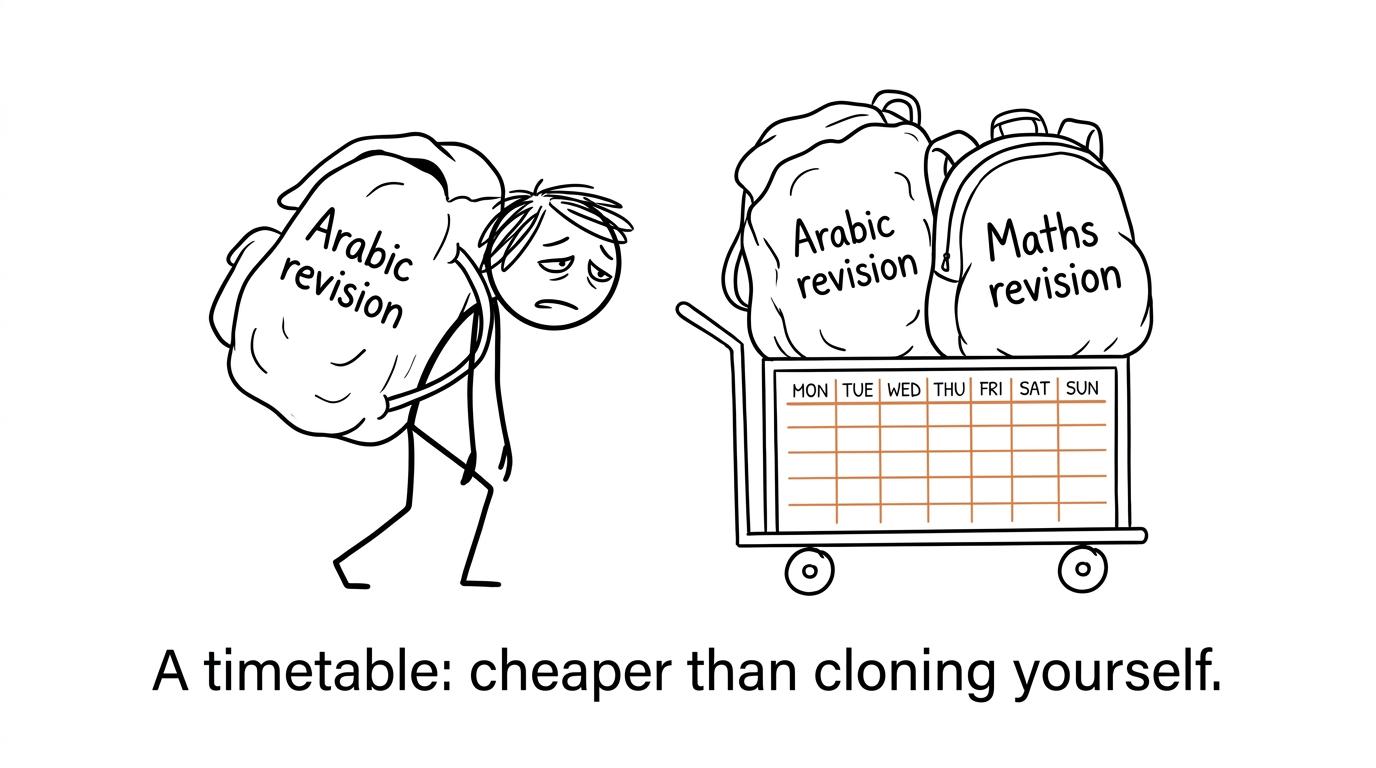 A calendar helping a student carry Arabic and maths revision together
A balanced week might separate tasks by purpose:
- the Arabic tutor addresses a weakness requiring feedback;
- short independent Arabic sessions reinforce that lesson;
- maths revision uses free, structured resources;
- timed practice checks whether knowledge survives exam pressure;
- one flexible session catches anything that slipped.
If maths feels disorganised, use the best order for learning GCSE maths topics to prioritise skills rather than revising randomly. Students approaching exams can adapt the GCSE one-month revision plan around their tutoring timetable.
The principle is simple: pay for the support that genuinely needs a specialist, then use excellent free resources wherever they can do the job.
Questions to ask before choosing a tutor
A short conversation before booking can prevent weeks of mismatched tuition. Ask:
- Which GCSE Arabic specification do you currently teach?
- Do you teach both foundation and higher tier?
- How do you assess listening, speaking, reading and writing?
- Will you mark writing outside lessons, and is that included?
- How do you use official-style questions and mark schemes?
- What work will I need to complete independently?
- How will we review progress?
- What happens if a lesson is cancelled?
For a student under 181818, parents or carers should also check identity, references, platform verification where applicable, and the practical safeguarding arrangements for online or in-person lessons. A trial session is useful for seeing whether explanations are clear and whether the student is expected to think rather than simply listen.
Common mistakes when paying for GCSE Arabic tuition
Choosing general Arabic instead of GCSE preparation
Arabic includes formal written language and many spoken varieties. A tutor may be excellent at conversational or religious Arabic without teaching the language, assessment structure and examination technique required for the GCSE qualification. Ask directly about current GCSE experience.
Comparing only the advertised hourly price
Travel, platform charges, shorter lessons, marking fees and cancellation policies can change the real cost. Calculate the total commitment before agreeing to a package.
Assuming a higher price guarantees a better match
An expensive tutor may be highly qualified but unsuitable for the student's particular weakness or personality. Clear explanations, diagnostic skill and purposeful feedback matter more than prestige alone.
Booking too many lessons without independent practice
Language improves through frequent retrieval and use. One weekly lesson cannot replace vocabulary review, speaking practice and corrected writing. Tuition should direct the practice, not become a substitute for it.
Letting tuition crowd out other GCSE subjects
Arabic matters, but so does the overall revision plan. Schedule maths paper practice in advance rather than leaving it for spare time. MathsGenie's guide to when to start GCSE past papers can help you phase this sensibly.
Near the exams, use GCSE predicted papers alongside past papers rather than relying on predictions alone. If pressure rises close to a paper, follow the GCSE maths night-before plan instead of attempting an exhausting last-minute rescue.
Make the cost serve a clear purpose
For most families, a sensible starting budget for private GCSE Arabic tuition is around pounds 20-- pounds 45 per hour. Paying more can be justified when the tutor brings relevant teaching experience, precise feedback and a structured understanding of the current specification. Paying less can still work when the student's need is narrow and the tutor is a good match.
Do not buy hours. Buy a clear diagnosis, deliberate practice and growing independence.
Then protect the rest of the revision week. Use MathsGenie's free maths resources for revision lessons and practice questions, build exam confidence with past papers and mark schemes, and sharpen preparation through predicted papers, mini tests and video solutions. The aim is not to fill every evening. It is to make each hour count.











