GCSE Arabic Revision Timetable Clash: A Realistic Plan
GCSE Arabic revision timetable clash? Build a realistic weekly plan that protects Arabic practice, maths progress, five other subjects and proper rest.
The difficult part of revising six subjects is not finding enough coloured pens. It is accepting that every subject can feel urgent at the same time. A GCSE Arabic revision timetable clash becomes especially awkward because Arabic needs regular contact, while maths also improves through repeated practice rather than occasional long sessions.
The practical answer is to give Arabic three short skill sessions and one longer session each week, protect three or four maths blocks, then rotate the remaining subjects according to exam dates and weaknesses. Do not divide every hour equally. Build a repeatable week that responds to evidence.
Your realistic revision checklist
Before filling a timetable, make these decisions:
- Confirm your examinations, dates, exam boards and tiers.
- Give Arabic several short contacts across the week.
- Protect regular maths practice rather than leaving it for weekends.
- Rank topics using marked questions, not anxiety.
- Assign one clear task to every session.
- Include catch-up space and a firm finishing time.
- Review the timetable weekly and change what is not working.
MathsGenie's GCSE maths revision hub is a useful starting point because you can choose your exam board and move between lessons, questions and papers without spending revision time searching for materials.
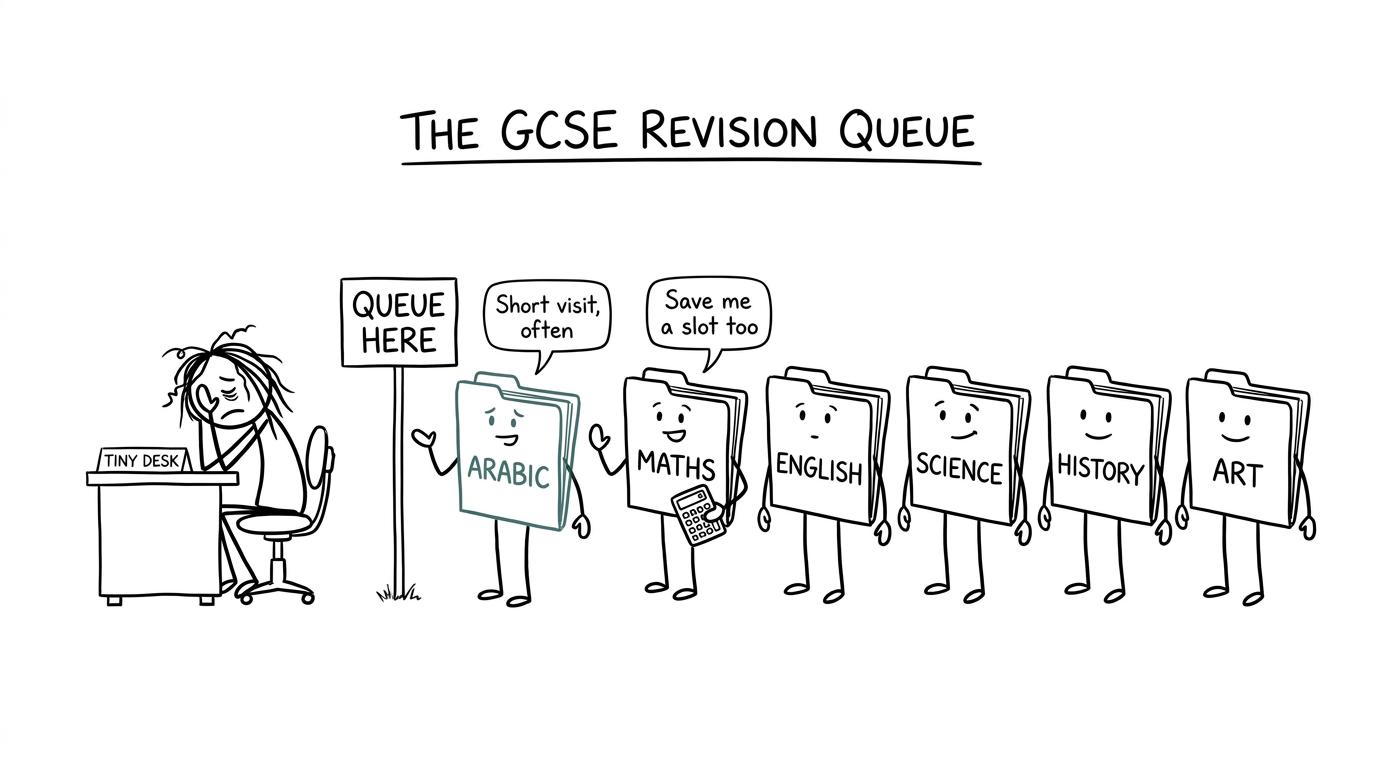 Six GCSE subjects queue politely for space in a student's revision week
Why Arabic cannot simply wait until the weekend
Pearson Edexcel GCSE Arabic assesses listening, speaking, reading and writing. Each skill contributes an equal share of the qualification, and the speaking assessment takes place before the main written examination period. That structure matters when you plan.
A single weekly Arabic session may feel substantial, but it leaves long gaps between encounters with vocabulary, sounds and sentence structures. It can also produce an unbalanced routine: two hours of writing does little for listening fluency, while silent vocabulary revision does not prepare you to answer aloud.
Instead, distribute Arabic across the week:
- Listening: short audio practice followed by recall of key details.
- Speaking: answer prompts aloud without reading a complete script.
- Reading: identify meaning, opinions, time frames and unfamiliar words from context.
- Writing: plan and produce a focused response, then correct it using teacher feedback or assessment criteria.
This is not about doing Arabic every day. It is about avoiding a pattern in which the language disappears for six days and returns as a Saturday marathon.
Build the timetable from fixed commitments
A timetable should describe the week you actually have. Begin with school, travel, meals, clubs, family commitments and sleep. Those are not inconvenient gaps in revision. They are the shape around which revision must fit.
Then mark the periods when you can usually concentrate. A demanding maths topic may suit an earlier evening slot; Arabic listening or vocabulary retrieval might fit a shorter period when energy is lower. The best task depends on the student, so observe when you work accurately rather than copying somebody else's routine.
Most teenagers need around 888 to 101010 hours of sleep. Protecting that time is part of exam preparation, not an alternative to it. Late-night revision that leaves you unable to think clearly in lessons merely borrows time from tomorrow.
The GCSE maths revision timetable guide explains how to prioritise weak topics, revisit material and leave room for catching up. Apply the same principles across all six subjects.
Use a repeatable weekly pattern
A realistic week might use the following rhythm. Treat it as a template, not a command.
| Day | Arabic focus | Maths focus | Other-subject space |
|---|---|---|---|
| Monday | 202020 minutes of listening and retrieval | 353535 minutes on one weak topic | One subject block |
| Tuesday | No planned Arabic | 202020 minutes of mixed questions | Two shorter subject blocks |
| Wednesday | 252525 minutes of speaking practice | No planned maths | One longer subject block |
| Thursday | 202020 minutes of reading | 353535 minutes of topic practice and marking | One subject block |
| Friday | Catch-up or rest | Short error-log review | Light recall only |
| Saturday | 454545 minutes of writing and correction | Timed mini test or paper section | One priority subject |
| Sunday | Vocabulary retrieval for 151515 minutes | Mark, correct and plan the next week | Two rotating subjects |
This pattern gives Arabic repeated contact without allowing it to occupy every evening. Maths also appears regularly, but not always as a full paper. The four other subjects rotate through the available spaces according to need.
Notice the Friday gap. A timetable with no spare capacity is already broken; it simply has not admitted it yet. If the week goes smoothly, use that space for rest or a small retrieval task. If schoolwork expands unexpectedly, the gap absorbs it.
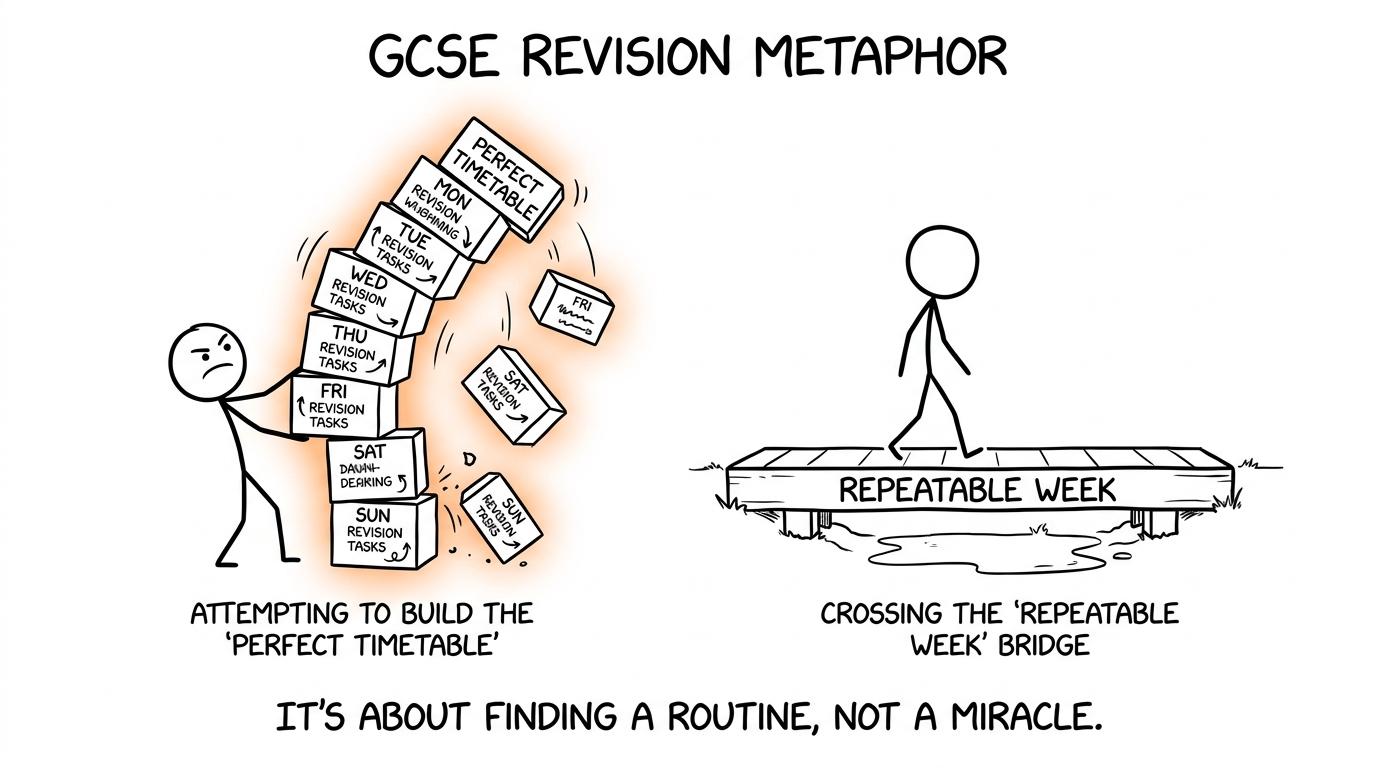 A wobbly perfect timetable tower beside a sturdy repeatable-week bridge
Decide which subject gets more time
Equal treatment sounds fair, but examinations do not create equal needs. One subject may have an earlier assessment. Another may contain a topic that repeatedly costs marks. Arabic speaking may require extra attention before its assessment window, while maths may need a larger share when your next paper is close.
Use three questions each Sunday:
- Which assessment happens first?
- Where did I lose marks this week?
- Which skill will weaken if I leave it untouched?
This creates a flexible priority order. In the weeks before Arabic speaking, one session from another subject might temporarily become speaking practice. Once that assessment is complete, the time can return to reading, writing, maths or another examination.
For maths, gather evidence with a short test or paper section. MathsGenie's guide to finding your weakest GCSE topics shows how to turn lost marks into a focused list. Edexcel students can use the GCSE maths mini tests when a full paper would be too large for the available slot.
Give every session a finish line
“Revise Arabic” is not a task. Neither is “do maths”. Both are invitations to drift.
A useful session has an action and an outcome. For example:
- retrieve vocabulary from one theme, then check it;
- record answers to speaking prompts and note recurring hesitations;
- complete one reading task and correct every misunderstood phrase;
- answer a focused set of maths questions, mark it and record one error pattern.
This follows the broader process of planning, monitoring and evaluating learning. It also makes the timetable easier to restart after a difficult day: you know precisely what the next action is.
On crowded school days, use the 20-minute maths revision routine. A short lesson, several questions and immediate marking can preserve momentum without competing with a longer Arabic task.
Make revision active in both subjects
Rereading can feel calm because it hides uncertainty. Testing yourself reveals what you genuinely know. That discomfort is useful information.
For Arabic, active revision could include:
- covering the English meaning and retrieving it;
- listening once without a transcript, then checking missed details;
- answering an unexpected speaking question aloud;
- writing from a brief rather than copying a model response;
- correcting mistakes and attempting the same skill later.
For maths, the equivalent loop is learn, practise, mark, fix and retest. Use revision lessons only long enough to understand the method, then attempt questions without support. The one-month GCSE maths revision plan offers a structured route from topic diagnosis towards timed papers.
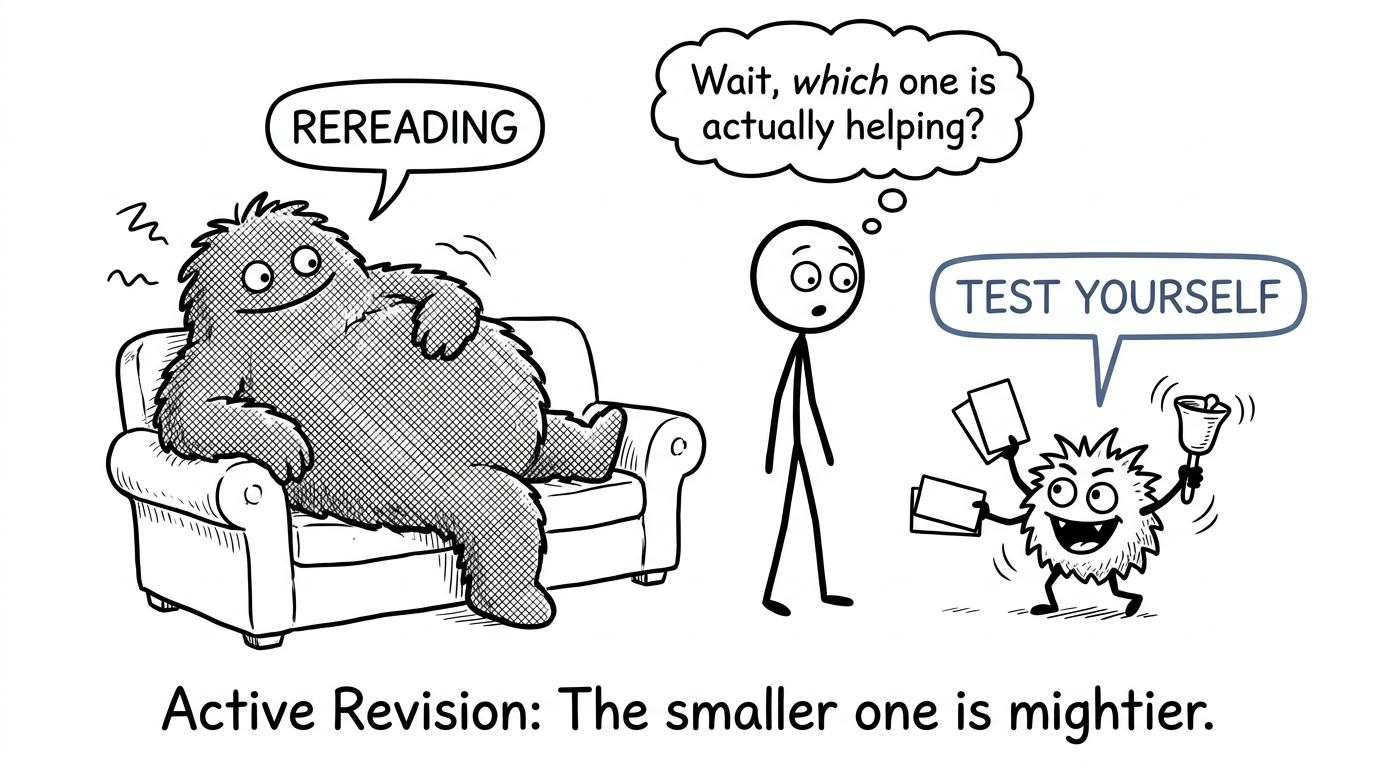 The energetic self-testing monster interrupts the comfortable rereading monster
Fit past papers around six subjects
Full papers matter, but they do not need to dominate every week from the beginning. Earlier in revision, use individual questions, mini tests and timed sections. As examinations approach, increase full-paper practice while reducing broad note-making.
Choose maths papers that match your board and tier. MathsGenie provides Edexcel GCSE maths past papers and AQA GCSE maths past papers, with mark schemes and worked solutions where available. Students following OCR, Eduqas, WJEC or CCEA can select the appropriate route from the main GCSE hub.
Do not schedule a paper without scheduling its review. Marking identifies whether the problem was knowledge, method, accuracy, timing or interpretation. That diagnosis should determine the next topic session.
Use predicted papers later as fresh exam-style practice, not as a promise of what will appear. Their value lies in exposing gaps under timed conditions.
Common mistakes when six subjects compete
Making every evening too ambitious
Three demanding blocks after a full school day may look impressive on Sunday and collapse by Tuesday. Choose a minimum week that you can repeat, then add work when capacity genuinely exists.
Giving Arabic one enormous block
Languages benefit from repeated contact across different skills. Split the time so that listening, speaking, reading and writing all remain active.
Protecting favourite topics
Comfortable revision creates neat pages but may leave the largest mark losses untouched. Use marked work, teacher feedback and error logs to choose tasks.
Treating missed work as debt
Do not move every unfinished task into tomorrow. That creates a timetable avalanche. Reassess its priority, move only what matters and let low-value tasks go.
Confusing time spent with work completed
A session is successful because you retrieved vocabulary, corrected a response or repaired a maths method, not because a timer ran for an hour.
Sacrificing sleep to rescue the plan
If the timetable regularly requires late nights, the plan is too large. Reduce the workload rather than reducing the recovery that makes learning possible.
A timetable should reduce decisions, not create guilt
A GCSE Arabic revision timetable clash is solved by rhythm rather than perfect balance. Keep Arabic alive through short, varied sessions. Protect regular maths practice. Rotate the other subjects using exam dates, marked work and teacher feedback. Leave space for real life.
Then let resources remove the friction. Start at the MathsGenie GCSE maths revision hub, choose your board and tier, and move from revision lessons to practice questions, mini tests and timed past papers. Use mark schemes and video solutions to correct mistakes, then introduce predicted papers as the examinations approach.
Your timetable does not need to look extraordinary. It needs to help you sit down, know what to do and begin.