

GCSE Arabic Revision: Silence or Noise?
GCSE Arabic revision silence or noise: explore the evidence on lyrics, instrumental music and quiet, then build an exam-ready routine that works.
A revision session can look productive while quietly achieving very little. The book is open. The playlist is running. An hour passes. Yet the vocabulary you covered seems to disappear as soon as you close the page.
So, for GCSE Arabic revision, silence or noise? The safest answer is silence for demanding language work. Music with lyrics is particularly likely to interfere with reading, writing and verbal memory. Quiet instrumental music may be harmless for some students, but research does not show a reliable learning advantage. Listening practice and speaking practice need their own carefully controlled sound environments.
The goal is not to defend silence or ban headphones. It is to match the environment to the task, and then test whether it genuinely improves your recall.
The quick revision checklist
Use this as your starting point:
- Choose silence for learning vocabulary, grammar, spelling and written responses.
- Avoid music with lyrics, especially lyrics in a language you understand.
- If silence feels uncomfortable, try quiet, predictable instrumental sound.
- Complete Arabic listening tasks with only the official recording playing.
- Speak aloud when practising pronunciation and exam responses.
- Recreate quiet exam conditions regularly, even if you normally revise with sound.
- Compare your recall afterwards rather than judging the session by how pleasant it felt.
- Keep your phone out of sight so background music does not become background scrolling.
This advice applies beyond Arabic. Students balancing language revision with maths can use the same principle: decide what the task demands, remove competing information and measure the result.
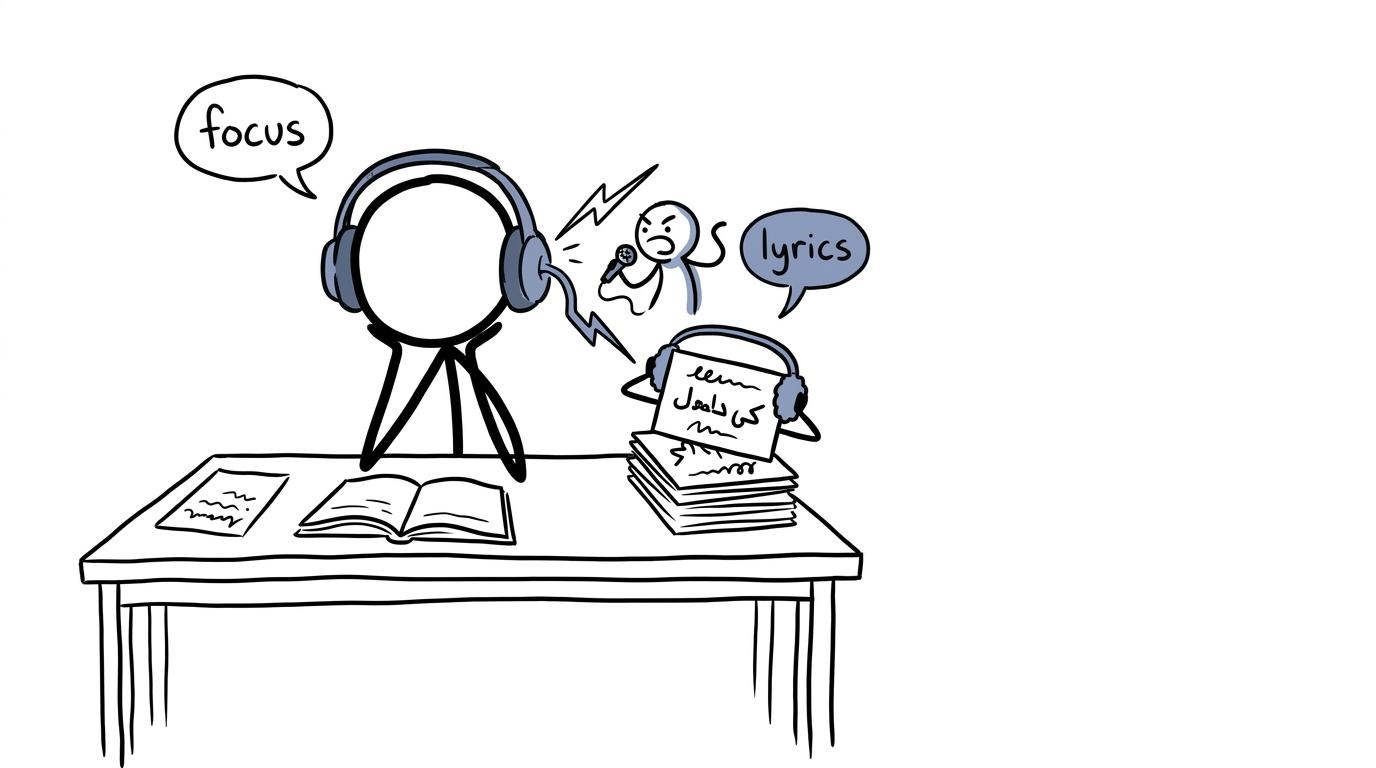 A singer emerging from headphones distracts Arabic vocabulary flashcards
What the evidence actually says about silence and noise
The research is more nuanced than the usual claim that classical music makes you clever or complete silence guarantees concentration.
A systematic review covering 959595 articles and 154154154 experiments found that background music generally had a detrimental effect on language-related and memory tasks. Music with lyrics tended to be more disruptive than instrumental music, while difficult tasks were more vulnerable than easy ones. Serial recall, remembering information in the correct order, was particularly affected.
A controlled study published in 202320232023 reached a similar conclusion. Music with lyrics reduced performance in verbal memory, visual memory and reading comprehension compared with silence. Instrumental lo-fi music did not reliably improve or impair performance.
However, not every review reaches an identical headline. A separate meta-analysis combining 474747 studies found a small positive average effect of background music on learning. The effect varied according to factors such as when the music was played, the type of learning, age and musical characteristics. Individual studies of vocabulary learning have also produced mixed results, from no meaningful difference to benefits for particular learners.
That apparent disagreement matters. It tells us there is no universal soundtrack that improves learning. Studies use different tasks, learners, music and testing methods. Music may improve mood or make a revision session easier to begin without improving what is remembered afterwards.
For GCSE Arabic, the practical conclusion is cautious but useful: silence is the most dependable default for demanding verbal work, and lyrics are the riskiest background sound.
Why lyrics compete with GCSE Arabic revision
Arabic revision places heavy demands on verbal processing. You may be trying to connect a written word with its meaning, remember its spelling, recognise a grammatical pattern or hold a sentence in mind long enough to translate it.
Lyrics introduce another stream of words. Even when you believe you are ignoring them, your attention must keep filtering them out. Familiar lyrics may be especially intrusive because your brain can follow their meaning or anticipate what comes next.
This overlap helps explain why background speech and lyrical music often damage verbal memory more than steady non-verbal sound. It is not simply that noise is bad. The content of the noise competes with the content of the task.
The risk rises when:
- the Arabic material is new;
- you are memorising ordered information;
- the text is grammatically demanding;
- you are translating between Arabic and English;
- the song is familiar or emotionally engaging;
- you keep changing tracks.
If you notice yourself singing internally, choosing songs or replaying a favourite section, the soundtrack is no longer in the background.
Match the sound environment to the Arabic skill
Pearson Edexcel GCSE Arabic assesses listening, speaking, reading and writing. Under its current specification, each skill contributes 25%25\%25% of the qualification, and students enter either foundation or higher tier across the papers. Your school should confirm the specification and tier you are taking.
Because the skills are different, one sound rule cannot cover every session.
Vocabulary, grammar and spelling
Start in silence. These activities depend heavily on verbal memory and accurate recall. After reviewing a small set, close your notes and retrieve the meanings or spellings without prompts.
If complete silence makes you restless, test quiet instrumental audio with no vocals and little variation. Keep the volume low enough that you do not actively follow it.
Reading and translation
Silence is usually the strongest choice. Reading comprehension already requires you to process written language, infer meaning and keep earlier information available while interpreting what follows. Lyrics add unnecessary verbal competition.
For translation, remove background speech in both Arabic and English. Your attention needs to move deliberately between the two languages.
Writing
Use silence for planning and producing exam-style answers. Writing requires vocabulary retrieval, grammar control, spelling and checking at the same time. A pleasant playlist cannot compensate if it causes missed agreements, repeated words or incomplete bullet points.
Occasional spoken self-checking can help: read your finished response aloud and listen for awkward phrasing. That is purposeful sound, not background noise.
Listening
Listening revision is the clear exception to silent work because the recording is the task. The room around it should still be quiet. Do not play music underneath an Arabic recording or allow a television to run nearby.
Use speakers or suitable headphones at a comfortable volume. Follow the conditions and playback arrangements specified by your teacher and exam board when completing formal practice.
Speaking
Speaking practice should not be silent. Rehearse aloud so you can hear pronunciation, pace and hesitation. Record yourself where appropriate, listen back and identify one correction at a time.
Background music is still unnecessary. Your voice should be the information you are monitoring.
Run a fair test on your own concentration
Preference is real, but preference is not proof. The best environment is the one that produces better recall and more accurate work afterwards.
Try three comparable revision sessions on separate days:
- silence;
- quiet instrumental audio;
- steady neutral sound, such as unobtrusive white or brown noise.
Keep the topic difficulty, session length and time of day as similar as reasonably possible. After each session, test yourself without notes. Record:
- how many vocabulary items you recalled;
- how many reading questions you answered correctly;
- how many corrections your writing needed;
- how often you became distracted;
- how mentally tired you felt.
Do not use lyrical music as your preferred condition merely because it feels familiar. If you test it, compare the results honestly.
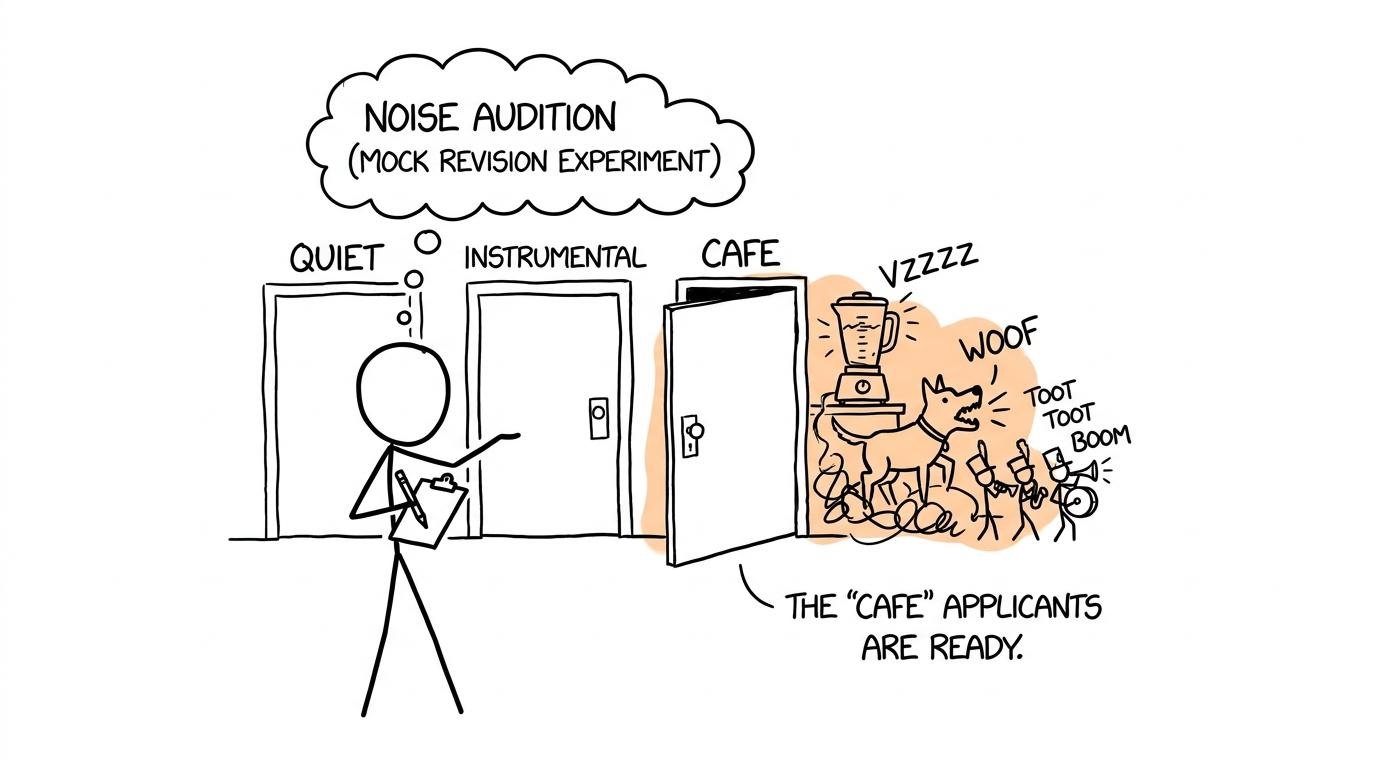 A student auditions quiet, instrumental sound and an absurdly noisy cafe
This is the same evidence-first habit that improves maths revision. MathsGenie’s guide to finding your weakest GCSE topics starts with performance rather than guesswork. For maths, a GCSE mini test provides quick feedback. For Arabic, a short vocabulary test or marked reading section can do the same job.
When background sound may still be useful
Silence is not equally accessible to everyone. A home may contain conversations, traffic, siblings or intermittent household noise. In that situation, predictable low-level sound may mask more disruptive changes.
Instrumental music may also help some students begin a low-demand task, such as organising resources or reviewing material they already know well. The important distinction is between helping you start and helping you learn.
Use background sound cautiously when:
- it masks unpredictable environmental noise;
- it contains no speech or lyrics;
- it remains quiet and steady;
- you are completing familiar rather than demanding material;
- your test results show no drop in accuracy or recall.
If you need sound to settle into a session, another option is to use music briefly before revision and switch it off when the difficult work begins.
Train for the environment you will face
Revision has two purposes. The first is learning. The second is being able to retrieve that learning under exam conditions.
Even if instrumental music works well during ordinary sessions, complete some timed practice in silence. Otherwise, the exam hall may feel strangely empty and your concentration routine may depend on a cue that is no longer available.
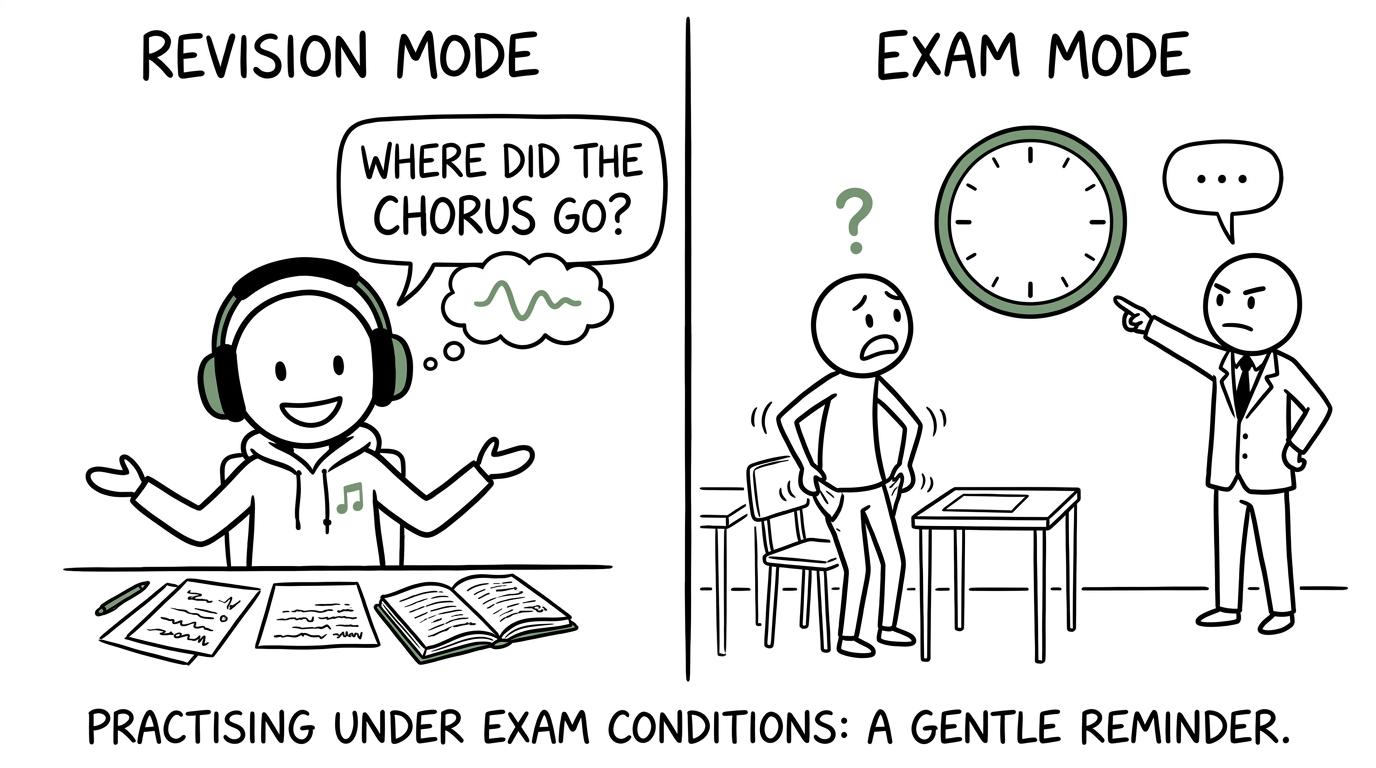 A student in an exam hall searches for the missing revision soundtrack
Build up gradually. Begin with a short quiet section, then extend towards the length and format required by your paper. Keep only permitted materials on the desk and avoid pausing to check notes.
For maths, you can practise the same transition through the GCSE Maths revision hub, then use the approach in how to use GCSE past papers properly. Students taking Edexcel, AQA, OCR or Eduqas maths should select the correct board and tier before starting timed work.
Build a routine instead of chasing perfect silence
The environment matters, but it cannot replace an effective revision method. A silent hour of rereading may achieve less than a focused period of retrieval and correction.
A strong session follows this pattern:
- choose one precise target;
- retrieve what you know before opening notes;
- review the missing material;
- answer questions without support;
- mark or check your responses;
- record one specific correction;
- revisit the skill later.
Use the MathsGenie revision planner to organise maths alongside Arabic and your other subjects. If time is tight, the GCSE 202020-minute maths revision routine shows how a small, repeatable block can still include recall, practice and feedback. A broader GCSE maths revision timetable can help you protect quiet practice time across the week.
Common mistakes when choosing silence or noise
Assuming enjoyment means better learning
Music can make revision feel faster. That does not prove it improved memory. Judge the session using a test completed afterwards.
Treating all background sound as equal
Lyrics, instrumental music, speech and steady noise affect attention differently. Familiar language is not equivalent to a constant, non-verbal sound.
Revising every Arabic skill in the same way
Reading generally needs quiet. Listening needs a clear recording. Speaking needs your voice. Match the environment to the assessed skill.
Changing too many variables at once
A comparison is not useful if you change the topic, session length, music and time of day together. Keep the conditions reasonably similar.
Never practising in exam conditions
Your favourite revision setup will not follow you into the exam hall. Include regular quiet, timed work without notes or notifications.
Focusing on sound while ignoring the phone
A silent room does not help if messages interrupt every few minutes. Put the phone out of reach, disable notifications and prepare resources before starting.
Choose the environment that makes recall easier
The evidence does not support one magical revision soundtrack. For GCSE Arabic, silence remains the strongest default for vocabulary, grammar, reading, translation and writing. Lyrics create the clearest risk of interference. Quiet instrumental or steady neutral sound may suit some students, particularly where it masks unavoidable noise, but it should earn its place through better results.
Then carry that discipline into maths. Choose your board and tier on MathsGenie, use free revision lessons and practice questions to repair weak topics, and test yourself with mini tests, past papers and predicted papers. Mark your work with the mark schemes and use video solutions when a method is unclear.
Start quietly. Test honestly. Keep the environment that helps your knowledge survive after the sound stops.











