GCSE Arabic Paper 4 Exam Date 2026 and Checklist
GCSE Arabic Paper 4 exam date 2026: Tuesday 2 June. Check the afternoon session, tier timings, equipment rules and a calm revision plan for exam day.
Exam dates often feel distant until they acquire a day, a session and a place on the school timetable. Then revision becomes real. The GCSE Arabic Paper 4 exam date 2026 was Tuesday 2 June 2026, in the afternoon session, according to Pearson Edexcel's final summer timetable. Foundation tier lasted 1 hour 20 minutes, while higher tier lasted 1 hour 25 minutes.
That is the direct answer. But knowing the date was only part of being ready. Students also needed the correct tier, paper code, equipment and writing strategy, while keeping maths revision moving during a crowded part of the exam season.
GCSE Arabic Paper 4 exam date 2026 at a glance
| Detail | Foundation tier | Higher tier |
|---|---|---|
| Date | Tuesday 2 June 2026 | Tuesday 2 June 2026 |
| Session | Afternoon | Afternoon |
| Duration | 1 hour 20 minutes | 1 hour 25 minutes |
| Paper code | 1AA0/4F | 1AA0/4H |
| Paper title | Writing in Arabic | Writing in Arabic |
| Total marks | 606060 marks | 606060 marks |
| Dictionary | Not permitted | Not permitted |
The published timetable gives an afternoon session rather than one universal arrival time. Your school's exams officer sets the precise reporting and starting arrangements, so the timetable issued by your centre should always be your practical guide.
If a school timetable appears to disagree with the paper code, tier or session above, do not guess. Ask your exams officer or Arabic teacher to check your entry.
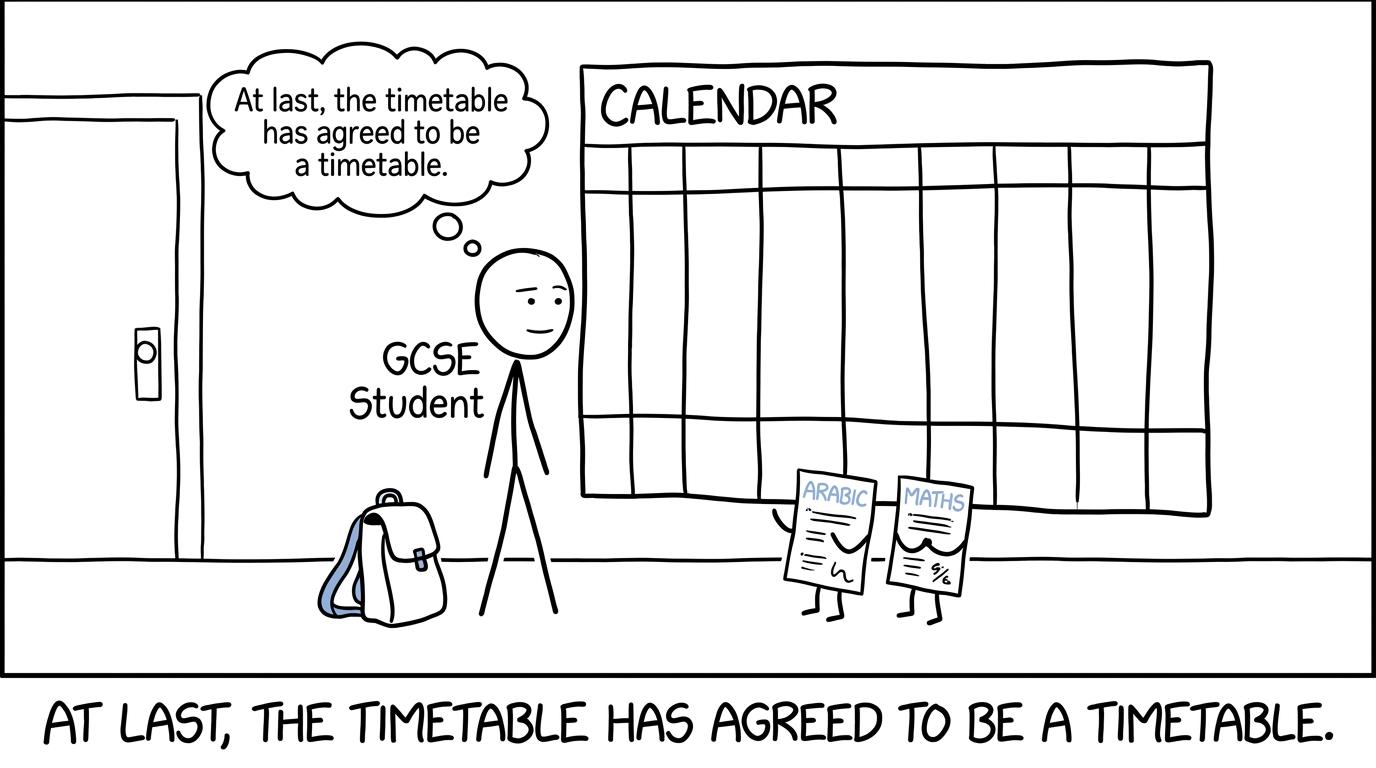 A student calmly checking the exam timetable while Arabic and maths papers wait in line
Your short preparation checklist
Before Paper 4, make sure you can confirm all of the following:
- your entry is Pearson Edexcel GCSE Arabic;
- you know whether you are entered for foundation or higher tier;
- the paper code on your timetable is 1AA0/4F or 1AA0/4H;
- you know your school's arrival time, room and seat arrangements;
- you have at least two working black pens;
- you know your centre and candidate details, or where your centre provides them;
- your phone, smartwatch, earbuds and notes will remain outside the exam room as directed;
- you have practised writing without a dictionary;
- you remain available for the national contingency day on Wednesday 24 June 2026.
The contingency day was reserved for national or significant local disruption. It was not an opportunity to move an examination because an individual student had missed it.
What GCSE Arabic Paper 4 assesses
Paper 4 is the writing component of Pearson Edexcel GCSE Arabic. It assesses how effectively students communicate ideas and opinions in written Arabic for different purposes and audiences. The paper draws vocabulary and structures from across the specification rather than testing one isolated theme.
Both tiers are worth 606060 marks and account for one quarter of the complete qualification. The instructions are presented in Arabic, and recommended word counts are given for the writing tasks.
Foundation tier contains three open-response tasks and a translation into Arabic. Higher tier contains two open-response tasks and a translation into Arabic. Some tasks provide a choice of prompts, but students must complete the required selection shown on the paper as well as the translation.
The distinction matters. It is easy to revise vocabulary while overlooking the decisions that writing requires: choosing an appropriate register, addressing every bullet point, organising ideas and controlling verbs across different time frames.
What examiners are looking for
Strong responses do more than contain ambitious vocabulary. They communicate the required information clearly and use language accurately enough that meaning remains secure.
Your final preparation should therefore cover:
- responding to every required bullet point;
- expressing and justifying opinions;
- using suitable vocabulary for the specified context;
- writing in an appropriate formal or informal register;
- controlling present, past and future references;
- joining ideas without creating sentences you cannot manage accurately;
- translating the full meaning rather than isolated words;
- checking spelling, agreement and verb forms.
Pearson's specification also states that students are not expected to add full vocalisation to their writing. Follow the conventions taught by your school rather than spending exam time trying to add unfamiliar markings.
What to have ready before the exam
The official materials information says candidates do not need additional materials for this paper. In practical terms, simplicity is useful.
Permitted essentials
Bring at least two reliable black ball-point pens in the type of pencil case required by your centre. Write clearly and use the combined question-and-answer booklet provided in the exam.
Know your candidate number and centre number if your school expects you to enter them yourself. Only complete the front of the booklet when instructed by the invigilator.
Items that must stay outside
A dictionary is not permitted in GCSE Arabic Paper 4. That restriction includes an Arabic-English dictionary and applies even if you normally use one while revising.
Phones, smartwatches, earbuds, notes and other unauthorised material must not enter the exam room. JCQ instructions also prohibit using correcting fluid or tape, erasable pens and gel pens in answers. If you make an error, cross it out neatly and continue.
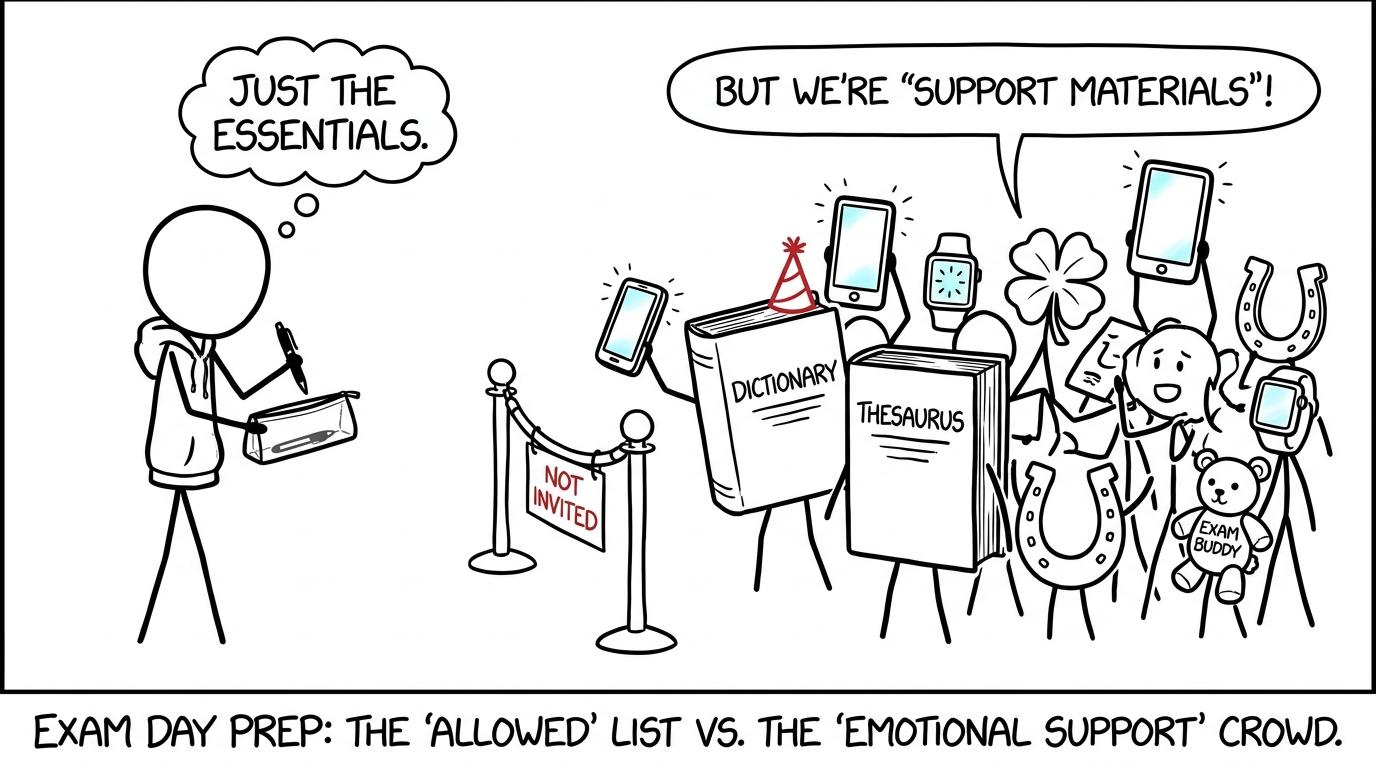 A black pen enters the exam while dictionaries and electronic devices wait behind a rope
Arrangements specific to you
If you have an approved access arrangement, check the practical details with your SENCo or exams officer before exam day. Do not assume that a normal classroom arrangement automatically applies in a public examination.
The calmest time to resolve uncertainty is several days beforehand. The least calm time is while everyone else is entering the room.
How to prepare for Paper 4 without losing maths time
For students taking Arabic alongside GCSE maths, early June can feel crowded. The answer is not to revise both subjects at once. It is to give each subject a clearly defined job.
Arabic writing benefits from short recall and writing sessions: retrieving vocabulary, planning responses, translating and checking accuracy. Maths improves through questions, marking and targeted repair. These activities are different enough that separating them reduces mental switching.
A sensible revision block might contain:
- one focused Arabic writing task under timed conditions;
- immediate review using the relevant assessment criteria;
- a proper break;
- one maths topic session or mini test;
- a short record of what must be revisited next.
For maths, begin from the GCSE Maths revision hub, where resources are organised by exam board and tier. If a complete paper feels too heavy during language revision, use Edexcel GCSE Maths mini tests to keep retrieval active in a smaller block.
Students who need a broader structure can adapt the GCSE one-month maths revision plan. If time is already tight, the 20-minute maths revision routine provides a more realistic daily minimum.
The point is continuity. One exam should not cause you to abandon another subject for a week.
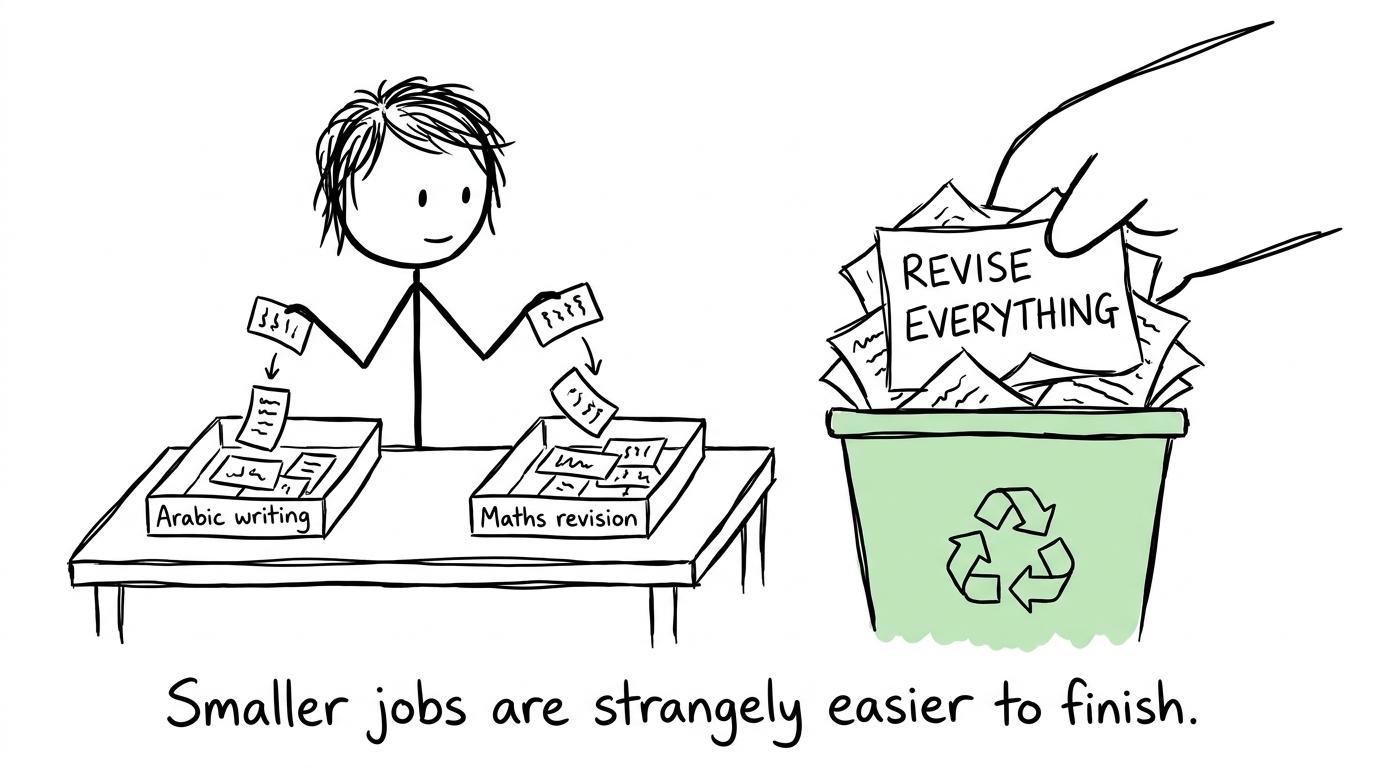 A student sorts manageable Arabic and maths tasks while discarding a pile labelled revise everything
A calm final-week approach
In the final days, revision should become more specific rather than more expansive. Do not attempt to memorise an entire vocabulary book or complete every remaining maths paper.
For Arabic, identify the areas that still create lost marks: missing bullet points, uncertain verb forms, weak translation, limited opinions or poor checking. Practise those weaknesses in short, timed sections.
Use a similar evidence-led method for maths. The guide to finding your weakest GCSE topics explains how to turn marked work into focused practice. If you are unsure when full papers become useful, read when to start GCSE past papers.
Close to an exam, quality matters more than volume. A paper that is completed, marked and corrected is valuable. Three papers rushed without review mainly produce tiredness.
The GCSE maths exam-week checklist can help you organise the days around your remaining papers. Edexcel students can also use GCSE Maths past papers with mark schemes to maintain exam technique between other subjects.
Common mistakes to avoid
Confusing Paper 4 with another Arabic component
Paper 4 is the writing examination. Check that your timetable shows 1AA0/4F or 1AA0/4H, not a listening, speaking or reading code.
Remembering the date but not the session
The paper was scheduled for the afternoon. Your school determines the reporting time, so arrive according to its instructions rather than interpreting “afternoon” for yourself.
Bringing a dictionary
Paper 4 must be completed without one. Revision should include closed-book writing so that the real conditions do not feel unfamiliar.
Answering the topic but missing a bullet point
A fluent response can still lose marks if it does not communicate the required content. Read the complete task, identify each requirement and check them off mentally before finishing.
Writing sentences that are too ambitious to control
Range is valuable, but clarity comes first. Use varied language you understand rather than forcing memorised expressions into the wrong context.
Letting Arabic revision replace all maths practice
A temporary loss of rhythm can make familiar maths feel slower. Protect a small daily minimum using revision lessons, practice questions or mini tests, then return to longer papers when your timetable allows.
Turn the date into a plan
The official GCSE Arabic Paper 4 slot was Tuesday 2 June 2026 in the afternoon: 1 hour 20 minutes for foundation and 1 hour 25 minutes for higher. The most important practical steps were to confirm the correct tier, follow the school's arrival instructions, bring black pens and prepare to write without a dictionary.
A date becomes useful when it changes what you do next. Build Arabic writing practice around the real conditions, keep maths active in short focused sessions, and let marked work decide what needs attention.
MathsGenie gives you a free place to continue that process with revision lessons, practice questions, past papers, predicted papers, mini tests, mark schemes, video solutions and a revision planner. Choose your exam board, complete one purposeful task, mark it honestly and use the result to choose the next one.