GCSE Arabic Paper 3: What to Actually Expect
GCSE Arabic Paper 3 explained: timings, sections, question types, translation, tier differences and a practical revision plan for exam-day confidence.
The unsettling thing about a reading exam is that you can recognise every letter and still wonder what the question wants. GCSE Arabic Paper 3 is not a writing paper disguised as reading. For Pearson Edexcel GCSE Arabic (1AA0), it assesses how accurately you understand written Arabic, select relevant details and translate meaning into natural English.
Paper 3 is worth one quarter of the qualification. Foundation students have fifty minutes; Higher students have one hour and five minutes. Both papers carry fifty marks, include three sections and must be completed without a dictionary.
Here is the essential checklist:
- Paper 3 is Reading and understanding in Arabic.
- Foundation is fifty minutes; Higher is one hour and five minutes.
- You must answer every question in Sections A, B and C.
- Section A has questions and instructions in English.
- Section B has questions and instructions in Arabic.
- Section C is a translation from Arabic into English.
- Expect multiple-response and short-answer questions.
- Texts can include adverts, emails, letters, articles and literary extracts.
- Vocabulary and structures can come from any specification theme.
- Dictionaries are not permitted.
Before relying on this guide, confirm that your entry is Pearson Edexcel GCSE Arabic specification 1AA0 rather than an International GCSE or another qualification. Paper titles and structures are not interchangeable.
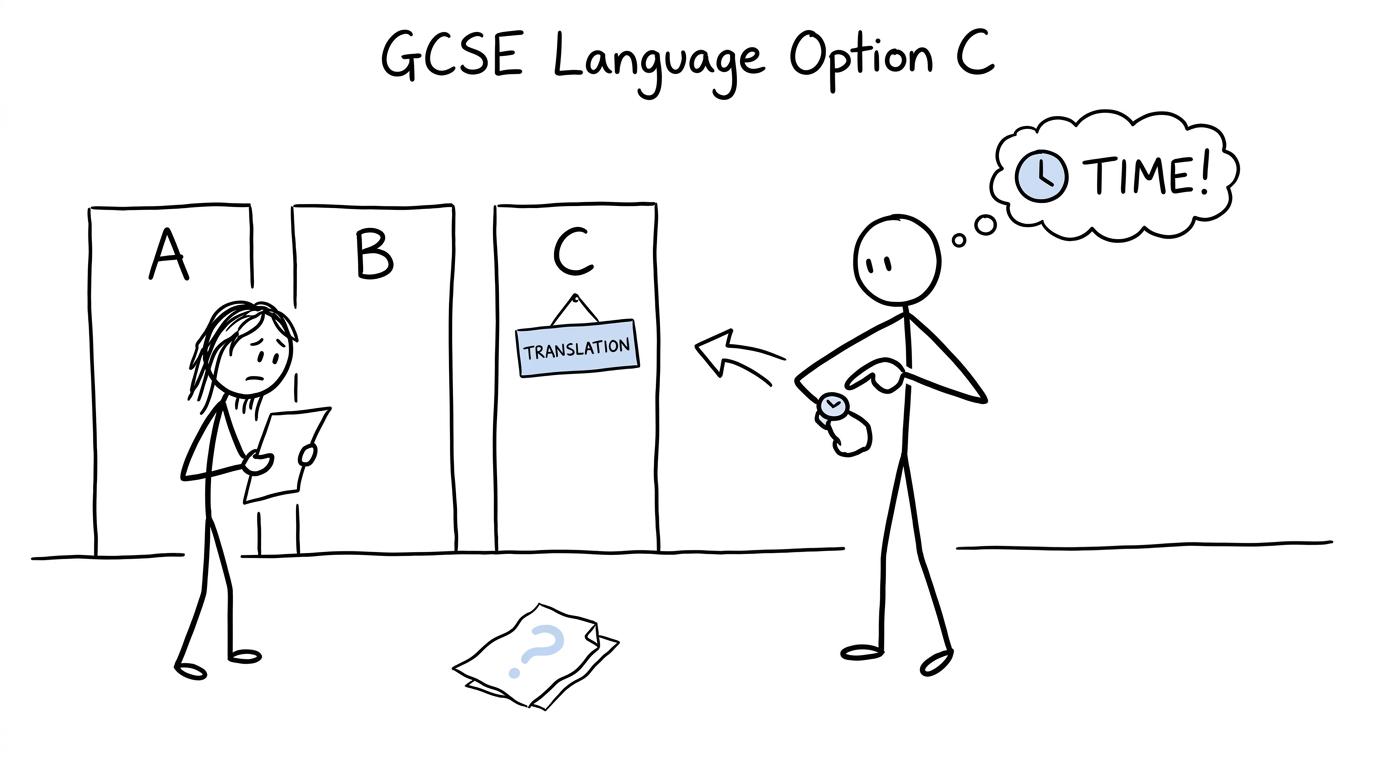 A student choosing between the three sections of an exam while watching the clock
What is actually different about GCSE Arabic Paper 3?
The four Edexcel Arabic components assess different language skills. Paper 1 is listening, Paper 2 is speaking, Paper 3 is reading and Paper 4 is writing. Each contributes one quarter of the GCSE.
Paper 3 therefore rewards recognition and interpretation rather than extended Arabic composition. You are not being asked to produce a long argument or demonstrate every impressive phrase you know. You are being asked to find evidence in a text and communicate its meaning precisely.
That creates three important differences.
First, the information is already on the page. Your task is to locate it, understand it and avoid adding ideas that are not there.
Second, the paper changes the language used in its questions. Section A gives you English questions, while Section B requires you to process the question itself in Arabic. A student may understand the passage but lose direction by misreading an Arabic instruction word.
Third, the paper ends with translation into English. Unlike Paper 4, where translation goes into Arabic, Paper 3 tests whether you can carry the complete meaning across into clear, accurate English.
GCSE Arabic Paper 3 timing and structure
Foundation tier
The Foundation paper lasts fifty minutes and is worth fifty marks. It draws on vocabulary and structures from across all five Edexcel themes:
- identity and culture
- local area, holiday and travel
- school
- future aspirations, study and work
- international and global dimension
Texts may be short and functional, such as notices or advertisements, but students can also meet emails, letters, articles and adapted literary material. The challenge is rarely just recognising a topic. Questions test whether you can distinguish between similar details, identify who did what and understand whether something happened in the past, present or future.
Higher tier
The Higher paper lasts one hour and five minutes and is also worth fifty marks. It uses the same three-section structure, but the reading demand is greater. Vocabulary may be less familiar, sentences can contain more complex structures, and questions may require closer interpretation rather than simple word matching.
Four questions are common to both tiers under the current specification. Higher tier does not simply mean a longer Foundation paper. The additional time reflects the greater complexity of the reading and the need to handle more demanding responses carefully.
A sensible use of time
The marks printed beside each question are your best guide. A low-mark item should not consume several minutes while a larger question remains untouched.
A practical approach is to complete Sections A and B steadily, leaving a protected block for the translation and a short final check. Recent Higher papers have advised students to spend approximately fifteen minutes on translation. Read the instructions printed on your own paper, because they are the directions that matter in the examination.
If one sentence refuses to open up, mark it clearly and continue. Reading papers often become expensive not because one question was difficult, but because a student allowed that question to take time away from several answerable ones.
The question types Paper 3 favours
Multiple-response questions
These may ask you to select the correct option, match statements or identify which person expressed a particular view. They can feel safer than written answers, but distractors are designed to resemble words or ideas from the text.
Do not choose an option merely because you have spotted the same noun. Check the whole phrase. A text may mention a holiday while explaining that it was cancelled, postponed or disliked. The surrounding verb, negative or opinion carries the mark.
Short-answer questions
Short-answer questions reward focused retrieval. If the question asks for one detail, give one clear detail. If it asks for two, provide two distinct answers.
Your response should be based on the passage rather than general knowledge. Avoid copying a long section in the hope that the correct idea is somewhere inside it. Selective answers make your understanding easier to credit.
In Section B, read the Arabic question before searching the passage. Identify the command or question word, the person involved and the relevant time frame. At Higher tier, Section B can include a short-answer open response as well as multiple-response items.
Reading for gist, detail and inference
Some items test the main message. Others depend on one small detail, such as a reason, comparison, opinion or change of plan. More demanding questions may require you to infer an attitude from the whole sentence rather than translate one isolated word.
Unknown vocabulary does not automatically make a question impossible. Look at:
- familiar words around it
- prefixes, suffixes and word families
- names, dates and locations
- connectives showing contrast or cause
- whether the sentence is positive or negative
- what the question has specifically asked you to find
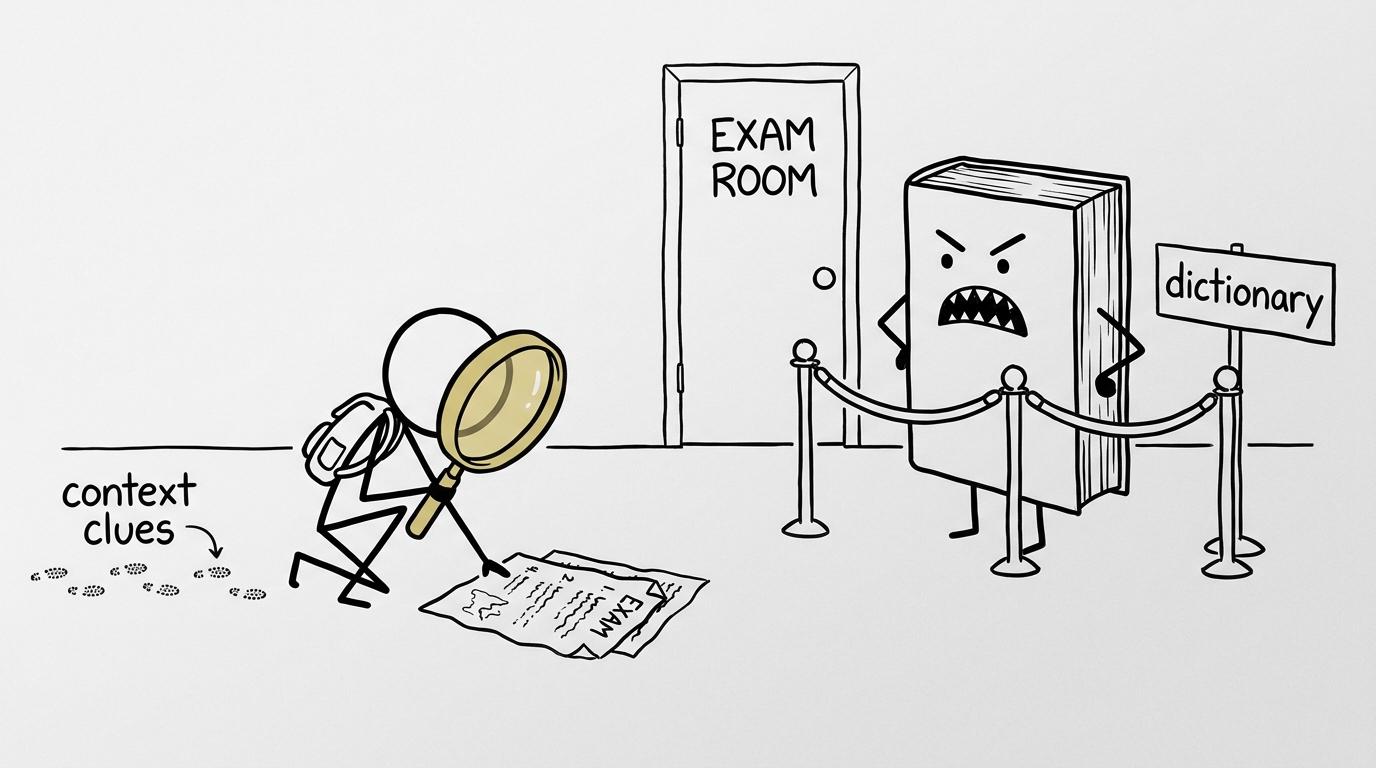 A student following context clues while a dictionary waits outside the examination room
Translation from Arabic into English
Section C contains one passage to translate into English. The objective is complete communication, not word-for-word imitation.
A strong translation preserves:
- every important idea
- the correct person
- tense and time reference
- negatives
- opinions and comparisons
- connectives such as cause, contrast and consequence
- natural English meaning
Translate in manageable units, but reread the finished version as one passage. An English sentence can be grammatically smooth while quietly reversing the Arabic meaning. Pay particular attention to small words that change direction: negatives, pronouns, prepositions and connectives.
How to revise for the reading paper
Paper 3 preparation should resemble Paper 3. Vocabulary lists help, but recognition under time pressure is a different skill from looking at a list and feeling familiar with it.
Build vocabulary in context
Organise vocabulary by the five specification themes, then learn words inside short phrases and sentences. Include verbs in different tenses, opinion language, negatives and common connectives. These grammatical signals often decide the meaning of a whole answer.
Do not revise only concrete nouns. Knowing the Arabic for school subjects is useful; understanding that somebody used to enjoy, no longer enjoys or would prefer a subject is often what separates the correct option from the distractor.
Use a paper, mark, repair, retest cycle
Complete official Paper 3 material under timed conditions, check it against the mark scheme and classify each error:
- vocabulary gap
- instruction misunderstood
- detail overlooked
- tense or negative missed
- answer too vague
- translation meaning incomplete
- time-management problem
Then repair the specific weakness before attempting another paper. This is the same disciplined loop MathsGenie recommends in its guide to using GCSE past papers properly. A paper tells you where the marks leaked; targeted revision closes the leak.
If you are planning revision across several subjects, the GCSE one-week revision plan offers a useful model for balancing diagnosis, focused practice and timed work. Adapt the method for Arabic rather than replacing Arabic revision with maths practice.
Practise translation separately
Translation deserves its own short revision sessions. Take a passage, translate it without a dictionary, compare it with the mark scheme and underline every idea you omitted or changed.
Keep a small translation-error list. If negatives, verb tenses or pronouns repeatedly cause trouble, those become the focus of your next session. Progress comes from noticing patterns, not simply completing more pages.
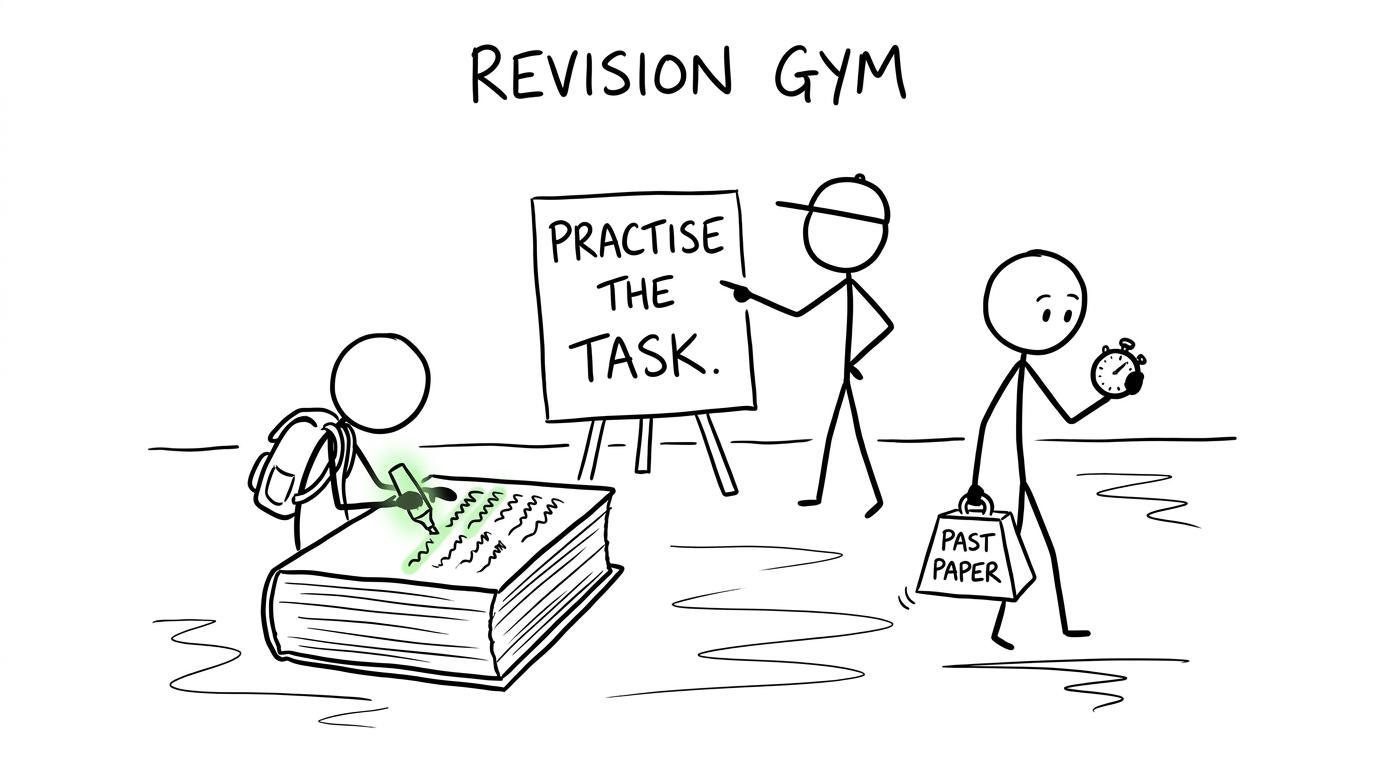 One student highlights endlessly while another practises the actual timed task
Common mistakes on GCSE Arabic Paper 3
Matching one familiar word
A repeated word does not prove that an option is correct. Read for the relationship between ideas, particularly where the passage includes contrast or negation.
Ignoring the number of required details
A two-mark question usually needs two creditworthy pieces of information. Separate them clearly and use the mark allocation as a checklist.
Giving more information than requested
An extra statement can contradict a correct one. Answer the precise question rather than writing everything you understood from the paragraph.
Translating too literally
Arabic and English do not always organise ideas in the same order. Preserve the meaning, then make the English natural without adding interpretation.
Missing small grammatical signals
Pronouns, tense markers, negatives and connectives may look less important than topic vocabulary, yet they often determine who acted, when it happened and how the writer felt.
Spending too long on one item
A blank answer cannot earn a mark. Move on when necessary, complete the rest of the paper and return with the remaining time.
Revising passively
Highlighting vocabulary feels productive because it is comfortable. Timed retrieval, translation and mark-scheme analysis expose uncertainty more honestly. For a broader explanation of when timed practice becomes useful, read when to start GCSE past papers.
Your final preparation plan
In the final weeks, alternate between themed reading practice, short translation sessions and complete timed papers. Mark every task. Revisit errors after a delay so that you test learning rather than short-term memory.
The evening before the exam, avoid attempting to relearn the entire vocabulary list. Review your recurring mistakes, a small group of high-value connectives and the structure of the paper. Maths students can use the same calm principle in the GCSE maths night-before plan.
Paper 3 becomes less mysterious when you see it for what it is: a sequence of evidence-finding decisions, followed by one careful translation. Read the question, locate the evidence, preserve the meaning and move at a pace that protects the whole paper.
MathsGenie is focused on free GCSE and A Level maths revision rather than Arabic resources. For your maths exams, make MathsGenie your revision base: use the Edexcel GCSE maths revision lessons and practice questions, build stamina with GCSE maths past papers and mark schemes, then sharpen your preparation with GCSE predicted papers, mini tests and video solutions. The subject changes. The reliable revision loop does not: practise, mark, repair and retest.