GCSE Arabic Paper 3 Exam Date 2026 and Checklist
GCSE Arabic Paper 3 exam date 2026: confirm the date, session, duration, paper format and what to prepare for your Edexcel reading exam.
Exam timetables have a habit of feeling abstract until one date suddenly matters. Then the questions arrive quickly: which session is it, how long is the paper, and what should you take into the exam hall?
The GCSE Arabic Paper 3 exam date 2026 was officially scheduled for Friday 22 May 2026 in the morning. This was Pearson Edexcel Paper 3: Reading and Understanding in Arabic. Foundation tier was scheduled for 50 minutes, while higher tier was scheduled for 1 hour 5 minutes.
Your school or exam centre decides the precise reporting and start times, so the timetable issued by your centre remains the final instruction to follow.
GCSE Arabic Paper 3 exam date 2026 at a glance
| Detail | Official information |
|---|---|
| Exam board | Pearson Edexcel |
| Qualification | GCSE Arabic |
| Exam date | Friday 22 May 2026 |
| Session | Morning |
| Foundation paper code | 1AA0/3F |
| Foundation duration | 50 minutes |
| Higher paper code | 1AA0/3H |
| Higher duration | 1 hour 5 minutes |
| Marks | 50 marks |
| Qualification weighting | 25% |
| Dictionary | Not permitted |
The same morning also contained Edexcel GCSE Arabic Paper 1, the listening examination. That makes your centre timetable particularly important: it will show when to arrive, how the two components are arranged and whether supervised arrangements apply between them.
A simple preparation checklist is:
- Confirm whether you are entered for foundation or higher tier.
- Check that your paper code is either 1AA0/3F or 1AA0/3H.
- Read your centre timetable for the exact arrival time and room.
- Know your candidate and centre details.
- Pack black pens and any equipment approved by your centre.
- Do not plan to use a dictionary.
- Tell your exams officer promptly about illness, access arrangements or a timetable concern.
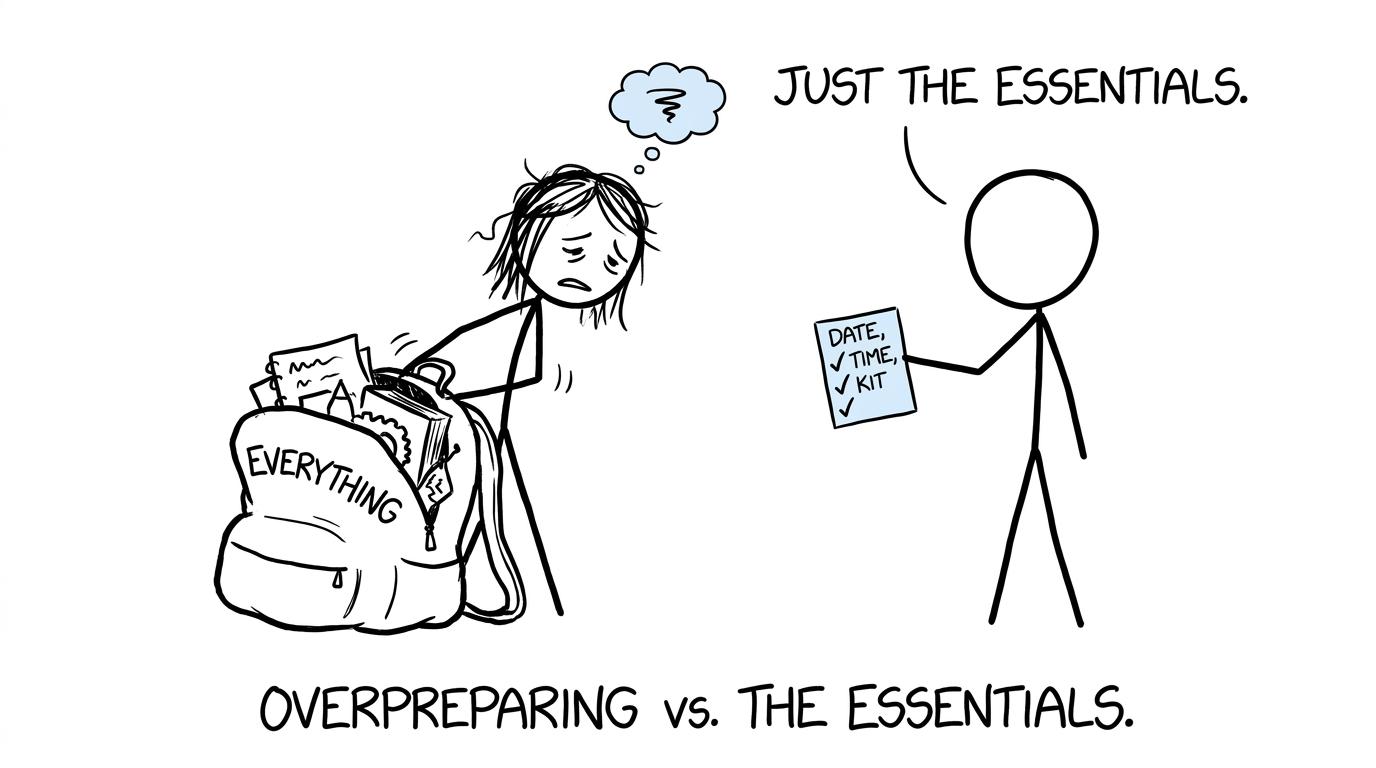 A student replacing an enormous revision backpack with a simple date, time and kit checklist
What is GCSE Arabic Paper 3?
Paper numbers can become confusing during GCSE season. In Edexcel Arabic, Paper 3 is the reading and understanding assessment. It is not a speaking or writing paper, and it should not be confused with GCSE Maths Paper 3, which has completely different rules and equipment.
Pearson's specification states that Arabic Paper 3 draws on vocabulary and structures from across the course themes. Students answer all questions in three sections:
- Section A: Arabic reading passages with questions and instructions in English.
- Section B: Arabic reading passages with questions and instructions in Arabic.
- Section C: translation from Arabic into English.
The assessment contains ten questions in total and is worth 50 marks. Both tiers carry the same number of marks, but the higher paper allows an additional 15 minutes and contains material appropriate to higher-tier demand.
This structure rewards more than knowing isolated vocabulary. You need to recognise meaning in context, notice changes of tense and viewpoint, distinguish the writer's opinion from factual detail, and communicate the meaning of a passage accurately in English.
Which tier and paper code should you check?
Foundation and higher entries happen before the examination, so your tier should not be a decision you make on the morning. Confirm it from your statement of entry or school timetable.
Foundation tier
Foundation students sit 1AA0/3F. The paper lasts 50 minutes and is worth 50 marks. The foundation tier contributes towards GCSE grades 1 to 5, subject to the qualification's grading rules and the overall performance across all four Arabic papers.
Higher tier
Higher students sit 1AA0/3H. The paper lasts 1 hour 5 minutes and is worth 50 marks. The higher tier targets grades 4 to 9, with an allowed grade 3 under the usual narrow safety-net conditions set by the awarding organisation.
Do not rely on what a friend is sitting. Two students in the same class can have different tier entries. If your centre timetable does not clearly show your tier or component code, ask your teacher or exams officer well before the examination.
What to have ready before the exam
The calmest exam mornings are usually built the evening before. Not through heroic last-minute revision, but by removing small uncertainties.
Your confirmed timetable
Keep the timetable supplied by your school or exam centre. It should show your reporting time, room, seat or candidate details where applicable, and the correct component.
Pearson labels the paper as a morning examination, but that does not mean every candidate should independently assume a particular clock time. Centres organise admission and permitted start-time arrangements. Follow your centre's instructions rather than an online countdown.
Black pens and candidate information
The published paper instructions require answers in black ink or black ballpoint pen. Take at least one spare. You will also need to complete the required information on the paper, including your name, centre number and candidate number.
Your centre may provide some of these details on a desk card. Even so, knowing where to find them avoids an unnecessary moment of panic.
No dictionary
Dictionaries are not permitted in any part of this examination. Revision should therefore train retrieval and contextual understanding rather than dependence on looking up every unfamiliar word.
An unknown word does not automatically make the whole passage unknowable. Read around it. Pronouns, connective words, time references and the question itself may reveal what kind of information you need.
Only permitted items
Follow your centre's rules for pencil cases, water bottles, watches and identification. Mobile phones, smartwatches and other unauthorised devices must not be taken to your desk. If you have an approved access arrangement, check with the special educational needs or exams team that it is correctly recorded.
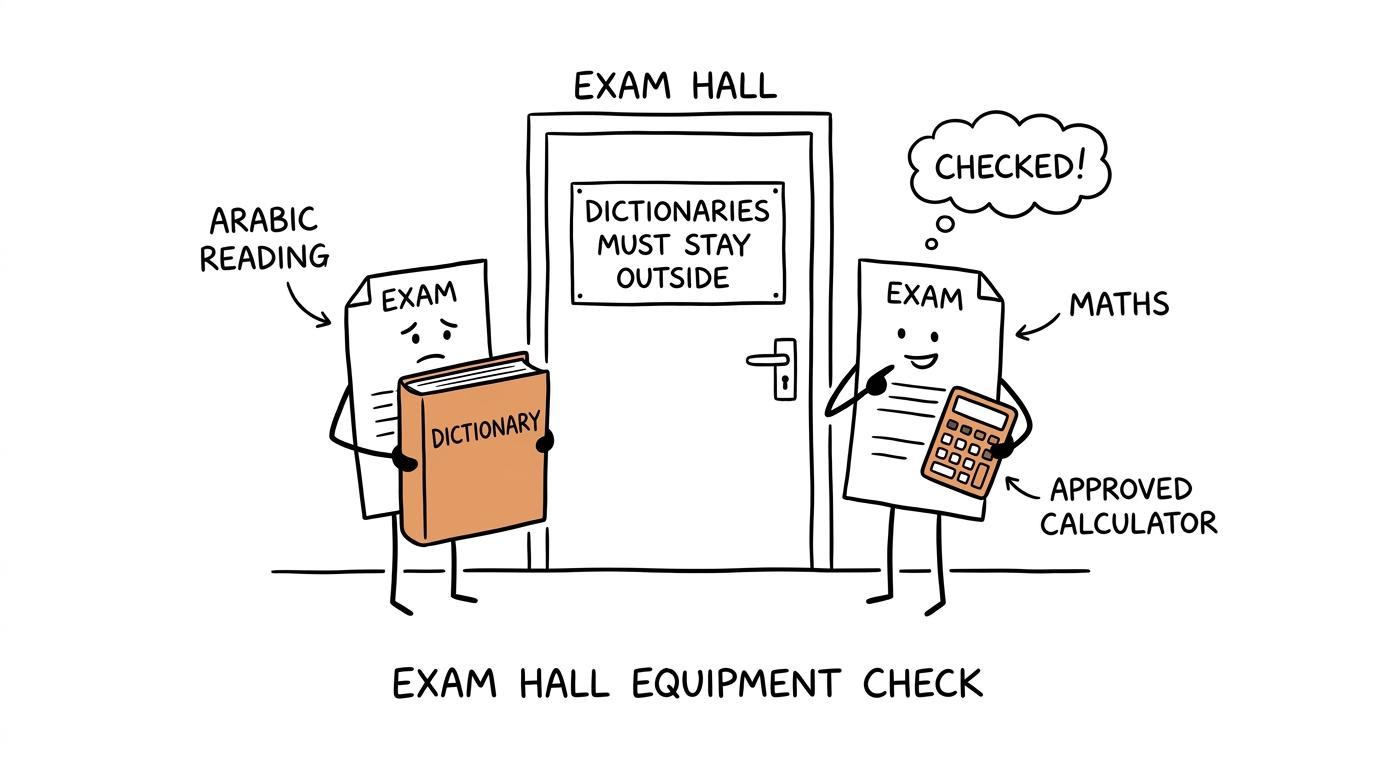 Arabic Reading leaves its dictionary outside while Maths carries an approved calculator
How to prepare for the reading paper without neglecting maths
GCSE preparation is not one subject politely waiting for another to finish. Arabic Paper 3 falls inside a crowded examination period, so the useful question is not simply how long you revise. It is how deliberately you switch between subjects.
Use a short Arabic reading session to practise:
- understanding questions before searching the passage;
- identifying synonyms and paraphrased ideas;
- noticing negatives, opinions and changes in time;
- answering in the language requested by the section;
- translating meaning into natural, accurate English;
- completing the whole paper within your tier's time limit.
Then use a separate maths block with a similarly clear purpose. The MathsGenie GCSE Maths revision hub lets you choose your exam board and work through revision lessons, worksheets, exam questions and papers at the correct level.
If a full maths paper is too much alongside language revision, use Edexcel GCSE Maths mini tests for a shorter timed session. The principle transfers neatly between subjects: attempt without help, check the evidence, identify the exact weakness and practise it again.
The 20-minute GCSE maths revision routine is useful on days containing Arabic practice or another examination. It protects maths recall without turning every evening into a marathon.
A sensible plan for the final days
Several days before the paper, complete timed Arabic reading practice using material supplied by your teacher or the official board resources chosen by your school. Review errors by category: vocabulary, misreading the question, tense, missed detail, Arabic response or translation.
Use the same evidence-led process for maths. The guide to finding your weakest GCSE topics explains how to turn dropped marks into a focused revision list instead of revising comfortable topics repeatedly.
On the evening before Arabic Paper 3:
- check the date, reporting time, room and tier;
- pack black pens and permitted items;
- review a short list of recurring vocabulary or errors;
- avoid beginning a large new topic;
- set alarms and protect your sleep.
If maths is also competing for attention, follow the GCSE maths exam-week checklist. A short, marked task is usually more useful than pages of passive reading.
After the Arabic examination, resist the temptation to spend hours reconstructing every answer. Your remaining GCSE papers deserve that energy. Move back to your schedule, perhaps using a realistic GCSE maths revision timetable to decide what comes next.
Exam-day reading habits
Read the instructions for each section carefully because the required response language changes. Use the mark allocation as a guide to the amount of information needed, and answer every question.
For the translation, preserve the complete meaning rather than forcing a word-for-word English sentence. Check subjects, pronouns, negatives, tenses and linking words. Your English should sound natural without adding ideas that are absent from the Arabic passage.
If one question blocks your progress, mark it clearly, move on and return later. One difficult phrase should not consume the time available for several accessible marks.
Common mistakes to avoid
Confusing Arabic Paper 3 with Maths Paper 3
Arabic Paper 3 is a reading paper and does not require a calculator or geometry equipment. Maths Paper 3 has separate dates, rules and resources. Keep each subject's timetable and equipment checklist distinct.
Assuming the morning session gives the arrival time
“Morning” is the official timetable session, not a complete instruction for candidates. Your centre may require you to arrive considerably earlier than the examination begins.
Bringing a dictionary
A dictionary is not allowed. Practise handling unfamiliar vocabulary through context so its absence does not feel surprising.
Revising the wrong tier
Foundation and higher papers have different codes and durations. Check your actual entry rather than assuming your tier from classroom groups or previous mock papers.
Answering in the wrong language
Section instructions matter. Section A and Section C use English instructions, while Section B uses Arabic. Pay attention to what each question requires rather than carrying one response habit across the entire paper.
Forgetting the wider exam calendar
The final national contingency day for the summer 2026 series was Wednesday 24 June 2026. Candidates were required to remain available in case national or significant local disruption caused an examination to be moved. A contingency day was not an automatic alternative for an individually missed exam.
Turn the date into a plan
The date is simple: Friday 22 May 2026, morning. The useful preparation happens around it: confirming your tier, knowing the paper format, practising reading under time and arriving with the correct equipment.
Your other GCSEs still matter while Arabic approaches. Use MathsGenie's Edexcel GCSE Maths past papers to practise under realistic conditions, then learn from the mark schemes and available video solutions. Shorter mini tests can maintain fluency on busy days, while revision lessons and practice questions repair the topics that continue to cost marks.
Start with the free MathsGenie GCSE Maths revision area, choose your exam board and tier, and build a calm loop: revise, practise, mark, fix and retest. Dates tell you when to perform. Good revision makes sure you are ready when they arrive.