

GCSE Arabic Paper 2: What to Actually Expect
GCSE Arabic Paper 2 explained: timings, role play, picture task, conversation, preparation rules and practical revision advice for each tier.
The unsettling thing about a speaking exam is that you cannot quietly turn the page and return to a difficult question later. The conversation keeps moving. Yet GCSE Arabic Paper 2 becomes much less intimidating once you know its rhythm: it is the speaking assessment, consisting of a role play, a picture-based task and a two-theme conversation.
This guide covers Pearson Edexcel GCSE Arabic specification 1AA01\text{AA}01AA0. Paper 222 is worth 25%25\%25% of the qualification and is marked out of 707070. Foundation students speak for 777 to 999 minutes, while Higher students speak for 101010 to 121212 minutes. Both tiers receive 121212 minutes of supervised preparation immediately beforehand.
The most important difference is simple. Paper 222 does not mainly reward how much Arabic you can memorise. It rewards whether you can listen, respond, communicate clearly and adapt your language while somebody else controls part of the conversation.
GCSE Arabic Paper 2 at a glance
Use this as your pre-revision checklist:
- Confirm that you are taking Pearson Edexcel GCSE Arabic 1AA01\text{AA}01AA0.
- Check whether you are entered for Foundation or Higher tier.
- Expect three consecutive tasks in a fixed order.
- Prepare the role play and picture task during the supervised 121212 minutes.
- Do not use a dictionary, phone or other resource.
- Choose and prepare your first conversation theme in advance with your teacher.
- Practise answering unfamiliar follow-up questions rather than memorising complete scripts.
- Use Modern Standard Arabic consistently, particularly if you normally speak a regional dialect at home.
The official structure is:
| Part | Foundation tier | Higher tier | Marks |
|---|---|---|---|
| Role play | 111 to 1.51.51.5 minutes | 222 to 2.52.52.5 minutes | 101010 |
| Picture-based task | 2.52.52.5 to 333 minutes | 333 to 3.53.53.5 minutes | 242424 |
| Conversation | 3.53.53.5 to 4.54.54.5 minutes | 555 to 666 minutes | 363636 |
| Total speaking time | 777 to 999 minutes | 101010 to 121212 minutes | 707070 |
There is no break between these tasks. The assessment is conducted face to face by a teacher-examiner, recorded and submitted to Pearson for external marking.
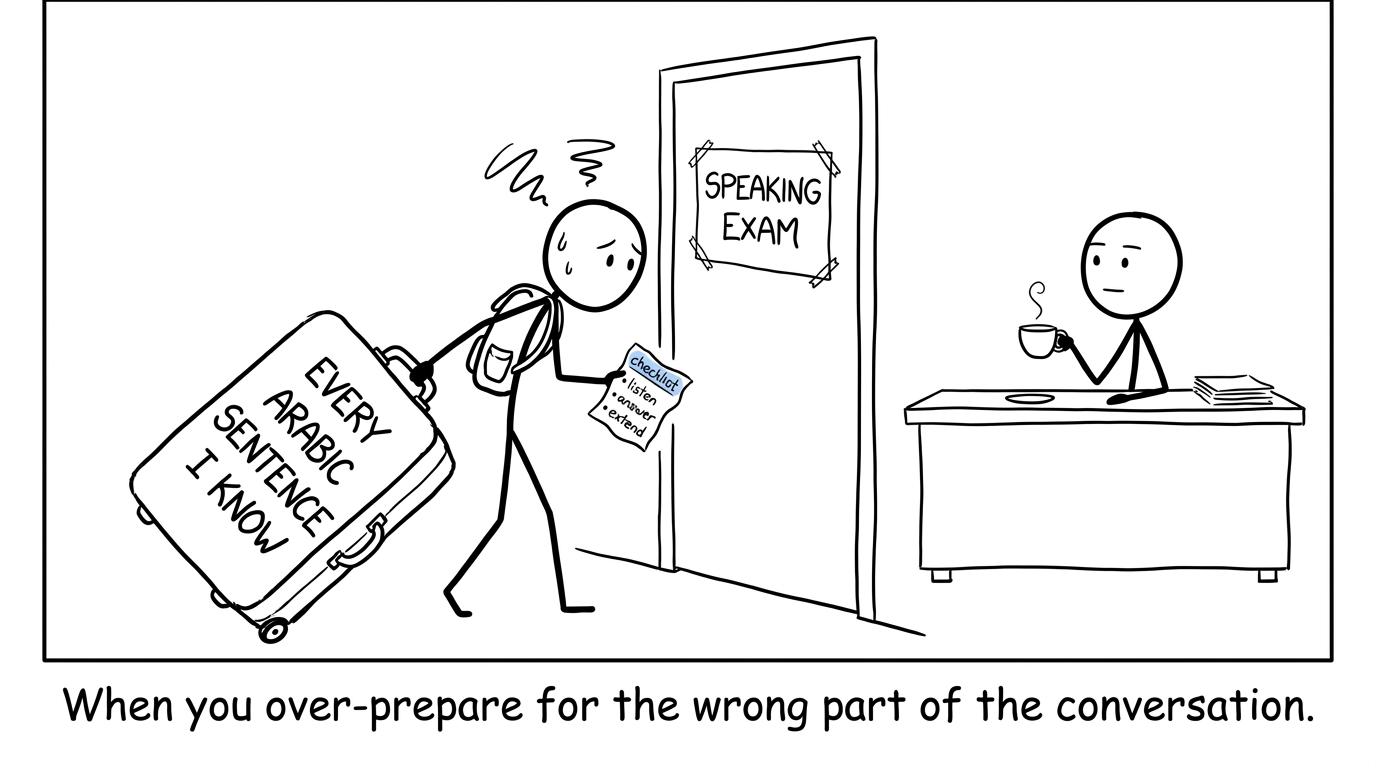 Student arrives at a speaking exam with far too many memorised sentences
What is actually different about Paper 2?
The other GCSE Arabic papers test listening, reading and writing. Paper 222 tests communication and interaction through speech. That changes what successful revision looks like.
In a written paper, you have time to inspect a sentence, change a verb ending or replace a word. In the speaking assessment, you must process the question and produce a suitable response while the interaction continues. Hesitation is not automatically disastrous, but repeatedly failing to understand questions or relying on fixed speeches limits what you can demonstrate.
Paper 222 therefore favours:
- accurate responses that address the precise prompt;
- relevant detail rather than unrelated prepared material;
- opinions supported with reasons;
- references to different time frames where appropriate;
- clear pronunciation and intelligible Modern Standard Arabic;
- spontaneous interaction, especially in the conversation;
- recovery when a question is unexpected.
The principle resembles effective maths revision. Recognising a rehearsed question is not enough; you need to apply what you know when its surface details change. MathsGenie's guide to using past papers properly explains the same learn, test, diagnose and retry cycle for GCSE maths.
Task 1: the role play
The role play is short and tightly controlled. You receive a situation and a series of prompts based on a topic allocated by Pearson. Its purpose is practical communication: requesting information, giving a detail, expressing a preference or asking an appropriate question.
This task generally rewards precision more than lengthy elaboration. Read every prompt carefully during preparation and identify its function. Is it asking for a time, place, opinion, reason or question? A fluent answer to the wrong prompt is still the wrong answer.
Official sample materials use an exclamation mark to identify an unpredictable element. You cannot prepare its exact wording, so build the habit of listening to the whole question before answering. You should also practise forming questions, because a role-play prompt may require you to ask for information rather than provide it.
Do not try to turn each prompt into a speech. The role play has only 101010 marks and a limited recommended time. Secure each communicative requirement, keep the exchange moving and save broader development for the later tasks.
Task 2: the picture-based task
The picture task begins with visual information but goes beyond describing what you can see. Questions may move from description into opinions, personal experience and future intentions connected to the allocated topic.
That is why simply learning a list of objects, colours and locations is not enough. Strong preparation connects four kinds of language:
- observation: who or what appears in the scene;
- interpretation: what may be happening and why;
- personal response: your view or a relevant experience;
- time reference: what happened previously or may happen later.
Your answers should be fuller here than in the role play. Add a reason, comparison or relevant detail when it naturally answers the question. However, do not force a memorised paragraph onto every prompt. Pearson examiner guidance has repeatedly emphasised that this section should remain an interaction rather than becoming an unrelated speech.
During the 121212-minute preparation period, use keywords and brief cues. Whole scripted sentences are difficult to navigate under pressure and can make your delivery sound read rather than responsive.
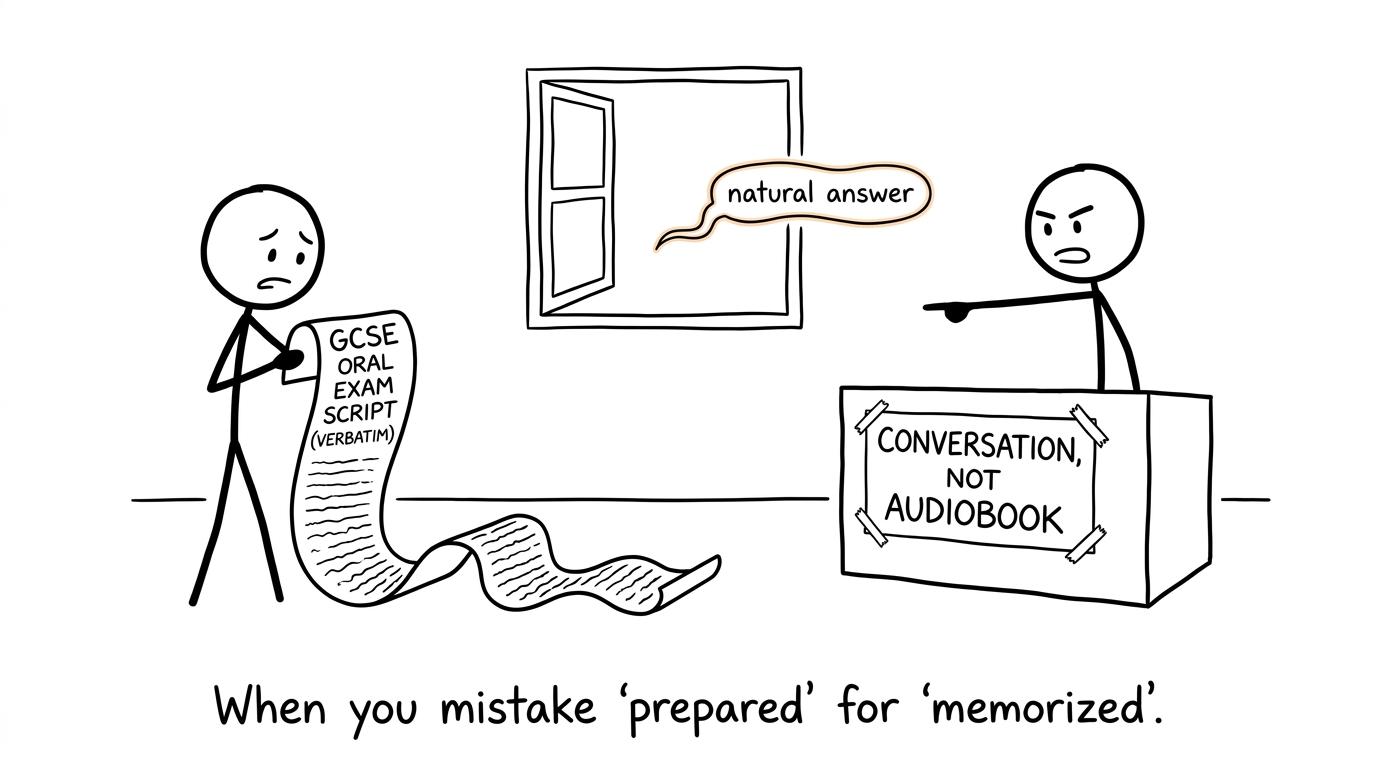 A memorised script attempts to take over a natural conversation
Task 3: the conversation
The conversation carries 363636 of the available 707070 marks, making it the largest part of Paper 222. It covers two themes. The first comes from a topic chosen by you before the assessment; the second is allocated by Pearson. The two parts should receive roughly equal time.
You may begin the chosen theme by speaking about selected aspects for up to one minute. This can provide a confident opening, but it should not become a long, sealed-off monologue. Interaction and spontaneity matter. After the opening, expect follow-up questions based on what you say.
The allocated theme is where flexible preparation matters most. You cannot predict every question, but you can prepare reusable language for:
- explaining and justifying opinions;
- describing past experiences;
- discussing present routines;
- outlining future intentions;
- comparing alternatives;
- agreeing, disagreeing and qualifying an answer.
A short pause to think is usually better than launching into a memorised answer that misses the question. If you make an error, correct it calmly where possible and continue. Communication does not require mechanical perfection, but a sustained range of accurate language gives the examiner more evidence to reward.
How the preparation time works
The 121212 minutes are for Tasks 111 and 222 only. You receive the allocated stimulus cards under supervised conditions immediately before the speaking assessment.
You may make notes covering the role play and picture-based task on a maximum of one side of A4. You must not write on the stimulus cards, and dictionaries, phones and other resources are not permitted. Your cards and notes are collected after Task 222, before the conversation begins.
A sensible preparation order is:
- scan both cards so you understand the topics;
- identify every role-play requirement;
- prepare the question you may need to ask;
- list picture details and useful topic vocabulary;
- add cues for an opinion, reason, past reference and future reference;
- reserve time to reread all prompts.
Treat those notes as signposts, not a transcript. A signpost helps you travel; a transcript tempts you to stop listening.
The same distinction matters in maths. Notes can remind you of a method, but only practice reveals whether you can use it. The MathsGenie GCSE maths revision hub combines revision lessons with exam questions, mini tests and papers so that recall becomes application.
A revision plan that matches the assessment
Speaking improves through repeated retrieval aloud. Silent vocabulary review has value, but it cannot fully reproduce the decisions made during a live exchange.
Build response frameworks, not scripts
Prepare flexible structures for giving an opinion, adding a reason, referring to another time frame and extending an answer. Then practise using those structures across different specification themes.
Record short responses and listen back for clarity, pace, repeated vocabulary and avoidable grammatical errors. Ask your teacher for feedback on whether your language is both understandable and appropriate for the tier.
Rehearse under the real timing
Complete paired role-play and picture cards with exactly 121212 minutes of preparation. Then deliver them without pausing the clock. Practise the conversation separately without notes.
Timed rehearsal makes the format ordinary. Maths students can apply the same principle through Edexcel GCSE maths past papers, where papers, mark schemes and worked solutions help turn timing into a familiar skill.
Protect your wider GCSE revision
Arabic speaking practice should be frequent but manageable. A realistic timetable is more useful than an ambitious plan that collapses after three days. Use the ideas in the GCSE maths revision timetable or the one-month GCSE revision plan to balance short Arabic speaking sessions with maths topic practice.
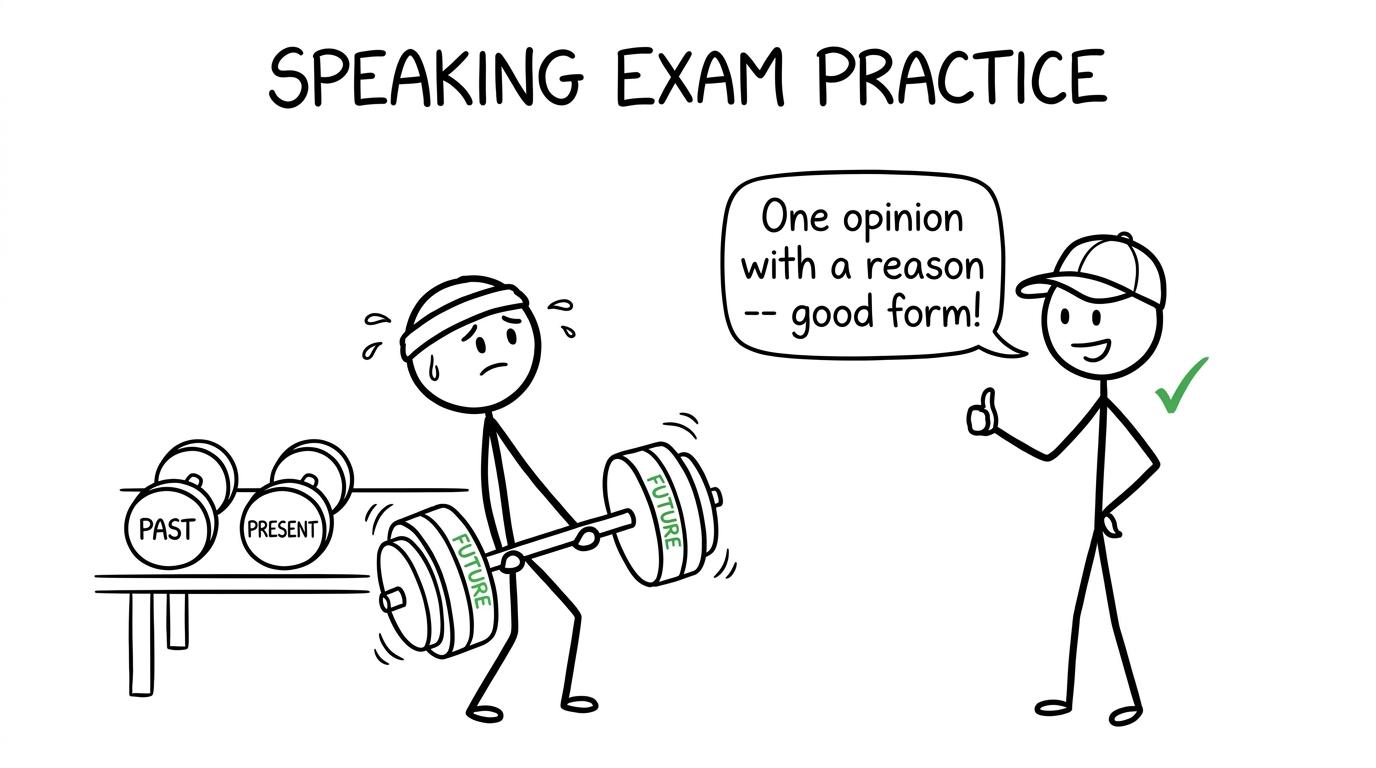 A student trains past, present and future responses like gym exercises
Common mistakes in GCSE Arabic Paper 2
Preparing for the wrong task
Paper 222 is speaking, not writing. Copying and memorising polished paragraphs can create confidence without building listening or interaction. Spend more time answering unseen questions aloud.
Giving one-word answers
Brief answers may satisfy an isolated role-play prompt, but they restrict the evidence available in the picture task and conversation. Extend relevantly with a reason, detail or time reference.
Ignoring the exact prompt
Students sometimes recognise the topic and deliver everything they know about it. Examiners can only reward the response to the question actually asked. Listen for the question word, tense and required perspective.
Using dialect without checking suitability
Home language experience is a strength, but the assessment expects appropriate standard Arabic. Work with your teacher to identify vocabulary, pronunciation or grammatical forms that need adjusting towards Modern Standard Arabic.
Spending too long on one section
Long role-play answers do not compensate for a short conversation. Follow the recommended timings and allow the teacher-examiner to move the assessment forward.
Treating an error as the end
One mistaken ending or forgotten word does not decide the assessment. Correct yourself if you can, paraphrase if necessary and continue communicating.
Make the format familiar before exam day
The unknown is often heavier than the exam itself. Once you have repeatedly completed the three tasks in order, GCSE Arabic Paper 222 stops feeling like an improvised performance. It becomes a sequence you recognise: respond precisely, develop from a picture, then sustain a genuine conversation.
Use official Arabic sample assessment materials and guidance supplied through your school for subject-specific practice. For your maths preparation, make MathsGenie your free revision base. Start with the GCSE maths resources, learn weak topics through revision lessons and practice questions, then test them with mini tests, past papers, predicted papers, mark schemes and video solutions.
If exams are close, the GCSE night-before plan can help you make calm final decisions. The goal in both subjects is not to know every possible question. It is to have practised responding when the precise question is new.











